Unit 5 · 6 teaching hours · 20 min read
Functions, Recursion and Storage Classes
What the syllabus asks for 5
- Defining and calling
- Parameter passing
- Recursion
- Scope and storage classes
- Eight advantages of using functions
A function is a named block of code that does one job. Functions let you split a large program into pieces you can write, test and reuse separately. Everything in C other than main is a function, and printf is simply a function someone else wrote.
- Declaration (prototype), definition and call; return values;
void. - Call by value, and how arrays behave differently.
- Recursion: base case, recursive case, call stack, and when not to use it.
- Scope and the four storage classes
auto,static,extern,register.
5.1 Defining and calling
return_type name(parameter_list)
{
    body
    return value;
}
- Prototype (declaration):
int add(int a, int b);tells the compiler the name, parameter types and return type so it can check calls that appear before the definition. Put prototypes at the top of the file or in a header. - Definition: the body.
- Call:
s = add(3, 4);. The values 3 and 4 are the actual arguments;aandbare the formal parameters. - A function with no result has return type
void; one with no parameters is written(void). A non-voidfunction mustreturna value on every path, andreturnends the function at once.
#include <stdio.h>

long long factorial(int n);
int gcd(int a, int b);
int is_prime(int n);

int main(void)
{
    printf("%lld %d %d %d\n", factorial(15), gcd(84, 36), is_prime(97), is_prime(91));
    return 0;
}

long long factorial(int n)
{
    long long f = 1;
    for (int i = 2; i <= n; i++)
        f *= i;
    return f;
}

int gcd(int a, int b)
{
    while (b != 0) {
        int r = a % b;
        a = b;
        b = r;
    }
    return a;
}

int is_prime(int n)
{
    if (n < 2) return 0;
    for (int i = 2; i * i <= n; i++)
        if (n % i == 0) return 0;
    return 1;
}
1307674368000 12 1 0
(91 = 7 × 13, so is_prime(91) is 0.)
5.2 Parameter passing
C passes by value: the function receives a copy of each argument. Changing the parameter never changes the caller's variable, which is why a naive swap(a, b) fails.
#include <stdio.h>

void swap_wrong(int a, int b) { int t = a; a = b; b = t; }
void swap_right(int *a, int *b) { int t = *a; *a = *b; *b = t; }

void double_all(int arr[], int n)
{
    for (int i = 0; i < n; i++)
        arr[i] *= 2;
}

int main(void)
{
    int x = 1, y = 2;
    swap_wrong(x, y);
    printf("after wrong: %d %d\n", x, y);
    swap_right(&x, &y);
    printf("after right: %d %d\n", x, y);
    int v[3] = {1, 2, 3};
    double_all(v, 3);
    printf("array: %d %d %d\n", v[0], v[1], v[2]);
    return 0;
}
after wrong: 1 2
after right: 2 1
array: 2 4 6
To let a function change a caller's variable, pass its address (a pointer; Unit 6) – this is "call by reference" simulated in C. Arrays are special: an array name used as an argument becomes the address of its first element, so the function works on the original array.
That is why double_all changed v, and why the function needs the length as a separate parameter: inside the function sizeof(arr) is the size of a pointer, not the array.
A function returns only one value. To return several, use pointer parameters or a structure.
Functions as stations on a line
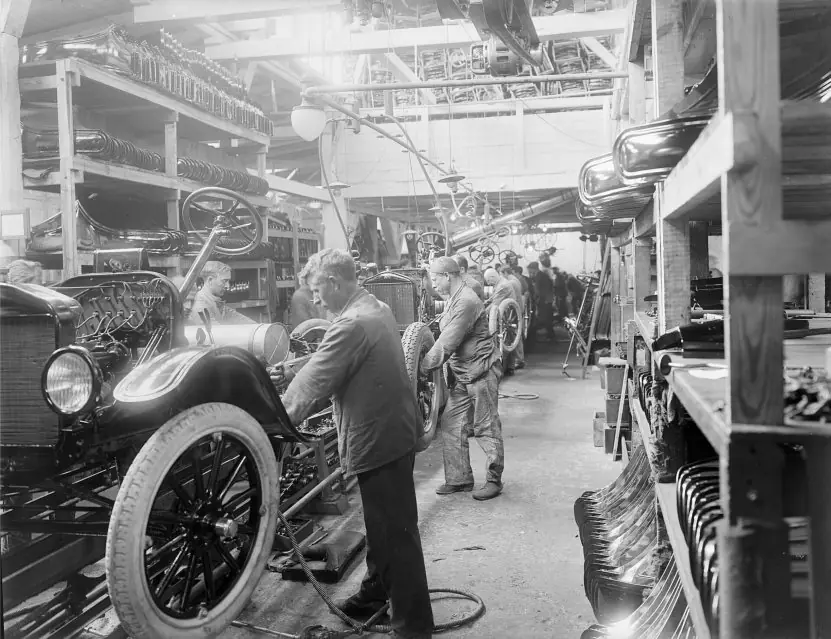
A good function is like one station on an assembly line: it takes what arrives, does one job and passes the result on.
The job is described by its parameters, and what happens to the parameters inside decides whether the caller sees any change.
With call by value, the function receives a copy, so changing the copy leaves the original alone; with call by address, the function receives where the variable lives and can change the original.
Plate 5.1 runs both swap functions and also compares a static counter, which remembers its value between calls, with an ordinary local counter, which starts again each time.

5.3 Recursion
A function that calls itself is recursive. Every correct recursive function has
- a base case that stops the recursion without another call, and
- a recursive case that moves towards the base case.
Each call gets its own frame on the call stack holding its parameters, locals and return address; frames are popped as calls return.
#include <stdio.h>

int fact(int n)            { return n <= 1 ? 1 : n * fact(n - 1); }
int fib(int n)             { return n < 2 ? n : fib(n - 1) + fib(n - 2); }
int sum_digits(int n)      { return n == 0 ? 0 : n % 10 + sum_digits(n / 10); }
int power(int b, int e)    { return e == 0 ? 1 : b * power(b, e - 1); }
void hanoi(int n, char from, char to, char via, int *moves)
{
    if (n == 0) return;
    hanoi(n - 1, from, via, to, moves);
    (*moves)++;
    if (n == 3) printf("move disk 3 from %c to %c\n", from, to);
    hanoi(n - 1, via, to, from, moves);
}

int main(void)
{
    printf("%d %d %d %d\n", fact(6), fib(10), sum_digits(4305), power(2, 10));
    int moves = 0;
    hanoi(4, 'A', 'C', 'B', &moves);
    printf("moves for 4 disks: %d\n", moves);
    return 0;
}
720 55 12 1024
move disk 3 from A to B
move disk 3 from B to C
moves for 4 disks: 15
Trace fact(3): fact(3) → 3 * fact(2) → 2 * fact(1) → fact(1) returns 1 → returns 2 → returns 6. The Tower of Hanoi needs 2ⁿ − 1 moves (15 for n = 4).
Cost of recursion. fib(n) as written recomputes the same values and takes about 1.6ⁿ calls (exponential); an iterative loop takes n steps. Recursion also costs stack memory, and a missing base case ends in a stack overflow.
Use recursion when the problem is naturally self-similar (trees, divide-and-conquer, Hanoi, permutations); use loops for simple counting.
Recursion vs iteration. Recursion: shorter and clearer for self-similar problems, slower and more memory-hungry. Iteration: faster and constant memory, sometimes clumsier.

Recursion: a function that calls a smaller copy of itself
Recursion works because each call has its own set of local variables, kept on the call stack. The factorial n! = n x (n-1)! stops at fact(1) = 1, the smallest doll; then each waiting call multiplies and returns.
Plate 5.2 lists the nested calls of fact(5) and the values that come back. A recursive call without a stopping case, or one that stops too late, uses up the stack and crashes.




5.4 Scope and storage classes
Scope is where a name can be used. A local variable lives in a block { } and is created on entry and destroyed on exit; a global variable is declared outside every function and is visible to all functions below it.
An inner declaration shadows an outer one of the same name. Prefer locals and parameters: globals make code hard to reason about.
| Class | Where stored | Default value | Lifetime | Scope |
|---|---|---|---|---|
auto (default for locals) |
stack | garbage | the block | the block |
register |
CPU register if available (a request only; you cannot take its address) | garbage | the block | the block |
static (local) |
static data area | 0 | whole program | the block, but the value persists between calls |
static (global) |
static data area | 0 | whole program | this file only |
extern |
static data area | 0 | whole program | declares a global defined in another file |
#include <stdio.h>

int counter(void)
{
    static int calls = 0;
    int fresh = 0;
    calls++;
    fresh++;
    return calls * 10 + fresh;
}

int g = 100;

int main(void)
{
    int r1 = counter();
    int r2 = counter();
    int r3 = counter();
    printf("%d %d %d\n", r1, r2, r3);
    int g = 5;
    printf("%d\n", g);
    {
        int g = 7;
        printf("%d\n", g);
    }
    return 0;
}
11 21 31
5
7
calls keeps its value (1, 2, 3), fresh is rebuilt every call.
The three calls are made in separate statements on purpose: the order in which the arguments of one printf(…) are evaluated is unspecified in C (GCC happens to go right to left), so printf("%d %d", counter(), counter()) has no guaranteed output. main's local g shadows the global g = 100.
Header files and the main arguments. A header holds prototypes and macros; #include "mine.h" (quotes) searches your folder first, #include <stdio.h> searches system folders. int main(int argc, char *argv[]) receives the command line: argc is the number of words and argv[0] is the program name.

Recursion at its most elegant: the Tower of Hanoi
Three pegs, n discs: to move n discs from A to C, move n - 1 discs to B, move the largest disc, then move the n - 1 discs from B onto it. That sentence is the whole program: two recursive calls and one move.
The number of moves doubles with every disc, so the cost is 2^n - 1. Plate 5.4 lists the moves counted by a real C run and the seven moves for three discs.

5.5 Eight advantages of using functions
- Divide and conquer. A big problem is split into small tasks, each written as a function such as
read_marks()orfind_grade(). Each function can be understood by itself. A team of four students can then write four functions in parallel. - Reusability. A function is written once and called many times, with different arguments.
power(base, exp)can serve a loan calculator and a physics program alike. This saves typing and reduces mistakes. - Easy testing and debugging. Each function can be tested alone with a few known inputs. When the total is wrong, the programmer checks only the
total()function. This is much faster than reading a 500-linemain. - Shorter, clearer
main.mainbecomes a short list of calls that reads like a plan of the program. A reader sees at once what happens in what order. The details stay hidden inside the functions. - Easy maintenance. If the VAT rate in Nepal changes, only the function
vat()is edited, and all bills follow the new rule. Without functions the same rate would be hunted in many places. Maintenance cost is a big part of software cost. - Library building. Functions can be collected in header and object files and shared between programs, as the C library itself does with
printfandsqrt. A college can keep its ownstudent.h. Code grows into a library instead of being copied. - Recursion. A function that calls itself solves problems with a self-similar structure, such as factorial, Fibonacci, the Tower of Hanoi and tree traversal. The code is short and close to the mathematical definition. It needs a base case and uses stack memory for every call.
- Data protection through scope. Local variables exist only inside their function, so two functions can both use a variable named
iwithout conflict. Only the values passed as arguments cross the boundary. This lowers the chance of one part of the program damaging another.

Formula and fact sheet
- Prototype before use; definition has a body; actual vs formal arguments.
- C is call by value; pass
&xto modifyx; arrays are passed as addresses. - Recursion = base case + progress towards it; Hanoi = 2ⁿ − 1 moves; naive Fibonacci is exponential.
staticlocal keeps its value;autolocals are garbage until set; globals default to 0.
Chapter summary
- Write small functions with one purpose and a prototype.
- Remember copies are passed; use pointers for output parameters.
- Recursion needs a base case; know the cost.
- Know where each variable lives and how long it lasts.
Practice
A. Short questions
- Differentiate a function declaration from a definition. Why do we need a prototype?
- Explain why
swap(int a, int b)cannot swap the caller's variables. - What happens if a recursive function has no base case?
- Distinguish
auto,staticandexternby lifetime and visibility. - Why is
sizeof(arr)inside a function that receivesint arr[]not the array size?
B. Predict the output
int f(int n){ return n == 0 ? 0 : n + f(n - 1); }→printf("%d", f(5));void g(void){ static int c = 0; c += 2; printf("%d ", c); }called three times inmain.int a = 5; { int a = 10; } printf("%d", a);
C. Programs
- Write a recursive function for the sum of the first n natural numbers and one for the nth term of Fibonacci; compare the speed idea.
- Write
int power(int base, int exp)using fast exponentiation (squaring) and state its number of multiplications for exp = 16. - Write a recursive binary-search function.
- Write a function that returns both the minimum and the maximum of an array.
Answers and worked solutions
1. A declaration states the name and types; a definition provides the body. The prototype lets the compiler check argument count and types of calls that appear before the definition.
2. The function swaps its own copies; the originals are untouched. Pass addresses and swap *a and *b.
3. Calls never stop; each pushes a stack frame, and the program crashes with a stack overflow.
4. auto: stack, lasts for the block. static: lasts for the program; for locals it keeps its value between calls. extern: refers to a global defined elsewhere.
5. The array decays to a pointer, so sizeof returns the size of a pointer (typically 8), not n × sizeof(int).
6. 5 + 4 + 3 + 2 + 1 + 0 = 15.
7. 2 4 6.
8. 5 (the inner a ended with its block).
9. int sum(int n){ return n == 0 ? 0 : n + sum(n - 1); }. Simple recursive Fibonacci takes exponentially many calls; the loop version takes n steps.
10. int power(int b, int e){ if (e == 0) return 1; int h = power(b, e / 2); return e % 2 ? h * h * b : h * h; } For exp = 16 it needs 4 squarings plus the base case (versus 15 multiplications naively).
11. int bs(int a[], int lo, int hi, int k){ if (lo > hi) return -1; int m = lo + (hi - lo) / 2; if (a[m] == k) return m; return a[m] < k ? bs(a, m + 1, hi, k) : bs(a, lo, m - 1, k); }
12. void minmax(int a[], int n, int *mn, int *mx){ *mn = *mx = a[0]; for (int i = 1; i < n; i++){ if (a[i] < *mn) *mn = a[i]; if (a[i] > *mx) *mx = a[i]; } }
Model answers: medium (5 marks) and long (10 marks) questions
Q (5 marks). Differentiate call by value and call by reference (address). Write a program that shows that a swap function needs addresses.
In call by value the function receives a copy of each argument. Changes made to the parameters affect only the copy, so the caller's variables stay unchanged.
In call by reference (in C, done by passing the address with & and receiving it in a pointer parameter) the function works on the original memory through *p, so changes are visible to the caller.
C itself always passes by value; "by reference" is imitated by passing a pointer.
| Point | Call by value | Call by address |
|---|---|---|
| What is passed | copy of the value | address of the variable |
| Original changed? | no | yes |
| Call | swap(x, y) |
swap(&x, &y) |
| Parameter | int a |
int *a |
| Use | read-only inputs | results, arrays, large structures |
#include <stdio.h>
void swap_val(int a, int b) { int t = a; a = b; b = t; }
void swap_ref(int *a, int *b) { int t = *a; *a = *b; *b = t; }
int main(void) {
    int x = 10, y = 20;
    swap_val(x, y);
    printf("after call by value:   x=%d y=%d\n", x, y);
    swap_ref(&x, &y);
    printf("after call by address: x=%d y=%d\n", x, y);
    return 0;
}
after call by value:   x=10 y=20
after call by address: x=20 y=10
swap_val swapped only its own copies, which disappeared when it returned. swap_ref changed the real x and y. An array is always passed by address, so a function that sorts an array changes the caller's array.
Q (10 marks). What is recursion? Explain it with a factorial and a Fibonacci function, and show how the call stack works. Compare recursion with iteration. Also explain the four storage classes of C.
Introduction. Recursion is a method in which a function calls itself to solve a smaller copy of the same problem. A recursive function needs (1) a base case that stops the calls and (2) a recursive case that moves toward the base case.
Factorial. n! = n × (n - 1)!, with 0! = 1! = 1. The function long fact(int n) { return n <= 1 ? 1 : n * fact(n - 1); } gives 5! = 120.
For fact(3) the calls go down to fact(1), which returns 1; then 2 × 1 = 2 and 3 × 2 = 6 come back (Figure 5.1). Each pending call keeps its own n in a stack frame.
Fibonacci. int fib(int n) { return n < 2 ? n : fib(n - 1) + fib(n - 2); } gives 0 1 1 2 3 5 8 for n = 0 to 6. It is simple, but fib(n) recomputes the same values many times, so the time grows roughly as 1.6ⁿ; a loop takes only n steps.
5! = 120
0 1 1 2 3 5 8
Recursion versus iteration.
| Point | Recursion | Iteration |
|---|---|---|
| Method | function calls itself | loop repeats a block |
| Termination | base case | loop condition |
| Memory | one stack frame per call | constant |
| Speed | slower (call overhead) | faster |
| Code | short, close to the definition | longer, but efficient |
| Risk | stack overflow | endless loop |
Storage classes decide the scope (where a name can be used), lifetime and default value (Figure 5.2).
auto: default for local variables; lives on the stack during one call; starts with garbage.register: a request to keep the variable in a CPU register for speed; its address cannot be taken.static: a local variable that keeps its value between calls and starts at 0. A function withstatic int c = 0; return ++c;called three times returns 3.extern: declares a global variable defined in another place or file, so several files share one variable.
Conclusion. Recursion expresses self-similar problems clearly, and the stack makes it work, but every call costs memory. Use it for trees, divide and conquer and the Tower of Hanoi, and use loops when a simple loop is enough.