Unit 3 · 7 teaching hours · 19 min read
Control Statements: Decisions, Loops and Jumps
What the syllabus asks for 5
- Decision making
- The switch statement
- Loops
- break, continue, goto
- Eight uses of loops and decisions in real programs
Straight-line code runs once, top to bottom. Real programs decide and repeat. Control statements are the whole of that power, and every algorithm in the rest of your degree (searching, sorting, graph traversal) is built from them.
if,if-else,else-ifladder, nestedif, and the dangling-else rule.switchand exactly when it falls through.for,while,do-while: which to choose, and the loop patterns that recur (counting, accumulating, digit processing, searching, nested loops for patterns).break,continue,goto.- A tracing method for predicting loop output.
3.1 Decision making
if runs a statement when the condition is non-zero:
if (condition)
    statement;
else
    statement;
A body of more than one statement needs braces. Always use braces, even for one statement; adding a second line later without braces is a standard bug.
else-if ladder. Conditions are tested top to bottom and the first true one wins; put the most restrictive first.
#include <stdio.h>

int main(void)
{
    int marks = 67;
    char grade;
    if (marks >= 90)      grade = 'A';
    else if (marks >= 80) grade = 'B';
    else if (marks >= 60) grade = 'C';
    else if (marks >= 40) grade = 'D';
    else                  grade = 'F';
    printf("%d -> %c\n", marks, grade);
    return 0;
}
67 -> C
Dangling else. An else belongs to the nearest unmatched if, whatever the indentation suggests:
#include <stdio.h>

int main(void)
{
    int a = 1, b = 0;
    if (a)
        if (b)
            printf("both\n");
        else
            printf("a only\n");
    return 0;
}
a only
The else pairs with if (b). To attach it to the outer if, wrap the inner one in braces.
Leap-year logic, a favourite exam program: a year is leap if divisible by 4 and not by 100, unless divisible by 400.
if ((y % 4 == 0 && y % 100 != 0) || y % 400 == 0)
Checks: 2000 → leap (400); 1900 → not (100 but not 400); 2024 → leap; 2026 → not.
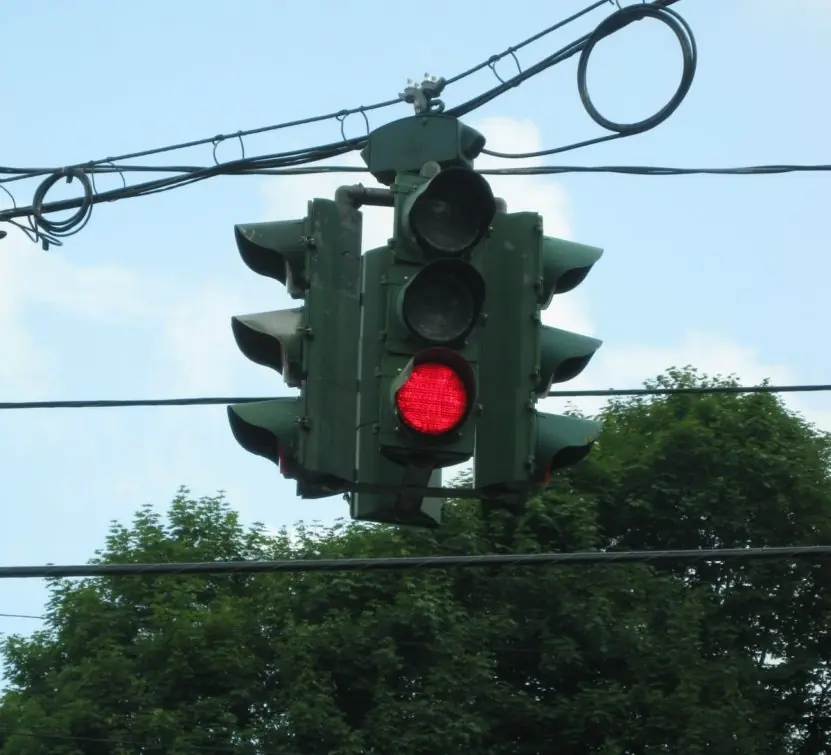
A decision with a time axis: the traffic light
A traffic-light controller is a decision made again and again.
At every second it asks which part of the cycle the clock is in and then switches the lamps: if the position is below 40 the light is green, below 45 it is yellow, otherwise red.
Plate 3.1 runs that controller for 300 seconds with if/else if and a switch on the state; the three cycles of 100 seconds give 120 s of green, 15 s of yellow and 165 s of red.
Note how the two decision tools work together: if chooses the state from a range, and switch acts on the exact state value.

3.2 The switch statement
switch (integer-expression) {
    case constant1: statements; break;
    case constant2: statements; break;
    default: statements;
}
Rules: the expression must be an integer or character type (no float, no strings); case labels must be distinct integer constants; default is optional and may appear anywhere.
Execution jumps to the matching label and then falls through every following label until a break or the closing brace. Fall-through is useful when several labels share code:
#include <stdio.h>

int main(void)
{
    char c = 'e';
    switch (c) {
    case 'a': case 'e': case 'i': case 'o': case 'u':
        printf("vowel\n");
        break;
    default:
        printf("consonant\n");
    }
    int n = 2;
    switch (n) {
    case 1: printf("one ");
    case 2: printf("two ");
    case 3: printf("three ");
    default: printf("end");
    }
    printf("\n");
    return 0;
}
vowel
two three end
The second switch shows the danger: with no break, n = 2 prints "two", "three" and "end". Use switch for a menu or a fixed set of values; use if for ranges.
The switch that keeps falling
Each case is only a label, not a closed box. After the matching label, C keeps running the following statements until it meets break or the closing brace.
That behaviour is called fall-through and it is the usual cause of the "extra output" bug. Plate 3.2 runs the same four inputs through two versions of a menu: one with break after every case, and one where case 1 and case 3 forget it.
Fall-through is useful when it is meant, for example case 'a': case 'e': case 'i': sharing one action for vowels.

3.3 Loops
A loop has four parts: initialisation, condition, body, update. Pick the form by what you know in advance.
| Loop | Form | Tested | Use when |
|---|---|---|---|
while |
while (cond) body |
before each pass | number of passes unknown; may run zero times |
do-while |
do body while (cond); |
after each pass | must run at least once (menus, input validation) |
for |
for (init; cond; update) body |
before each pass | counted loops |
for (;;) is an infinite loop (an empty condition means true). Trace by writing a small table of variable values per iteration; it is the only reliable way to predict output.
#include <stdio.h>

int main(void)
{
    int n = 4305, sum = 0, rev = 0;
    int t = n;
    while (t > 0) {
        int d = t % 10;
        sum += d;
        rev = rev * 10 + d;
        t /= 10;
    }
    printf("sum of digits = %d, reverse = %d\n", sum, rev);

    int i, fact = 1;
    for (i = 1; i <= 10; i++)
        fact *= i;
    printf("10! = %d\n", fact);

    int a = 0, b = 1;
    printf("Fibonacci:");
    for (i = 0; i < 10; i++) {
        printf(" %d", a);
        int next = a + b;
        a = b;
        b = next;
    }
    printf("\n");

    int k = 10;
    do {
        printf("%d ", k);
        k -= 3;
    } while (k > 0);
    printf("\n");
    return 0;
}
sum of digits = 12, reverse = 5034
10! = 3628800
Fibonacci: 0 1 1 2 3 5 8 13 21 34
10 7 4 1
Overflow warning: 13! does not fit in a 4-byte int (12! = 479,001,600 is the last that does); use long long or double for larger factorials.
Common loop patterns.
- Counting:
count++when a condition holds. - Accumulating:
sum += x;product *= x(start at 0 and 1 respectively). - Digit processing:
d = n % 10; n /= 10;(Armstrong, palindrome, reverse, digit sum). - Prime test: loop
ifrom 2 whilei * i <= n. - Search with early exit:
breakwhen found. - Sentinel input: read until a special value or until
scanfreturns something other than 1.
Nested loops — the outer loop drives rows, the inner drives columns:
#include <stdio.h>

int main(void)
{
    int n = 4;
    for (int i = 1; i <= n; i++) {
        for (int s = 1; s <= n - i; s++)
            printf(" ");
        for (int j = 1; j <= 2 * i - 1; j++)
            printf("*");
        printf("\n");
    }
    return 0;
}
   *
  ***
 *****
*******
(Declaring int i inside for needs C99 or later; compile with -std=c99 or -std=c11.) For a pattern, count per row: spaces = n − i, stars = 2i − 1; this "row formula" method solves every pattern question.

Counting trips through a loop
The three loop statements are not interchangeable at the boundary. for and while test first, so they may run zero times; do-while tests last, so it always runs at least once.
Plate 3.3 counts the real trips for three values of n, and also counts the trips of a nested loop and of a loop that uses continue and break. These numbers are the answers to a favourite exam question: how many times does the body run?

3.4 break, continue, goto
breakleaves the innermost loop orswitchimmediately.continueskips the rest of the current iteration and goes to the update (infor) or condition (inwhile).goto label;jumps to a label in the same function. It is legal, rarely justified; one accepted use is leaving several nested loops at once. Avoid it elsewhere: it produces "spaghetti" flow.
#include <stdio.h>

int main(void)
{
    int i;
    for (i = 1; i <= 10; i++) {
        if (i % 2 == 0)
            continue;
        if (i > 7)
            break;
        printf("%d ", i);
    }
    printf("| stopped at i=%d\n", i);
    return 0;
}
1 3 5 7 | stopped at i=9
Trace: even i skipped; at i = 9 (odd, > 7) the loop breaks, so i is 9 afterwards.
for (i = 0; i < 5; i++); — the stray semicolon is an empty body; the following block runs once. while (i = 5) assigns instead of testing. for (float x = 0; x != 1.0; x += 0.1) may never terminate because 0.1 has no exact binary form; compare with < or a tolerance.
An unsigned counter counting down with i >= 0 never ends because it cannot go negative.
The loop that nobody could prove would end
Edsger Dijkstra argued in 1968 that unrestricted goto makes programs hard to understand, and the structured statements of this chapter (if, switch, for, while, do-while) grew from that idea.
Even a very short loop can behave in a way that is hard to predict. The Collatz rule (halve an even number, triple and add one to an odd number) is a two-line while loop, yet nobody has proved that it always reaches 1.
Plate 3.4 plots the real trajectory of 27, which takes 111 steps and climbs to 9,232 before collapsing.


3.5 Eight uses of loops and decisions in real programs
- Menu-driven programs. A
do-whileloop shows the menu at least once and repeats until the user chooses Exit. Aswitchthen selects the action. A mobile top-up or ATM menu in Nepal works in just this way. - Input validation. A loop asks again until the value is acceptable, for example a mark between 0 and 100. The decision
if (m < 0 || m > 100)stops wrong data from entering the record. This protects every later calculation. - Processing a list of records. A
forloop visits each student, voter or customer in turn to add, count or find the largest. A TU result program with 500 students needs one loop and a few decisions. Without loops the same code would have to be written 500 times. - Grading and classification. An
if-else ifladder maps a percentage to Distinction, First, Second or Pass. The conditions are tested from top to bottom, and the first true one wins. The order of the conditions therefore matters. - Searching and sorting. Linear search uses a loop with a
breakwhen the key is found, and bubble sort uses a loop inside a loop. These are the base of every directory and phone-book function. The number of repeats decides the speed. - Number problems. Sum of digits, reversal, prime test, GCD and Fibonacci series all use
whileloops with%and/. A prime test loops only up to the square root of n to save work. These are the favourite exam programs. - Pattern printing. Nested loops print triangles and pyramids: the outer loop controls the rows, the inner loop controls the columns. This trains the habit of tracing two counters together. The same idea draws rows and columns on a screen.
- Games and real-time monitoring. A game loop reads input, updates the state and redraws the screen until the player quits. A sensor program that checks a river level every minute and sounds an alarm above a limit is also an endless loop with a decision. In such programs a
breakis the safe exit.
Formula and fact sheet
elsepairs with the nearestif.switchfalls through withoutbreak; its expression must be integral.whileandfortest first;do-whileruns at least once.- Pattern rows: spaces
n − i, stars2i − 1for a centred pyramid. - Leap year:
(y%4==0 && y%100!=0) || y%400==0. - Digit loop:
d = n % 10; n /= 10;· reverse:rev = rev*10 + d. - 12! = 479,001,600 is the largest factorial in a 32-bit
int.
Chapter summary
- Decide with
if/else if/switch; repeat withfor/while/do-while. - Trace loops in a table; count iterations by hand before running.
breakexits,continueskips,gotois a last resort.- The commonest bugs are
=for==, an accidental;afterfor/if, missingbreak, and floating-point loop counters.
Practice
A. Predict the output
int i; for (i = 0; i < 3; i++) printf("%d ", i * i); printf("%d", i);int n = 5, s = 0; while (n) { s += n; n -= 2; } printf("%d", s);int x = 0; do { x += 5; } while (x < 5); printf("%d", x);for (int i = 1; i <= 3; i++) for (int j = 1; j <= i; j++) printf("%d", i * j);int k = 3; switch (k) { case 1: printf("A"); case 3: printf("B"); case 4: printf("C"); break; case 5: printf("D"); }
B. Programs
- Read a number and print whether it is prime.
- Print all Armstrong numbers from 100 to 999 (153 = 1³ + 5³ + 3³).
- Read n and print the sum 1 + 1/2 + 1/3 + … + 1/n to 4 decimals (careful with integer division).
- Print the pattern with n = 4: row i has the numbers 1 … i.
- Menu-driven calculator using
do-whileandswitchthat quits on option 5.
Answers and worked solutions
1. 0 1 4 3 (squares 0, 1, 4; after the loop i is 3).
2. It never ends. Trace: s = 5, n = 3; s = 8, n = 1; s = 9, n = −1. The value −1 is non-zero, hence true, so n keeps decreasing past zero. Test n > 0 instead of n.
3. The body runs once before the test: x = 5, test 5 < 5 false. Output 5.
4. i = 1 prints 1; i = 2 prints 2 and 4; i = 3 prints 3, 6, 9. No separators are printed, so the output is 124369.
5. k = 3 jumps to case 3: prints B, falls to case 4 prints C, then break. Output BC.
6. scanf("%d",&n); int p = n >= 2; for (int i = 2; i * i <= n; i++) if (n % i == 0) { p = 0; break; } printf(p ? "prime" : "not prime");
7. For n from 100 to 999: a = n/100, b = n/10%10, c = n%10; if a*a*a + b*b*b + c*c*c == n print. The four are 153, 370, 371, 407.
8. double s = 0; for (int i = 1; i <= n; i++) s += 1.0 / i; printf("%.4f", s); (1 / i would be 0 for i > 1.)
9. for (i = 1; i <= 4; i++) { for (j = 1; j <= i; j++) printf("%d ", j); printf("\n"); }
10. do { printf("1.Add 2.Sub 3.Mul 4.Div 5.Quit: "); scanf("%d",&ch); switch (ch) { case 1: ...; break; ... case 5: break; default: printf("invalid"); } } while (ch != 5);
Model answers: medium (5 marks) and long (10 marks) questions
Q (5 marks). Differentiate between if-else if ladder and switch. Write a program that prints the day name for a number from 1 to 7.
Both statements choose one action out of many.
The if-else if ladder tests a chain of conditions from top to bottom and runs the block of the first true condition; its conditions can be any logical or relational expression, including ranges such as marks >= 80.
The switch compares one integer or character expression with constant case labels, jumps directly to the matching label and needs break to stop falling into the next case; a default label handles all other values.
| Point | if-else if |
switch |
|---|---|---|
| Condition | any expression, ranges, && \|\| |
one integer/char value against constants |
| Data types | int, float, char, strings (with strcmp) |
int and char only |
| Speed | tests one by one | often a jump table, faster |
Missing break |
not applicable | falls through to next case |
| Best use | ranges, grades | menus, days, options |
#include <stdio.h>
int main(void) {
    int d;
    scanf("%d", &d);
    switch (d) {
        case 1: printf("Sunday\n");    break;
        case 2: printf("Monday\n");    break;
        case 3: printf("Tuesday\n");   break;
        case 4: printf("Wednesday\n"); break;
        case 5: printf("Thursday\n");  break;
        case 6: printf("Friday\n");    break;
        case 7: printf("Saturday\n");  break;
        default: printf("Invalid day\n");
    }
    return 0;
}
For input 6 the output is Friday. In Nepal's week Saturday is the holiday, so a programmer could group case 7 with a message "Holiday" without any change to the other cases.
Q (10 marks). Explain the loop statements of C with syntax, flowchart and an example of each. Compare the while, do-while and for loops, and explain break and continue.
Introduction. A loop repeats a block of statements as long as a condition holds. Loops remove repeated code, so a program that handles 500 students needs the same few lines as one that handles 5. C has three loops: while, do-while and for (Figure 3.1).
The while loop. while (condition) { body }. The condition is tested first; if it is false at the start, the body never runs (entry-controlled).
Example i = 1; while (i <= 5) { printf("%d ", i); i++; } prints 1 2 3 4 5.
The do-while loop. do { body } while (condition); The body runs once before the test (exit-controlled), so it always runs at least once. Note the semicolon after the condition. It suits menus: do { show_menu(); scanf("%d", &c); } while (c != 0);
The for loop. for (init; condition; update) { body }. The initialisation runs once, then the condition is tested before every pass and the update runs after every pass.
Example for (i = 1; i <= 5; i++) sum += i; gives sum = 15. It is the best choice when the number of repeats is known.
Jump statements. break leaves the nearest loop or switch at once; for example, a linear search stops when the key is found.
continue skips the rest of the current pass and goes to the next test (in a for loop to the update); for example, skipping negative marks while adding. goto jumps to a label and should be avoided.
Comparison.
| Point | while |
do-while |
for |
|---|---|---|---|
| Test position | before body | after body | before body |
| Minimum runs | 0 | 1 | 0 |
| Best when | repeats unknown | menu, validation | repeats known |
| Init/update | separate lines | separate lines | in header |
| Semicolon at end | no | yes | no |
Nested loops. A loop inside a loop runs the inner loop fully for each pass of the outer loop.
A 4-row triangle uses for (i = 1; i <= 4; i++) { for (j = 1; j <= i; j++) printf("*"); printf("\n"); } and prints 1, 2, 3 and 4 stars in the four rows, 10 stars in total.
Conclusion. The three loops are interchangeable in power, so the choice is about clarity: for for counting, while for waiting on a condition, do-while when the body must run once. A loop must always change something that leads to a false condition, or it never ends.