Unit 7 · 6 teaching hours · 19 min read
Money, Banking and International Trade
What the syllabus asks for 6
- Concept and functions of money
- Inflation
- Banking: commercial banks and the central bank
- International trade, balance of trade and balance of payments
- Seeing money, inflation, central banking and trade
- Eight roles of money, banks and trade in everyday Nepali life
The final unit covers the money that circulates in the economy, the institutions that create and control it, the price changes it can cause (inflation), and trade with other countries, with attention to Nepal.
- Concept and functions of money, the value of money, money supply (M1, M2).
- Inflation: types, causes, effects and control.
- Commercial banks and the central bank (Nepal Rastra Bank).
- Internal versus international trade; balance of trade and balance of payments.
7.1 Concept and functions of money
Money is anything generally accepted as a means of payment and settlement of debts. It solves the double coincidence of wants problem of barter.
Functions: primary: medium of exchange and unit of account (a common measure of value); secondary: store of value and standard of deferred payment; contingent: transfer of value, liquidity.
Forms: commodity money, fiat money (legal tender with value by government decree: banknotes), bank (deposit) money, and digital payments. Qualities: acceptability, durability, portability, divisibility, uniformity, scarcity.
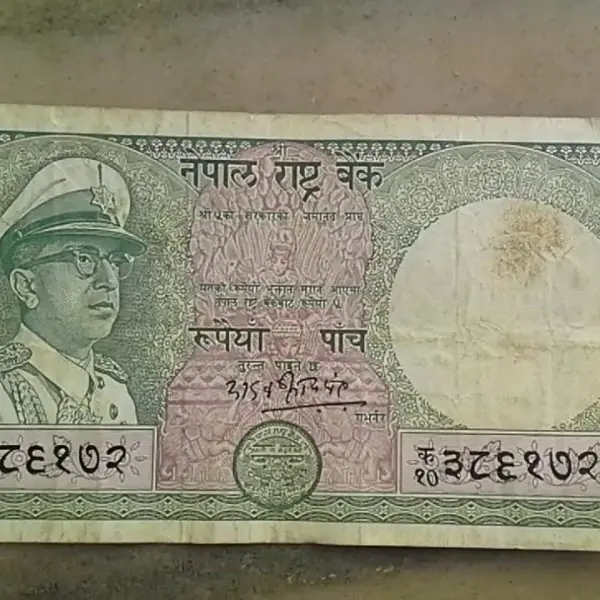
Nepal's rupee is a fiat currency, pegged to the Indian rupee (NPR 1.60 = INR 1 since 1993).
Value of money
The value (purchasing power) of money is the inverse of the price level: value = 1/P. If the consumer price index (CPI) rises from 100 to 125, one rupee buys 100/125 = 0.8 of what it did.
The quantity theory says MV = PT (money supply × velocity = price level × output): with V and output stable, prices rise in proportion to money supply.
Money supply
The money supply is the total money held by the public.
Nepal Rastra Bank defines, in the usual pattern: M1 (narrow money) = currency in the hands of the public + demand (current) deposits; M2 (broad money) = M1 + savings and fixed (time) deposits of banks and financial institutions (and foreign-currency deposits, depending on the definition).
Banks create deposits through lending: with a reserve ratio r, the money multiplier = 1/r.
Initial deposit NPR 1,000; required reserve ratio 10%. The bank lends 900, which is deposited elsewhere and 810 is lent again, and so on. Maximum total deposits = 1,000 × (1/0.10) = 10,000, so 9,000 of new deposit money is created.
With a 20% ratio the multiplier is 5 and total deposits 5,000 (4,000 created). A higher reserve ratio restricts money creation, which is how a central bank tightens credit.
7.2 Inflation
Inflation is a sustained rise in the general price level (equivalently, a fall in the value of money), measured by the percentage change in a price index such as the CPI: inflation = (CPI₁ − CPI₀)/CPI₀ × 100.
A basket costs NPR 5,000 in the base year and 5,900 now: CPI = 5,900/5,000 × 100 = 118. If last year's CPI was 112, inflation = (118 − 112)/112 = 5.36%.
Types: by speed: creeping (< 3%), walking/trotting (3–10%), galloping/running (10–100%+), hyperinflation (extreme, like Zimbabwe 2008); by cause: demand-pull, cost-push, structural.
Causes: demand-pull (too much money chasing too few goods: money supply growth, government deficit spending, rising exports or remittances raising spending, easy credit); cost-push (higher wages, fuel and raw materials, imported inflation, taxes, supply disruptions, monopoly pricing); structural (bottlenecks, poor infrastructure and supply chains); expectations feed back (wage–price spiral).
In Nepal, prices are strongly influenced by India's prices through the open border and fixed exchange rate and by fuel imports.
Effects: debtors gain and creditors lose (loans repaid with cheaper money); fixed-income earners (pensioners, salaried workers) lose purchasing power; savers lose if interest is below inflation (negative real interest); uncertainty reduces investment; exports lose competitiveness; income is redistributed toward those with real assets (land, gold).
Mild inflation (2–5%) is usually considered consistent with growth.
Control: monetary measures (raise policy interest rates, raise reserve requirements, sell government securities, credit ceilings); fiscal measures (cut public spending, raise taxes, budget surplus); supply-side measures (increase production, improve supply chains, import essentials, buffer stocks) and price and wage controls (temporary).
7.3 Banking: commercial banks and the central bank
Commercial banks accept deposits and lend.
Functions: primary: accepting deposits (current, savings, fixed, recurring), granting loans and advances (overdraft, term loans, discounting bills); secondary/agency: remittance and money transfer, issuing cheques, cards and letters of credit, collecting bills, utility payments, locker and advisory services, foreign-exchange dealing, and digital banking; credit creation (7.1).
Banks earn from the spread between lending and deposit rates and from fees; they hold reserves and keep a balance between liquidity, safety and profitability.
Central bank (Nepal Rastra Bank, NRB), established in 1956 (2013 BS; governed now by the Nepal Rastra Bank Act, 2058), is the apex monetary authority. Functions:
- Issues currency (sole right to issue notes).
- Banker, agent and adviser to the government (keeps its accounts, manages public debt).
- Banker to banks and lender of last resort; holds banks' reserves, settles interbank payments.
- Formulates and implements monetary policy to control money supply, interest rates, inflation and the exchange rate.
- Regulates and supervises banks and financial institutions (licensing, capital adequacy, directives).
- Manages foreign-exchange reserves and the exchange rate regime.
Instruments of credit control: quantitative: cash reserve ratio (CRR), statutory liquidity ratio (SLR), bank rate, repo and reverse repo/standing liquidity facility (policy rate corridor), open market operations (buy/sell securities); qualitative: moral suasion, credit rationing, margin requirements, directives on sector lending limits.
Tight policy (higher rates and CRR) lowers inflation but slows growth; loose policy does the reverse.
7.4 International trade, balance of trade and balance of payments
Internal (domestic) trade is between regions of one country; international trade between countries.
Differences: factor immobility across borders (labour and capital move less freely), different currencies and exchange-rate risk, different laws, tariffs, quotas and regulations, differing languages and customs, and more transport, documentation and political risk.
Theory: countries gain from trade by comparative advantage: specialise in goods with the lowest opportunity cost and trade (Ricardo).
Barriers: tariffs, quotas, subsidies, non-tariff barriers; Nepal is a landlocked country, depending on transit through India, which raises trade costs; the largest trading partner is India, and imports greatly exceed exports.
Balance of trade (BoT) = value of merchandise (visible) exports − imports. A deficit means imports exceed exports. Balance of payments (BoP) is the systematic record of all economic transactions between residents and the rest of the world in a period:
| Account | Includes |
|---|---|
| Current account | trade in goods (BoT), trade in services (tourism, transport, IT exports), primary income (wages, investment income), secondary income (remittances, grants) |
| Capital account | capital transfers, debt forgiveness, acquisition of non-produced assets |
| Financial account | foreign direct investment, portfolio investment, loans, changes in reserve assets |
Because it is a double-entry record the BoP always balances in total (with errors and omissions): a current-account deficit is financed by a surplus in the capital and financial accounts or by drawing down reserves.
A deficit/surplus refers to a particular part (usually the current account or the overall change in reserves).
Merchandise exports 100 and imports 450 (units of NPR billion): BoT = −350 (deficit). Net services and income +10; remittances and other transfers +300. Current account = −350 + 10 + 300 = −40.
Capital and financial account = +30 (loans and investment inflows). Overall balance = −40 + 30 = −10, financed by a fall in foreign exchange reserves of 10.
This pattern, a large trade deficit offset by remittance inflows, is typical of Nepal.
7.5 Seeing money, inflation, central banking and trade



7.6 Eight roles of money, banks and trade in everyday Nepali life
- Money makes exchange simple. Without money a farmer who wants a phone must find a phone seller who wants rice. A common medium of exchange removes this double coincidence of wants. Notes, cards and QR payments such as Fonepay all do the same job.
- Money is a store of value and a unit of account. Savings kept as money can be spent later, but they lose value when prices rise. Every price in a Nepali shop is quoted in rupees, so goods can be compared quickly. Inflation reduces this value, which is why real assets are sometimes preferred.
- Banks turn savings into loans. A bank lends most of its deposits, and the loan is deposited again, so deposits multiply. This lets a small saving finance a farm loan, a shop or a house. The reserve ratio limits how far the process can go.
- Inflation changes who gains and who loses. Borrowers repay in cheaper money and gain, while pensioners and salaried people lose buying power. Prices of fuel, rice and vegetables matter most to poor families. This is why governments watch the consumer price index every month.
- The central bank guards stability. The Nepal Rastra Bank issues notes, supervises banks and sets policy rates to keep prices and the financial system stable. When it raises rates, loans become costlier and spending cools. It also acts as the lender of last resort in a crisis.
- Digital banking cuts transaction costs. ConnectIPS, eSewa and mobile banking let people send money without travelling to a branch. A migrant worker's family in Gorkha can receive money in minutes. Lower costs help small firms and bring more people into the formal system.
- Trade lets Nepal specialise. By the principle of comparative advantage, a country gains by making what it produces at lowest opportunity cost and importing the rest. Nepal exports items such as cardamom, tea and handicrafts, and imports fuel, machinery and vehicles. The gains come through lower prices and wider choice.
- The balance of payments shows dependence on remittance. A big trade deficit is paid for by money sent home by workers abroad, as in the worked example. This keeps reserves safe but ties the economy to foreign labour markets. Reading the BoP tells whether this pattern can last.
Formula and fact sheet
- Money: medium of exchange, unit of account, store of value, standard of deferred payment.
- Value of money = 1/price level. Quantity theory MV = PT. Money multiplier = 1/reserve ratio.
- M1 = currency + demand deposits; M2 = M1 + time/savings deposits (NRB definition varies slightly).
- Inflation = (CPI₁ − CPI₀)/CPI₀ × 100; demand-pull, cost-push, structural.
- NRB tools: CRR, SLR, bank rate, repo/SLF, open market operations.
- BoT = exports − imports (goods). BoP = current + capital + financial account (= 0 overall).
Chapter summary
- Money serves four functions; its value falls as the price level rises; the money supply (M1, M2) is created by banks via the multiplier and controlled by the central bank.
- Inflation, caused by demand, costs or structure, redistributes income and is fought with monetary, fiscal and supply measures.
- Commercial banks take deposits and lend; the NRB issues currency, regulates banks and conducts monetary policy.
- International trade differs from domestic trade by frictions and currencies; BoT covers goods, while the BoP records all transactions and balances in total.
Practice
- List the functions of money and explain how money solves the problem of barter.
- Deposit 5,000 with a reserve ratio of 20%: find the money multiplier and maximum deposits.
- The CPI was 120 last year and is 132 now. Find the inflation rate and the change in the value of money.
- Distinguish demand-pull and cost-push inflation; suggest controls for each.
- List the functions of a commercial bank and of the Nepal Rastra Bank.
- Differentiate BoT and BoP; compute BoT for exports 80 and imports 300.
- Explain how raising the CRR affects the money supply.
- List differences between internal and international trade.
Answers and worked solutions
1. Medium of exchange, unit of account, store of value, standard of deferred payment. Money removes the need for a double coincidence of wants: you can sell for money and buy anything with it.
2. Multiplier = 1/0.20 = 5; maximum deposits = 5,000 × 5 = 25,000 (20,000 new).
3. Inflation = (132 − 120)/120 = 10%. Value of money falls from 1/120 to 1/132, i.e. by 120/132 − 1 = −9.1%.
4. Demand-pull: excess aggregate demand (control: tighter money and fiscal policy). Cost-push: rising input costs (control: improve supply, reduce taxes on essentials, import, wage restraint).
5. Commercial bank: deposits, loans, remittances, payments, forex, agency services. NRB: issues currency, banker to government and banks, monetary policy, regulation, reserves.
6. BoT covers only visible goods (80 − 300 = −220); BoP records all transactions including services, income, transfers, capital and financial flows.
7. Banks must hold more cash with the NRB, lend less, deposit creation falls, so money supply contracts.
8. Factor mobility, currency, laws and tariffs, transport and risk, language and customs.
Model answers: medium (5 marks) and long (10 marks) questions
Q1 (5 marks). Define money and explain its functions. How do banks create deposits? Show with an example of NPR 1,000 and a 10% reserve ratio.
Introduction. Money is anything generally accepted as a means of payment and for settling debts. It removes the double coincidence of wants of barter. Forms include commodity money, fiat notes, bank deposits and digital payments.
Functions. (1) Medium of exchange: buyers and sellers accept it for any good. (2) Unit of account: all prices are quoted in rupees, so values can be compared. (3) Store of value: purchasing power can be saved for later.
(4) Standard of deferred payment: loans and wages are fixed in money.
Deposit creation (Figure 7.1). Banks keep a fraction r of deposits as reserve and lend the rest, and the loan returns as a new deposit. With an initial deposit of 1,000 and r = 10%, the bank lends 900, then 810, then 729, and so on.
The money multiplier is 1/r = 10, so total deposits can reach 1,000 × 10 = 10,000, of which 9,000 is newly created. With r = 20% the multiplier is 5 and total deposits are 5,000.
Conclusion. A higher reserve ratio limits credit creation; this is the lever the central bank uses to tighten or loosen money.
Q2 (5 marks). Distinguish between balance of trade and balance of payments. From the data, calculate the current account and the overall balance.
Introduction. International transactions are recorded in two ways: a narrow account for goods and a wide account for everything.
| Point | Balance of trade | Balance of payments |
|---|---|---|
| Covers | visible goods only | goods, services, income, transfers, capital and finance |
| Formula | exports − imports | current + capital + financial account |
| Balances? | rarely | always, as a double-entry record |
| Nepal | large deficit | cushioned by remittance |
Structure. The current account has trade in goods, services, primary income and secondary income (remittances and grants). The capital account has capital transfers. The financial account has foreign investment, loans and changes in reserves.
Calculation (Figure 7.4), NPR billion. BoT = 100 − 450 = −350. Current account = −350 + 10 + 300 = −40. Capital and financial account = +30. Overall balance = −40 + 30 = −10, financed by a fall of 10 in foreign-exchange reserves.
Conclusion. A large trade deficit offset by remittances is typical of Nepal; the BoP shows how it is financed.
Q3 (10 marks). Define inflation. Explain its types, causes, effects and the measures to control it. A basket costs NPR 5,000 in the base year and 5,900 now; last year's CPI was 112.
Introduction. Inflation is a sustained rise in the general price level, equal to a fall in the value of money. It is measured by the percentage change in a price index such as the consumer price index (CPI).
Measurement. CPI = 5,900/5,000 × 100 = 118. Inflation = (118 − 112)/112 × 100 = 5.36%. One rupee now buys 100/118 = 0.85 of what it bought in the base year.
Types. By speed: creeping (below 3%), walking (3 to 10%), galloping (10% and more) and hyperinflation. By cause: demand-pull, cost-push and structural.
Causes (Figure 7.2).
- Demand-pull: too much money chasing too few goods, through money growth, deficit spending, rising remittance spending and easy credit. AD shifts right.
- Cost-push: higher wages, fuel and raw material prices, imported inflation, taxes, monopoly pricing. AS shifts up and output falls (stagflation).
- Structural: poor roads, weak supply chains and bottlenecks. In Nepal prices also follow India's through the open border and the peg.
Effects. Debtors gain and creditors lose; pensioners and salaried people lose real income; savers lose if the interest rate is below inflation; uncertainty reduces investment; exports become less competitive; real assets such as land and gold gain.
Control.
| Measure | Examples | Works against |
|---|---|---|
| Monetary | higher policy rate, higher CRR, selling securities | demand-pull |
| Fiscal | lower spending, higher taxes, surplus budget | demand-pull |
| Supply-side | more production, better supply chain, buffer stocks | cost-push, structural |
| Controls | temporary price and wage limits | short-term relief |
Conclusion. Mild inflation of 2 to 5% is consistent with growth; the right cure depends on whether demand or supply is the cause.
Q4 (10 marks). Explain the functions of the Nepal Rastra Bank and the instruments it uses to control credit.
Introduction. The Nepal Rastra Bank (NRB) is Nepal's central bank. It was established in 1956 (2013 BS) and now works under the Nepal Rastra Bank Act, 2058.
It is the apex monetary authority and, unlike a commercial bank, it does not work for profit or deal with the public.
Functions.
- Issuer of currency: it holds the sole right to issue notes.
- Banker, agent and adviser to the government: it keeps government accounts and manages public debt.
- Banker to banks: it holds their reserves and settles payments between them.
- Lender of last resort: it lends to a sound bank in a liquidity crisis, which protects depositors.
- Monetary policy: it controls the money supply, interest rates, inflation and the exchange rate.
- Regulation and supervision: it licenses banks and sets capital adequacy and lending directives.
- Reserve manager: it holds and manages foreign-exchange reserves and the rate regime.
Instruments of credit control (Figure 7.3).
| Type | Instrument | How it works |
|---|---|---|
| Quantitative | Cash reserve ratio (CRR) | a higher ratio leaves banks less to lend |
| Quantitative | Statutory liquidity ratio (SLR) | banks must hold a share in liquid assets |
| Quantitative | Bank rate, repo and standing liquidity facility | a higher rate makes borrowing from NRB dearer |
| Quantitative | Open market operations | selling securities drains money; buying adds it |
| Qualitative | Moral suasion, credit rationing, margin rules, sector limits | direct guidance of lending |
Effect. A tight policy (higher rates and CRR) cuts borrowing and spending and lowers inflation, but it slows growth and jobs. A loose policy does the opposite.
With a reserve ratio change from 10% to 20% the multiplier halves from 10 to 5, which shows how strong a lever the CRR is.
Conclusion. The NRB keeps prices, the banking system and the external position stable, and trades off inflation against growth in choosing its instruments.