Unit 8 · General and Physical Chemistry · 3 teaching hours · 21 min read
Chemical equilibrium
What the syllabus asks for 6
- Physical and chemical equilibrium
- Dynamic nature of chemical equilibrium
- Law of mass action
- Expression for equilibrium constant and its importance
- Relationship between Kp and Kc
- Le Chatelier's Principle (numericals not required)
Most reactions do not go to completion. Long before all the reactants are used up, the products begin turning back into reactants, and the two opposing changes settle down to the same speed.
Nothing appears to happen after that, yet both reactions are still running.
This balanced, unfinished state is chemical equilibrium, and it decides how much ammonia a Haber plant can make and how much sulphur trioxide a contact plant can make.
Numerically, only two things come up: writing K_c from a balanced equation and converting between K_p and K_c.
Theoretically, expect "state the law of mass action", "give four characteristics of dynamic equilibrium" and "apply Le Chatelier's principle to the Haber process". Le Chatelier numericals are not required.
8.1 Physical and chemical equilibrium
A reversible change is one that can go in both directions under the same conditions; it is written with a double half-arrow, ⇌. When the two opposing changes go at the same rate in a closed system, the system is in equilibrium.
Physical equilibrium involves only a change of physical state — no new substance is formed.
| Physical equilibrium | Example | Condition |
|---|---|---|
| Solid ⇌ Liquid | H₂O(s) ⇌ H₂O(l) | melting point, 0 °C at 1 atm |
| Liquid ⇌ Vapour | H₂O(l) ⇌ H₂O(g) | any closed vessel; fixes the vapour pressure |
| Solid ⇌ Vapour | I₂(s) ⇌ I₂(g) | sublimation, as in camphor or naphthalene |
| Solute ⇌ Solution | sugar(s) ⇌ sugar(aq) | a saturated solution |
| Gas ⇌ Solution | CO₂(g) ⇌ CO₂(aq) | a sealed bottle of soda |
Chemical equilibrium involves a chemical reaction, so new substances are formed. Examples:
- N₂(g) + 3H₂(g) ⇌ 2NH₃(g)
- 2SO₂(g) + O₂(g) ⇌ 2SO₃(g)
- H₂(g) + I₂(g) ⇌ 2HI(g)
- CH₃COOH(l) + C₂H₅OH(l) ⇌ CH₃COOC₂H₅(l) + H₂O(l)
- CaCO₃(s) ⇌ CaO(s) + CO₂(g) (in a closed vessel)
8.2 Dynamic nature of chemical equilibrium
At the start of a reaction only reactants are present, so the forward rate is large and the backward rate is zero. As reactants are consumed the forward rate falls; as products accumulate the backward rate rises. Sooner or later the two rates become equal.
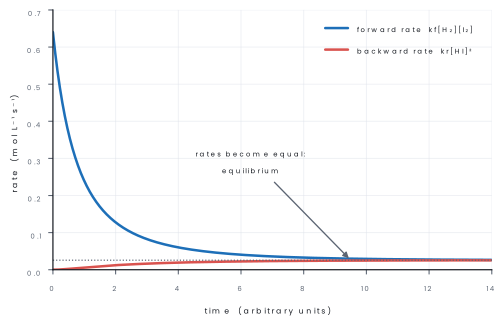
Chemical equilibrium is the state of a reversible reaction in a closed system at which the rate of the forward reaction becomes equal to the rate of the backward reaction, so that the concentrations of reactants and products no longer change with time.
Equilibrium is dynamic, not static. Its characteristics are:
- It is reached only in a closed system at constant temperature.
- The forward and backward reactions never stop; they merely go at equal rates. Isotopic labelling proves this — label the iodine as I-131 in 2HI and the label soon appears in I₂.
- All observable properties (concentration, colour, pressure, density) become constant with time.
- The same equilibrium state can be reached from either direction — from pure reactants or from pure products — provided the temperature and total composition are the same.
- A catalyst does not change the position of equilibrium; it only makes the system reach it faster, because it speeds up both reactions equally.
8.3 Law of mass action
At a given temperature, the rate of a chemical reaction is directly proportional to the product of the molar concentrations of the reactants, each raised to the power equal to its coefficient in the balanced chemical equation.
The molar concentration of a substance is called its active mass, written in square brackets: [A] in mol L⁻¹. For the general reversible reaction
aA + bB ⇌ cC + dD
the law of mass action gives the two rates as
Active mass means molar concentration (mol L⁻¹), not the mass in grams. For a pure solid or a pure liquid the concentration is fixed by its density, so its active mass is taken as 1 and it is left out of the equilibrium expression.
8.4 Expression for equilibrium constant and its importance
At equilibrium the two rates are equal, r_f = r_b:
K_c is the equilibrium constant in terms of concentration. If all species are gases we may use partial pressures instead:
The units of K_c are (\text{mol L}^{-1})^{\Delta n} and of K_p are (\text{atm})^{\Delta n}, where \Delta n = (c+d) - (a+b) is the change in the number of gaseous moles. When \Delta n = 0 both are dimensionless.
| Reaction | K_c expression | \Delta n | Units of K_c |
|---|---|---|---|
| H₂ + I₂ ⇌ 2HI | [HI]²/([H₂][I₂]) | 0 | none |
| N₂ + 3H₂ ⇌ 2NH₃ | [NH₃]²/([N₂][H₂]³) | −2 | mol⁻² L² |
| PCl₅ ⇌ PCl₃ + Cl₂ | [PCl₃][Cl₂]/[PCl₅] | +1 | mol L⁻¹ |
| 2SO₂ + O₂ ⇌ 2SO₃ | [SO₃]²/([SO₂]²[O₂]) | −1 | mol⁻¹ L |
| CaCO₃(s) ⇌ CaO(s) + CO₂(g) | [CO₂] | +1 | mol L⁻¹ |
Importance of the equilibrium constant
- Extent of reaction. A large K (say >10^{3}) means the equilibrium mixture is almost all products; a small K (<10^{-3}) means the reaction hardly proceeds. K \approx 1 means comparable amounts of both.
- Direction of reaction. Compute the reaction quotient Q using the same expression but with the actual concentrations. If Q < K the reaction moves forward; if Q > K it moves backward; if Q = K it is already at equilibrium.
- Calculation of equilibrium concentrations and of the yield of a product.
- K depends only on temperature — not on pressure, volume, initial concentrations or the presence of a catalyst.
- Reversing a reaction replaces K by 1/K; multiplying the equation through by n replaces K by K^{n}.
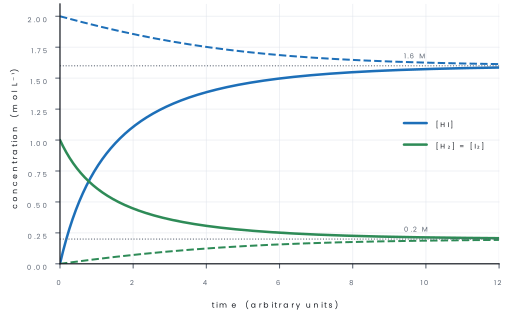
Problem. One mole of H₂ and one mole of I₂ are heated in a closed 10 L flask at 450\ ^{\circ}\text{C}. At equilibrium 1.6 mol of HI is present. Calculate K_c.
Solution. Let x mol of H₂ react. Build an ICE (Initial–Change–Equilibrium) table in moles first.
| H₂ | I₂ | 2HI | |
|---|---|---|---|
| Initial (mol) | 1 | 1 | 0 |
| Change (mol) | −x | −x | +2x |
| Equilibrium (mol) | 1 − x | 1 − x | 2x |
Given 2x = 1.6, so x = 0.8. Equilibrium amounts are H₂ = 0.2 mol, I₂ = 0.2 mol, HI = 1.6 mol. Divide by the volume (10 L) to get concentrations:
K_c = 64, with no units because \Delta n = 0.
Problem. For H₂ + I₂ ⇌ 2HI, K_c = 64 at 450\ ^{\circ}\text{C}. If 1 mol of H₂ and 1 mol of I₂ are placed in a 1 L vessel at this temperature, find the equilibrium concentration of HI.
Solution. With V = 1\ \text{L}, moles and concentrations are numerically equal.
| H₂ | I₂ | 2HI | |
|---|---|---|---|
| Initial (M) | 1 | 1 | 0 |
| Change (M) | −x | −x | +2x |
| Equilibrium (M) | 1 − x | 1 − x | 2x |
Both sides are perfect squares, so take the square root — this avoids the quadratic:
So x = 0.8 and [HI] = 2x = 1.6\ \text{mol L}^{-1}, with [H_2] = [I_2] = 0.2\ \text{mol L}^{-1} — the same mixture as in Example 8.1, as it must be.
8.5 Relationship between K_p and K_c
For an ideal gas, PV = nRT, so the partial pressure of a gas is related to its molar concentration by
Substituting this for every species in the expression for K_p:
Three cases follow at once:
| \Delta n | Relation | Example |
|---|---|---|
| \Delta n = 0 | K_p = K_c | H₂ + I₂ ⇌ 2HI |
| \Delta n > 0 | K_p > K_c | PCl₅ ⇌ PCl₃ + Cl₂ |
| \Delta n < 0 | K_p < K_c | N₂ + 3H₂ ⇌ 2NH₃ |
If K_p is wanted in atm, use R = 0.0821\ \text{L atm K}^{-1}\text{mol}^{-1} and concentrations in mol L⁻¹. Using R = 8.314 with atmospheres is the most common error in this calculation. And T is always in kelvin.
Problem. 2 mol of PCl₅ were heated in a closed 2 L vessel at 250\ ^{\circ}\text{C}. At equilibrium PCl₅ was found to be 40 % dissociated. Calculate K_c and K_p.
Solution. Moles dissociated = 0.40 \times 2 = 0.8\ \text{mol}.
| PCl₅ | PCl₃ | Cl₂ | |
|---|---|---|---|
| Initial (mol) | 2 | 0 | 0 |
| Change (mol) | −0.8 | +0.8 | +0.8 |
| Equilibrium (mol) | 1.2 | 0.8 | 0.8 |
Dividing by V = 2\ \text{L}:
Here \Delta n = 2 - 1 = +1 and T = 250 + 273 = 523\ \text{K}, so
Problem. For N₂(g) + 3H₂(g) ⇌ 2NH₃(g), K_c = 0.50\ \text{mol}^{-2}\text{L}^{2} at 400\ ^{\circ}\text{C}. Calculate K_p.
Solution. \Delta n = 2 - (1+3) = -2 and T = 400 + 273 = 673\ \text{K}.
K_p < K_c, as expected for \Delta n < 0.
8.6 Le Chatelier's Principle
If a system at equilibrium is disturbed by a change in concentration, pressure or temperature, the equilibrium shifts in the direction that tends to oppose or undo the effect of the change.
| Change applied | Direction of shift | Reason |
|---|---|---|
| Increase concentration of a reactant | forward | system consumes the added reactant |
| Remove a product as it forms | forward | system replaces what was removed |
| Increase total pressure (decrease volume) | towards the side with fewer gaseous moles | that reduces the pressure again |
| Decrease pressure | towards the side with more gaseous moles | — |
| Increase temperature | in the endothermic direction | that absorbs the added heat |
| Decrease temperature | in the exothermic direction | — |
| Add a catalyst | no shift | both rates are speeded up equally |
| Add an inert gas at constant volume | no shift | partial pressures are unchanged |
Only a change of temperature changes the value of K. Concentration and pressure changes move the position of equilibrium but leave K the same.
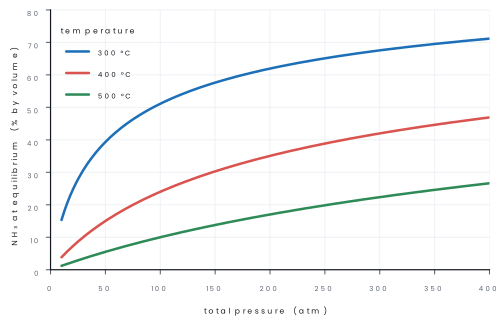
Application 1 — Haber process. N₂(g) + 3H₂(g) ⇌ 2NH₃(g); ΔH = −92.4 kJ mol⁻¹
Since \Delta n = -2, a high pressure (about 200 atm) pushes the equilibrium towards ammonia.
Since the forward reaction is exothermic, a low temperature would give a better yield — but at low temperature the reaction is far too slow, so a compromise optimum temperature of about 450–500 °C is used, with a finely divided iron catalyst promoted by molybdenum.
Ammonia is condensed out continuously, which pulls the equilibrium further forward.
Application 2 — Contact process. 2SO₂(g) + O₂(g) ⇌ 2SO₃(g); ΔH = −196 kJ mol⁻¹
Again \Delta n = -1 and the forward reaction is exothermic, so high pressure and low temperature favour SO₃.
In practice the equilibrium yield is already above 95 % at 1–2 atm, so high pressure is not worth its cost; the plant runs at 400–450 °C over a V₂O₅ catalyst with an excess of air (Le Chatelier applied to concentration).
Application 3 — physical equilibrium. Ice ⇌ water is accompanied by a decrease in volume, so increasing the pressure melts ice. This is why a wire loaded at both ends cuts slowly through a block of ice — the phenomenon of regelation.

Chapter summary
- Chemical equilibrium is the state of a reversible reaction in a closed system where the forward and backward rates are equal. It is dynamic, reachable from either side, and unaffected in position by a catalyst.
- Law of mass action: rate ∝ product of active masses (molar concentrations), each raised to its stoichiometric coefficient.
- For aA + bB ⇌ cC + dD, K_c = \dfrac{[C]^{c}[D]^{d}}{[A]^{a}[B]^{b}} and K_p = \dfrac{p_C^{c}p_D^{d}}{p_A^{a}p_B^{b}}; pure solids and pure liquids are omitted.
- K_p = K_c(RT)^{\Delta n} with \Delta n the change in gaseous moles; K_p = K_c when \Delta n = 0.
- K measures the extent of reaction and depends only on temperature; comparing the reaction quotient Q with K predicts the direction of change.
- Le Chatelier: a disturbed equilibrium shifts so as to oppose the disturbance. High pressure favours the side with fewer gas moles; a temperature rise favours the endothermic direction.
- Haber: N₂ + 3H₂ ⇌ 2NH₃, ΔH = −92.4 kJ mol⁻¹, run at ≈200 atm and 450–500 °C over promoted iron. Contact: 2SO₂ + O₂ ⇌ 2SO₃, ΔH = −196 kJ mol⁻¹, at 400–450 °C over V₂O₅.
Practice questions
Group A — Multiple choice (1 mark each)
- For the reaction N₂(g) + 3H₂(g) ⇌ 2NH₃(g), the relation between K_p and K_c is [1]aK_p = K_cbK_p = K_c RTcK_p = K_c(RT)^{-2}dK_p = K_c(RT)^{2}
- Which of the following will not change the position of an equilibrium? [1]aadding a catalystbchanging the temperaturecchanging the pressure when \Delta n \ne 0dremoving a product
- The value of the equilibrium constant depends on [1]ainitial concentrationsbpressurectemperaturedthe catalyst used
- In the reaction CaCO₃(s) ⇌ CaO(s) + CO₂(g), the equilibrium constant K_c is [1]a[CaO][CO₂]/[CaCO₃]b[CO₂]c1/[CO₂]d[CaO][CO₂]
- If Q > K_c for a reacting mixture, the reaction will [1]ago forwardbgo backwardcalready be at equilibriumdstop completely
Answers to Group A
1. (c) — \Delta n = 2 - 4 = -2.
2. (a) — a catalyst speeds up both directions equally.
3. (c) — K is a function of temperature alone.
4. (b) — pure solids have constant active mass and are omitted.
5. (b) — there is too much product, so the reverse reaction dominates until Q falls to K_c.
Group B — Short answer (5 marks each)
- State the law of mass action and use it to derive the expression for the equilibrium constant K_c of the reaction aA + bB ⇌ cC + dD. [5]
- Give any five characteristics of dynamic chemical equilibrium. [5]
- Derive the relationship K_p = K_c(RT)^{\Delta n} and state when K_p = K_c. [5]
- 1 mol of ethanoic acid and 1 mol of ethanol were mixed and allowed to reach equilibrium at 298 K. At equilibrium 2/3 mol of ester had formed. Calculate K_c for the esterification. [5]
- For 2SO₂(g) + O₂(g) ⇌ 2SO₃(g), K_c = 4.0\ \text{mol}^{-1}\text{L} at 1000 K. Calculate K_p at the same temperature. [5]
Answers to Group B
1. Statement as in §8.3, then equate k_f[A]^a[B]^b = k_r[C]^c[D]^d at equilibrium and rearrange to K_c = k_f/k_r = [C]^c[D]^d/([A]^a[B]^b).
2. Any five from §8.2: closed system; equal forward and backward rates; reactions continue (dynamic); measurable properties constant; attainable from either direction; catalyst does not shift it; K fixed at a given temperature.
3. As derived in §8.5, using p_i = [i]RT. K_p = K_c when \Delta n = 0.
4. CH₃COOH + C₂H₅OH ⇌ CH₃COOC₂H₅ + H₂O with x = 2/3. Equilibrium amounts: acid = 1/3, alcohol = 1/3, ester = 2/3, water = 2/3. Because \Delta n = 0, the volume V cancels:
5. \Delta n = 2 - 3 = -1, T = 1000\ \text{K}, RT = 0.0821 \times 1000 = 82.1. K_p = K_c(RT)^{-1} = 4.0/82.1 = 0.0487\ \text{atm}^{-1}.
Group C — Long answer (8 marks each)
- (a) What is meant by dynamic chemical equilibrium? Distinguish it from physical equilibrium with one example of each. [3](b) State Le Chatelier's principle and apply it to the manufacture of ammonia by the Haber process, justifying the pressure, the temperature and the use of a catalyst. [5]
- (a) Derive K_p = K_c(RT)^{\Delta n}. [3](b) 4 mol of PCl₅ were heated in a 4 L closed vessel at 250\ ^{\circ}\text{C}. At equilibrium 50 % had dissociated into PCl₃ and Cl₂. Using an ICE table, calculate K_c and K_p. [5]
Answers to Group C
1.(a) See §8.1 and §8.2 — physical equilibrium involves only a change of state (ice ⇌ water), chemical equilibrium forms new substances (N₂ + 3H₂ ⇌ 2NH₃).(b) Statement of the principle, then: \Delta n = -2 so high pressure (200 atm) increases the yield; the forward reaction is exothermic (ΔH = −92.4 kJ mol⁻¹) so a low temperature increases the yield but lowers the rate, hence the compromise at 450–500 °C; the iron catalyst does not change the yield, only the time taken to reach it.
2(b). Dissociated = 0.50 \times 4 = 2\ \text{mol}.
| PCl₅ | PCl₃ | Cl₂ | |
|---|---|---|---|
| Initial (mol) | 4 | 0 | 0 |
| Change (mol) | −2 | +2 | +2 |
| Equilibrium (mol) | 2 | 2 | 2 |
Dividing by 4 L: [PCl_5] = [PCl_3] = [Cl_2] = 0.5\ \text{mol L}^{-1}.
With \Delta n = +1 and T = 523\ \text{K}, K_p = 0.5 \times 0.0821 \times 523 = 21.5\ \text{atm}.
Group D — Model answers for long questions (10 marks each, for deeper revision)
- State the law of mass action. Derive the expression for the equilibrium constant, and the relation between K_{p} and K_{c}, with numericals. [10]
- State Le Chatelier's principle. Discuss the effect of concentration, pressure, temperature and catalyst, and apply it to Haber's process. [10]
Model answer D1: law of mass action, K_{c} and K_{p} (10 marks)
Introduction. A reversible reaction reaches a state of chemical equilibrium when the rate of the forward reaction equals the rate of the backward reaction. At that point the concentrations stay constant, but the reaction does not stop; it is dynamic.
Law of mass action (Guldberg and Waage, 1864). At constant temperature, the rate of a chemical reaction is directly proportional to the product of the active masses (molar concentrations) of the reactants, each raised to the power of its stoichiometric coefficient.
Derivation. For the reaction a\text{A} + b\text{B} \rightleftharpoons c\text{C} + d\text{D}:
- Forward rate = k_{f}[\text{A}]^{a}[\text{B}]^{b}.
- Backward rate = k_{r}[\text{C}]^{c}[\text{D}]^{d}.
- At equilibrium the two rates are equal, so
For gases, K_{p} = \dfrac{p_{\text{C}}^{c}\,p_{\text{D}}^{d}}{p_{\text{A}}^{a}\,p_{\text{B}}^{b}}.
Relation between K_{p} and K_{c}. For an ideal gas p = (n/V)RT = CRT. Substituting in K_{p}:
| Reaction | \Delta n | Relation |
|---|---|---|
| H₂ + I₂ ⇌ 2HI | 0 | K_{p} = K_{c} |
| N₂ + 3H₂ ⇌ 2NH₃ | -2 | K_{p} = K_{c}(RT)^{-2} |
| PCl₅ ⇌ PCl₃ + Cl₂ | +1 | K_{p} = K_{c}(RT) |
Features of K. It depends only on temperature; a catalyst changes the rate but not K; a large K means a high yield; reversing the reaction gives 1/K; pure solids and liquids are left out of the expression.
Numerical 1 (K_{p} from K_{c}). For N₂ + 3H₂ ⇌ 2NH₃, K_{c} = 0.50\ \text{L}^{2}\text{mol}^{-2} at 500\ \text{K}. Then RT = 0.0821\times500 = 41.05, and K_{p} = 0.50\times(41.05)^{-2} = 2.97\times10^{-4}\ \text{atm}^{-2}.
Numerical 2 (equilibrium composition). 1 mol H₂ and 1 mol I₂ are heated in a 1 L vessel with K_{c} = 50. Let x mol of each react: K_{c} = \dfrac{(2x)^{2}}{(1-x)^{2}} = 50, so \dfrac{2x}{1-x} = 7.07, giving x = 0.78.
At equilibrium [\text{HI}] = 1.56\ \text{M} and [\text{H}_2] = [\text{I}_2] = 0.22\ \text{M}.
Check 1.56^{2}/0.22^{2} = 50. ✓
Reaction quotient Q. It has the same form as K but uses the present concentrations. If Q < K the reaction goes forward, if Q > K it goes backward, and if Q = K it is at equilibrium.
Conclusion. The law of mass action gives the expression of K_{c}, and K_{p} = K_{c}(RT)^{\Delta n} connects the two forms. The equilibrium constant tells us the extent and direction of a reaction.
Model answer D2: Le Chatelier's principle and Haber's process (10 marks)
Introduction. Le Chatelier's principle (1884): if a system at equilibrium is disturbed by a change in concentration, pressure or temperature, the system shifts in the direction that tends to oppose (reduce) the change.
Effect of the factors.
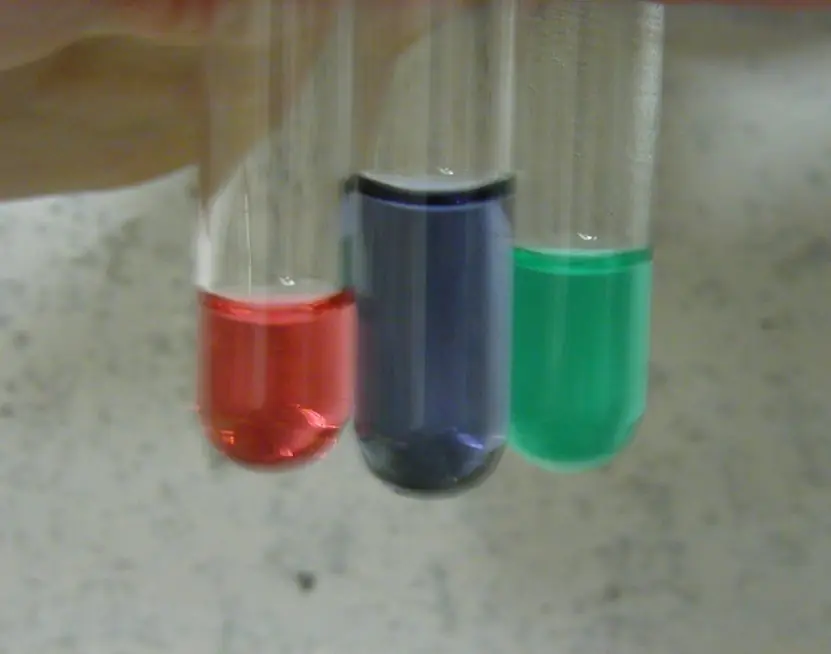
- Concentration. Adding a reactant (or removing a product) shifts the equilibrium to the right; adding a product shifts it to the left. Example: in Fe³⁺ + SCN⁻ ⇌ FeSCN²⁺ (red), adding more Fe³⁺ deepens the red colour.
- Pressure (for gases). Increasing the pressure shifts the equilibrium towards the side with fewer moles of gas. If \Delta n = 0 (H₂ + I₂ ⇌ 2HI) there is no effect.
- Temperature. Heating favours the endothermic direction and cooling favours the exothermic direction. Unlike the other changes, a change in temperature changes the value of K.
- Catalyst. It speeds up both reactions equally, so the equilibrium is reached sooner, but the position and K are unchanged.
- Inert gas at constant volume has no effect; at constant pressure it acts like a reduction in pressure.
| Change | Shift | Effect on K |
|---|---|---|
| Add reactant | Forward | None |
| Increase pressure | Towards fewer gas moles | None |
| Raise temperature (exothermic reaction) | Backward | K decreases |
| Catalyst | None | None |
Haber's process. \text{N}_2(g) + 3\text{H}_2(g) \rightleftharpoons 2\text{NH}_3(g), \Delta H = -92\ \text{kJ}. There are 4 moles of gas on the left and 2 on the right, and the forward reaction is exothermic.
- High pressure (200 atm): favours the side with fewer moles, so more NH₃.
- Low temperature would favour the product, but it makes the reaction too slow. A compromise of 450 °C is used.
- Catalyst: finely divided iron with promoters (Al₂O₃, K₂O) increases the rate.
- Removal of NH₃ by liquefaction keeps shifting the equilibrium to the right. The yield is about 15% per pass, and the unreacted gas is recycled.
Contact process. 2\text{SO}_2 + \text{O}_2 \rightleftharpoons 2\text{SO}_3, \Delta H = -197\ \text{kJ}: V₂O₅ catalyst, 450 °C, 1-2 atm (the yield is already about 98%).
Importance. Ammonia from Haber's process makes the urea and DAP fertilisers on which the farmers of Nepal depend; the principle helps industry to choose the conditions of the maximum yield at an economic cost.
Conclusion. Le Chatelier's principle predicts the direction of shift, which industries use to maximise the yield: high pressure and a moderate temperature with a catalyst for ammonia.
Practise more: Chemistry question bank