Unit 4 · General and Physical Chemistry · 5 teaching hours · 25 min read
Classification of elements and Periodic Table
What the syllabus asks for 4
- Modern periodic law and modern periodic table; classification into groups, periods and blocks
- IUPAC classification of elements
- Nuclear charge and effective nuclear charge
- Periodic trend and periodicity: atomic radii, ionic radii, ionization energy, electron affinity, electronegativity, metallic character
There are 118 known elements. Learning each one separately would be hopeless; learning the pattern they fall into takes an afternoon.
Arrange the elements in order of atomic number and their properties come back again and again at regular intervals.
This unit explains why the table has the shape it has, and how six properties — atomic radius, ionic radius, ionization energy, electron affinity, electronegativity and metallic character — change in a way you can predict.
Nearly every NEB question on this unit is one of three kinds: (i) place an element given its electronic configuration, (ii) compare two elements on a trend, (iii) explain an irregularity (Be above B, N above O, Cl above F).
Stating the trend earns half the marks. The reason — always effective nuclear charge, shell number or half-filled stability — earns the other half.
4.1 Modern periodic law and modern periodic table
Mendeleev (1869) arranged the elements by increasing atomic mass, but had to reverse some pairs to keep the chemistry right: Ar (39.9) before K (39.1), Co before Ni, Te before I. In 1913 Henry Moseley measured the frequency \nu of the characteristic X-rays emitted by different metals and found
where Z is the atomic number and a, b are constants. Atomic number, not atomic mass, is the fundamental property of an element, and every reversal disappears when the elements are ordered by Z.
The physical and chemical properties of the elements are periodic functions of their atomic numbers.
The long form (modern) periodic table has 7 horizontal periods and 18 vertical groups. A period number equals the principal quantum number n of the outermost shell being filled, so the number of elements in a period is fixed by how many orbitals that shell offers.
| Period | n | Subshells filled | No. of elements | Name |
|---|---|---|---|---|
| 1 | 1 | 1s | 2 | very short |
| 2 | 2 | 2s 2p | 8 | short |
| 3 | 3 | 3s 3p | 8 | short |
| 4 | 4 | 4s 3d 4p | 18 | long |
| 5 | 5 | 5s 4d 5p | 18 | long |
| 6 | 6 | 6s 4f 5d 6p | 32 | very long |
| 7 | 7 | 7s 5f 6d 7p | 32 | very long |
Elements in the same group have the same valence configuration, so they behave alike: all of group 1 reacts with water to give a hydroxide and hydrogen, all of group 17 forms an X⁻ ion.
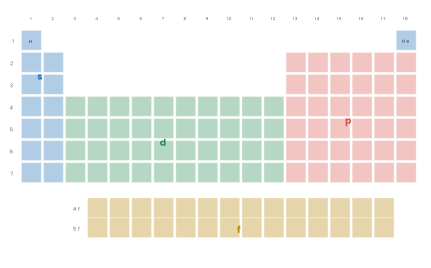
Depending on which subshell receives the last electron, an element belongs to one of four blocks.
| Block | Last electron enters | Outer configuration | Groups | Character |
|---|---|---|---|---|
| s | ns | ns¹⁻² | 1, 2 (and He) | soft, very reactive metals |
| p | np | ns² np¹⁻⁶ | 13–18 | metals, metalloids, non-metals |
| d | (n−1)d | (n−1)d¹⁻¹⁰ ns⁰⁻² | 3–12 | transition metals |
| f | (n−2)f | (n−2)f¹⁻¹⁴ (n−1)d⁰⁻¹ ns² | inside group 3 | inner transition |
4.2 IUPAC classification of elements
The old labels IA, IIA … IB, IIB were used differently in Europe and America, which caused confusion. In 1988 IUPAC replaced them: the groups are simply numbered 1 to 18 from left to right.
| IUPAC group | Old (CAS) | Family name | Valence configuration |
|---|---|---|---|
| 1 | IA | Alkali metals | ns¹ |
| 2 | IIA | Alkaline earth metals | ns² |
| 3–12 | IIIB–IIB | Transition elements | (n−1)d¹⁻¹⁰ns¹⁻² |
| 13 | IIIA | Boron family | ns²np¹ |
| 14 | IVA | Carbon family | ns²np² |
| 15 | VA | Nitrogen family | ns²np³ |
| 16 | VIA | Chalcogens | ns²np⁴ |
| 17 | VIIA | Halogens | ns²np⁵ |
| 18 | 0 | Noble gases | ns²np⁶ (He: 1s²) |
IUPAC also fixed the quarrel over who discovered the very heavy elements by giving a systematic name to every element with Z > 100.
Write the digits of the atomic number, replace each digit by its Latin/Greek root, join them in order, and add -ium. The symbol is the first letter of each root.
| 0 | 1 | 2 | 3 | 4 | 5 | 6 | 7 | 8 | 9 |
|---|---|---|---|---|---|---|---|---|---|
| nil | un | bi | tri | quad | pent | hex | sept | oct | enn |
| n | u | b | t | q | p | h | s | o | e |
Two spelling rules: bi + ium → bium and tri + ium → trium (one i is dropped), and enn + nil → ennil (one n is dropped).
Problem. Give the IUPAC systematic name and symbol for the elements with Z = 105, Z = 109 and Z = 113.
Solution.
Z = 105 \Rightarrow 1, 0, 5 → un + nil + pent + ium = Unnilpentium, symbol Unp.
Z = 109 \Rightarrow 1, 0, 9 → un + nil + enn + ium = Unnilennium, symbol Une.
Z = 113 \Rightarrow 1, 1, 3 → un + un + tri + ium; triium loses one i, giving Ununtrium, symbol Uut.
(These three are now officially dubnium Db, meitnerium Mt and nihonium Nh, but the systematic name is what NEB asks you to construct.)
4.3 Nuclear charge and effective nuclear charge
The nucleus carries a charge of +Ze. An outer electron, however, does not feel the full pull of +Ze, because the electrons between it and the nucleus push it outwards.
This partial cancellation is the screening or shielding effect, measured by the screening constant \sigma. What the electron actually feels is the effective nuclear charge:
Screening power depends on how close to the nucleus an orbital keeps its electron. Penetration falls in the order s > p > d > f, so the shielding power of the subshells also falls in the order s > p > d > f.
The effective nuclear charge is the net positive charge actually experienced by a particular electron in a multi-electron atom, after the shielding due to all the other electrons has been subtracted from the true nuclear charge.
\sigma can be estimated with Slater's rules. Write the configuration in the groups (1s)(2s,2p)(3s,3p)(3d)(4s,4p)… and, for an electron in an ns or np orbital, add up:
| Other electrons located in | Contribution to \sigma each |
|---|---|
| a group to the right (higher shells) | 0.00 |
| the same (ns, np) group | 0.35 (but 0.30 in 1s) |
| the shell just inside, n-1 | 0.85 |
| shell n-2 and deeper | 1.00 |
Problem. Calculate Z_{\text{eff}} felt by a 3s electron of sodium (Z = 11) and by a 3p electron of chlorine (Z = 17).
Solution. Sodium: (1s²)(2s²2p⁶)(3s¹). The 3s electron has no partner in its own group, eight electrons in the n-1 shell and two in the n-2 shell.
Chlorine: (1s²)(2s²2p⁶)(3s²3p⁵). The chosen 3p electron has six partners in the (3s,3p) group, eight electrons in shell 2 and two in shell 1.
Across period 3 the nuclear charge rises by 6 but the screening rises by only 2.10, so Z_{\text{eff}} almost triples. That single number explains every trend in the rest of this chapter.
| Period 3 element | Na | Mg | Al | Si | P | S | Cl |
|---|---|---|---|---|---|---|---|
| Z | 11 | 12 | 13 | 14 | 15 | 16 | 17 |
| Z_{\text{eff}} (Slater) | 2.20 | 2.85 | 3.50 | 4.15 | 4.80 | 5.45 | 6.10 |
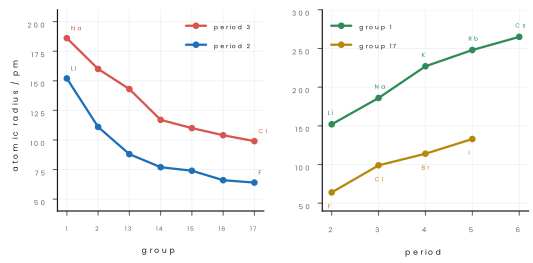
| Atomic radius / pm | 186 | 160 | 143 | 117 | 110 | 104 | 99 |
| IE₁ / kJ mol⁻¹ | 496 | 738 | 578 | 786 | 1012 | 1000 | 1251 |
Potassium (Z = 19) has a far bigger nuclear charge than lithium (Z = 3), yet its valence electron is held much more weakly.
The reason is that Z_{\text{eff}} for the outermost electron of every alkali metal is only about 2.2, while the electron sits in a shell of larger and larger n. Always compare Z_{\text{eff}} and n together, never Z alone.
4.4 Periodic trend and periodicity: atomic radii, ionic radii, ionization energy, electron affinity, electronegativity, metallic character
Periodicity is the repetition of similar properties after regular intervals in the periodic table. It happens because the outer-shell configuration repeats: every element in group 1 ends in ns¹, so every element in group 1 behaves alike.
Atomic radii
An atom has no sharp boundary, so radius is always defined operationally.
| Type | Defined as | Used for |
|---|---|---|
| Covalent radius | half the internuclear distance in X–X of a single bond | non-metals, e.g. Cl 99 pm |
| Metallic radius | half the internuclear distance of nearest atoms in the metal crystal | metals, e.g. Na 186 pm |
| van der Waals radius | half the distance of closest approach of two non-bonded atoms | noble gases, e.g. Ar 154 pm |
For the same element van der Waals radius > metallic radius > covalent radius.
Across a period the radius decreases: n stays the same while Z_{\text{eff}} rises, pulling the shell in. Down a group it increases: a whole new shell is added, which easily beats the rise in Z_{\text{eff}}.
Ionic radii
A cation is always smaller than its parent atom: Na (186 pm) → Na⁺ (95 pm), because the whole 3s shell is removed and the remaining 10 electrons are pulled in by 11 protons.
An anion is always larger: Cl (99 pm) → Cl⁻ (181 pm), because the added electron increases electron–electron repulsion while Z is unchanged.
For an isoelectronic series — ions with the same number of electrons — size falls as nuclear charge rises:
| Ion | N³⁻ | O²⁻ | F⁻ | Ne | Na⁺ | Mg²⁺ | Al³⁺ |
|---|---|---|---|---|---|---|---|
| Electrons | 10 | 10 | 10 | 10 | 10 | 10 | 10 |
| Protons | 7 | 8 | 9 | 10 | 11 | 12 | 13 |
| Radius / pm | 171 | 140 | 136 | — | 95 | 65 | 50 |
Problem. Arrange O²⁻, F⁻, Na⁺, Mg²⁺ in increasing order of ionic radius and justify your answer.
Solution. Each ion has 10 electrons, so the screening is identical. Only the nuclear charge differs: Mg²⁺ (12 p) > Na⁺ (11 p) > F⁻ (9 p) > O²⁻ (8 p).
The charge per electron is 12/10 = 1.20, 1.10, 0.90 and 0.80 respectively, so the pull on each electron weakens in that order and the ions swell:
Mg²⁺ (65) < Na⁺ (95) < F⁻ (136) < O²⁻ (171) pm.
Ionization energy
The first ionization energy (IE₁) is the minimum energy required to remove the most loosely bound electron from one mole of isolated gaseous atoms in their ground state: M(g) + IE₁ → M⁺(g) + e⁻. It is measured in kJ mol⁻¹ or eV atom⁻¹ (1 eV atom⁻¹ = 96.5 kJ mol⁻¹).
Successive values always increase, IE₁ < IE₂ < IE₃ …, because each electron is pulled from an ion of higher positive charge.
A very big jump marks the point at which a noble-gas core is broken: for sodium IE₁ = 496 but IE₂ = 4562 kJ mol⁻¹, which is why sodium forms Na⁺ and never Na²⁺.
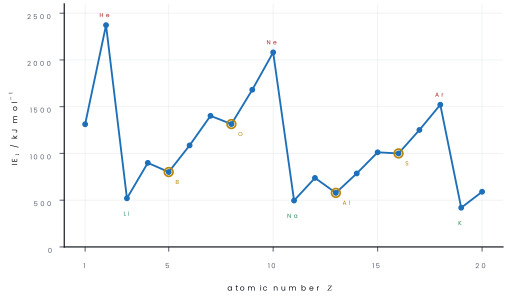
Ionization energy increases across a period (Z_{\text{eff}} up, size down) and decreases down a group (size up, shielding up).
Two irregularities are asked almost every year:
- Be (899) > B (801). Beryllium's electron leaves a filled 2s² orbital, while boron's leaves a 2p orbital that is higher in energy and well shielded by 2s².
- N (1402) > O (1314). Nitrogen is 2p³, a half-filled subshell with extra exchange stability and no paired electron. Oxygen is 2p⁴; the two electrons paired in one 2p orbital repel each other, so one is easier to pull off.
The same pair of reasons gives Mg > Al and P > S in period 3.
Electron affinity
Electron affinity is the energy released when an electron is added to one mole of isolated gaseous atoms in the ground state: X(g) + e⁻ → X⁻(g) + energy.
A large positive electron affinity means a strong pull for the extra electron (the corresponding enthalpy change ΔH is negative).
Second electron affinity is always endothermic, because the electron must be forced onto an already negative ion: O⁻(g) + e⁻ → O²⁻(g) needs about +780 kJ mol⁻¹.
Electron affinity rises across a period and falls down a group, but the first member of each group breaks the rule.
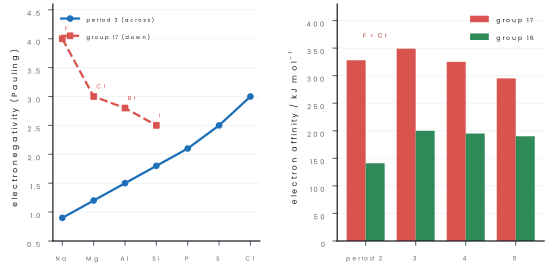
Fluorine (328) has a smaller electron affinity than chlorine (349), and oxygen (141) a smaller one than sulphur (200): in F and O the 2p subshell is so compact that the electrons already there repel the incoming one strongly.
Groups 2, 15 and 18 have near-zero or negative values because their subshells are filled or half-filled.
Electronegativity
Electronegativity is the tendency of an atom in a molecule to attract the shared pair of electrons towards itself. It is a relative, dimensionless number; on Pauling's scale fluorine, the most electronegative element, is 4.0 and caesium is 0.7.
It increases across a period and decreases down a group.
It is not the same as electron affinity: electron affinity belongs to an isolated atom and is an energy in kJ mol⁻¹, whereas electronegativity belongs to a bonded atom and has no units.
The electronegativity difference decides whether a bond is non-polar covalent, polar covalent or ionic (Unit 5).
Metallic character
Metallic (electropositive) character is the tendency to lose electrons. It runs opposite to ionization energy: it decreases across a period and increases down a group. The diagonal staircase B, Si, Ge, As, Sb, Te (the metalloids) marks the metal / non-metal boundary.
| Property | Across a period (left → right) | Down a group | Main reason |
|---|---|---|---|
| Atomic radius | decreases | increases | Z_{\text{eff}} vs new shell |
| Ionic radius | decreases (same charge) | increases | same |
| Ionization energy | increases | decreases | Z_{\text{eff}} vs size and shielding |
| Electron affinity | increases | decreases | Z_{\text{eff}} vs size |
| Electronegativity | increases | decreases | Z_{\text{eff}} vs size |
| Metallic character | decreases | increases | opposite of IE |
| Valency w.r.t. oxygen | 1 → 7 | constant | valence electrons |

Chapter summary
- Modern periodic law: properties are periodic functions of atomic number, established by Moseley's relation \sqrt{\nu} = a(Z-b).
- The long form has 7 periods (2, 8, 8, 18, 18, 32, 32 elements) and 18 IUPAC groups; blocks s, p, d, f are named after the subshell filled last.
- Elements with Z > 100 are named systematically from the roots nil, un, bi, tri, quad, pent, hex, sept, oct, enn plus -ium.
- Z_{\text{eff}} = Z - \sigma; screening power falls as s > p > d > f. Slater's rules give Z_{\text{eff}} = 2.20 for Na(3s) and 6.10 for Cl(3p).
- Across a period: radius ↓, IE ↑, EA ↑, EN ↑, metallic character ↓. Down a group: radius ↑, IE ↓, EA ↓, EN ↓, metallic character ↑.
- Cations are smaller and anions larger than the parent atom; in an isoelectronic series radius falls as the number of protons rises.
- Anomalies: Be > B and N > O (and Mg > Al, P > S) in ionization energy because of filled 2s and half-filled 2p stability; Cl > F and S > O in electron affinity because the second-period atoms are too compact.
Practice questions
Group A — Multiple choice (1 mark each)
- An element has the configuration [Ar] 3d¹⁰ 4s² 4p³. It belongs to [1]agroup 13, p-blockbgroup 15, p-blockcgroup 5, d-blockdgroup 15, d-block
- The correct order of ionic radii is [1]aAl³⁺ > Mg²⁺ > Na⁺ > F⁻bO²⁻ > F⁻ > Na⁺ > Mg²⁺cNa⁺ > F⁻ > O²⁻ > N³⁻dF⁻ > O²⁻ > N³⁻ > Na⁺
- The first ionization energy of nitrogen is greater than that of oxygen because [1]anitrogen has higher nuclear chargebnitrogen has a half-filled 2p subshellcoxygen is more electronegativedoxygen has a larger radius
- The IUPAC systematic name of the element with Z = 106 is [1]aUnnilhexiumbUnnilsextiumcUnunhexiumdUnhexium
- Using Slater's rules, the effective nuclear charge felt by the 3s electron of sodium is [1]a11.00b8.80c2.20d1.00
Answers to Group A
1. (b) — the last electron enters 4p, so p-block; 2 + 3 = 5 valence electrons gives group 15 (arsenic, Z = 33).
2. (b) — all are isoelectronic with 10 electrons, so radius falls as protons rise: 8 < 9 < 11 < 12.
3. (b) — 2p³ is half-filled and has no paired 2p electron, so it is extra stable.
4. (a) — 1, 0, 6 → un + nil + hex + ium.
5. (c) — \sigma = 8(0.85) + 2(1.00) = 8.80, so Z_{\text{eff}} = 11 - 8.80 = 2.20.
Group B — Short answer (5 marks each)
- State the modern periodic law. Explain, in terms of orbital filling, why the second period contains 8 elements while the fourth contains 18. [5]
- Define effective nuclear charge. Using Slater's rules calculate Z_{\text{eff}} for a 3p electron of phosphorus (Z=15) and of sulphur (Z=16), and comment on the result. [5]
- Define ionization energy. Why is the second ionization energy of sodium (4562 kJ mol⁻¹) nearly nine times the first (496 kJ mol⁻¹)? [5]
- Why is the electron affinity of fluorine smaller than that of chlorine even though fluorine is the more electronegative element? Distinguish clearly between electron affinity and electronegativity. [5]
- Arrange with reasons: (i) Li, Be, B, C in increasing atomic radius; (ii) N³⁻, O²⁻, F⁻, Na⁺ in decreasing ionic radius. [5]
Answers to Group B
1. Properties are periodic functions of atomic number. Period 2 fills 2s and 2p only: 1 + 3 = 4 orbitals × 2 electrons = 8 elements. Period 4 fills 4s, then 3d, then 4p: 1 + 5 + 3 = 9 orbitals × 2 = 18 elements.
2. Z_{\text{eff}} = Z - \sigma. Phosphorus (1s²)(2s²2p⁶)(3s²3p³): \sigma = 4(0.35)+8(0.85)+2(1.00) = 1.40+6.80+2.00 = 10.20, so Z_{\text{eff}} = 15-10.20 = 4.80.
Sulphur (3s²3p⁴): \sigma = 5(0.35)+6.80+2.00 = 10.55, so Z_{\text{eff}} = 16-10.55 = 5.45.
Adding one proton raises Z_{\text{eff}} by only 0.65 because the new electron screens 0.35 of it — this is why atoms shrink only gradually across a period.
3. IE₁ removes the 3s¹ electron from a neutral atom. IE₂ must break into the filled 2s²2p⁶ neon core of Na⁺, where the electron is in a lower shell, feels a much larger Z_{\text{eff}} and must be pulled away from a positive ion.
Hence the huge jump, and hence sodium's valency of 1.
4. Adding an electron to the very small fluorine atom forces it into a compact 2p subshell where inter-electronic repulsion is severe; chlorine's 3p subshell is larger, so more energy is released (F 328, Cl 349 kJ mol⁻¹).
Electron affinity is an energy (kJ mol⁻¹) belonging to an isolated gaseous atom; electronegativity is a dimensionless relative number describing a bonded atom's pull on a shared pair.
5. (i) C (77) < B (88) < Be (111) < Li (152) pm: across period 2, n is fixed but Z_{\text{eff}} rises, so the shell contracts. (ii) N³⁻ (171) > O²⁻ (140) > F⁻ (136) > Na⁺ (95) pm: isoelectronic, so radius falls as protons rise.
Group C — Long answer (8 marks each)
- (a) Classify the elements into s-, p-, d- and f-blocks, giving the general outer electronic configuration and one example of each. [4](b) Discuss the variation of atomic radius and first ionization energy along period 3, and explain the irregularities observed at aluminium and sulphur. [4]
- (a) Define ionization energy, electron affinity and electronegativity, and state how each varies across a period and down a group, with the reason. [5](b) An element X has atomic number 26. Write its ground-state electronic configuration and deduce its period, group and block. [3]
Answers to Group C
1.(b) Radius falls steadily 186 → 99 pm because Z_{\text{eff}} climbs from 2.20 to 6.10 while n = 3 throughout. IE₁ rises overall 496 → 1251 kJ mol⁻¹ but dips twice.
Al (578) < Mg (738): aluminium's electron comes from 3p, which is higher in energy and shielded by the filled 3s². S (1000) < P (1012): phosphorus is 3p³, half-filled and stable, whereas sulphur is 3p⁴ with one repelling pair.
2.(b) X is iron: 1s² 2s² 2p⁶ 3s² 3p⁶ 3d⁶ 4s². The outermost shell is n = 4, so the period is 4.
The last electron enters 3d, so it is a d-block element, and for groups 3–10 the group number = (number of d electrons) + (number of s electrons) = 6 + 2 = group 8. Common oxidation states +2 and +3.
Group D — Model answers for long questions (10 marks each, for deeper revision)
- State the modern periodic law. Discuss the periodic trends in atomic radius, ionisation energy, electron affinity and electronegativity across a period and down a group. [10]
- Describe the structure of the modern periodic table, its blocks, and the merits and demerits of Mendeleev's table compared with the modern table. [10]
Model answer D1: periodic trends (10 marks)
Introduction. The modern periodic law (Moseley, 1913) states that the physical and chemical properties of the elements are a periodic function of their atomic numbers. Properties repeat because the outer electron configurations repeat.
Two things control the trends: the effective nuclear charge Z_{eff} and the distance of the valence electrons from the nucleus.
1. Atomic radius.
- Across a period (left to right): decreases. The nuclear charge increases while the electrons enter the same shell, so Z_{eff} rises and pulls the shell closer. Na (186 pm) to Cl (99 pm).
- Down a group: increases. A new shell is added each time and the screening by inner electrons increases. Li (152 pm) to Cs (265 pm).
2. Ionisation energy (IE). The energy needed to remove the most loosely held electron from a gaseous atom: \text{M}(g) \rightarrow \text{M}^{+}(g) + e^{-}.
- Across a period: increases, since the radius falls and Z_{eff} rises.
- Down a group: decreases, as the outer electron is farther away and better shielded.
- Exceptions: Be (900 kJ/mol) is higher than B (801) since 2s is more stable than 2p; N (1402) is higher than O (1314) since the half-filled 2p³ is stable.
- IE₁ < IE₂ < IE₃, because it is harder to remove an electron from a positive ion. A big jump shows the removal of a core electron, which identifies the group of an element.
| Element | Na | Mg | Al | Si | P | S | Cl | Ar |
|---|---|---|---|---|---|---|---|---|
| IE₁ (kJ/mol) | 496 | 738 | 577 | 786 | 1012 | 1000 | 1251 | 1521 |
3. Electron affinity (EA). The energy released when a gaseous atom gains an electron.
- Across a period: becomes more negative (more energy released). The halogens have the highest.
- Down a group: decreases in general.
- Exception: chlorine (-349 kJ/mol) has a higher electron affinity than fluorine (-328), because the small 2p subshell of F suffers strong electron-electron repulsion.
- Noble gases and Be, N have values near zero or positive.
4. Electronegativity (EN). The ability of an atom in a bond to attract the shared electrons (Pauling scale, F = 4.0).
- Increases across a period and decreases down a group. F (4.0) > O (3.5) > N, Cl (3.0) > C (2.5) > H (2.1).
- Uses: predicting the polarity of a bond (the difference > 1.7 means mainly ionic) and the nature of oxides.
| Property | Across a period | Down a group |
|---|---|---|
| Atomic radius | Decreases | Increases |
| Ionisation energy | Increases | Decreases |
| Electron affinity | More negative | Less negative |
| Electronegativity | Increases | Decreases |
| Metallic character | Decreases | Increases |
| Acidic nature of oxides | Increases | Decreases |
Other trends. Ionic radius: a cation is smaller than its atom (Na⁺ 95 pm, Na 186 pm) and an anion is larger (Cl⁻ 181 pm, Cl 99 pm); in an isoelectronic series (N³⁻, O²⁻, F⁻, Na⁺, Mg²⁺, Al³⁺) the radius falls as the nuclear charge rises.
Conclusion. Periodic trends follow from the effective nuclear charge and the atomic size. They help to predict the reactivity, bond type and properties of the elements.
Model answer D2: structure of the modern periodic table and Mendeleev's table (10 marks)
Introduction. Early attempts to classify elements included Dobereiner's triads, Newlands' law of octaves and Lothar Meyer's curves. Mendeleev (1869) arranged the elements by increasing atomic mass, and Moseley (1913) showed that atomic number is the correct basis.
Structure of the modern table.
- 18 vertical groups and 7 horizontal periods. Period 1 has 2 elements, periods 2 and 3 have 8 each, periods 4 and 5 have 18 each, period 6 has 32 and period 7 is incomplete.
- Elements in a group have the same number of valence electrons and similar properties.
- The period number is the number of the outermost shell.
Blocks.
| Block | Groups | Last electron enters | General configuration | Nature |
|---|---|---|---|---|
| s | 1, 2 | s subshell | ns^{1-2} | Reactive metals (alkali, alkaline earth) |
| p | 13-18 | p subshell | ns^{2}np^{1-6} | Non-metals, metalloids, some metals, noble gases |
| d | 3-12 | d subshell | (n-1)d^{1-10}ns^{0-2} | Transition metals |
| f | Lanthanides, actinides | f subshell | (n-2)f^{1-14} | Inner transition metals |
Merits of Mendeleev's table. (1) It was the first useful and systematic classification; (2) it predicted undiscovered elements, such as eka-aluminium (gallium), eka-silicon (germanium) and eka-boron (scandium), with their properties; (3) it corrected the atomic masses of some elements; (4) it left gaps for new elements.
Demerits of Mendeleev's table.
- Position of hydrogen was unclear.
- Anomalous pairs such as Ar (39.9) before K (39.1), and Te before I, break the order of atomic mass.
- Isotopes have different atomic masses but one position, and no place was given to them.
- Chemically dissimilar elements were put in the same group (Cu and Na).
- The position of lanthanides and actinides was not explained.
Advantages of the modern table. It is based on atomic number, so the anomalous pairs are resolved; it is related to electron configuration, which explains the periodicity; it separates the s, p, d and f blocks; it has a place for the isotopes, and a separate row for the lanthanides and actinides.
| Feature | Mendeleev's table | Modern table |
|---|---|---|
| Basis | Atomic mass | Atomic number |
| Groups | 8 (with subgroups) | 18 |
| Anomalies | Ar-K, Te-I | Resolved |
| Isotopes | Problem | No problem |
| Explanation | Empirical | Electron configuration |
Conclusion. The modern periodic table links the position of an element to its electron configuration. It improved on Mendeleev's table, which was successful in predicting elements but had faults that were removed by the atomic number basis.
Practise more: Chemistry question bank