Unit 6 · General and Physical Chemistry · 5 teaching hours · 26 min read
Oxidation and Reduction
What the syllabus asks for 4
- General and electronic concept of oxidation and reduction
- Oxidation number and rules for assigning oxidation number
- Balancing redox reactions by oxidation number and ion-electron (half reaction) method
- Electrolysis: qualitative aspect; quantitative aspect (Faraday's laws of electrolysis)
Rusting iron, a burning candle, the battery in a torch, the dry cell in a phone, photosynthesis in a leaf and the refining of copper at Bhaktapur are all the same reaction type: electrons move from one species to another.
This unit gives you the bookkeeping — oxidation numbers — that turns that idea into a method, then applies it twice: to balancing equations that look impossible, and to electrolysis, where we pay for the electrons ourselves.
One idea (electrons move), one tool (oxidation number), two skills (balance a redox equation by two different methods, and calculate a mass from a current). Marks in the NEB paper come almost entirely from the two skills.
6.1 General and electronic concept of oxidation and reduction
The old, classical definitions came from the laboratory bench:
| Oxidation | Reduction | |
|---|---|---|
| Oxygen | addition of oxygen: 2Mg + O₂ → 2MgO | removal of oxygen: CuO + H₂ → Cu + H₂O |
| Hydrogen | removal of hydrogen: H₂S + Cl₂ → 2HCl + S | addition of hydrogen: N₂ + 3H₂ → 2NH₃ |
| Electronegative element | addition: Fe + S → FeS | removal: 2FeCl₃ + H₂ → 2FeCl₂ + 2HCl |
| Electropositive element | removal: 2KI + H₂O₂ → 2KOH + I₂ | addition: HgCl₂ + Hg → Hg₂Cl₂ |
These four rules agree with one another but cover only reactions that happen to contain oxygen or hydrogen. The electronic concept replaces all four:
Oxidation is the loss of electrons; reduction is the gain of electrons. Remember it as OIL RIG — Oxidation Is Loss, Reduction Is Gain.
The species that takes electrons is the oxidising agent (and is itself reduced); the species that gives them up is the reducing agent (and is itself oxidised).
Because electrons cannot float about free, the two processes always happen together, in exactly matching numbers — which is why the reaction is called a redox reaction.
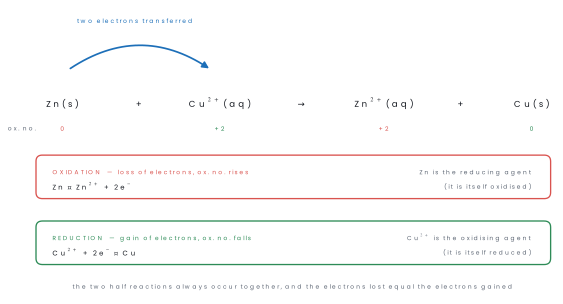
A species can even oxidise and reduce itself. In disproportionation the same element in a single substance is simultaneously oxidised and reduced:
Cl₂ + 2NaOH → NaCl + NaOCl + H₂O
Here chlorine goes from 0 to −1 (in NaCl) and from 0 to +1 (in NaOCl).
6.2 Oxidation number and rules for assigning oxidation number
The oxidation number (oxidation state) of an atom in a compound is the charge it would carry if every bond in the compound were assumed to be completely ionic, with each shared pair given entirely to the more electronegative atom.
It is a bookkeeping device, not a real charge — carbon in CH₄ is not really 4−. The rules, applied in this order, settle every case you will meet:
| # | Rule | Example |
|---|---|---|
| 1 | Every atom in a free element is 0 | Na, O₂, P₄, S₈, Cl₂ |
| 2 | A monatomic ion has the oxidation number of its charge | Na⁺ = +1, S²⁻ = −2, Al³⁺ = +3 |
| 3 | Group 1 metals are +1, group 2 metals +2, aluminium +3 | NaCl, CaO, AlCl₃ |
| 4 | Hydrogen is +1, except −1 in metal hydrides | HCl (+1) but NaH, CaH₂ (−1) |
| 5 | Oxygen is −2, except −1 in peroxides, −½ in superoxides, +2 in OF₂ | H₂O (−2), H₂O₂ (−1), KO₂ (−½) |
| 6 | Fluorine is always −1; other halogens are −1 except with oxygen or a more electronegative halogen | HCl (−1) but HClO₄ (+7) |
| 7 | The sum over a neutral molecule is 0 | H₂SO₄: 2(+1) + x + 4(−2) = 0 |
| 8 | The sum over a polyatomic ion equals the charge on the ion | Cr₂O₇²⁻: 2x + 7(−2) = −2 |
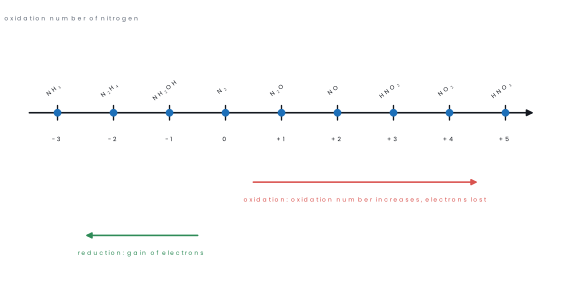
Oxidation number may be fractional, because it is an average over atoms that are not all equivalent.
Problem. Find the oxidation number of the bold atom in(a) Cr in K₂Cr₂O₇,(b) S in Na₂S₂O₃,(c) Fe in Fe₃O₄,(d) C in C₆H₁₂O₆.
Solution. (a) K is +1 and O is −2, and the molecule is neutral:
(b) 2(+1) + 2x + 3(-2) = 0 \Rightarrow 2x = +4 \Rightarrow x = +2.
(c) 3x + 4(-2) = 0 \Rightarrow x = +8/3. The fraction is real: Fe₃O₄ is FeO·Fe₂O₃, containing one Fe²⁺ and two Fe³⁺, and (2+3+3)/3 = 8/3.
(d) 6x + 12(+1) + 6(-2) = 0 \Rightarrow 6x = 0 \Rightarrow x = 0. Glucose is a reminder that an oxidation number of zero does not mean an uncombined element.
The valency of carbon is 4 in every one of CH₄, CH₃OH, HCHO, HCOOH and CO₂, but its oxidation number runs −4, −2, 0, +2, +4. Valency counts bonds and is never negative or fractional; oxidation number counts notional charge and can be both.
6.3 Balancing redox reactions by oxidation number and ion-electron methods
Oxidation number method — follow the atoms whose oxidation number changes:
- Assign oxidation numbers and find which atoms are oxidised and which reduced.
- Compute the total increase and the total decrease per formula unit.
- Multiply the two species by whatever factors make increase = decrease.
- Balance the remaining atoms by inspection: other elements first, then H, then O (add H₂O), checking charge at the end.
Ion-electron (half reaction) method — split the reaction into two ion equations:
- Write the skeletal ionic equation and split it into an oxidation half and a reduction half.
- Balance all atoms except H and O in each half.
- Balance O by adding H₂O, then H by adding H⁺.
- In basic medium only: add to both sides as many OH⁻ as there are H⁺, and combine H⁺ + OH⁻ into H₂O.
- Balance charge by adding electrons to the more positive side.
- Multiply the halves so the electrons cancel, then add them.
Problem. Balance Cu + HNO₃ → Cu(NO₃)₂ + NO + H₂O.
Solution. Oxidation numbers: Cu goes 0 → +2, an increase of 2. Nitrogen goes +5 in HNO₃ → +2 in NO, a decrease of 3. (The nitrogen in Cu(NO₃)₂ is still +5, so it is a spectator.)
To equalise, take 3 Cu (total increase 6) and 2 N reduced (total decrease 6):
3Cu + HNO₃ → 3Cu(NO₃)₂ + 2NO + H₂O
Nitrogen: 6 atoms are needed for the nitrate and 2 more are reduced, so 8 HNO₃:
3Cu + 8HNO₃ → 3Cu(NO₃)₂ + 2NO + 4H₂O
Check. Cu 3 = 3; N 8 = 6 + 2; H 8 = 8; O 24 = 18 + 2 + 4. Charge is 0 on both sides. Balanced.
Problem. Balance, in acidic medium, Cr₂O₇²⁻ + I⁻ → Cr³⁺ + I₂ by(a) the oxidation number method and(b) the ion-electron method.
(a) Oxidation number method. Cr is +6 in Cr₂O₇²⁻ and +3 in Cr³⁺: a decrease of 3 per Cr, so 6 per dichromate ion. Iodine goes −1 → 0: an increase of 1 per atom, so 2 per I₂. Equalising, one Cr₂O₇²⁻ needs 3 I₂, i.e. 6 I⁻:
Cr₂O₇²⁻ + 6I⁻ → 2Cr³⁺ + 3I₂
Balance the 7 oxygens with 7 H₂O on the right and therefore 14 H⁺ on the left:
Cr₂O₇²⁻ + 6I⁻ + 14H⁺ → 2Cr³⁺ + 3I₂ + 7H₂O
(b) Ion-electron method. Reduction half — balance Cr, then O with water, then H with H⁺, then charge with electrons:
Cr₂O₇²⁻ + 14H⁺ + 6e⁻ → 2Cr³⁺ + 7H₂O (charge: −2 + 14 − 6 = +6 = 2 × +3)
Oxidation half:
2I⁻ → I₂ + 2e⁻ (charge: −2 = −2)
Multiply the oxidation half by 3 so that 6 electrons cancel, then add:
Cr₂O₇²⁻ + 6I⁻ + 14H⁺ → 2Cr³⁺ + 3I₂ + 7H₂O
Check. Cr 2 = 2; I 6 = 6; H 14 = 14; O 7 = 7. Charge: (−2) + (−6) + (+14) = +6 on the left and 2(+3) = +6 on the right. Both methods agree.
Problem. Balance MnO₄⁻ + I⁻ → MnO₂ + I₂ in alkaline solution.
Solution. Reduction half, first in acid:
MnO₄⁻ + 4H⁺ + 3e⁻ → MnO₂ + 2H₂O
Add 4 OH⁻ to each side to remove the H⁺, since the medium is basic:
MnO₄⁻ + 4H₂O + 3e⁻ → MnO₂ + 2H₂O + 4OH⁻, i.e. MnO₄⁻ + 2H₂O + 3e⁻ → MnO₂ + 4OH⁻
Charge: −1 − 3 = −4 on the left and −4 on the right. Oxidation half: 2I⁻ → I₂ + 2e⁻. The LCM of 3 and 2 is 6, so multiply the halves by 2 and 3:
2MnO₄⁻ + 4H₂O + 6e⁻ → 2MnO₂ + 8OH⁻ 6I⁻ → 3I₂ + 6e⁻
Adding,
2MnO₄⁻ + 6I⁻ + 4H₂O → 2MnO₂ + 3I₂ + 8OH⁻
Check. Mn 2 = 2; I 6 = 6; H 8 = 8; O (8 + 4) = 12 = (4 + 8). Charge: (−2) + (−6) = −8 on the left, 8(−1) = −8 on the right. Balanced.
Always finish with the charge check, not just the atom check — an equation can have every atom balanced and still be wrong. And in the ion-electron method, never add H⁺ to an alkaline solution and leave it there: neutralise it with OH⁻ in step 4.
6.4 Electrolysis: qualitative and quantitative aspects
Qualitative aspect
The decomposition of an electrolyte, in the molten state or in aqueous solution, by the passage of direct current through it.
An electrolyte conducts by the movement of ions.
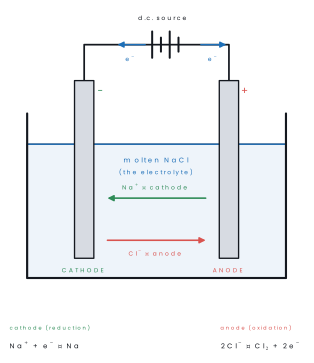
The electrode joined to the positive terminal is the anode, where anions give up electrons and are oxidised; the electrode joined to the negative terminal is the cathode, where cations accept electrons and are reduced.
(In electrolysis the cathode is negative — the opposite of a galvanic cell.)
When more than one kind of ion is present, the one discharged is the one needing the least energy — the rule of preferential discharge:
| Discharged with most difficulty → most easily | |
|---|---|
| Cations | K⁺ < Na⁺ < Ca²⁺ < Mg²⁺ < Al³⁺ < Zn²⁺ < Fe²⁺ < H⁺ < Cu²⁺ < Ag⁺ |
| Anions | SO₄²⁻ < NO₃⁻ < OH⁻ < Cl⁻ < Br⁻ < I⁻ |
This explains three standard cases:
- Molten NaCl: Na at the cathode, Cl₂ at the anode (the Down's process).
- Aqueous NaCl: H⁺ from water beats Na⁺, so H₂ is released at the cathode while Cl₂ comes off at the anode and NaOH is left in solution — the chlor-alkali industry.
- Aqueous CuSO₄ with platinum electrodes: Cu at the cathode, O₂ at the anode (since SO₄²⁻ is very hard to discharge).
Electrolysis is used for electroplating, the electrorefining of copper, the extraction of reactive metals (Na, Mg, Al by the Hall–Héroult process) and the manufacture of NaOH, Cl₂ and H₂.
Quantitative aspect — Faraday's laws
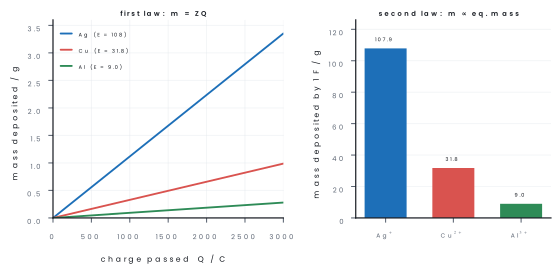
First law. The mass of a substance deposited or liberated at an electrode is directly proportional to the quantity of electricity passed:
where Z is the electrochemical equivalent — the mass deposited by one coulomb.
Second law. When the same quantity of electricity is passed through different electrolytes, the masses deposited are proportional to their chemical equivalent masses E:
One faraday, 1\,F = 96500 C, is the charge on one mole of electrons (N_A e = 6.022\times10^{23} \times 1.602\times10^{-19} C), and it deposits exactly one equivalent of any substance. Combining the two laws,
Problem. A current of 1.5 A is passed for 30 minutes through solutions of AgNO₃ and CuSO₄ connected in series. Calculate the mass of silver and of copper deposited. (Ag = 108, Cu = 63.5, 1 F = 96500 C)
Solution. The same charge passes through both cells:
For silver, Ag⁺ + e⁻ → Ag, so the valency is 1 and E = 108/1 = 108:
For copper, Cu²⁺ + 2e⁻ → Cu, so E = 63.5/2 = 31.75:
Check with the second law: m_{Ag}/m_{Cu} = 3.02/0.888 = 3.40, and E_{Ag}/E_{Cu} = 108/31.75 = 3.40. The two agree.

Chapter summary
- Classically, oxidation is addition of oxygen or removal of hydrogen; electronically it is loss of electrons (OIL RIG). Reduction is the reverse, and the two always occur together.
- The oxidising agent gains electrons and is reduced; the reducing agent loses electrons and is oxidised. In disproportionation one element does both.
- Oxidation number is the charge an atom would have if all bonds were ionic. Key rules: free element 0; H = +1 (−1 in hydrides); O = −2 (−1 in peroxides); the sum equals 0 for a molecule and the charge for an ion.
- Oxidation number can be fractional (Fe₃O₄ = +8/3, Na₂S₄O₆ = +2.5) because it is an average; valency never can.
- Oxidation number method: equalise total increase with total decrease, then balance the rest by inspection.
- Ion-electron method: split into halves, balance O with H₂O and H with H⁺ (converting to OH⁻ in base), balance charge with electrons, cross-multiply and add.
- Always verify both mass and charge.
- In electrolysis the anode is positive and oxidises anions; the cathode is negative and reduces cations. Preferential discharge decides which ion reacts.
- Faraday: m = Zit = Eit/96500; one faraday (96500 C) is one mole of electrons and deposits one equivalent of any substance.
Practice questions
Group A — Multiple choice (1 mark each)
- The oxidation number of chromium in K₂Cr₂O₇ is [1]a+2b+3c+6d+7
- In the reaction Zn + CuSO₄ → ZnSO₄ + Cu, the oxidising agent is [1]aZnbCu²⁺cSO₄²⁻dZnSO₄
- The oxidation number of oxygen in hydrogen peroxide is [1]a−2b−1c0d+2
- One faraday of electricity is equal to [1]a965 Cb9650 Cc96500 Cd1 C
- During the electrolysis of molten NaCl, chlorine is liberated at the anode because [1]aCl⁻ is reduced therebCl⁻ is oxidised therecNa⁺ migrates theredthe anode is negative
Answers to Group A
1. (c) — 2(+1) + 2x + 7(-2) = 0 gives x = +6.
2. (b) — Cu²⁺ gains the two electrons lost by zinc, so it is reduced and is therefore the oxidising agent.
3. (b) — H₂O₂ is a peroxide; with H at +1, 2(+1) + 2x = 0 gives x = -1.
4. (c) — 96500 C, the charge carried by one mole of electrons.
5. (b) — the anode is positive, so it attracts anions and removes electrons from them: 2Cl⁻ → Cl₂ + 2e⁻.
Group B — Short answer (5 marks each)
- Define oxidation and reduction in terms of electron transfer. Identify the oxidising and reducing agent in (i) 2Na + Cl₂ → 2NaCl and (ii) MnO₂ + 4HCl → MnCl₂ + Cl₂ + 2H₂O. [5]
- Find the oxidation number of the named atom: S in H₂SO₄, S in Na₂S₂O₃, Cl in HClO₄, Fe in Fe₃O₄ and S in S₈. [5]
- Balance by the oxidation number method: MnO₂ + HCl → MnCl₂ + Cl₂ + H₂O. [5]
- Balance by the ion-electron method in acidic medium: MnO₄⁻ + C₂O₄²⁻ → Mn²⁺ + CO₂. [5]
- State Faraday's two laws of electrolysis. A current of 2 A is passed through copper sulphate solution for 965 s. Calculate the mass of copper deposited (Cu = 63.5). [5]
Answers to Group B
1. Oxidation is loss of electrons, reduction is gain. (i) Na → Na⁺ + e⁻, so sodium is oxidised and is the reducing agent; Cl₂ + 2e⁻ → 2Cl⁻, so chlorine is reduced and is the oxidising agent.
(ii) Mn falls from +4 to +2, so MnO₂ is the oxidising agent; Cl rises from −1 to 0, so HCl is the reducing agent (only two of the four HCl are oxidised, the rest form MnCl₂).
2. H₂SO₄: 2 + x - 8 = 0, x = +6. Na₂S₂O₃: 2 + 2x - 6 = 0, x = +2. HClO₄: 1 + x - 8 = 0, x = +7. Fe₃O₄: 3x - 8 = 0, x = +8/3. S₈: a free element, so x = 0.
3. Mn: +4 → +2, a decrease of 2. Cl: −1 → 0, an increase of 1 per atom, i.e. 2 per Cl₂. One MnO₂ therefore oxidises 2 Cl⁻; two more Cl are needed for MnCl₂, so 4 HCl in all, and the 4 H with the 2 O give 2 H₂O:
MnO₂ + 4HCl → MnCl₂ + Cl₂ + 2H₂O
(Mn 1 = 1, Cl 4 = 2 + 2, H 4 = 4, O 2 = 2; charge 0 = 0.)
4. Halves: MnO₄⁻ + 8H⁺ + 5e⁻ → Mn²⁺ + 4H₂O and C₂O₄²⁻ → 2CO₂ + 2e⁻. Multiplying by 2 and 5 to cancel 10 electrons:
2MnO₄⁻ + 5C₂O₄²⁻ + 16H⁺ → 2Mn²⁺ + 10CO₂ + 8H₂O
Charge: (−2) + (−10) + (+16) = +4 on the left and 2(+2) = +4 on the right.
5. Q = it = 2 \times 965 = 1930 C; E = 63.5/2 = 31.75; m = 31.75 \times 1930 / 96500 = 0.635 g.
Group C — Long answer (8 marks each)
- (a) State the rules for assigning oxidation numbers and use them to find the oxidation number of Mn in KMnO₄, Cr in Cr₂O₇²⁻ and S in Na₂S₄O₆. [4](b) Balance by the ion-electron method in basic medium: MnO₄⁻ + I⁻ → MnO₂ + I₂. [4]
- (a) Describe the electrolysis of molten sodium chloride, writing the reaction at each electrode, and state the rule of preferential discharge. [3](b) State Faraday's two laws. The same current of 1.5 A is passed for 30 minutes through AgNO₃ and CuSO₄ solutions connected in series. Calculate the mass of silver and of copper deposited. [5]
Answers to Group C
1.(a) KMnO₄: 1 + x - 8 = 0, so Mn is +7. Cr₂O₇²⁻: 2x - 14 = -2, so Cr is +6. Na₂S₄O₆: 2 + 4x - 12 = 0, so 4x = 10 and S is +2.5, an average over four non-equivalent sulphur atoms.
1.(b) MnO₄⁻ + 2H₂O + 3e⁻ → MnO₂ + 4OH⁻ and 2I⁻ → I₂ + 2e⁻. Multiplying by 2 and 3 to cancel 6 electrons gives
2MnO₄⁻ + 6I⁻ + 4H₂O → 2MnO₂ + 3I₂ + 8OH⁻
with charge −8 on both sides and O 12 = 12.
2.(b) Q = 1.5 \times 1800 = 2700 C. Silver: E = 108, so m = 108 \times 2700/96500 = 3.02 g. Copper: E = 63.5/2 = 31.75, so m = 31.75 \times 2700/96500 = 0.888 g. The ratio 3.40 equals E_{Ag}/E_{Cu}, as the second law requires.
Group D — Model answers for long questions (10 marks each, for deeper revision)
- Balance the redox reaction between permanganate and ferrous ion in acid medium by the ion-electron method and by the oxidation number method. Explain the rules for oxidation numbers. [10]
- State Faraday's laws of electrolysis and solve numericals on copper and aluminium. [10]
- Describe the electrolysis of molten sodium chloride and of aqueous brine, and give eight applications of electrolysis. [10]
Model answer D1: balancing redox reactions (10 marks)
Introduction. In a redox reaction one species is oxidised (loses electrons, oxidation number increases) and another is reduced (gains electrons, oxidation number decreases). OIL RIG: Oxidation Is Loss, Reduction Is Gain.
The oxidising agent is reduced and the reducing agent is oxidised.
Rules for oxidation numbers.
- The oxidation number of an atom in an element is zero (Na, O₂, S₈).
- For a monatomic ion it equals the charge (Na⁺ = +1, Cl⁻ = -1).
- The sum of the oxidation numbers in a neutral compound is zero, and in a polyatomic ion equals the ion's charge.
- Group 1 metals are +1; group 2 are +2; fluorine is always -1.
- Hydrogen is +1 (except -1 in metal hydrides) and oxygen is -2 (except -1 in peroxides and +2 in OF₂). Example: in KMnO₄, +1 + x + 4(-2) = 0, so Mn is +7; in Cr₂O₇²⁻, 2x - 14 = -2, so Cr is +6.
Problem. \text{MnO}_4^{-} + \text{Fe}^{2+} \rightarrow \text{Mn}^{2+} + \text{Fe}^{3+} in acid solution.
A. Ion-electron (half-reaction) method.
- Oxidation half: \text{Fe}^{2+} \rightarrow \text{Fe}^{3+} + e^{-}.
- Reduction half: \text{MnO}_4^{-} \rightarrow \text{Mn}^{2+}. Balance O with 4 H₂O on the right: \text{MnO}_4^{-} \rightarrow \text{Mn}^{2+} + 4\text{H}_2\text{O}. Balance H with 8 H⁺ on the left: \text{MnO}_4^{-} + 8\text{H}^{+} \rightarrow \text{Mn}^{2+} + 4\text{H}_2\text{O}. Balance charge with 5 electrons: \text{MnO}_4^{-} + 8\text{H}^{+} + 5e^{-} \rightarrow \text{Mn}^{2+} + 4\text{H}_2\text{O}.
- Equalise the electrons: multiply the oxidation half by 5 and add.
- Final equation:
Check: charge on the left is -1 + 10 + 8 = +17, and on the right +2 + 15 = +17. ✓ Atoms of O and H also balance.
B. Oxidation number method.
- Mn changes from +7 to +2: a decrease of 5. Fe changes from +2 to +3: an increase of 1.
- Equalise: 1 Mn needs 5 Fe, so the ratio is \text{MnO}_4^{-} : \text{Fe}^{2+} = 1 : 5.
- Balance the O with H₂O and the H with H⁺ (acidic medium), giving the same final equation.
| Step | Ion-electron method | Oxidation number method |
|---|---|---|
| Basis | Half-reactions and electrons | Change in oxidation number |
| Needs | Medium (acid or base) | Medium for H₂O and H⁺ |
| Best for | Ionic reactions | Molecular equations |
Medium effect. In alkaline solution, balance H by adding H₂O and OH⁻ instead. Permanganate changes to MnO₂ (neutral) or MnO₄²⁻ (strongly basic), not Mn²⁺.
Application. This reaction is the basis of permanganate titration: the purple colour of MnO₄⁻ disappears until the end point, when one drop gives a permanent pink colour (self-indicator).
Conclusion. A redox equation is balanced when the electrons lost equal the electrons gained. Both methods give the same equation: \text{MnO}_4^{-} + 5\text{Fe}^{2+} + 8\text{H}^{+} \rightarrow \text{Mn}^{2+} + 5\text{Fe}^{3+} + 4\text{H}_2\text{O}.
Model answer D2: Faraday's laws of electrolysis (10 marks)
Introduction. Electrolysis is the chemical decomposition of an electrolyte by the passage of electric current. Michael Faraday (1833) found the quantitative relations between the electricity passed and the substance deposited.
Faraday's first law. The mass of a substance deposited or liberated at an electrode is directly proportional to the quantity of electricity passed.
where Z is the electrochemical equivalent (mass deposited by 1 coulomb) in g C⁻¹.
Faraday's second law. When the same quantity of electricity passes through different electrolytes in series, the masses of substances deposited are proportional to their equivalent masses.
Faraday constant. One mole of electrons carries F = 96500\ \text{C} (96485 C). Combining the laws for an ion of charge z and molar mass M:
| Ion | Electrode reaction | Charge to deposit 1 mol |
|---|---|---|
| Na⁺ | \text{Na}^{+} + e^{-} \rightarrow \text{Na} | 1 F = 96500 C |
| Cu²⁺ | \text{Cu}^{2+} + 2e^{-} \rightarrow \text{Cu} | 2 F = 193000 C |
| Al³⁺ | \text{Al}^{3+} + 3e^{-} \rightarrow \text{Al} | 3 F = 289500 C |
Numerical 1 (copper). A current of 2\ \text{A} passes through copper sulphate solution for 30 minutes (Cu = 63.5). Q = 2\times1800 = 3600\ \text{C}, and m = \dfrac{63.5}{2\times96500}\times3600 = \mathbf{1.18\ g}.
Numerical 2 (aluminium). How long must a current of 10\ \text{A} flow to obtain 9 g of Al (Al = 27) from molten alumina? Moles of Al = 9/27 = 1/3 mol; electrons needed = 3 × 1/3 = 1 mol = 96500 C. Time = 96500/10 = 9650\ \text{s} = \mathbf{2.68\ hours}.
Numerical 3 (second law). The same current passes through silver nitrate and copper sulphate in series, depositing 1.08 g of Ag (Ag = 108).
Moles of Ag = 0.01, so 0.01 mol e⁻ passed, and Cu deposited = 0.005 mol × 63.5 = 0.318 g, which agrees with the ratio of the equivalent masses 108 : 31.75.
Limitations. In practice the current efficiency is below 100% because of side reactions, so the actual mass is less than the theoretical value.
Conclusion. One faraday of charge (96500 C) deposits one equivalent of any substance. The relation m = MIt/zF is used for electroplating and metal refining.
Model answer D3: electrolysis of molten NaCl, brine and its applications (10 marks)
Introduction. In electrolysis, positive ions (cations) go to the cathode (reduction) and negative ions (anions) to the anode (oxidation). The products depend on whether the electrolyte is molten or aqueous.
1. Molten sodium chloride (Downs cell). Only Na⁺ and Cl⁻ are present.
- Cathode: \text{Na}^{+} + e^{-} \rightarrow \text{Na} (molten sodium).
- Anode: 2\text{Cl}^{-} \rightarrow \text{Cl}_2 + 2e^{-} (chlorine gas).
- Overall: 2\text{NaCl} \rightarrow 2\text{Na} + \text{Cl}_2. Calcium chloride is added to lower the melting point from 801 °C to about 600 °C.
2. Aqueous sodium chloride (brine). Ions present: Na⁺, Cl⁻, H⁺ and OH⁻ (from water).
- Cathode: water is more easily reduced than Na⁺, so 2\text{H}_2\text{O} + 2e^{-} \rightarrow \text{H}_2 + 2\text{OH}^{-}.
- Anode: Cl⁻ is oxidised (at high concentration) to give 2\text{Cl}^{-} \rightarrow \text{Cl}_2 + 2e^{-}.
- Solution left: NaOH.
- Overall: 2\text{NaCl} + 2\text{H}_2\text{O} \rightarrow 2\text{NaOH} + \text{H}_2 + \text{Cl}_2 (the chlor-alkali process).
| Feature | Molten NaCl | Aqueous NaCl |
|---|---|---|
| Cathode product | Sodium metal | Hydrogen gas |
| Anode product | Chlorine | Chlorine |
| Other product | None | NaOH solution |
| Reason | Only Na⁺ and Cl⁻ | Water competes |
Factors deciding the product. The standard electrode potential (a species with a higher reduction potential is reduced first), the concentration of ions and the nature of the electrode (an active copper anode dissolves instead).
Eight applications of electrolysis.
- Electroplating: a thin layer of silver, gold, nickel or chromium is applied to utensils, jewellery and bicycle parts.
- Extraction of reactive metals: sodium, potassium, magnesium and calcium from their molten salts, and aluminium (Hall-Héroult process) from alumina in cryolite.
- Refining of metals: impure copper is the anode and pure copper the cathode in copper sulphate, giving 99.99% pure copper for electric wires.
- Chlor-alkali industry: NaOH, Cl₂ and H₂, used in soap, paper and water treatment.
- Production of hydrogen by the electrolysis of water, a clean fuel.
- Anodising of aluminium to form a hard, protective oxide layer.
- Manufacture of chemicals such as sodium chlorate, fluorine and hydrogen peroxide.
- Electrotyping and purifying water, and in batteries (charging a lead-acid battery is electrolysis in reverse).
Conclusion. The products of electrolysis depend on the electrolyte and on the competing ions. Molten NaCl gives sodium and chlorine, brine gives hydrogen, chlorine and NaOH, and electrolysis is essential to metallurgy and chemical industry.
Practise more: Chemistry question bank