Unit 3 · General and Physical Chemistry · 8 teaching hours · 27 min read
Atomic Structure
What the syllabus asks for 11
- Rutherford's atomic model and its limitations
- Postulates of Bohr's atomic model and its application
- Spectrum of hydrogen atom
- Defects of Bohr's theory
- Elementary idea of quantum mechanical model: de Broglie's wave equation
- Heisenberg's Uncertainty Principle
- Concept of probability
- Quantum Numbers
- Orbitals and shape of s and p orbitals only
- Aufbau Principle; Pauli's exclusion principle; Hund's rule
- Electronic configurations of atoms and ions (up to atomic number 30)
This unit follows one long argument. Rutherford showed the atom has a tiny positive nucleus but could not say where the electrons are.
Bohr placed them in fixed orbits and successfully predicted the hydrogen spectrum — then failed for every other atom.
De Broglie and Heisenberg showed why: an electron is not a particle on a track, and the best we can state is a probability.
What survives is the quantum mechanical model, four quantum numbers and the three filling rules you will use in every later unit.
Write the electronic configuration of any atom or ion up to Z = 30 without hesitating; quote Bohr's postulates and the three filling rules; and handle the four standard numericals — Bohr radius and energy, the Rydberg equation, \lambda = h/mv, and \Delta x\,\Delta p \geq h/4\pi.
3.1 Rutherford's atomic model and its limitations
In 1909 Geiger and Marsden, working under Rutherford, fired a narrow beam of α-particles (He²⁺, mass 4 u, charge +2) at a gold foil about 0.00004 cm thick and recorded the flashes on a movable zinc sulphide screen. Rutherford explained their results in 1911.
| Observation | Conclusion |
|---|---|
| Most α-particles passed straight through | The atom is mostly empty space |
| A small fraction were deflected by small angles | There is a concentrated positive charge that repels them |
| Roughly 1 in 8,000 was turned through more than 90° | All the positive charge and almost all the mass is packed into a very small nucleus |
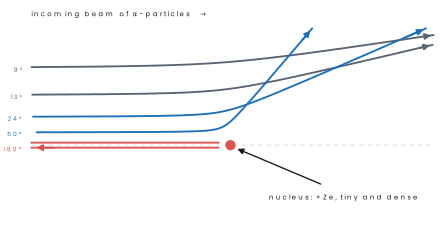
The model. The atom has a small, dense, positively charged nucleus containing practically the whole mass; electrons revolve around it at relatively large distances, and the centripetal force is supplied by electrostatic attraction.
The nuclear radius is of the order of 10⁻¹⁵ m against an atomic radius of 10⁻¹⁰ m — the nucleus is about 10⁵ times smaller than the atom.
Limitations.
- It predicts an unstable atom. By Maxwell's electromagnetic theory a charged body moving in a circle is accelerating, so it must radiate energy continuously. The electron would spiral into the nucleus in about 10⁻⁸ s. Matter would not exist.
- It predicts the wrong spectrum. A continuously spiralling electron would emit a continuous spectrum, whereas atoms give sharp line spectra.
- It says nothing about the arrangement of electrons — no shells, no energies, so it cannot explain chemical behaviour or valency.
3.2 Postulates of Bohr's atomic model and its application
Niels Bohr (1913) kept the nuclear atom and added quantisation.
- Electrons revolve round the nucleus only in certain permitted circular paths called stationary states or energy levels, in which they do not radiate energy.
- Only those orbits are allowed for which the angular momentum is an integral multiple of h/2\pi:
- Energy is emitted or absorbed only when an electron jumps from one stationary state to another, in a packet of size
- The electrostatic attraction between nucleus and electron provides the centripetal force needed for the circular motion.
For a one-electron species of nuclear charge +Ze, balancing the Coulomb force against the centripetal force,
with k = 1/4\pi\varepsilon_0. From the quantisation condition v = nh/2\pi mr; substituting and solving for r,
The total energy is kinetic plus potential, E = \frac{1}{2}mv^{2} - kZe^{2}/r = -\frac{1}{2}kZe^{2}/r. Putting in r_n,
The energy is negative because the electron is bound; zero energy corresponds to a free electron at infinity. The orbital speed works out as v_n = 2.188\times10^{6}\,(Z/n)\ \text{m s}^{-1}.
Problem. Calculate the radius and the energy of the third Bohr orbit of the hydrogen atom. How much energy is needed to remove the electron completely from the ground state?
Solution. For hydrogen Z = 1.
Ionisation from the ground state means n = 1 \rightarrow n = \infty:
Per mole this is 2.18\times10^{-18}\times6.022\times10^{23} = 1.31\times10^{6}\ \text{J} = 1312\ \text{kJ mol}^{-1}.
3.3 Spectrum of hydrogen atom
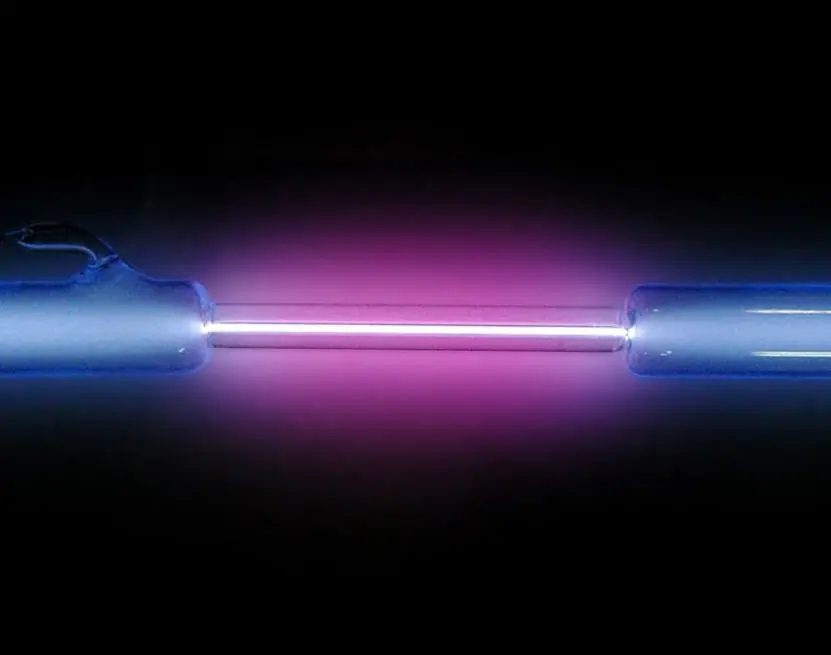
When hydrogen gas at low pressure is excited in a discharge tube and the light is passed through a prism, the result is not a continuous rainbow but a set of sharp coloured lines on a dark background — an emission line spectrum.
The wavenumber of every line fits one empirical equation:
where R_H = 1.097\times10^{7}\ \text{m}^{-1} is the Rydberg constant. Bohr's model derives this equation: putting \Delta E = h c/\lambda with E_n = -13.6/n^2 eV reproduces R_H to three figures. That was its triumph.
| Series | n_1 | n_2 | Region |
|---|---|---|---|
| Lyman | 1 | 2, 3, 4 … | Ultraviolet |
| Balmer | 2 | 3, 4, 5 … | Visible |
| Paschen | 3 | 4, 5, 6 … | Infrared |
| Brackett | 4 | 5, 6, 7 … | Infrared |
| Pfund | 5 | 6, 7, 8 … | Far infrared |
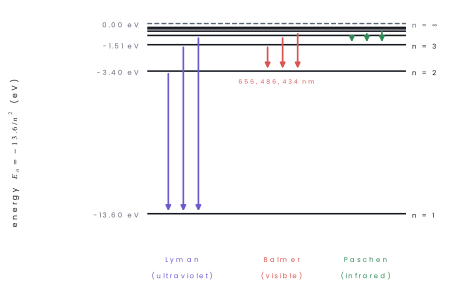
Problem. Calculate the wavelength of the radiation emitted when the electron in a hydrogen atom falls from n = 4 to n = 2. To which series does it belong and what colour is it? (R_H = 1.097\times10^{7}\ \text{m}^{-1})
Solution.
Since n_1 = 2 it is the second line of the Balmer series (Hβ), in the blue-green part of the visible spectrum.
3.4 Defects of Bohr's theory
| Defect | What Bohr could not explain |
|---|---|
| Multi-electron atoms | The theory works only for one-electron species (H, He⁺, Li²⁺); it fails even for helium |
| Fine structure | Under a high-resolution spectroscope each line is really several closely spaced lines |
| Zeeman effect | Splitting of spectral lines in a magnetic field |
| Stark effect | Splitting of spectral lines in an electric field |
| Wave nature | It treats the electron purely as a particle, ignoring de Broglie's wave character |
| Uncertainty principle | Fixing both the radius of an orbit and the momentum in it is forbidden by Heisenberg |
| Shape of orbits | It assumes circular orbits only; Sommerfeld had to add elliptical ones |
| Bonding | It cannot explain the shapes of molecules or how chemical bonds form |
The two fundamental objections are the wave nature of the electron and the uncertainty principle: they do not merely say Bohr got details wrong, they say the idea of a definite orbit is meaningless. Quote these two first; the rest are experimental failures.
3.5 Elementary idea of the quantum mechanical model: de Broglie's wave equation
Light behaves as a wave (diffraction) and as a particle (photoelectric effect). In 1924 Louis de Broglie proposed that all matter has this dual character.
For a photon, Planck's relation gives E = h\nu = hc/\lambda and Einstein's mass–energy relation gives E = mc^{2}. Equating them,
Replacing the speed of light by the speed v of any material particle,
The wavelength is inversely proportional to mass, which is why the effect is invisible for everyday objects: a 100 g ball thrown at 10 m s⁻¹ has \lambda \approx 6.6\times10^{-34} m, far too small to detect.
For an electron it is about 10⁻¹⁰ m — the size of an atom — and Davisson and Germer confirmed it in 1927 by diffracting electrons from a nickel crystal.
Problem. The electron in the first Bohr orbit of hydrogen moves with speed 2.19\times10^{6}\ \text{m s}^{-1}. Calculate its de Broglie wavelength and compare it with the circumference of that orbit (r_1 = 0.529 Å).
(h = 6.626\times10^{-34} J s, m_e = 9.11\times10^{-31} kg)
Solution.
The circumference of the first orbit is
They are equal. The first Bohr orbit holds exactly one de Broglie wavelength, so the electron wave joins up on itself and forms a standing wave. Generalising, 2\pi r = n\lambda = nh/mv, which rearranges to Bohr's second postulate mvr = nh/2\pi.
3.6 Heisenberg's Uncertainty Principle
It is impossible to determine simultaneously and with complete accuracy both the position and the momentum of a microscopic particle. If \Delta x is the uncertainty in position and \Delta p that in momentum,
The same limit applies to energy and time, \Delta E\cdot\Delta t \geq h/4\pi. The principle is not a limitation of our instruments: any measurement of an electron requires a photon, and the photon inevitably disturbs it.
Problem. The position of an electron is measured to an accuracy of 10^{-11} m. Calculate the minimum uncertainty in its velocity and comment.
Solution.
This uncertainty is larger than the electron's own speed in the first Bohr orbit (2.19\times10^{6} m s⁻¹). Once we pin the electron down to a tenth of an ångström we have no idea how fast it is going, so a definite "orbit" cannot exist.
3.7 Concept of probability
Because a path cannot be defined, Erwin Schrödinger (1926) replaced it with a wave function \psi, obtained by solving his wave equation for the electron.
The wave function itself has no physical meaning, but Max Born showed that \psi^{2} at any point gives the probability density — the chance of finding the electron in unit volume at that point.
An orbital is the three-dimensional region around the nucleus where the probability of finding an electron is maximum (conventionally the region that encloses about 90 % of the total probability).
An orbital is therefore a charge cloud, not a track. Solving the Schrödinger equation automatically produces three quantum numbers n, l and m; the fourth, s, comes from experiment.
3.8 Quantum numbers
| Quantum number | Symbol | Allowed values | Tells us |
|---|---|---|---|
| Principal | n | 1, 2, 3, … | Shell (K, L, M, N); size and main energy of the orbital |
| Azimuthal / angular momentum | l | 0 to (n-1) | Subshell (s, p, d, f) and the shape of the orbital |
| Magnetic | m | -l to +l, including 0 | Orientation of the orbital in space |
| Spin | s | +\tfrac{1}{2} or -\tfrac{1}{2} | Direction of spin of the electron |
| l | Subshell | Values of m | Orbitals | Maximum electrons |
|---|---|---|---|---|
| 0 | s | 0 | 1 | 2 |
| 1 | p | −1, 0, +1 | 3 | 6 |
| 2 | d | −2 … +2 | 5 | 10 |
| 3 | f | −3 … +3 | 7 | 14 |
For a shell of principal quantum number n there are n^{2} orbitals and at most 2n^{2} electrons. Angular momentum of the electron in an orbital is \sqrt{l(l+1)}\,(h/2\pi).
In "4d⁷": the 4 is n, the letter d means l = 2, and the superscript 7 is the number of electrons. So those electrons are in the fourth shell, in a five-orbital d subshell that can hold ten.
3.9 Orbitals and shape of s and p orbitals
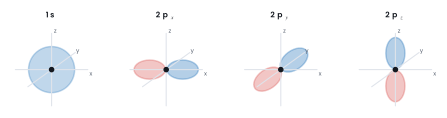
| s orbital | p orbital | |
|---|---|---|
| Value of l | 0 | 1 |
| Shape | Spherical | Dumb-bell |
| Number per shell | 1 | 3 (p_x, p_y, p_z) |
| Orientation | Non-directional | Directional, along the three axes, mutually perpendicular |
| Nodal planes through the nucleus | 0 | 1 |
| Present from shell | n = 1 | n = 2 |
The three p orbitals of a given shell are degenerate — equal in energy — in an isolated atom. A 1s orbital is smaller than a 2s orbital, and a 2s orbital has one spherical node inside it, but both are spheres.
3.10 Aufbau Principle, Pauli's exclusion principle and Hund's rule
Aufbau principle. In the ground state, electrons occupy the available orbitals in order of increasing energy: the lowest-energy orbital is filled first.
Pauli's exclusion principle. No two electrons in an atom can have the same values of all four quantum numbers. Hence an orbital holds at most two electrons, and they must have opposite spins.
Hund's rule of maximum multiplicity. Pairing of electrons in the orbitals of a given subshell does not begin until each orbital of that subshell has one electron, and these unpaired electrons have parallel spins.
The order of energies follows the (n + l) rule: the subshell with the lower value of (n+l) fills first, and if two subshells have the same (n+l), the one with the lower n fills first. For 4s, n+l = 4+0 = 4; for 3d, n+l = 3+2 = 5; so 4s fills before 3d.
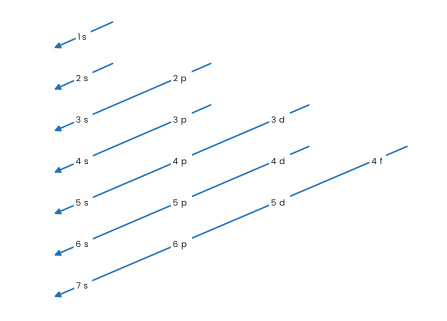
4s is filled before 3d, yet when a transition metal forms a cation the 4s electrons are removed first, because once 3d is occupied the 3d level drops below 4s. So Fe is [Ar]3d⁶4s² but Fe²⁺ is [Ar]3d⁶ — not [Ar]3d⁴4s².
3.11 Electronic configurations of atoms and ions (up to atomic number 30)
| Z | Element | Configuration | Z | Element | Configuration |
|---|---|---|---|---|---|
| 1 | H | 1s¹ | 16 | S | [Ne]3s²3p⁴ |
| 2 | He | 1s² | 17 | Cl | [Ne]3s²3p⁵ |
| 3 | Li | [He]2s¹ | 18 | Ar | [Ne]3s²3p⁶ |
| 4 | Be | [He]2s² | 19 | K | [Ar]4s¹ |
| 5 | B | [He]2s²2p¹ | 20 | Ca | [Ar]4s² |
| 6 | C | [He]2s²2p² | 21 | Sc | [Ar]3d¹4s² |
| 7 | N | [He]2s²2p³ | 22 | Ti | [Ar]3d²4s² |
| 8 | O | [He]2s²2p⁴ | 23 | V | [Ar]3d³4s² |
| 9 | F | [He]2s²2p⁵ | 24 | Cr | [Ar]3d⁵4s¹ |
| 10 | Ne | [He]2s²2p⁶ | 25 | Mn | [Ar]3d⁵4s² |
| 11 | Na | [Ne]3s¹ | 26 | Fe | [Ar]3d⁶4s² |
| 12 | Mg | [Ne]3s² | 27 | Co | [Ar]3d⁷4s² |
| 13 | Al | [Ne]3s²3p¹ | 28 | Ni | [Ar]3d⁸4s² |
| 14 | Si | [Ne]3s²3p² | 29 | Cu | [Ar]3d¹⁰4s¹ |
| 15 | P | [Ne]3s²3p³ | 30 | Zn | [Ar]3d¹⁰4s² |
The two anomalies. Chromium is [Ar]3d⁵4s¹ and copper is [Ar]3d¹⁰4s¹, not 3d⁴4s² and 3d⁹4s².
A half-filled (d⁵) or completely filled (d¹⁰) subshell is extra stable, because such an arrangement is symmetrical and gives the maximum exchange energy between electrons of parallel spin.
Ions. For an anion, add electrons in the usual Aufbau order; for a cation, remove electrons from the shell of highest n first.
| Ion | Derived from | Configuration |
|---|---|---|
| Na⁺ | Na [Ne]3s¹ | 1s²2s²2p⁶ = [Ne] |
| Cl⁻ | Cl [Ne]3s²3p⁵ | [Ne]3s²3p⁶ = [Ar] |
| O²⁻ | O [He]2s²2p⁴ | 1s²2s²2p⁶ = [Ne] |
| Fe²⁺ | Fe [Ar]3d⁶4s² | [Ar]3d⁶ |
| Fe³⁺ | Fe [Ar]3d⁶4s² | [Ar]3d⁵ (half-filled, hence the stability of Fe³⁺) |
| Cu²⁺ | Cu [Ar]3d¹⁰4s¹ | [Ar]3d⁹ |
| Zn²⁺ | Zn [Ar]3d¹⁰4s² | [Ar]3d¹⁰ |
Problem.(a) Write the electronic configuration of the element with Z = 24 and explain why it is not [Ar]3d⁴4s².(b) How many unpaired electrons does Fe³⁺ contain?(c) Give the four quantum numbers of the last electron of chlorine (Z = 17).
Solution.
(a) Chromium: [Ar]3d⁵4s¹. Moving one 4s electron into 3d makes both subshells exactly half-filled (3d⁵ and 4s¹), a symmetrical arrangement of lower energy than 3d⁴4s².
(b) Fe (Z = 26) is [Ar]3d⁶4s². Removing the two 4s electrons and one 3d electron gives Fe³⁺ = [Ar]3d⁵. By Hund's rule the five 3d electrons occupy the five orbitals singly, so Fe³⁺ has 5 unpaired electrons.
(c) Cl is 1s²2s²2p⁶3s²3p⁵. The last electron enters the 3p subshell, so n = 3, l = 1. With five electrons the three p orbitals hold 2, 2 and 1, so the last one pairs up in the first orbital: m = -1 and s = -\tfrac{1}{2}.

Chapter summary
- Rutherford's α-scattering proved the nuclear atom but predicted an unstable atom and a continuous spectrum, and said nothing about electron arrangement.
- Bohr quantised angular momentum, mvr = nh/2\pi, giving r_n = 0.529\,n^2/Z Å and E_n = -13.6\,Z^2/n^2 eV, and radiation only on transitions, \Delta E = h\nu.
- Hydrogen line spectrum: 1/\lambda = R_H(1/n_1^{2} - 1/n_2^{2}) with R_H = 1.097\times10^{7}\ \text{m}^{-1}; Lyman (UV, n_1=1), Balmer (visible, n_1=2), Paschen, Brackett, Pfund (IR).
- Bohr fails for many-electron atoms, fine structure, Zeeman and Stark effects, and contradicts both wave–particle duality and the uncertainty principle.
- De Broglie: \lambda = h/mv. A Bohr orbit is a standing wave, 2\pi r = n\lambda.
- Heisenberg: \Delta x\cdot\Delta p \geq h/4\pi, so orbits give way to probability; \psi^{2} is the probability density and an orbital is the 90 % probability region.
- Quantum numbers: n (shell, size), l = 0 to n-1 (shape), m = -l to +l (orientation), s = \pm\tfrac{1}{2} (spin); a shell holds n^{2} orbitals and 2n^{2} electrons.
- s orbitals are spherical, p orbitals are dumb-bell shaped with one nodal plane and three orientations.
- Fill by the Aufbau (n+l) rule, two per orbital with opposite spins (Pauli), singly first with parallel spins (Hund). Cr and Cu are anomalous; cations lose their 4s electrons before their 3d electrons.
Practice questions
Group A — Multiple choice (1 mark each)
- The Balmer series of the hydrogen spectrum lies in the [1]aultraviolet regionbvisible regioncinfrared regiondX-ray region
- The maximum number of electrons in a shell with principal quantum number n is [1]an^{2}b2n^{2}c2ndn+1
- The electronic configuration of Cr (Z = 24) is [1]a[Ar]3d⁴4s²b[Ar]3d⁵4s¹c[Ar]3d⁶d[Ar]3d³4s²
- The number of unpaired electrons in Fe³⁺ is [1]a3b4c5d6
- Which pair of quantum numbers is not allowed? [1]an = 3,\ l = 2bn = 2,\ l = 1cn = 2,\ l = 2dn = 4,\ l = 0
Answers to Group A
1. (b) — Balmer transitions end at n = 2 and fall at 656–410 nm.
2. (b) — n^{2} orbitals, each holding 2 electrons.
3. (b) — a half-filled 3d⁵ with 4s¹ is more stable than 3d⁴4s².
4. (c) — Fe³⁺ is [Ar]3d⁵, and by Hund's rule all five are unpaired.
5. (c) — l can only run from 0 to n-1, so l = 2 is impossible for n = 2.
Group B — Short answer (5 marks each)
- Describe Rutherford's α-scattering experiment and state the conclusions drawn from it. Give two limitations of his model. [5]
- State the postulates of Bohr's atomic theory and mention any three defects of the theory. [5]
- Calculate the radius and energy of the second Bohr orbit of the hydrogen atom, and the wavelength of the first line of the Lyman series. (R_H = 1.097\times10^{7}\ \text{m}^{-1}) [5]
- State Heisenberg's uncertainty principle. Calculate the uncertainty in the position of an electron whose velocity is known to within 1.0\times10^{5}\ \text{m s}^{-1}. [5]
- Define the four quantum numbers and write the electronic configurations of Sc (Z = 21), Cu (Z = 29) and Zn²⁺. [5]
Answers to Group B
3. r_2 = 0.529\times2^{2} = 2.116\ \text{Å} = 2.116\times10^{-10} m and E_2 = -13.6/4 = -3.40 eV.
First Lyman line is n = 2 \rightarrow n = 1: 1/\lambda = 1.097\times10^{7}(1 - 1/4) = 8.23\times10^{6}\ \text{m}^{-1}, so \lambda = 1.215\times10^{-7}\ \text{m} = 121.5 nm (ultraviolet).
4. \Delta x = h/(4\pi m \Delta v) = 6.626\times10^{-34}/(4\times3.1416\times9.11\times10^{-31}\times1.0\times10^{5}) = 6.626\times10^{-34}/(1.145\times10^{-24}) = 5.79\times10^{-10} m, i.e. about 5.8 Å — several atomic diameters.
5. Sc: [Ar]3d¹4s². Cu: [Ar]3d¹⁰4s¹ (filled 3d is extra stable). Zn²⁺: Zn is [Ar]3d¹⁰4s², so removing the two 4s electrons gives [Ar]3d¹⁰.
Group C — Long answer (8 marks each)
- (a) State Bohr's postulates and derive expressions for the radius and the energy of the n^{\text{th}} orbit of a hydrogen-like atom. [5](b) Using these, show how the Rydberg equation for the hydrogen spectrum follows, and name the series obtained for n_1 = 1, 2 and 3. [3]
- (a) State the Aufbau principle, Pauli's exclusion principle and Hund's rule. [3](b) Write the ground-state electronic configurations of ₂₄Cr, ₂₆Fe, ₂₉Cu and ₃₀Zn, explaining the two anomalies. [3](c) Calculate the de Broglie wavelength of an electron moving with a velocity of 1.0\times10^{7}\ \text{m s}^{-1}. [2]
Answer outline for Group C
1 (b). For a jump from n_2 to n_1, \Delta E = 13.6(1/n_1^{2} - 1/n_2^{2}) eV.
Since \Delta E = hc/\lambda, 1/\lambda = (13.6\times1.602\times10^{-19})/(hc)\times(1/n_1^{2} - 1/n_2^{2}), and the constant evaluates to 1.097\times10^{7}\ \text{m}^{-1} = R_H. n_1 = 1 gives the Lyman series (UV), n_1 = 2 the Balmer series (visible) and n_1 = 3 the Paschen series (IR).
2 (b). Cr [Ar]3d⁵4s¹, Fe [Ar]3d⁶4s², Cu [Ar]3d¹⁰4s¹, Zn [Ar]3d¹⁰4s². Cr and Cu promote one 4s electron to 3d because a half-filled (d⁵) or completely filled (d¹⁰) subshell is symmetrical and of lower energy.
2 (c). \lambda = h/mv = 6.626\times10^{-34}/(9.11\times10^{-31}\times1.0\times10^{7}) = 6.626\times10^{-34}/(9.11\times10^{-24}) = 7.27\times10^{-11} m = 0.727 Å.
Group D — Model answers for long questions (10 marks each, for deeper revision)
- State the postulates of Bohr's atomic model. Derive the radius and energy of the nth orbit of hydrogen and explain the hydrogen spectrum, with a numerical. [10]
- What are quantum numbers? Describe the shapes of s and p orbitals and the rules for filling electrons, and write the electronic configurations of Cr, Cu and Fe³⁺. [10]
- Explain de Broglie's equation and Heisenberg's uncertainty principle, with numericals, and state the failure of Bohr's model. [10]
Model answer D1: Bohr's model and the hydrogen spectrum (10 marks)
Introduction. Rutherford's model could not explain why an orbiting electron does not spiral into the nucleus, or the line spectrum of hydrogen. In 1913 Niels Bohr combined Rutherford's nuclear atom with Planck's quantum idea.
Postulates.
- An electron moves in fixed circular orbits (stationary states) around the nucleus without radiating energy.
- The orbits are allowed only if the angular momentum is quantised: mvr = nh/2\pi (n = 1, 2, 3...).
- Energy is emitted or absorbed only when an electron jumps between orbits: \Delta E = E_{2} - E_{1} = h\nu.
- The electrostatic attraction provides the centripetal force.
Radius of the nth orbit. Setting \dfrac{mv^{2}}{r} = \dfrac{ke^{2}}{r^{2}} and using v = nh/2\pi mr gives
Energy of the nth orbit. The total energy is the sum of kinetic and potential: E_{n} = -\dfrac{ke^{2}}{2r_{n}}, which gives
The energy is negative (bound), E_{1} = -13.6\ \text{eV} (ground state), and the ionisation energy of hydrogen is 13.6 eV.
Hydrogen spectrum. When an electron falls from n_{2} to n_{1},
| Series | n_{1} | n_{2} | Region |
|---|---|---|---|
| Lyman | 1 | 2, 3, 4... | Ultraviolet |
| Balmer | 2 | 3, 4, 5... | Visible |
| Paschen | 3 | 4, 5, 6... | Infrared |
| Brackett | 4 | 5, 6... | Infrared |
| Pfund | 5 | 6, 7... | Far infrared |
Numerical (H-alpha line). For the Balmer transition n = 3 \to 2: \Delta E = 13.6(1/4 - 1/9) = 1.89\ \text{eV}, and 1/\lambda = 1.097\times10^{7}\times0.1389 = 1.524\times10^{6}\ \text{m}^{-1}, so \lambda = 656\ \text{nm} (the red line).
The first Lyman line (2 \to 1) has \Delta E = 10.2\ \text{eV} and \lambda = 121.6\ \text{nm}.
Merits. It explained the stability of the atom and the hydrogen line spectrum.
Limitations: it fails for atoms with more than one electron; it cannot explain the splitting of lines in a magnetic field (Zeeman) or electric field (Stark); it violates the uncertainty principle by giving exact orbits; and it does not explain chemical bonding.
Conclusion. Bohr's model introduced quantised energy levels. Its predictions for hydrogen are accurate, but a complete theory needed quantum mechanics.
Model answer D2: quantum numbers, orbitals and electron configuration (10 marks)
Introduction. In the quantum mechanical model an electron's state is described by an orbital, a region where the probability of finding the electron is high. Four quantum numbers specify an electron.
The four quantum numbers.
| Quantum number | Symbol | Allowed values | Gives |
|---|---|---|---|
| Principal | n | 1, 2, 3... | Shell, size and energy |
| Azimuthal (angular momentum) | l | 0 to n-1 (s, p, d, f) | Subshell, shape |
| Magnetic | m_{l} | -l to +l | Orientation; (2l+1) orbitals |
| Spin | m_{s} | +\tfrac12 or -\tfrac12 | Spin of the electron |
A shell n holds 2n^{2} electrons. A subshell s holds 2, p holds 6, d holds 10 and f holds 14 electrons.
Shapes. An s orbital is spherical, and it grows larger with n (1s, 2s have a spherical node in 2s).
A p orbital is dumb-bell shaped with two lobes and a nodal plane through the nucleus; there are three, p_{x}, p_{y} and p_{z}, at right angles to each other and of equal energy.
Rules for filling.
- Aufbau principle: electrons fill the lowest energy orbital first, in the order of increasing (n + l): 1s, 2s, 2p, 3s, 3p, 4s, 3d, 4p, 5s...
- Pauli's exclusion principle: no two electrons in an atom can have the same set of four quantum numbers, so an orbital holds at most two electrons of opposite spin.
- Hund's rule: in degenerate orbitals one electron enters each orbital with parallel spin before pairing starts.
Electronic configurations.
- Cr (Z = 24): expected 4s² 3d⁴, but actual [Ar] 3d⁵ 4s¹, because a half-filled d subshell is extra stable (symmetry and exchange energy).
- Cu (Z = 29): expected 4s² 3d⁹, but actual [Ar] 3d¹⁰ 4s¹, because a completely filled d subshell is extra stable.
- Fe (Z = 26): [Ar] 3d⁶ 4s². Fe³⁺: the 4s electrons leave first, then one 3d electron, giving [Ar] 3d⁵ (half-filled and so more stable than Fe²⁺). It has 5 unpaired electrons.
Example of quantum numbers. For the last electron of Na (3s¹): n = 3, l = 0, m_{l} = 0, m_{s} = +\tfrac12.
Conclusion. The four quantum numbers give a complete address of every electron. The filling rules explain the periodic table and the exceptions of chromium and copper arise from the extra stability of half-filled and fully filled subshells.
Model answer D3: de Broglie wavelength, uncertainty principle and failure of Bohr's model (10 marks)
Introduction. Light behaves as both wave and particle. In 1924 Louis de Broglie suggested that matter also has wave properties. In 1927 Heisenberg showed that there is a basic limit to how exactly we can know the position and momentum of a small particle.
de Broglie's equation. For a photon, E = h\nu = hc/\lambda and E = mc^{2}, giving \lambda = h/mc. Extending this to a particle of mass m and speed v,
The wave nature was proved by electron diffraction (Davisson and Germer, 1927), and it is the basis of the electron microscope.
Numerical 1. An electron moving at 2.19\times10^{6}\ \text{m s}^{-1} (the speed in the first Bohr orbit): \lambda = \dfrac{6.626\times10^{-34}}{9.109\times10^{-31}\times2.19\times10^{6}} = 3.32\times10^{-10}\ \text{m} = 0.332\ \text{nm}, about the size of an atom, so wave behaviour matters.
Numerical 2. A cricket ball of 0.15\ \text{kg} at 40\ \text{m s}^{-1}: \lambda = 6.626\times10^{-34}/(0.15\times40) = 1.1\times10^{-34}\ \text{m}, which is too small to detect. So the wave nature is noticeable only for tiny particles.
Heisenberg's uncertainty principle. It is impossible to measure both the exact position and the exact momentum of a particle at the same time.
Numerical 3. If an electron's position is known to \Delta x = 10^{-10}\ \text{m} (the size of an atom), then \Delta v \geq \dfrac{h}{4\pi m\,\Delta x} = \dfrac{6.626\times10^{-34}}{4\pi\times9.109\times10^{-31}\times10^{-10}} = 5.8\times10^{5}\ \text{m s}^{-1}.
This uncertainty in speed is large, so it makes no sense to talk about a definite path (orbit) of an electron.
Significance. The principle replaced Bohr's orbits with orbitals and probability (the wave function squared gives the probability density).
Failures of Bohr's model.
- It applies only to one-electron species such as H, He⁺ and Li²⁺.
- It does not explain the fine structure of spectral lines.
- It could not explain the Zeeman and Stark effects.
- It treats the electron as a particle only and ignores its wave nature.
- It violates the uncertainty principle.
- It does not explain the shapes of molecules.
| Idea | Equation | Meaning |
|---|---|---|
| de Broglie | \lambda = h/mv | Every moving particle has a wavelength |
| Heisenberg | \Delta x\,\Delta p \geq h/4\pi | Position and momentum cannot both be exact |
| Bohr | mvr = nh/2\pi | Quantised orbits (replaced by orbitals) |
Conclusion. Matter shows wave-particle duality, and the uncertainty principle sets a limit on our knowledge. These ideas led to the quantum mechanical model of the atom.
Practise more: Chemistry question bank