Unit 2 · General and Physical Chemistry · 8 teaching hours · 26 min read
Stoichiometry
What the syllabus asks for 8
- Dalton's atomic theory and its postulates
- Laws of stoichiometry
- Avogadro's law and deductions: molecular mass and vapour density; molecular mass and volume of gas; molecular mass and number of particles
- Mole and its relation with mass, volume and number of particles
- Calculations based on mole concept
- Limiting reactant and excess reactant
- Theoretical yield, experimental yield and percentage yield
- Calculation of empirical and molecular formula from percentage composition
Stoichiometry is the arithmetic of chemistry: given a balanced equation, how much of one substance reacts with, or produces, how much of another.
It rests on a single idea — atoms are neither created nor destroyed, only rearranged — and on a single counting unit, the mole.
This is the longest unit in the physical chemistry area and the one that carries most of the numerical marks in the board paper, so every step here is worth practising until it is automatic.
Never go straight from grams of A to grams of B. Always travel mass → moles → (mole ratio from the balanced equation) → moles → mass. The mole ratio is the only place where the chemistry enters; everything else is division and multiplication.
2.1 Dalton's atomic theory and its postulates
John Dalton (1808) explained the mass laws by assuming matter is made of indivisible particles. His postulates are:
- All matter is made up of extremely small, indivisible particles called atoms.
- Atoms can neither be created nor destroyed in a chemical reaction.
- Atoms of the same element are identical in mass, size and all other properties.
- Atoms of different elements differ in mass, size and properties.
- Atoms combine in small whole-number ratios to form compound atoms (molecules).
- The relative number and kind of atoms in a given compound are fixed.
| Postulate | Law it explains | Modern status |
|---|---|---|
| Atoms are indivisible | Conservation of mass | Wrong — atoms contain e⁻, p⁺, n |
| Atoms are neither created nor destroyed | Conservation of mass | Valid for chemical change; fails in nuclear reactions |
| Atoms of one element are identical in mass | Definite proportions | Wrong — isotopes (¹H, ²H, ³H) differ in mass |
| Atoms combine in small whole-number ratios | Multiple proportions | Valid for simple compounds; fails for polymers and non-stoichiometric solids such as Fe₀.₉₅O |
Examiners want both sides. The theory is superseded, not useless: its book-keeping (atoms conserved, combining in fixed ratios) is still exactly how we balance equations. Only the claims about indivisibility and identical masses have failed.
2.2 Laws of stoichiometry
| Law | Statement | Example |
|---|---|---|
| Conservation of mass (Lavoisier, 1789) | Matter is neither created nor destroyed in a chemical reaction; total mass of reactants = total mass of products | 2H₂ + O₂ → 2H₂O : 4 g + 32 g = 36 g |
| Definite (constant) proportions (Proust, 1799) | A pure compound always contains the same elements combined in the same fixed ratio by mass, whatever its source | H₂O from a Kathmandu tap or from a lab always has H : O = 1 : 8 by mass |
| Multiple proportions (Dalton, 1803) | When two elements form more than one compound, the masses of one element combining with a fixed mass of the other are in a simple whole-number ratio | Cu₂O and CuO: O per 63.5 g Cu = 8 g and 16 g, ratio 1 : 2 |
| Reciprocal proportions (Richter, 1792) | The masses of two elements that combine separately with a fixed mass of a third element are either in the same ratio, or a simple multiple of it, as when they combine together | H and O each combine with S; H : O in H₂S and SO₂ relate simply to H : O in H₂O |
| Gaseous volumes (Gay-Lussac, 1808) | Gases react, and the gaseous products form, in volumes that bear a simple whole-number ratio to one another at the same temperature and pressure | 2 vol H₂ + 1 vol O₂ → 2 vol steam |
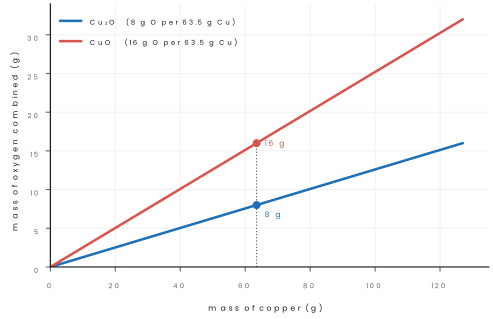
Problem. Copper forms two oxides. Sample A contains 88.8 % copper and sample B contains 79.9 % copper by mass. Show that these figures obey the law of multiple proportions.
Solution. Take 100 g of each sample.
| Cu (g) | O (g) | O per 1 g of Cu | |
|---|---|---|---|
| A | 88.8 | 11.2 | 11.2 / 88.8 = 0.126 |
| B | 79.9 | 20.1 | 20.1 / 79.9 = 0.252 |
Ratio of the oxygen masses for a fixed mass of copper
a simple whole-number ratio, so the law is obeyed. A is Cu₂O and B is CuO.
2.3 Avogadro's law and its deductions
Equal volumes of all gases, measured at the same temperature and pressure, contain an equal number of molecules.
Avogadro's law rescued Gay-Lussac's volume ratios, which contradicted Dalton's assumption that elementary gases were monoatomic. Writing hydrogen and oxygen as H₂ and O₂ makes 2 volumes + 1 volume → 2 volumes come out exactly right:
2H₂ + O₂ → 2H₂O (2 molecules + 1 molecule → 2 molecules)
Deduction 1 — molecular mass and vapour density
Vapour density (VD) is the ratio of the mass of a certain volume of a gas to the mass of the same volume of hydrogen, both measured at the same temperature and pressure.
Let each volume contain n molecules (Avogadro's law).
Multiplying numerator and denominator by 2 and using the fact that the molecular mass of H₂ is 2,
Deduction 2 — molecular mass and volume of a gas
One mole of any gas occupies 22.4 litres at STP (273 K, 1 atm). This volume is called the gram molecular volume. Hence the molecular mass in grams of any gas occupies 22.4 L at STP, and
Deduction 3 — molecular mass and number of particles
The gram molecular mass of any substance contains the same number of molecules, the Avogadro number N_A = 6.022\times10^{23}\ \text{mol}^{-1}.
Problem. 0.50 g of a gas occupies 280 cm³ at STP. Calculate(a) its molecular mass and(b) its vapour density.
Solution. (a) 280 cm³ = 0.280 L.
(b) VD = M/2 = 40/2 = 20. The gas is argon.
2.4 Mole and its relation with mass, volume and number of particles
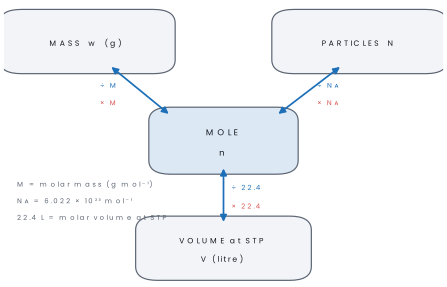
A mole is the amount of a substance that contains as many elementary entities (atoms, molecules, ions or electrons) as there are atoms in exactly 12 g of carbon-12, that is 6.022\times10^{23} entities.
| Starting from | To get moles | From moles |
|---|---|---|
| Mass w (g) | n = w/M | w = n\times M |
| Number of particles N | n = N/N_A | N = n\times N_A |
| Volume of gas at STP V (L) | n = V/22.4 | V = n\times22.4 |
Problem. For 8.8 g of carbon dioxide at STP calculate(a) the number of moles,(b) the number of molecules,(c) the number of oxygen atoms and(d) the volume occupied. (C = 12, O = 16)
Solution. M(CO₂) = 12 + 2(16) = 44 g mol⁻¹.
(a) n = 8.8/44 = 0.20\ \text{mol}
(b) N = 0.20 \times 6.022\times10^{23} = 1.204\times10^{23} molecules
(c) each molecule has 2 oxygen atoms, so N_O = 2 \times 1.204\times10^{23} = 2.409\times10^{23} atoms
(d) V = 0.20 \times 22.4 = 4.48\ \text{L}
2.5 Calculations based on mole concept
A balanced equation is read in moles. For
the coefficients 1 : 1 : 1 mean 1 mol (100 g) of calcium carbonate gives 1 mol (56 g) of calcium oxide and 1 mol (22.4 L at STP) of carbon dioxide.
- Write and balance the equation.
- Convert the given quantity to moles.
- Multiply by the mole ratio taken from the coefficients.
- Convert the answer back to the unit asked for (g, L or particles).
Problem. 25 g of limestone from Udayapur, which is 80 % pure CaCO₃, is heated strongly. Calculate the mass of quicklime formed and the volume of CO₂ liberated at STP. (Ca = 40, C = 12, O = 16)
Solution. Mass of pure CaCO₃ = 80 % of 25 g = 20 g.
The mole ratio CaCO₃ : CaO : CO₂ is 1 : 1 : 1, so n(\text{CaO}) = n(\text{CO}_2) = 0.20 mol.
Apply the purity before converting to moles (it changes the mass you actually have), and apply the percentage yield after the stoichiometry (it changes what you actually collect). Mixing the two up is the commonest lost mark in this unit.
2.6 Limiting reactant and excess reactant
When reactants are not mixed in exactly the ratio required by the equation, one runs out first and stops the reaction.
The limiting reactant is the reactant that is completely consumed and so decides how much product can form. Any reactant left over when the limiting reactant is used up is the excess reactant.
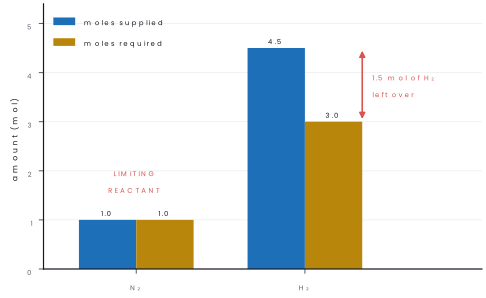
To find it, divide the moles available of each reactant by its coefficient in the balanced equation. The smallest quotient marks the limiting reactant.
Problem. 28 g of nitrogen is mixed with 9 g of hydrogen and passed over an iron catalyst. Identify the limiting reactant, find the mass of ammonia formed and the mass of the excess reactant left. (N = 14, H = 1)
Solution. The balanced equation is
N₂ + 3H₂ → 2NH₃
Dividing by the coefficients: N₂ gives 1.0/1 = 1.0 and H₂ gives 4.5/3 = 1.5. The smaller value belongs to nitrogen, so N₂ is limiting and H₂ is in excess.
Hydrogen used = 3 × 1.0 = 3.0 mol; hydrogen left = 4.5 − 3.0 = 1.5 mol, i.e. 1.5 × 2 = 3 g of H₂.
Ammonia formed = 2 × 1.0 = 2.0 mol = 2.0 × 17 = 34 g of NH₃.
Check by mass: 28 g + 6 g reacted = 34 g of product, and 3 g of H₂ remains.
2.7 Theoretical yield, experimental yield and percentage yield
Real reactions rarely give everything the equation promises: they may be reversible, side reactions occur, or product is lost on filtering and drying.
| Term | Meaning |
|---|---|
| Theoretical yield | Maximum mass of product calculated from the balanced equation, assuming the limiting reactant is fully converted |
| Experimental (actual) yield | Mass of pure product actually obtained in the laboratory |
| Percentage yield | Actual yield expressed as a percentage of the theoretical yield |
Problem. In the reaction of Worked example 2.5 only 27.2 g of ammonia is collected. Calculate the percentage yield. If a plant needs 1.00 tonne of ammonia per day at this yield, what mass of nitrogen must it supply?
Solution. Theoretical yield = 34 g.
For 1.00 t = 1000 kg of actual NH₃, the theoretical yield needed is
From the equation 28 kg of N₂ gives 34 kg of NH₃, so
2.8 Calculation of empirical and molecular formula from percentage composition
Problem. An organic compound contains C 40.0 %, H 6.7 % and O 53.3 % by mass. Its molecular mass is 180. Find its empirical and molecular formulae.
Solution.
| Element | % | ÷ atomic mass | ÷ smallest (3.33) | Whole number |
|---|---|---|---|---|
| C | 40.0 | 40.0/12 = 3.33 | 1.00 | 1 |
| H | 6.7 | 6.7/1 = 6.70 | 2.01 | 2 |
| O | 53.3 | 53.3/16 = 3.33 | 1.00 | 1 |
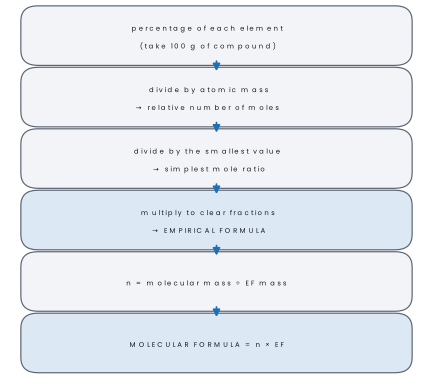
Empirical formula = CH₂O; empirical formula mass = 12 + 2 + 16 = 30.
which is glucose.
If the simplest ratio comes out as 1 : 2.5 : 1, multiply all of them by 2 to get 2 : 5 : 2. Only round when the value is within about 0.1 of a whole number (2.01 → 2 is fine; 2.5 → 2 destroys the answer).

Chapter summary
- Dalton's postulates: atoms are indivisible, conserved, identical within an element and combine in small whole-number ratios. Isotopes and subatomic particles have since disproved the first and third.
- The mass laws: conservation of mass, definite proportions, multiple proportions, reciprocal proportions, and Gay-Lussac's law of gaseous volumes.
- Avogadro's law: equal volumes of gases at the same T and P contain equal numbers of molecules. Deductions: molecular mass = 2 × vapour density; 1 mol of gas occupies 22.4 L at STP; 1 mol contains N_A = 6.022\times10^{23} particles.
- Mole conversions: n = w/M = N/N_A = V/22.4 (V in litres, at STP).
- Stoichiometry route: mass → moles → mole ratio from the balanced equation → moles → mass or volume.
- The limiting reactant is the one with the smallest value of (moles ÷ coefficient); it fixes the amount of product. The rest is excess.
- \%\ \text{yield} = (\text{actual}/\text{theoretical})\times100. Purity is applied to the reactant, yield to the product.
- Empirical formula: % → ÷ atomic mass → ÷ smallest → clear fractions; molecular formula = n\times empirical formula with n = \text{molecular mass}/\text{EF mass}.
Practice questions
Group A — Multiple choice (1 mark each)
- The number of molecules in 11.2 L of any gas at STP is [1]a6.022 × 10²³b3.011 × 10²³c1.204 × 10²⁴d12.044 × 10²³
- The vapour density of a gas is 32. Its molecular mass is [1]a16b32c64d128
- In the reaction 2H₂ + O₂ → 2H₂O, 4 g of H₂ is mixed with 16 g of O₂. The limiting reactant is [1]aH₂bO₂cneitherdboth equally
- Which law is explained by the existence of CO and CO₂? [1]aconservation of massbdefinite proportionscmultiple proportionsdreciprocal proportions
- The empirical formula of a compound is CH₂O and its molecular mass is 60. Its molecular formula is [1]aCH₂ObC₂H₄O₂cC₃H₆O₃dC₆H₁₂O₆
Answers to Group A
1. (b) — 11.2 L is half a mole, so 0.5 × 6.022 × 10²³ = 3.011 × 10²³.
2. (c) — molecular mass = 2 × VD = 64.
3. (b) — n(H₂) = 2, n(O₂) = 0.5; dividing by coefficients gives 1.0 and 0.5, so oxygen runs out first.
4. (c) — for a fixed 12 g of carbon, the oxygen masses are 16 g and 32 g, a ratio of 1 : 2.
5. (b) — EF mass = 30, n = 60/30 = 2.
Group B — Short answer (5 marks each)
- State the postulates of Dalton's atomic theory and mention two of its limitations. [5]
- State Avogadro's law and derive the relation: molecular mass = 2 × vapour density. [5]
- Calculate the number of moles, molecules and atoms present in 3.4 g of ammonia gas, and the volume it occupies at STP. (N = 14, H = 1) [5]
- 6.5 g of zinc is dropped into excess dilute hydrochloric acid. Calculate the volume of hydrogen liberated at STP and the mass of zinc chloride formed. (Zn = 65, Cl = 35.5) [5]
- Define limiting reactant. 50 g of CaCO₃ is treated with 35 g of HCl. Which is the limiting reactant, and what mass of CO₂ is produced? (Ca = 40, C = 12, O = 16, H = 1, Cl = 35.5) [5]
Answers to Group B
3. M(NH₃) = 17 g mol⁻¹, so n = 3.4/17 = 0.20 mol. Molecules = 0.20 × 6.022 × 10²³ = 1.204 × 10²³. Each NH₃ has 4 atoms, so atoms = 4 × 1.204 × 10²³ = 4.82 × 10²³. Volume at STP = 0.20 × 22.4 = 4.48 L.
4. Zn + 2HCl → ZnCl₂ + H₂↑. n(Zn) = 6.5/65 = 0.10 mol. Mole ratio Zn : H₂ : ZnCl₂ = 1 : 1 : 1, so n(H₂) = n(ZnCl₂) = 0.10 mol. V(H₂) = 0.10 × 22.4 = 2.24 L at STP. M(ZnCl₂) = 65 + 71 = 136, so mass = 0.10 × 136 = 13.6 g.
5. CaCO₃ + 2HCl → CaCl₂ + H₂O + CO₂↑. n(CaCO₃) = 50/100 = 0.50 mol; n(HCl) = 35/36.5 = 0.959 mol.
Dividing by coefficients: 0.50/1 = 0.50 and 0.959/2 = 0.479, so HCl is limiting. n(CO₂) = 0.959/2 = 0.479 mol, giving 0.479 × 44 = 21.1 g of CO₂ (equivalently 10.7 L at STP).
Group C — Long answer (8 marks each)
- (a) State the law of multiple proportions. Two oxides of nitrogen contain 63.6 % and 46.7 % nitrogen by mass. Show that the data illustrate the law and identify the oxides. (N = 14, O = 16) [5](b) Define theoretical yield and percentage yield, and explain two reasons why the actual yield of an industrial reaction is always less than the theoretical yield. [3]
- A hydrocarbon contains 85.7 % carbon and 14.3 % hydrogen by mass. Its vapour density is 21. [8](a) Determine its empirical formula.(b) Determine its molecular mass and molecular formula.(c) Calculate the volume of oxygen at STP required for the complete combustion of 4.2 g of this hydrocarbon.
Answers to Group C
1 (a). In 100 g of the first oxide: N = 63.6 g, O = 36.4 g, so oxygen per 1 g of nitrogen = 36.4/63.6 = 0.572. In the second: N = 46.7 g, O = 53.3 g, giving 53.3/46.7 = 1.141.
The ratio is 0.572 : 1.141 = 1 : 2, a simple whole-number ratio, so the law holds. The first is N₂O (28 : 16) and the second is NO (14 : 16).
1 (b). Theoretical yield is the maximum product calculable from the balanced equation for the limiting reactant; percentage yield is actual/theoretical × 100.
Actual yields fall short because many reactions are reversible and reach equilibrium before completion, side reactions consume reactant, and product is lost during filtration, transfer and purification.
2. (a) C: 85.7/12 = 7.14; H: 14.3/1 = 14.3. Dividing by 7.14 gives 1 : 2, so the empirical formula is CH₂ (EF mass 14).
(b) Molecular mass = 2 × VD = 2 × 21 = 42, so n = 42/14 = 3 and the molecular formula is C₃H₆ (propene).
(c) C₃H₆ + 4.5O₂ → 3CO₂ + 3H₂O, i.e. 2C₃H₆ + 9O₂ → 6CO₂ + 6H₂O. n(C₃H₆) = 4.2/42 = 0.10 mol, so n(O₂) = 0.10 × 4.5 = 0.45 mol. V(O₂) = 0.45 × 22.4 = 10.08 L at STP.
Group D — Model answers for long questions (10 marks each, for deeper revision)
- State and explain the laws of chemical combination with examples and give the modern explanation by Dalton's atomic theory. [10]
- Define limiting reactant and percentage yield. Solve a full problem on the formation of ammonia from nitrogen and hydrogen. [10]
- How are the empirical and molecular formulae of a compound found from its percentage composition? Work out an example. [10]
Model answer D1: laws of chemical combination and Dalton's theory (10 marks)
Introduction. Stoichiometry is the study of the quantitative relationships between reactants and products. It rests on five laws, found by experiment between 1774 and 1811, and on Dalton's atomic theory (1808), which explained them.
1. Law of conservation of mass (Lavoisier, 1774). Matter can neither be created nor destroyed in a chemical reaction, so the total mass of the reactants equals that of the products.
Example 2 g of H₂ burns with 16 g of O₂ to give exactly 18 g of H₂O. (In nuclear reactions mass is converted to energy.)
2. Law of constant (definite) proportions (Proust, 1799). A pure compound always contains the same elements in the same ratio by mass, whatever its source.
Water from the Bagmati and from a Himalayan spring is always 11.2% hydrogen and 88.8% oxygen by mass, a ratio of 1 : 8.
3. Law of multiple proportions (Dalton, 1803). When two elements form more than one compound, the masses of one element that combine with a fixed mass of the other are in a simple whole-number ratio.
Example H₂O has 8 g of oxygen per 1 g of hydrogen, and H₂O₂ has 16 g of oxygen per 1 g of hydrogen; the ratio is 8 : 16 = 1 : 2. Similarly CO has 12 : 16 and CO₂ has 12 : 32, with oxygen in the ratio 1 : 2.
4. Gay-Lussac's law of combining volumes (1808). Gases react in volumes that bear a simple whole-number ratio to each other and to the volumes of gaseous products at the same temperature and pressure.
Example 2 volumes of H₂ + 1 volume of O₂ give 2 volumes of steam.
5. Avogadro's law (1811). Equal volumes of all gases at the same temperature and pressure contain the same number of molecules. It explains Gay-Lussac's law, and shows that gases like H₂ and O₂ are diatomic. At STP one mole of any gas occupies 22.4 L.
Dalton's atomic theory.
- Matter is made of indivisible atoms.
- Atoms of the same element are identical in mass and properties.
- Atoms of different elements differ.
- Atoms combine in simple whole-number ratios to form compounds.
- Atoms are neither created nor destroyed in a reaction, only rearranged. Postulates 4 and 5 explain the laws of constant proportions, multiple proportions and conservation of mass.
| Law | Explained by Dalton's postulate | Example |
|---|---|---|
| Conservation of mass | Atoms are not created or destroyed | 2 g H₂ + 16 g O₂ = 18 g H₂O |
| Constant proportions | Fixed ratio of atoms | H : O = 1 : 8 in water |
| Multiple proportions | Whole-number ratio of atoms | H₂O and H₂O₂ |
Limitations of Dalton's theory. Atoms are divisible (electron, proton, neutron); isotopes of an element differ in mass; isobars of different elements have the same mass; and some compounds, such as sugar, do not combine in simple ratios.
Numerical. A sample of CuO from the laboratory has 3.18 g Cu with 0.80 g O (ratio 3.975 : 1) and another from a mine has 15.9 g Cu with 4.0 g O (ratio 3.975 : 1). Both ratios are identical, which proves the law of constant proportions.
Conclusion. The five laws fix how the masses and volumes of substances change in a reaction, and Dalton's atomic theory provides a particle-level explanation for them.
Model answer D2: limiting reactant and percentage yield (10 marks)
Introduction. In a real reaction the reactants are rarely taken in the exact ratio of the balanced equation.
The reactant that is used up first and so limits the product is called the limiting reactant (limiting reagent); the other is in excess.
The theoretical yield is the maximum product predicted from the limiting reactant, and the actual yield is what is really obtained.
Problem. 28 g of N₂ is mixed with 10 g of H₂ to make ammonia, \text{N}_2 + 3\text{H}_2 \rightarrow 2\text{NH}_3 (N = 14, H = 1).
Find (a) the limiting reactant, (b) the mass of NH₃ formed, (c) the mass of the excess reactant left, (d) the percentage yield if 27.2 g of NH₃ is actually obtained.
Step 1: moles.
- N₂: 28 g / 28 g mol⁻¹ = 1 mol.
- H₂: 10 g / 2 g mol⁻¹ = 5 mol.
Step 2: find the limiting reactant. The equation needs 3 mol of H₂ for each mole of N₂. For 1 mol N₂ only 3 mol H₂ are needed, but 5 mol is available. So N₂ is the limiting reactant and H₂ is in excess.
Step 3: product. From the equation, 1 mol N₂ gives 2 mol NH₃, so the theoretical yield is 2 mol × 17 g mol⁻¹ = 34 g of NH₃.
Step 4: excess left. H₂ used = 3 mol; left = 5 - 3 = 2 mol = 4 g.
Step 5: percentage yield. = 27.2/34 \times 100 = \mathbf{80\%}.
| Species | Initial (mol) | Used or formed (mol) | Final (mol) |
|---|---|---|---|
| N₂ | 1 | -1 | 0 |
| H₂ | 5 | -3 | 2 |
| NH₃ | 0 | +2 | 2 |
Check by mass: 28 g + 10 g = 38 g before; after the reaction there are 34 g NH₃ + 4 g H₂ = 38 g. ✓
Why yield is below 100%. The reaction may be reversible (Haber's process reaches equilibrium), side reactions occur, some product is lost during separation, and the reactants may be impure.
Importance. The idea guides industry: Nepal's fertiliser import calculations use it, and a chemical engineer always chooses the cheaper reactant in excess so that the costly one is completely used.
Conclusion. The limiting reactant fixes the maximum product. Converting grams to moles, comparing them with the ratio of the equation, and then calculating the yield from the limiting reactant is the standard method.
Model answer D3: empirical and molecular formula (10 marks)
Introduction. The empirical formula shows the simplest whole-number ratio of atoms in a compound, and the molecular formula shows the actual number of atoms in a molecule. The molecular formula is a whole-number multiple n of the empirical formula:
Procedure (six steps).
- Write the percentage of each element (take 100 g of the compound, so the percentages become grams).
- Divide each mass by the atomic mass to get moles.
- Divide all the mole values by the smallest one.
- If any ratio is not a whole number, multiply all by a small integer (2, 3...) to make them whole (for example 1.5 x 2 = 3).
- Write the formula; this is the empirical formula.
- Find n from the molar mass and multiply to get the molecular formula.
Worked example. A compound has 40.0% C, 6.67% H and 53.33% O, and a molar mass of 180 g mol⁻¹ (C = 12, H = 1, O = 16).
| Element | Mass (g in 100 g) | Moles | Divide by smallest (3.33) | Ratio |
|---|---|---|---|---|
| C | 40.0 | 40.0/12 = 3.33 | 1.00 | 1 |
| H | 6.67 | 6.67/1 = 6.67 | 2.00 | 2 |
| O | 53.33 | 53.33/16 = 3.33 | 1.00 | 1 |
The empirical formula is CH₂O, with an empirical mass of 12 + 2 + 16 = 30. Then n = 180/30 = 6 and the molecular formula is C₆H₁₂O₆, which is glucose.
Second example (fractions). A sample of an iron oxide has 69.9% Fe and 30.1% O. Moles: Fe 69.9/55.8 = 1.253, O 30.1/16 = 1.881. Dividing by 1.253 gives 1 : 1.50. Multiplying by 2 gives 2 : 3, so the formula is Fe₂O₃ (haematite).
Uses. The method identifies unknown compounds from a combustion analysis (percent C and H by mass of CO₂ and H₂O produced) and is used in pharmaceutical quality control.
| Compound | Empirical formula | Molecular formula | n |
|---|---|---|---|
| Glucose | CH₂O | C₆H₁₂O₆ | 6 |
| Acetic acid | CH₂O | C₂H₄O₂ | 2 |
| Benzene | CH | C₆H₆ | 6 |
| Hydrogen peroxide | HO | H₂O₂ | 2 |
Conclusion. The empirical formula comes from the percentage composition, and the molecular formula needs the molar mass in addition. Different compounds can share the same empirical formula, such as glucose and acetic acid.
Practise more: Chemistry question bank