Chapter 6 · Physics · 2 questions in the paper · 15 min read
Modern Physics
What the syllabus asks for 5
- Electrons: Millikan's experiment, cathode rays, specific charge
- Photons and quantization of energy: photoelectric effect, Planck's constant, Bohr theory, spectral series, de Broglie, uncertainty principle, X-rays and Bragg's law, laser
- Solids and semiconductor devices: intrinsic and extrinsic semiconductors, p-n junction, rectification, Zener diode, transistor, logic gates
- Radioactivity and nuclear reactions: atomic mass, isotopes, nuclear density, mass-energy relation, mass defect, fission and fusion, radioactive decay law, carbon dating, health hazard
- Recent trends: particle physics, the universe, seismology, telecommunication, environment, new technology and materials
Modern physics carries about 2 questions (our estimate), but the syllabus is long: electrons, the photoelectric effect, Bohr, de Broglie, X-rays, semiconductors and gates, radioactivity and nuclear energy, plus a list of "recent trends" (particle physics, the universe, seismology, telecommunication, environment, new materials).
The numerical questions repeat a few formulae; the recent-trends items are definitions you can score by reading once.
- e/m=1.76\times10^{11} C kg⁻¹; Millikan: charge is quantised, e=1.6\times10^{-19} C.
- Photon E=hf=\frac{1240\ \text{eV nm}}{\lambda}; Einstein K_{max}=hf-\phi; eV_s=K_{max}.
- Bohr: E_n=-\frac{13.6}{n^2} eV; \frac{1}{\lambda}=R\big(\frac{1}{n_1^2}-\frac{1}{n_2^2}\big); Lyman, Balmer, Paschen.
- de Broglie \lambda=\frac{h}{p}, \lambda\approx\frac{1.227}{\sqrt{V}} nm for electrons; uncertainty \Delta x\,\Delta p\ge\frac{\hbar}{2}; Bragg 2d\sin\theta=n\lambda.
- Semiconductors: p-n junction, rectifier, Zener, transistor (\beta=\frac{\alpha}{1-\alpha}), logic gates.
- Nuclear: N=N_0e^{-\lambda t}, T_{1/2}=\frac{0.693}{\lambda}, E=\Delta m\,c^2 (1 u = 931.5 MeV), fission, fusion, carbon dating.
6.1 Electrons
Cathode rays (a discharge tube at low pressure) are streams of electrons: deflected by electric and magnetic fields, negatively charged, travel in straight lines, produce X-rays on striking a target. J.J. Thomson: with crossed fields the speed is v=\frac{E}{B}; the deflection with only B gives the specific charge \frac{e}{m}=1.76\times10^{11} C kg⁻¹. Millikan's oil-drop: drops balanced between plates, qE=mg; every charge is an integral multiple of e=1.6\times10^{-19} C (charge is quantised). Electron mass 9.1\times10^{-31} kg. An electron accelerated through V volts gains eV joules (1\ \text{eV}=1.6\times10^{-19} J) and speed \sqrt{\frac{2eV}{m}}.
6.2 Photons and quantization of energy
Photoelectric effect. Light of frequency above the threshold f_0 ejects electrons instantly; K_{max} depends on frequency, not intensity; the photo-current depends on intensity.
h=6.63\times10^{-34} J s; photon energy E=\frac{hc}{\lambda}=\frac{1240}{\lambda(\text{nm})} eV; photon momentum \frac{h}{\lambda}. The wave theory cannot explain the instantaneous emission or the threshold.
A 100 W sodium lamp (589 nm) emits about 3\times10^{20} photons per second.
Bohr's theory (hydrogen): angular momentum mvr=\frac{nh}{2\pi}; E_n=-\dfrac{13.6}{n^2} eV; r_n=0.53n^2 Å; v_n=\frac{2.2\times10^6}{n} m s⁻¹.
Emission when an electron falls: h f=E_{n_2}-E_{n_1}, \frac{1}{\lambda}=R\Big(\frac{1}{n_1^2}-\frac{1}{n_2^2}\Big), R=1.097\times10^7 m⁻¹.
| Series | Final level n_1 | Region |
|---|---|---|
| Lyman | 1 | ultraviolet |
| Balmer | 2 | visible (H\alpha 656 nm for 3→2) |
| Paschen | 3 | infrared |
| Brackett, Pfund | 4, 5 | far infrared |
Ionisation energy of hydrogen is 13.6 eV; the first excitation energy 10.2 eV.
de Broglie: \lambda=\frac{h}{p}=\frac{h}{mv}; electron through V volts: \lambda=\frac{1.227}{\sqrt{V}} nm (V=150 V gives 0.1 nm). Heisenberg uncertainty: \Delta x\Delta p\ge\frac{\hbar}{2}=\frac{h}{4\pi}.
X-rays: produced when fast electrons strike a metal target; the continuous spectrum has a minimum wavelength \lambda_{min}=\frac{hc}{eV}; the characteristic lines depend on the target (Moseley). Bragg's law: 2d\sin\theta=n\lambda.
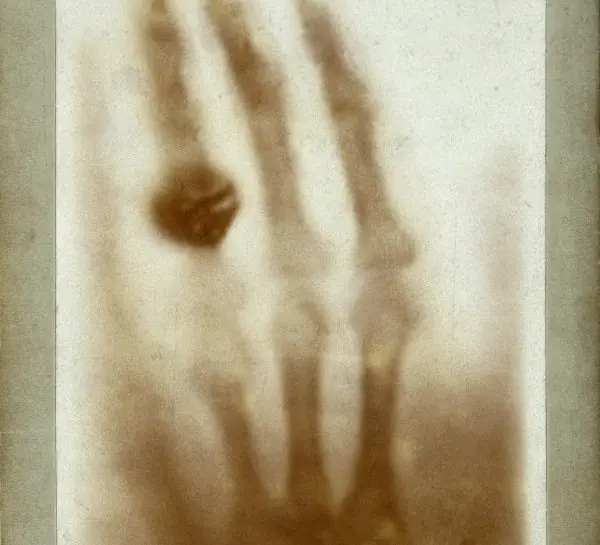
X-rays are not deflected by fields, penetrate matter, are used in medicine and crystallography.
Laser: stimulated emission, population inversion, optical cavity; light is coherent, monochromatic, directional and intense (surgery, cutting, communication, barcode readers).
6.3 Solids and semiconductor devices
Band theory: conductors (bands overlap), insulators (gap >3 eV), semiconductors (gap about 1 eV: Si 1.1, Ge 0.7). Intrinsic semiconductors have equal electron and hole numbers; their resistance falls with temperature.
Extrinsic: n-type (donor, pentavalent: P, As, Sb; electrons majority), p-type (acceptor, trivalent: B, Al, In; holes majority); n_en_h=n_i^2.
p-n junction: diffusion creates a depletion layer and a barrier potential (0.3 V Ge, 0.7 V Si). Forward bias (p to +): the layer narrows and current flows; reverse bias: the layer widens, a tiny leakage current flows.
Rectification: half-wave (one diode, ripple frequency = input), full-wave (two diodes or a bridge, ripple 2f); a capacitor smooths the output.
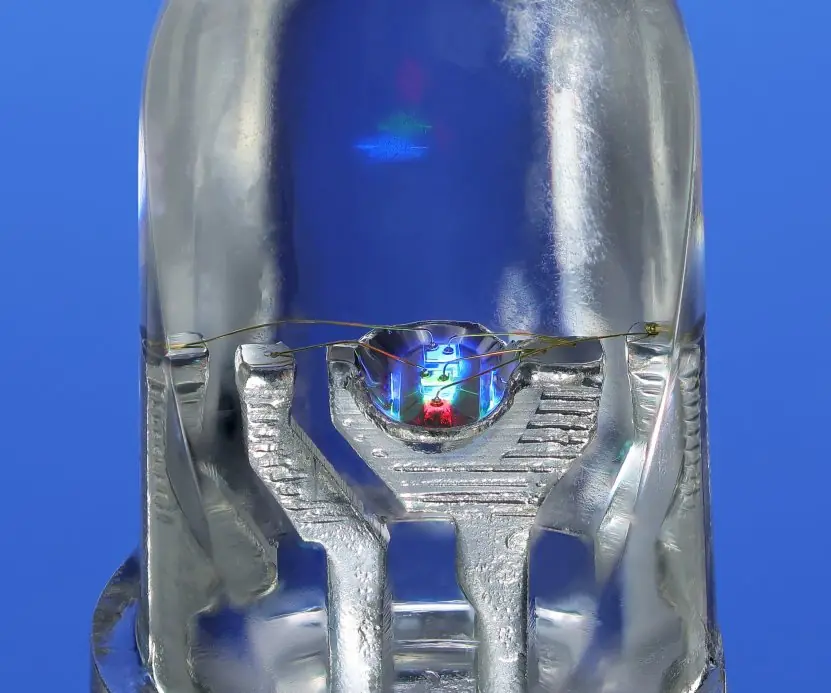
Zener diode: in reverse breakdown it holds a constant voltage (a regulator); LED and photodiode are other junction devices.
Transistor (npn / pnp; emitter, base, collector): I_E=I_B+I_C; \alpha=\frac{I_C}{I_E}, \beta=\frac{I_C}{I_B}, \beta=\frac{\alpha}{1-\alpha} (\alpha=0.98: \beta=49); amplifier in common-emitter mode (phase reversal 180^\circ), switch in cut-off and saturation. Logic gates:
| Gate | Output | Note |
|---|---|---|
| AND | 1 only if both inputs 1 | |
| OR | 1 if any input 1 | |
| NOT | inverts | |
| NAND, NOR | negations of AND, OR | universal gates |
| XOR | 1 if inputs differ |
De Morgan: \overline{A\cdot B}=\bar A+\bar B, \overline{A+B}=\bar A\cdot\bar B.
6.4 Radioactivity and nuclear reaction
Nucleus: A=Z+N; radius R=R_0A^{1/3}, R_0=1.2 fm; so density is constant, about 2.3\times10^{17} kg m⁻³, independent of A. Isotopes share Z; isobars share A; isotones share N. Atomic mass unit: 1 u =1.66\times10^{-27} kg =931.5 MeV/c^2.
Mass–energy: E=mc^2; mass defect \Delta m=Zm_p+Nm_n-m_{nucleus}; binding energy =\Delta m\times931.5 MeV; BE per nucleon peaks near ^{56}Fe (8.8 MeV), so fission of heavy and fusion of light nuclei both release energy.
Conversion of 1 g of matter gives 9\times10^{13} J.
Decay law: N=N_0e^{-\lambda t}=N_0\big(\frac{1}{2}\big)^{t/T_{1/2}}; T_{1/2}=\frac{\ln2}{\lambda}=\frac{0.693}{\lambda}; mean life \tau=\frac{1}{\lambda}=1.44T_{1/2}; activity A=\lambda N (becquerel = 1 decay s⁻¹; curie =3.7\times10^{10} Bq).
After n half-lives \big(\frac{1}{2}\big)^n remains. \alpha decay: Z-2, A-4; \beta^-: Z+1, an antineutrino emitted; \gamma: no change in Z,A.
Carbon dating: living matter has a constant ^{14}C/^{12}C ratio; after death ^{14}C (T_{1/2}=5730 y) decays; a sample with 25 % of the original is 11 460 years old.
Fission: ^{235}U + n → fragments + 2–3 neutrons + about 200 MeV, a chain reaction controlled by moderator (graphite, heavy water) and control rods (Cd, B). Fusion: light nuclei combine at about 10^7 K (Sun: proton–proton cycle).
Health hazards: ionising radiation damages DNA; dose in sievert; shielding, distance and time reduce exposure; radioactive waste handling.
6.5 Recent trends in physics
- Particle physics: every particle has an antiparticle (positron–electron annihilation \to2\gamma). Quarks (up, down, strange, charm, top, bottom; fractional charge \pm\frac{1}{3},\pm\frac{2}{3}) build hadrons: baryons (three quarks: proton uud, neutron udd) and mesons (quark–antiquark, e.g. pion). Leptons (electron, muon, tau and their neutrinos) are fundamental. The Higgs boson (found at the LHC, CERN, 2012; mass about 125 GeV) is the quantum of the field that gives mass.
- Universe: Big Bang about 13.8 billion years ago; Hubble's law v=H_0d (galaxies recede; expansion); the cosmic microwave background; dark matter (galaxy rotation curves) and dark energy; gravitational waves (ripples of space-time from merging black holes, first detected by LIGO in 2015); black hole: escape speed exceeds c, event horizon r_s=\frac{2GM}{c^2}.
- Seismology: P-waves (longitudinal, fastest, through solids and liquids), S-waves (transverse, solids only); surface (L) waves cause the greatest damage; the Richter / magnitude scale is logarithmic.
- Telecommunication: radio (AM, FM, modulation), TV, mobile (cells), GPS (24+ satellites, timing signals; relativistic corrections), remote sensing (satellite imaging of land, forests, floods).
- Environment: energy crisis, greenhouse effect and global warming, ozone layer depletion by CFCs (UV-B), pollution.
- New materials: nanotechnology (1–100 nm; properties change with size), superconductors (zero resistance below T_c, Meissner effect — expel magnetic field; used in MRI and maglev), distinguished from a perfect conductor (which does not expel fields).


Formula and fact sheet
| Topic | Result |
|---|---|
| e/m | 1.76\times10^{11} C kg⁻¹ |
| photon | E=hf=1240/\lambda_{nm} eV |
| photoelectric | K_{max}=hf-\phi |
| Bohr | E_n=-13.6/n^2 eV |
| de Broglie | \lambda=h/p; 1.227/\sqrt{V} nm |
| Bragg | 2d\sin\theta=n\lambda |
| \beta | \alpha/(1-\alpha) |
| decay | N=N_02^{-t/T}; T=0.693/\lambda |
| energy | 1 u =931.5 MeV |
Chapter summary
- Photons carry hf; only frequency above threshold ejects electrons.
- Bohr energies scale as 1/n^2; series are named by the final level.
- Wave–particle duality: \lambda=h/p; the uncertainty principle limits x and p.
- Forward bias narrows the depletion layer; NAND and NOR are universal.
- N=N_0(\tfrac{1}{2})^{n} after n half-lives; binding energy peaks near iron.
- Know the recent-trends vocabulary: quark, boson, Hubble, LIGO, P/S waves, nano, superconductor.
Practice questions
Set A — Recall (10 questions)
- The specific charge of the electron isa1.76\times10^{11} C kg⁻¹b9.1\times10^{-31} C kg⁻¹c1.6\times10^{-19} C kg⁻¹d1.76\times10^{-11} C kg⁻¹
- The energy of a photon of wavelength 620 nm isa1 eVb2 eVc4 eVd0.5 eV
- Photons of energy 5 eV fall on a metal of work function 2 eV. The stopping potential isa2 Vb5 Vc3 Vd7 V
- The energy of the hydrogen atom in the n=2 level isa-13.6 eVb-6.8 eVc-1.51 eVd-3.4 eV
- The Balmer series of hydrogen lies in theavisible regionbultravioletcinfrareddX-ray region
- The de Broglie wavelength of an electron accelerated through 150 V is abouta1 nmb0.1 nmc0.01 nmd10 nm
- After three half-lives the fraction of a radioactive sample that remains isa1/3b1/6c1/8d1/9
- An energy equivalent to 1 atomic mass unit isa9.3 MeVb93 MeVc9315 MeVd931.5 MeV
- In forward bias the depletion region of a p-n junctionanarrowsbwidenscis unchangeddis permanent
- Which gate is known as a universal gate?aANDbORcNANDdXOR
Answers and explanations — Set A
1. (a) — e/m=1.76\times10^{11} C kg⁻¹.
2. (b) — \frac{1240}{620}=2 eV.
3. (c) — K_{max}=5-2=3 eV, so V_s=3 V.
4. (d) — -\frac{13.6}{4}.
5. (a) — Balmer lines end at n=2 and are visible; Lyman is UV.
6. (b) — \frac{1.227}{\sqrt{150}}=0.1 nm.
7. (c) — (\frac{1}{2})^3.
8. (d) — standard.
9. (a) — the applied field opposes the barrier.
10. (c) — NAND (and NOR) can make every other gate.
Set B — Understanding (6 questions)
- A metal has threshold wavelength 500 nm. Light of wavelength 400 nm falls on it. The maximum kinetic energy of the photoelectrons is nearlya0.62 eVb1.24 eVc3.1 eVd2.48 eV
- The wavelength of the H\alpha line (the n=3\to2 transition) of hydrogen is nearlya486 nmb656 nmc434 nmd122 nm
- A sample of 80 g of a radioactive element has a half-life of 10 days. After 30 days the mass remaining isa40 gb20 gc10 gd5 g
- A wood sample has 25 % of the ^{14}C of a living sample (T_{1/2}=5730 y). Its age is abouta5730 yb2865 yc17190 yd11460 y
- X-rays reflect from planes spaced 0.2 nm at a glancing angle of 30^\circ in first order. The wavelength isa0.2 nmb0.1 nmc0.4 nmd0.346 nm
- The energy released by the complete conversion of 1 g of matter isa9\times10^{16} Jb9\times10^{13} Jc9\times10^{10} Jd3\times10^{8} J
Answers and explanations — Set B
1. (a) — \frac{1240}{400}-\frac{1240}{500}=3.10-2.48=0.62 eV.
2. (b) — \Delta E=13.6(\frac{1}{4}-\frac{1}{9})=1.89 eV; \lambda=\frac{1240}{1.89}=656 nm.
3. (c) — three half-lives: 80\to40\to20\to10.
4. (d) — 25 % is two half-lives, 2\times5730.
5. (a) — \lambda=2d\sin\theta=2\times0.2\times0.5.
6. (b) — 10^{-3}\times(3\times10^8)^2.
Set C — Application (4 questions)
- A 100 W lamp emits light of wavelength 589 nm, all of its power. The number of photons per second is abouta3\times10^{20}b3\times10^{18}c3\times10^{22}d3\times10^{19}
- A nucleus has a mass defect of 0.03 u. Its binding energy is nearlya2.8 MeVb28 MeVc280 MeVd0.28 MeV
- A transistor has \alpha=0.98. Its current gain \beta isa98b4.9c49d0.02
- An electron is localised to within 1 Å. The minimum uncertainty in its momentum (\hbar=1.05\times10^{-34} J s) is abouta5.3\times10^{-24}b6.6\times10^{-24}c1.1\times10^{-34}d5.3\times10^{-25} kg m s⁻¹
Answers and explanations — Set C
1. (a) — E=\frac{hc}{\lambda}=3.38\times10^{-19} J; N=\frac{100}{3.38\times10^{-19}}.
2. (b) — 0.03\times931.5=27.9 MeV.
3. (c) — \beta=\frac{0.98}{0.02}=49.
4. (d) — \Delta p\ge\frac{\hbar}{2\Delta x}=\frac{1.05\times10^{-34}}{2\times10^{-10}}=5.3\times10^{-25}.
Group D — Model answers for long questions (10 marks each, for deeper revision)
- Explain the photoelectric effect with Einstein's equation, the de Broglie hypothesis and the Bohr model of hydrogen, with numericals. [10]
- Explain p-n junction diodes, rectification and the transistor, and describe radioactive decay and nuclear binding energy with numericals. [10]
Model answer D1: Photons, matter waves and the Bohr atom (10 marks)
Introduction. Classical physics could not explain the photoelectric effect or atomic spectra, so quantum ideas were needed.
Photoelectric effect. Light of high enough frequency ejects electrons from a metal.
Observations: (a) there is a threshold frequency f_0 below which no electrons are emitted, however bright the light; (b) the maximum kinetic energy depends on frequency, not on intensity; (c) emission is instantaneous; (d) the photocurrent is proportional to intensity.
Einstein's equation: each photon gives all its energy hf to one electron:
Numerical: sodium has \phi = 2.3\ \text{eV}. For \lambda = 400\ \text{nm}, E = \frac{1240}{400} = 3.1\ \text{eV}, so K_{\max} = 0.8\ \text{eV} and the stopping potential is 0.8\ \text{V}.
The threshold wavelength is \frac{1240}{2.3} = 539\ \text{nm}. Uses: photocells, automatic doors and light meters.
de Broglie hypothesis. Matter has wave nature: \lambda = \frac{h}{p} = \frac{h}{mv}.
For an electron accelerated through V volts, \lambda = \frac{1.227}{\sqrt{V}}\ \text{nm}; at 100\ \text{V}, \lambda = 0.1227\ \text{nm}, comparable with atomic spacing, which makes the electron microscope possible and was confirmed by Davisson and Germer.
Bohr model of hydrogen. Postulates: (1) electrons move in stationary orbits without radiating; (2) angular momentum L = \frac{nh}{2\pi}; (3) a photon is emitted or absorbed when an electron jumps, hf = E_i - E_f.
The energy is E_n = -\frac{13.6}{n^2}\ \text{eV}. For n = 3 \to 2: \Delta E = 13.6\left(\frac14 - \frac19\right) = 1.89\ \text{eV}, giving \lambda = 656\ \text{nm} (red, the first Balmer line).
| Idea | Key equation | Example value |
|---|---|---|
| Photoelectric | hf = \phi + K_{\max} | 0.8\ \text{eV} |
| de Broglie | \lambda = h/p | 0.1227\ \text{nm} |
| Bohr energy | E_n = -13.6/n^2 | -3.4\ \text{eV} for n = 2 |
Conclusion. Light shows particle behaviour and matter shows wave behaviour, which is the basis of quantum mechanics.
Model answer D2: Semiconductors and the nucleus (10 marks)
Introduction. Semiconductors (Si, Ge) have a small band gap. Doping with a pentavalent atom (P, As) gives n-type, and a trivalent atom (B, Al) gives p-type.
p-n junction diode. Electrons and holes diffuse across the junction and leave a depletion layer with a barrier potential (about 0.7\ \text{V} for Si, 0.3\ \text{V} for Ge).
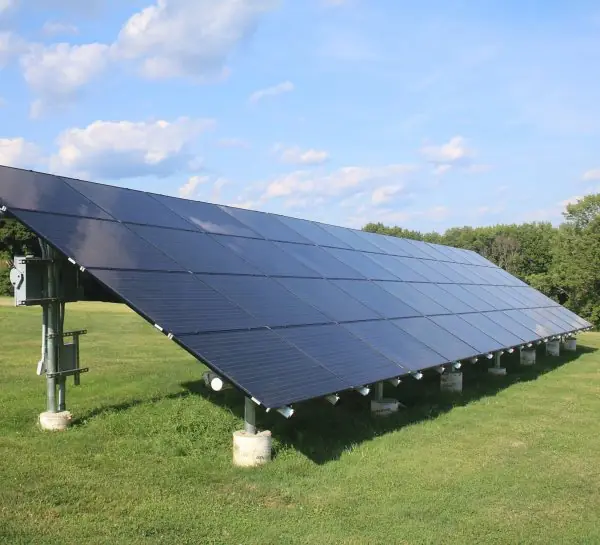
In forward bias the barrier is reduced and current flows; in reverse bias only a tiny leakage current flows. Uses: half-wave and full-wave rectifiers (with a bridge of four diodes), LEDs, solar cells and Zener voltage regulation.
Transistor. A three-layer device (n-p-n or p-n-p) with emitter, base and collector. As an amplifier a small base current controls a large collector current, with \beta = \frac{I_C}{I_B} and I_E = I_B + I_C.
As a switch it is either cut off or saturated. Logic gates (AND, OR, NOT, NAND, NOR) are made from it.
Radioactivity. The nucleus of an unstable atom emits alpha (^4_2\text{He}), beta (electron) or gamma rays. Decay law: N = N_0e^{-\lambda t}, with half-life T_{1/2} = \frac{0.693}{\lambda}, so N = N_0\left(\frac12\right)^{t/T}.
Numerical: iodine-131 has T = 8 days, so 80\ \text{g} left for 24 days (3 half-lives) becomes \frac{80}{2^3} = 10\ \text{g}. The activity is A = \lambda N, and \lambda = \frac{0.693}{8\times86400} = 1.0\times10^{-6}\ \text{s}^{-1}.
Binding energy. E = \Delta m\,c^2 and 1\ \text{u} = 931.5\ \text{MeV}. For helium-4: \Delta m = 2(1.007825) + 2(1.008665) - 4.002603 = 0.030377\ \text{u}, so E_b = 28.3\ \text{MeV}, or 7.07\ \text{MeV} per nucleon.
Fission (U-235 + n) and fusion (hydrogen to helium in the Sun) both release energy because the products have a higher binding energy per nucleon.
| Device or effect | Principle | Use |
|---|---|---|
| Diode | One-way conduction | Rectifier, LED |
| Transistor | Current control | Amplifier, switch |
| Radioactive decay | N = N_0e^{-\lambda t} | Medical tracers, dating |
| Fission, fusion | Mass defect | Power, the Sun |
Conclusion. Semiconductors run modern electronics, and the nucleus stores energy that is released in decay, fission and fusion.