Chapter 2 · Physics · 4 questions in the paper · 13 min read
Heat and Thermodynamics
What the syllabus asks for 5
- Temperature and quantity of heat: thermal equilibrium, specific heat, latent heat, method of mixture, Newton's law of cooling, triple point
- Thermal expansion of solids and liquids
- Transfer of heat: conduction, convection, radiation, thermal conductivity, black body, Stefan-Boltzmann law
- Thermal properties of matter: kinetic theory of gases, heat capacities of gases and solids
- Laws of thermodynamics: first law, processes, second law, heat engine, Carnot, Otto and Diesel cycles, refrigerator, entropy
Heat and thermodynamics carry about 4 questions (our estimate).
Calorimetry (mixing hot and cold substances, ice), thermal expansion, radiation (T^4), the first law on a gas process, kinetic-theory averages and the efficiency of a Carnot or Otto engine are the standard shapes.
Numerical questions are mostly one formula with careful unit handling (kelvin, not Celsius, in T^4 and in engine efficiency).
- Calorimetry: Q=mc\Delta T, Q=mL; the final temperature of a mixture; triple point 273.16 K.
- Expansion: \Delta L=L\alpha\Delta T, \gamma=3\alpha for solids; thermal stress Y\alpha\Delta T.
- Conduction \frac{Q}{t}=\frac{kA\Delta T}{L}; radiation P=\sigma AT^4; Newton's law of cooling.
- Kinetic theory: \bar K=\frac{3}{2}kT, v_{rms}=\sqrt{\frac{3RT}{M}}, U=\frac{f}{2}nRT, C_p-C_v=R.
- First law \Delta U=Q-W on isothermal, adiabatic, isobaric and isochoric processes; PV^\gamma= const.
- Heat engines: \eta=1-\frac{T_2}{T_1} (Carnot), Otto \eta=1-r^{1-\gamma}, refrigerator COP, entropy.
2.1 Temperature and quantity of heat
Thermal equilibrium is the content of the zeroth law: bodies in equilibrium with a third are in equilibrium with each other, which defines temperature.
Scales: \frac{C}{5}=\frac{F-32}{9}=\frac{K-273}{5} (the same reading -40 on Celsius and Fahrenheit). Triple point of water: 273.16 K, 0.01 °C, 611.7 Pa (the fixed point of the Kelvin scale).
Heat is energy in transit. Q=mc\Delta T; heat capacity C=mc; Q=mL (L_f=336 kJ kg⁻¹ for ice, L_v=2256 kJ kg⁻¹ for steam; c_{water}=4200 J kg⁻¹ K⁻¹, c_{ice}\approx2100).
Method of mixtures: heat lost = heat gained; check first whether all the ice melts. Measuring c by mixtures; L by the electrical method VIt=mL (Joule's constant J=4.18 J cal⁻¹).
Newton's law of cooling: rate of cooling \propto(T-T_s) for a small excess; T=T_s+(T_0-T_s)e^{-kt}; for the average values \frac{T_1-T_2}{t}=K\Big(\frac{T_1+T_2}{2}-T_s\Big).
2.2 Thermal expansion
Linear \Delta L=L\alpha\Delta T; area \beta=2\alpha; volume \gamma=3\alpha (\alpha:\beta:\gamma=1:2:3). Liquids have real expansion \gamma_r=\gamma_a+\gamma_{vessel}.
Water contracts from 0 to 4 °C, so its density is maximum at 4 °C (ice floats; lakes freeze from the top). If an expansion is prevented, the thermal stress is Y\alpha\Delta T. A pendulum clock runs slow in summer (l increases).
The Bimetallic strip bends towards the metal of lower \alpha. Gas expansion: PV=nRT; Charles (V\propto T at constant P), Boyle (PV const at constant T), Gay-Lussac (P\propto T).
2.3 Transfer of heat
Conduction: \dfrac{Q}{t}=\dfrac{kA(T_1-T_2)}{L} (k in W m⁻¹ K⁻¹). Rods of different material in series: R=\sum\frac{L}{kA} (thermal resistance); in parallel the conductances add.
Interface temperature of two slabs in series: T=\frac{k_1T_1/L_1+k_2T_2/L_2}{k_1/L_1+k_2/L_2}. Convection moves heat with a fluid (sea breeze, boiling). Radiation needs no medium.
A black body absorbs all radiation. Stefan–Boltzmann: E=\sigma T^4, \sigma=5.67\times10^{-8} W m⁻² K⁻⁴; net power from a body at T in surroundings T_s: P=e\sigma A(T^4-T_s^4). Doubling T multiplies the radiated power by 16.
Wien: \lambda_mT=2.9\times10^{-3} m K. Kirchhoff: a good absorber is a good emitter. Thermos flask: silvering reduces radiation, vacuum stops conduction and convection.
2.4 Thermal properties of matter and kinetic theory
Ideal gas: PV=nRT=NkT, R=8.314 J mol⁻¹ K⁻¹, k=1.38\times10^{-23} J K⁻¹, N_A=6.02\times10^{23}.
Kinetic theory: P=\frac{1}{3}\rho\overline{v^2}; average translational KE of a molecule \frac{3}{2}kT (independent of the gas); v_{rms}=\sqrt{\frac{3RT}{M}}=\sqrt{\frac{3P}{\rho}}, mean v_{av}=\sqrt{\frac{8RT}{\pi M}}, most probable \sqrt{\frac{2RT}{M}} (v_{mp}:v_{av}:v_{rms}=\sqrt{2}:\sqrt{8/\pi}:\sqrt{3}). v_{rms}\propto\sqrt{T/M}: hydrogen is 4 times faster than oxygen at the same temperature.
Mean free path \lambda=\frac{1}{\sqrt{2}\pi d^2n}.
Degrees of freedom f (3 monatomic, 5 diatomic at ordinary temperature, 6 non-linear polyatomic); energy per molecule \frac{f}{2}kT, so U=\frac{f}{2}nRT, C_v=\frac{f}{2}R, C_p=C_v+R (Mayer), \gamma=\frac{C_p}{C_v}=1+\frac{2}{f} (5/3, 7/5, 4/3).
Solids (Dulong–Petit): molar heat capacity \approx3R=25 J mol⁻¹ K⁻¹. Vapour pressure, humidity, dew point, boiling at lower pressure on mountains (water boils below 100 °C at the summit of Everest).
2.5 Laws of thermodynamics
First law: \Delta U=Q-W (heat added to the system, work done by it); W=\int P\,dV (area under the P–V curve).
| Process | Condition | W | Q | \Delta U |
|---|---|---|---|---|
| isothermal | T const, PV const | nRT\ln\frac{V_2}{V_1} | =W | 0 |
| isobaric | P const | P\Delta V | nC_p\Delta T | nC_v\Delta T |
| isochoric | V const | 0 | nC_v\Delta T | =Q |
| adiabatic | Q=0 | \frac{P_1V_1-P_2V_2}{\gamma-1} | 0 | -W |
Adiabatic: PV^\gamma= const, TV^{\gamma-1}= const, T^\gamma P^{1-\gamma}= const. Compressing a gas adiabatically 8-fold (monatomic) raises P by 8^{5/3}=32. A cyclic process returns \Delta U=0; the work is the enclosed area.
Second law (Kelvin–Planck: no engine converts heat wholly into work; Clausius: heat does not flow spontaneously from cold to hot). Heat engine: \eta=\frac{W}{Q_1}=1-\frac{Q_2}{Q_1}.
Carnot cycle (two isotherms, two adiabats): \eta=1-\frac{T_2}{T_1} (kelvin), the maximum possible between two temperatures, reversible. Otto (petrol): \eta=1-\frac{1}{r^{\gamma-1}} (r=8, \gamma=1.4: 56.5 %).
Diesel: higher compression ratio, injection at constant pressure. Refrigerator: COP =\frac{Q_2}{W}=\frac{T_2}{T_1-T_2}.
Entropy \Delta S=\frac{Q}{T}; the entropy of an isolated system never decreases; melting at T: \Delta S=\frac{mL}{T}.
Use kelvin in T^4, efficiency and v_{rms}. In \Delta U=Q-W, W is work done by the gas. Efficiency of any real engine is below Carnot. Specific heat capacity of an isothermal process is infinite; of an adiabatic one, zero.

Formula and fact sheet
| Topic | Result |
|---|---|
| mixture | \sum mc\Delta T=0 (with latent heat if a phase changes) |
| expansion | \Delta L=L\alpha\Delta T; \gamma=3\alpha |
| conduction | \frac{kA\Delta T}{L} |
| radiation | \sigma AT^4; \lambda_mT=2.9\times10^{-3} |
| kinetic | \frac{3}{2}kT; v_{rms}=\sqrt{3RT/M} |
| gas energy | U=\frac{f}{2}nRT; C_p-C_v=R |
| isothermal work | nRT\ln\frac{V_2}{V_1} |
| Carnot \eta | 1-T_2/T_1 |
Chapter summary
- Heat lost = heat gained; check for a phase change first.
- \gamma=3\alpha; blocked expansion gives stress Y\alpha\Delta T.
- Radiation scales as T^4 (kelvin), conduction as \Delta T/L.
- \bar K=\frac{3}{2}kT for every ideal gas; v_{rms}\propto\sqrt{T/M}.
- Know the four processes' W, Q and \Delta U; adiabatic means PV^\gamma= const.
- No engine beats Carnot; entropy of an isolated system never decreases.
Practice questions
Set A — Recall (10 questions)
- The temperature of the triple point of water isa273.15 Kb273.16 Kc0 Kd373.15 K
- The heat required to raise 2 kg of water by 10 °C (c=4200 J kg⁻¹ K⁻¹) isa8400 Jb42000 Jc84000 Jd840 J
- If the absolute temperature of a black body is doubled, the radiated power becomesa2 timesb4 timesc8 timesd16 times
- For a solid, the coefficients of linear and volume expansion are related bya\gamma=3\alphab\gamma=2\alphac\gamma=\alpha/3d\gamma=\alpha
- In an isothermal process of an ideal gasaQ=0bW=0c\Delta U=0d\Delta P=0
- For an ideal gas C_p-C_v equalsaRbR/2c2Rd0
- The efficiency of a Carnot engine working between 600 K and 300 K isa25 %b50 %c75 %d100 %
- The mean translational kinetic energy of a gas molecule at temperature T isa\frac{1}{2}kTbkTc\frac{3}{2}kTd3kT
- In a spontaneous process the entropy of the universeaincreasesbdecreasescis zerodstays constant
- The SI unit of thermal conductivity isaW m⁻²bJ K⁻¹cW KdW m⁻¹ K⁻¹
Answers and explanations — Set A
1. (b) — 273.16 K (0.01 °C), the defining fixed point.
2. (c) — 2\times4200\times10.
3. (d) — P\propto T^4, 2^4=16.
4. (a) — \gamma=3\alpha (\beta=2\alpha is the area coefficient).
5. (c) — constant temperature means no change in internal energy; Q=W.
6. (a) — Mayer's relation.
7. (b) — 1-\frac{300}{600}.
8. (c) — \frac{3}{2}kT, independent of the gas.
9. (a) — second law.
10. (d) — from Q/t=kA\Delta T/L.
Set B — Understanding (7 questions)
- 100 g of ice at 0 °C is added to 0.5 kg of water at 40 °C (L_f=336 kJ kg⁻¹, c=4.2 kJ kg⁻¹ K⁻¹). The final temperature isa10 °Cb25 °Cc20 °Cd30 °C
- A 1 m rod expands by 1.2 mm when heated through 100 °C. Its coefficient of linear expansion isa1.2\times10^{-6} K⁻¹b1.2\times10^{-5} K⁻¹c1.2\times10^{-4} K⁻¹d1.2\times10^{-3} K⁻¹
- A slab of k=0.8 W m⁻¹ K⁻¹, area 2 m² and thickness 0.1 m has 25 K across it. The heat conducted per second isa200 Wb800 Wc400 Wd40 W
- A monatomic ideal gas (\gamma=\frac{5}{3}) is compressed adiabatically to \frac{1}{8} of its volume. Its pressure rises by a factora8b32c16d40
- One mole of an ideal gas at 300 K expands isothermally to twice its volume. The work done is nearly (R=8.314)a1.73 kJb2.49 kJc0.86 kJd3.46 kJ
- A refrigerator keeps its inside at 270 K in a room at 300 K. Its maximum coefficient of performance isa9b0.9c10d1/9
- The ratio of v_{rms} of hydrogen to oxygen at the same temperature isa16b2c8d4
Answers and explanations — Set B
1. (c) — water gives 0.5\times4200\times40=84000 J to reach 0 °C; melting uses 0.1\times336000=33600 J; the rest, 50400 J, warms 0.6 kg: \Delta T=\frac{50400}{2520}=20 °C.
2. (b) — \alpha=\frac{\Delta L}{L\Delta T}=\frac{1.2\times10^{-3}}{100}.
3. (c) — \frac{0.8\times2\times25}{0.1}=400 W.
4. (b) — P_2/P_1=8^{5/3}=2^5=32.
5. (a) — RT\ln2=8.314\times300\times0.693\approx1729 J.
6. (a) — \frac{T_2}{T_1-T_2}=\frac{270}{30}.
7. (d) — \sqrt{M_O/M_H}=\sqrt{32/2}=4.
Set C — Application (5 questions)
- A Carnot engine between 500 K and 300 K absorbs 1000 J per cycle. The work done per cycle isa600 Jb400 Jc200 Jd500 J
- A 0.5 kg metal block at 100 °C is dropped into 1 kg of water at 20 °C and the final temperature is 25 °C (c_w=4200). The specific heat of the metal isa560 J kg⁻¹ K⁻¹b420c840d280
- An Otto engine has compression ratio 8 and \gamma=1.4. Its efficiency is abouta43.5 %b65 %c87.5 %d56.5 %
- A steel rail fixed at both ends is heated by 20 °C (Y=2\times10^{11} Pa, \alpha=12\times10^{-6} K⁻¹). The thermal stress isa4.8\times10^7 Pab2.4\times10^7 Pac4.8\times10^6 Pad9.6\times10^7 Pa
- The internal energy of 2 mol of a monatomic ideal gas at 300 K is nearlya5.0 kJb12.5 kJc7.5 kJd3.7 kJ
Answers and explanations — Set C
1. (b) — \eta=1-\frac{300}{500}=0.4; W=400 J.
2. (a) — 0.5\,c\,(75)=1\times4200\times5\Rightarrow c=560.
3. (d) — 1-8^{-0.4}=1-0.435.
4. (a) — Y\alpha\Delta T=2\times10^{11}\times12\times10^{-6}\times20.
5. (c) — U=\frac{3}{2}nRT=1.5\times2\times8.314\times300\approx7.5 kJ.
Group D — Model answers for long questions (10 marks each, for deeper revision)
- State the laws of thermodynamics; derive the work in an isothermal and an adiabatic change and the efficiency of a Carnot engine. [10]
- Explain conduction, convection and radiation, calorimetry with change of state, thermal expansion and the kinetic theory result for pressure and rms speed. [10]
Model answer D1: Thermodynamics (10 marks)
Introduction. Thermodynamics studies the relation between heat, work and internal energy of a system.
Laws.
- Zeroth law: if A and B are each in thermal equilibrium with C, then A and B are in equilibrium with each other. This defines temperature.
- First law: \Delta Q = \Delta U + \Delta W, a statement of energy conservation. Heat given to a gas raises its internal energy and does external work.
- Second law: Kelvin–Planck: no engine can turn all heat from one source into work. Clausius: heat cannot flow from a cold body to a hot body by itself.
Processes of an ideal gas.
| Process | Condition | Work | Heat |
|---|---|---|---|
| Isothermal | T constant, PV = constant | W = nRT\ln\frac{V_2}{V_1} | Q = W |
| Adiabatic | Q = 0, PV^{\gamma} = constant | W = \frac{nR(T_1 - T_2)}{\gamma - 1} | 0 |
| Isobaric | P constant | W = P\Delta V | nC_p\Delta T |
| Isochoric | V constant | 0 | nC_v\Delta T |
Derivation (isothermal). W = \int P\,dV = \int \frac{nRT}{V}dV = nRT\ln\frac{V_2}{V_1}.
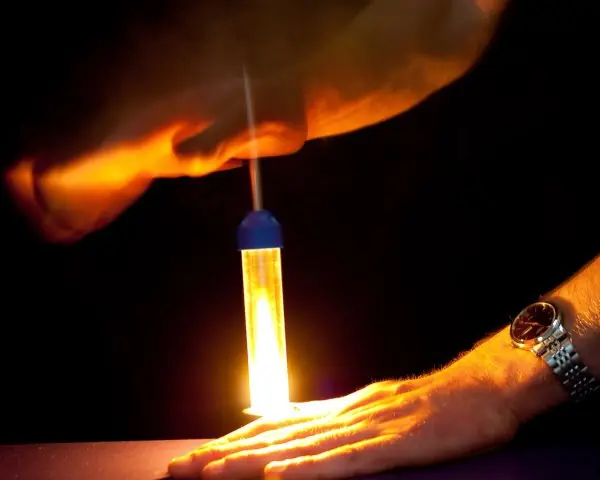
Numerical. 2 mol of gas expands isothermally at 300\ \text{K} to twice its volume: W = 2\times8.314\times300\times\ln2 = 3458\ \text{J}. For an adiabatic halving of volume (\gamma = 1.4) T_2 = 300\times2^{0.4} = 396\ \text{K}, the heating used in a fire piston.
Carnot engine. It has four steps: isothermal expansion at T_1, adiabatic expansion, isothermal compression at T_2 and adiabatic compression. Its efficiency is
For T_1 = 500\ \text{K} and T_2 = 300\ \text{K}, \eta = 1 - 0.6 = 40\%. No real engine working between the same temperatures can do better.
Conclusion. Energy is conserved (first law), but its conversion to work is limited (second law), as the Carnot efficiency shows.
Model answer D2: Heat transfer, calorimetry and kinetic theory (10 marks)
Introduction. Heat flows by three methods, and its effects are a change of temperature, a change of state or expansion.
Modes of transfer.
- Conduction: through a solid with no bulk movement. H = \frac{kA(\theta_1 - \theta_2)}{L}. A copper rod (k = 400, A = 2\ \text{cm}^2, L = 0.5\ \text{m}, \Delta\theta = 100^\circ) conducts 400\times2\times10^{-4}\times100/0.5 = 16\ \text{W}.
- Convection: by moving fluid (sea breeze, boiling water).
- Radiation: electromagnetic waves, needing no medium. Stefan's law: E = \sigma AT^4 for a black body, with \sigma = 5.67\times10^{-8}\ \text{W m}^{-2}\text{K}^{-4}.
Calorimetry (principle of mixtures). Heat lost = heat gained. Numerical: 100\ \text{g} of ice at 0^\circ\text{C} is added to 400\ \text{g} of water at 40^\circ\text{C} (L = 336\ \text{J g}^{-1}, c = 4.2\ \text{J g}^{-1}\text{K}^{-1}).
Melting needs 33{,}600\ \text{J}. The water can supply 400\times4.2\times40 = 67{,}200\ \text{J} down to 0^\circ\text{C}. The spare 33{,}600\ \text{J} warms 500\ \text{g} by 33600/(500\times4.2) = 16^\circ\text{C}. So the final temperature is 16 °C.
Thermal expansion. \Delta L = L\alpha\Delta T.
A 20\ \text{m} steel rail (\alpha = 1.2\times10^{-5}\ \text{K}^{-1}) warmed by 40\ \text{K} lengthens by 20\times1.2\times10^{-5}\times40 = 9.6\ \text{mm}, so gaps are left in railway lines. Also \gamma = 3\alpha and \beta = 2\alpha.
Kinetic theory. Pressure of a gas: P = \frac{1}{3}\rho\overline{c^2} = \frac{1}{3}\frac{mN}{V}\overline{c^2}, and the average kinetic energy per molecule is \frac{3}{2}kT. Hence
For nitrogen (M = 0.028\ \text{kg mol}^{-1}) at 300\ \text{K}: c_{rms} = \sqrt{3\times8.314\times300/0.028} = 517\ \text{m s}^{-1}.
| Mode | Needs a medium? | Example |
|---|---|---|
| Conduction | Yes (solid) | Hot spoon handle |
| Convection | Yes (fluid) | Sea breeze |
| Radiation | No | Sunlight |
Conclusion. Heat transfer, calorimetry and expansion follow from the idea that temperature measures the average kinetic energy of molecules.