Chapter 4 · Physics · 2 questions in the paper · 11 min read
Waves and Sound
What the syllabus asks for 4
- Wave motion: travelling and stationary waves
- Mechanical waves: velocity of sound in solid, liquid and gas; effect of temperature, pressure, humidity
- Waves in pipes and strings: closed and open pipes, resonance tube, laws of vibration of a string
- Acoustic phenomena: pressure amplitude, intensity level, quality and pitch, ultrasonic and infrasonic, Doppler effect
Waves and sound carry about 2 questions (our estimate), from a short list: v=f\lambda, the speed of sound and what changes it, resonance in a closed or open pipe, the fundamental of a stretched string, beats, decibels, and the Doppler effect.
Each has a one-line formula; the skill is choosing the right one and keeping track of which end of a pipe is closed.
- v=f\lambda; wave equation y=A\sin(\omega t-kx), k=\frac{2\pi}{\lambda}; nodes and antinodes.
- Speed of sound: v=\sqrt{\gamma P/\rho}, \propto\sqrt{T}, independent of pressure at fixed T, increases with humidity.
- Pipes: closed f=\frac{(2n-1)v}{4L} (odd harmonics), open f=\frac{nv}{2L} (all harmonics); end correction 0.6r.
- String: v=\sqrt{T/\mu}, f_1=\frac{1}{2L}\sqrt{T/\mu} and the laws of vibration.
- Intensity level \beta=10\log\frac{I}{I_0} dB; beats |f_1-f_2|; Doppler f'=f\frac{v\pm v_o}{v\mp v_s}.
4.1 Wave motion: travelling and stationary waves
A wave transfers energy without transferring matter. Transverse (displacement perpendicular to propagation: string, light) and longitudinal (compressions and rarefactions: sound). v=f\lambda.
A progressive wave y=A\sin(\omega t-kx) with \omega=2\pi f, k=\frac{2\pi}{\lambda}, v=\frac{\omega}{k}; phase difference =\frac{2\pi}{\lambda}\times path difference. Intensity \propto A^2f^2.
Stationary waves form by superposing two identical waves moving oppositely: y=2A\cos kx\sin\omega t.
Nodes (no motion) are \frac{\lambda}{2} apart, as are the antinodes; every point between two nodes is in phase; no energy is transmitted; amplitude varies with position.
A fixed end is a node (phase change \pi on reflection); a free end is an antinode.
4.2 Mechanical waves: speed of sound
Newton–Laplace: v=\sqrt{\dfrac{E}{\rho}}: solid \sqrt{Y/\rho}, liquid \sqrt{B/\rho}, gas \sqrt{\gamma P/\rho}=\sqrt{\gamma RT/M} (Laplace, adiabatic; Newton's isothermal assumption gave 280 m s⁻¹).
Typical values: air 332 m s⁻¹ at 0 °C (\approx331+0.61t), water about 1480, steel about 5000 m s⁻¹.
- Temperature: v\propto\sqrt{T} (kelvin).
- Pressure: no effect at constant temperature (P/\rho is constant).
- Humidity: moist air is less dense, so v rises.
- Gas type: lighter gas, faster sound (v_{H_2}\approx4v_{O_2} at the same T).
- Wind adds its component along the direction.
4.3 Waves in pipes and strings
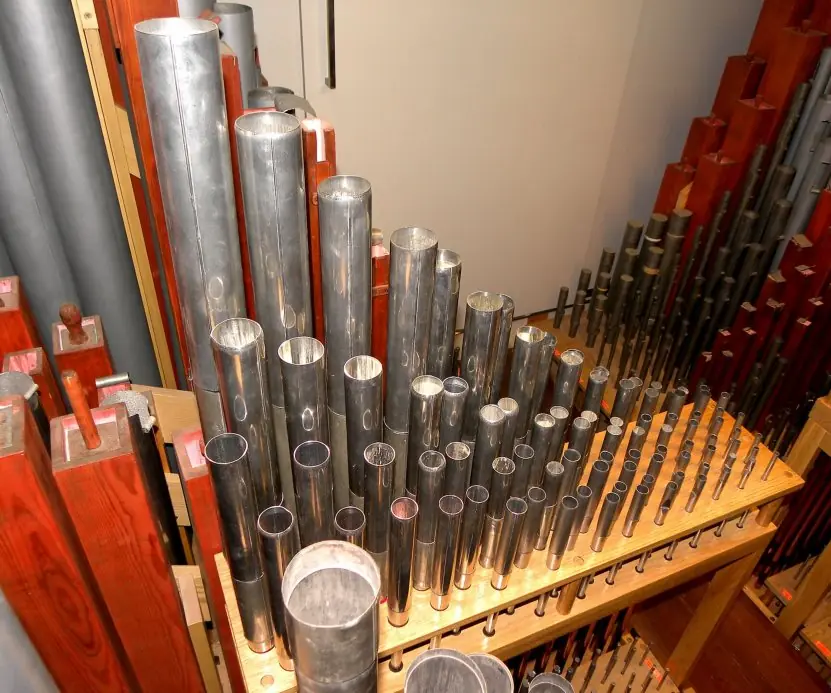
Closed pipe (one end closed): node at the closed end, antinode at the open end; f_n=\dfrac{(2n-1)v}{4L} — only odd harmonics (f_1:f_2:f_3=1:3:5). Open pipe: antinodes at both ends; f_n=\dfrac{nv}{2L} — all harmonics (1:2:3).
A closed pipe's fundamental is half that of an open pipe of the same length. End correction e=0.6r, so L+0.6r is used.
Resonance tube: first resonance at l_1+e=\frac{\lambda}{4}, second at l_2+e=\frac{3\lambda}{4}; hence \lambda=2(l_2-l_1) and v=2f(l_2-l_1) (end correction cancels).
Stretched string (length L, tension T, mass per length \mu): v=\sqrt{\dfrac{T}{\mu}}; f_n=\dfrac{n}{2L}\sqrt{\dfrac{T}{\mu}}.
Laws of vibration: f\propto\frac{1}{L}, f\propto\sqrt{T}, f\propto\frac{1}{\sqrt{\mu}} (or \frac{1}{r} for a given material). The sonometer verifies them; a tuning fork of known frequency resonates with the wire.
4.4 Acoustic phenomena
- Intensity I=\frac{P}{A} (W m⁻²); threshold of hearing I_0=10^{-12} W m⁻²; level \beta=10\log_{10}\frac{I}{I_0} dB (a hundred-fold intensity is +20 dB; doubling adds 3 dB). Pressure amplitude p_0=\sqrt{2\rho vI}. Loudness is subjective (phon, sone).
- Pitch is set by frequency, loudness by amplitude (intensity), quality (timbre) by the number and strength of overtones.
- Beats: two close frequencies give |f_1-f_2| beats per second; adding wax to a fork lowers its frequency; filing raises it.
- Ultrasonic >20 kHz (sonar, imaging, cleaning, bats); infrasonic <20 Hz (earthquakes, elephants). Audible range 20 Hz – 20 kHz.
- Doppler effect: f'=f\dfrac{v+v_o}{v-v_s} (v_o positive toward the source, v_s positive toward the observer). Approach raises the pitch; recession lowers it. For a 500 Hz source approaching at 34 m s⁻¹: 500\times\frac{340}{306}\approx556 Hz. If the medium moves, include its speed.
The wavelength of the closed-pipe fundamental is 4L (not 2L). A change in pressure at constant temperature does not change the speed of sound. Light has no Doppler dependence on a medium but sound does.

Formula and fact sheet
| Topic | Result |
|---|---|
| wave speed | v=f\lambda=\omega/k |
| gas | v=\sqrt{\gamma P/\rho}\propto\sqrt{T} |
| closed / open pipe | \frac{(2n-1)v}{4L} / \frac{nv}{2L} |
| string | \frac{1}{2L}\sqrt{T/\mu} |
| level | 10\log(I/I_0) dB |
| beats | |f_1-f_2| |
| Doppler | f\frac{v+v_o}{v-v_s} |
Chapter summary
- v=f\lambda; stationary-wave nodes are \frac{\lambda}{2} apart.
- Sound speed depends on temperature, medium and humidity; not on pressure alone.
- Closed pipes give odd harmonics; the resonance-tube method gives v=2f(l_2-l_1).
- A string's frequency rises with tension and falls with length and mass density.
- Beats count the frequency difference; a ten-fold intensity change is 10 dB.
Practice questions
Set A — Recall (10 questions)
- A source of 500 Hz produces waves of wavelength 0.68 m. The speed of the wave isa170 m s⁻¹b680 m s⁻¹c340 m s⁻¹d1000 m s⁻¹
- If the absolute temperature of a gas is quadrupled, the speed of sound in itahalvesbdoublescquadruplesdis unchanged
- The fundamental frequency of an open pipe 0.5 m long is (v=340 m s⁻¹)a340 Hzb170 Hzc680 Hzd85 Hz
- A pipe closed at one end can produceano resonanceball harmonicsconly even harmonicsdonly odd harmonics
- A sound of intensity 10^{-6} W m⁻² has an intensity level ofa6 dBb120 dBc60 dBd600 dB
- When a source of sound approaches a stationary observer, the observed frequencyaincreasesbdecreasescis unchangeddis zero
- Ultrasonic waves have frequenciesabelow 20 Hzbabove 20 kHzcfrom 20 Hz to 20 kHzdof exactly zero
- In a stationary wave of wavelength 1 m, the distance between consecutive nodes isa1 mb0.25 mc2 md0.5 m
- If the tension in a stretched string is made four times, its fundamental frequencyabecomes four timesbhalvescdoublesdis unchanged
- Two forks of 256 Hz and 260 Hz sounded together produce beats per second equal toa4b258c516d2
Answers and explanations — Set A
1. (c) — 500\times0.68=340.
2. (b) — v\propto\sqrt{T}, \sqrt{4}=2.
3. (a) — \frac{v}{2L}=\frac{340}{1}.
4. (d) — closed pipe: f=\frac{(2n-1)v}{4L}.
5. (c) — 10\log\frac{10^{-6}}{10^{-12}}=60.
6. (a) — approach compresses the waves.
7. (b) — above the audible limit.
8. (d) — \frac{\lambda}{2}.
9. (c) — f\propto\sqrt{T}.
10. (a) — 260-256.
Set B — Understanding (6 questions)
- The speed of sound in air at 27 °C, taking v_0=331 m s⁻¹ at 0 °C and the rule v=331+0.61\,t, isa347 m s⁻¹b331 m s⁻¹c360 m s⁻¹d300 m s⁻¹
- A pipe closed at one end is 0.85 m long (v=340 m s⁻¹). Its first overtone isa100 Hzb200 Hzc300 Hzd400 Hz
- In a resonance-tube experiment with a 500 Hz fork, resonance occurs at air-column lengths 17 cm and 51 cm. The speed of sound isa340 m s⁻¹b170 m s⁻¹c680 m s⁻¹d510 m s⁻¹
- A 1 m string under 100 N tension has linear density 0.01 kg m⁻¹. Its fundamental frequency isa25 Hzb50 Hzc100 Hzd200 Hz
- A 500 Hz source approaches a stationary observer at 34 m s⁻¹ (v=340). The observed frequency is nearlya450 Hzb500 Hzc556 Hzd600 Hz
- If the intensity of a sound is increased 100-fold, the level rises bya2 dBb10 dBc100 dBd20 dB
Answers and explanations — Set B
1. (a) — 331+0.61\times27=347.5.
2. (c) — f_1=\frac{340}{4\times0.85}=100 Hz; the first overtone is the third harmonic, 300 Hz.
3. (a) — v=2f(l_2-l_1)=2\times500\times0.34.
4. (b) — v=\sqrt{100/0.01}=100; f_1=\frac{100}{2\times1}.
5. (c) — 500\times\frac{340}{340-34}=555.6.
6. (d) — 10\log100=20.
Set C — Application (4 questions)
- A fork of 256 Hz and an unknown fork give 4 beats per second. Loading the unknown fork with wax reduces the beats to 2 per second. The unknown frequency isa252 Hzb260 Hzc258 Hzd264 Hz
- An open pipe has fundamental frequency 300 Hz. If one end is closed, its fundamental becomesa150 Hzb300 Hzc600 Hzd75 Hz
- A whistle of 400 Hz on a train moving at 40 m s⁻¹ (v=340) is heard by a stationary person ahead of the train at nearlya400 Hzb360 Hzc467 Hzd453 Hz
- At a point each of 10 identical sources produces a 50 dB level. The combined level isa500 dBb51 dBc60 dBd55 dB
Answers and explanations — Set C
1. (b) — loading lowers the unknown frequency, and the beats fell from 4 to 2, so the unknown was above 256: it was 260 Hz, loaded down to 258 Hz.
2. (a) — open: \frac{v}{2L}; closed: \frac{v}{4L}, half.
3. (d) — 400\times\frac{340}{300}=453 Hz.
4. (c) — intensities add: 10 times, +10 dB.
Group D — Model answers for long questions (10 marks each, for deeper revision)
- Explain stationary waves in a stretched string, an open pipe and a closed pipe, with the harmonics and numericals. [10]
- Derive the speed of sound in a gas, and explain beats, the Doppler effect and the intensity level of sound. [10]

Model answer D1: Stationary waves in strings and pipes (10 marks)
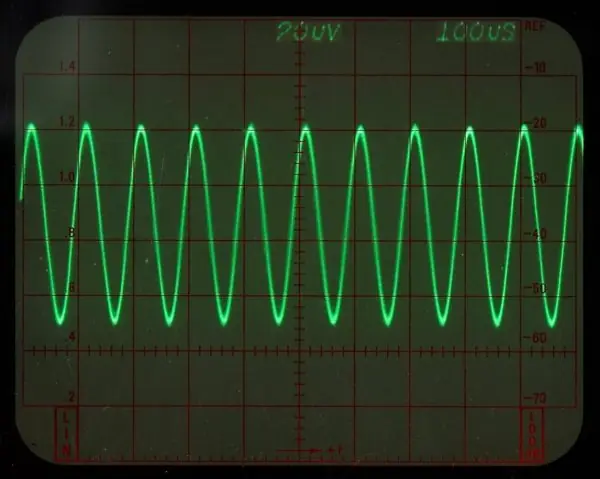
Introduction. A stationary (standing) wave forms when two identical waves travel in opposite directions. It has fixed nodes (zero displacement) and antinodes (maximum displacement) a half wavelength \frac{\lambda}{2} apart, and it carries no net energy.
Stretched string (fixed at both ends). The speed is v = \sqrt{T/\mu} and the allowed wavelengths are \lambda_n = \frac{2L}{n}, so
All harmonics are present. Numerical: L = 0.6\ \text{m}, T = 100\ \text{N}, \mu = 0.01\ \text{kg m}^{-1}: v = 100\ \text{m s}^{-1}, f_1 = 100/1.2 = 83.3\ \text{Hz}, f_2 = 166.7\ \text{Hz}, f_3 = 250\ \text{Hz}.
Laws: f \propto 1/L, f \propto \sqrt{T}, f \propto 1/\sqrt{\mu}.
Open pipe (both ends open, antinodes at both ends). f_n = \frac{nv}{2L}. All harmonics are present. For L = 0.5\ \text{m} and v = 340\ \text{m s}^{-1}: f_1 = 340\ \text{Hz}, then 680 and 1020\ \text{Hz}.
Closed pipe (one end closed: node at the closed end, antinode at the open end). f_n = \frac{(2n-1)v}{4L}. Only odd harmonics are present. For L = 0.5\ \text{m}: f_1 = 170\ \text{Hz}, and the next are 510\ \text{Hz} and 850\ \text{Hz} (ratio 1:3:5).
End correction. The antinode is slightly outside the open end, so the effective length is L + e, with e \approx 0.6r. In the resonance-tube experiment, v = 2(l_2 - l_1)f eliminates e.
| Source | Harmonics | Fundamental |
|---|---|---|
| String, both ends fixed | All | v/2L |
| Open pipe | All | v/2L |
| Closed pipe | Odd only | v/4L |
Conclusion. The boundary conditions fix the wavelengths, so the tone of an instrument depends on its length and on which harmonics are present.
Model answer D2: Speed of sound, beats, Doppler effect and intensity (10 marks)
Introduction. Sound is a longitudinal mechanical wave that needs a medium.
Speed of sound. Newton assumed isothermal changes and got v = \sqrt{P/\rho} (about 280\ \text{m s}^{-1}), which is wrong. Laplace said that compressions are so fast that they are adiabatic, so
For air, \gamma = 1.4, P = 1.013\times10^5\ \text{Pa}, \rho = 1.29\ \text{kg m}^{-3}: v = 331.6\ \text{m s}^{-1} at 0^\circ\text{C}.
The speed increases about 0.61\ \text{m s}^{-1} per ^\circ\text{C}, so it is about 343\ \text{m s}^{-1} at 20^\circ\text{C}. It does not depend on pressure at constant temperature, and it increases with humidity.
Beats. Two sounds of nearby frequencies f_1 and f_2 give periodic loud-soft variations. The beat frequency is |f_1 - f_2|; for 256\ \text{Hz} and 260\ \text{Hz} it is 4 beats per second. Musicians use beats to tune instruments.
Doppler effect. The apparent frequency changes when the source or observer moves: f' = f\,\frac{v \pm v_o}{v \mp v_s}.
Numerical: a 340\ \text{Hz} siren moving at 20\ \text{m s}^{-1} towards a still observer (v = 340): f' = 340\times\frac{340}{320} = 361\ \text{Hz}, and when moving away f' = 340\times\frac{340}{360} = 321\ \text{Hz}.
It is used in radar, ultrasound blood-flow scans and speed guns.
Intensity level. The loudness is measured by \beta = 10\log_{10}\frac{I}{I_0} decibels, with I_0 = 10^{-12}\ \text{W m}^{-2}. For I = 10^{-6} the level is 60\ \text{dB}, and two such sources together (2\times10^{-6}) give 63\ \text{dB}, not 120\ \text{dB}.
| Effect | Cause | Formula |
|---|---|---|
| Beats | Two close frequencies | \lvert f_1 - f_2\rvert |
| Doppler | Relative motion | f' = f\,\frac{v \pm v_o}{v \mp v_s} |
| Sound level | Logarithmic scale | 10\log(I/I_0) |
Conclusion. The adiabatic correction of Laplace gives the correct speed, and beats, the Doppler effect and the decibel scale describe how we hear sound.