Chapter 5 · Physics · 7 questions in the paper · 16 min read
Electricity and Magnetism
What the syllabus asks for 7
- Electrostatics: Coulomb's law, field, Gauss's law, potential, capacitors and their combinations, dielectrics, energy stored
- DC circuits: Ohm's law, resistivity, work and power, galvanometer and ohmmeter, internal resistance, Joule's law, Kirchhoff's laws
- Thermoelectric effect: Seebeck, thermocouples, Peltier, thermopile, Thomson
- Magnetic effect: force on a conductor and a charge, torque, Hall effect, Biot-Savart law, Ampere's law, force between parallel conductors
- Magnetic properties of matter: earth's magnetism, magnetic materials, permeability, susceptibility, hysteresis
- Electromagnetic induction: Faraday's law, induced emf, AC generator, self and mutual induction, energy in an inductor, transformer
- Alternating currents: rms value, phasors of R, L, C, quality factor, power factor
Electricity and magnetism carry about 7 questions (our estimate), second only to mechanics.
Seven sub-areas share them: electrostatics and capacitors, DC circuits, thermoelectricity, magnetic force and fields, magnetic materials, induction, and AC.
Most numerical questions are a single formula; Section B ones chain two (a cell with internal resistance, an RLC power factor, a charge in a magnetic field).
- Coulomb F=\frac{kq_1q_2}{r^2}, field and potential of a point charge, Gauss's law, field of sphere / sheet / line.
- Capacitors: C=\frac{\varepsilon_0A}{d}, series \frac{1}{C}=\sum\frac{1}{C_i}, parallel \sum C_i, U=\frac{1}{2}CV^2, dielectric K.
- DC: R=\rho\frac{l}{A}, P=I^2R=\frac{V^2}{R}, internal resistance V=\varepsilon-Ir, Kirchhoff, Wheatstone, shunt and multiplier.
- Magnetism: F=qvB\sin\theta, F=BIl, torque NIAB, Biot–Savart, solenoid \mu_0nI, wires \frac{\mu_0I_1I_2}{2\pi d}, Hall effect.
- Induction: \varepsilon=-N\frac{d\Phi}{dt}, motional emf Blv, L, M, U=\frac{1}{2}LI^2, transformer.
- AC: I_{rms}=\frac{I_0}{\sqrt{2}}, X_L=\omega L, X_C=\frac{1}{\omega C}, Z, resonance f=\frac{1}{2\pi\sqrt{LC}}, \cos\phi=\frac{R}{Z}.
5.1 Electrostatics
Coulomb's law: F=\dfrac{1}{4\pi\varepsilon_0}\dfrac{q_1q_2}{r^2}, k=9\times10^9 N m² C⁻²; in a medium divide by \varepsilon_r.
Two charges of 1 µC at 1 m: 9\times10^{-3} N. Electric field E=\frac{F}{q}=\frac{kQ}{r^2} (lines start on positive charges, never cross, are perpendicular to conductors' surfaces); between plates E=\frac{V}{d}.
Dipole: p=qd; torque pE\sin\theta; energy -pE\cos\theta; axial field \frac{2kp}{r^3}, equatorial \frac{kp}{r^3}.
Gauss's law: \oint\vec E\cdot d\vec A=\frac{q_{enc}}{\varepsilon_0}.
Results: infinite line \frac{\lambda}{2\pi\varepsilon_0r}; infinite sheet \frac{\sigma}{2\varepsilon_0}; conductor surface \frac{\sigma}{\varepsilon_0}; charged sphere outside \frac{kQ}{r^2}, inside a conductor 0, inside a uniformly charged solid sphere \frac{kQr}{R^3}.
Potential V=\frac{kQ}{r} (scalar; adds algebraically); E=-\frac{dV}{dr}; work W=q(V_A-V_B); potential energy of two charges \frac{kq_1q_2}{r}; equipotential surfaces are perpendicular to field lines. 1 eV =1.6\times10^{-19} J. Point-charge zero field between like charges 4\muC and 1\muC 30 cm apart is at 20 cm from the larger one.
Capacitors. C=\frac{Q}{V}; parallel plate C=\frac{\varepsilon_0A}{d} (with a dielectric K\frac{\varepsilon_0A}{d}); sphere 4\pi\varepsilon_0R; cylindrical, spherical shells.
Series: \frac{1}{C}=\frac{1}{C_1}+\frac{1}{C_2}, same charge; parallel: C=C_1+C_2, same voltage. Energy U=\frac{1}{2}CV^2=\frac{Q^2}{2C}=\frac{1}{2}QV; energy density \frac{1}{2}\varepsilon_0E^2.
Dielectric (inserted with the battery off): C\to KC, V\to\frac{V}{K}, E\to\frac{E}{K}, Q constant, U\to\frac{U}{K}; (battery on: V same, Q\to KQ). Polarisation reduces the field inside the dielectric; displacement D=\varepsilon E.
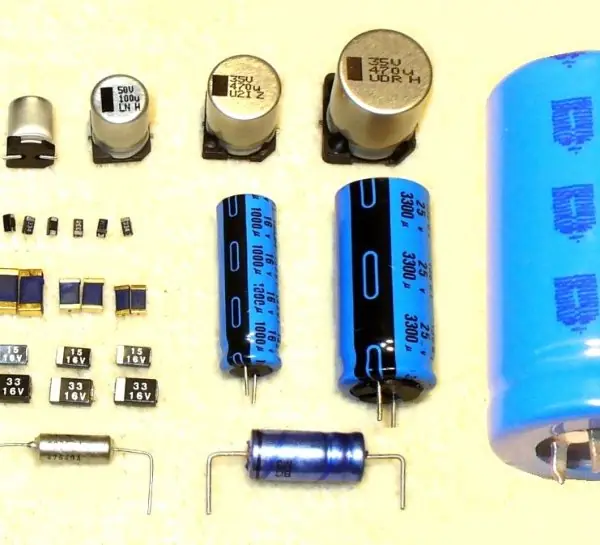
Types: paper, mica, electrolytic (polarised), variable. Sharing charge between capacitors: common V=\frac{C_1V_1+C_2V_2}{C_1+C_2}, with an energy loss.
5.2 DC circuits
Ohm's law V=IR; resistivity R=\rho\frac{l}{A} (\rho rises with T for metals, falls for semiconductors); drift velocity v_d=\frac{I}{nAe}; conductivity \sigma=\frac{1}{\rho}. R_t=R_0(1+\alpha t).
Series R=\sum R_i; parallel \frac{1}{R}=\sum\frac{1}{R_i} (6 Ω ∥ 3 Ω = 2 Ω). Power P=VI=I^2R=\frac{V^2}{R}; a 100 W, 220 V bulb has R=484\ \Omega and, on 110 V, gives 25 W. Energy =Pt; H=I^2Rt (Joule's law).
Cell: \varepsilon=V+Ir; current I=\frac{\varepsilon}{R+r}; terminal voltage V=\varepsilon-Ir (cell of 2 V, r=0.5 Ω, R=4.5 Ω: 1.8 V). Maximum power transfer when R=r. Series of n cells n\varepsilon, nr; parallel \varepsilon, \frac{r}{n}.
Kirchhoff: junction rule \sum I=0 (charge conservation); loop rule \sum\varepsilon=\sum IR (energy). Wheatstone bridge balances when \frac{P}{Q}=\frac{R}{S}.
Meter bridge, potentiometer (compare emfs, \frac{\varepsilon_1}{\varepsilon_2}=\frac{l_1}{l_2}; measures without drawing current).
Galvanometer (moving coil, \theta\propto I): ammeter by a parallel shunt S=\frac{I_gG}{I-I_g}; voltmeter by a series multiplier R=\frac{V}{I}_g-G; an ideal ammeter has zero resistance, an ideal voltmeter infinite.
Ohmmeter uses a cell with the galvanometer and a series resistor (zero at right end).
5.3 Thermoelectric effect
Seebeck effect: a loop of two different metals with junctions at different temperatures carries an emf, \varepsilon=aT+\frac{1}{2}bT^2 (a thermocouple).
The neutral temperature is where \frac{d\varepsilon}{dT}=0, the inversion temperature is 2T_n-T_c. A thermopile (several couples in series) detects small radiation.
Peltier effect: current through a junction absorbs or releases heat (\Pi), the reverse of Seebeck; it makes thermoelectric coolers. Thomson effect: heat is absorbed or released along a single conductor with a temperature gradient.
Applications: thermometry of very high and low temperatures, refrigeration.
5.4 Magnetic effect of current
Force on a charge: \vec F=q\vec v\times\vec B (no work done); in a perpendicular field the path is a circle of radius r=\frac{mv}{qB}, period T=\frac{2\pi m}{qB} (independent of speed: the cyclotron); with \vec E also: Lorentz q(\vec E+\vec v\times\vec B).
A proton at 10^6 m s⁻¹ in 0.1 T: r\approx10 cm. Force on a conductor: F=BIl\sin\theta. Torque on a coil: \tau=NIAB\sin\theta (moving-coil galvanometer); magnetic moment m=NIA.
Hall effect: V_H=\frac{BI}{nqt} gives the sign and density of the carriers and measures B.
Biot–Savart: dB=\frac{\mu_0}{4\pi}\frac{I\,dl\sin\theta}{r^2}, \mu_0=4\pi\times10^{-7} T m A⁻¹.
Long straight wire B=\frac{\mu_0I}{2\pi r} (5 A at 0.1 m: 10^{-5} T); centre of a circular loop \frac{\mu_0NI}{2R}; on the axis \frac{\mu_0IR^2}{2(R^2+x^2)^{3/2}}; solenoid B=\mu_0nI (n turns per metre), toroid \frac{\mu_0NI}{2\pi r}.
Ampère's law: \oint\vec B\cdot d\vec l=\mu_0I_{enc}. Parallel wires: force per length \frac{\mu_0I_1I_2}{2\pi d}, attractive for currents in the same direction (defines the ampere). 10 A and 20 A at 10 cm: 4\times10^{-4} N m⁻¹.
5.5 Magnetic properties of matter
Earth's magnetism: declination, dip (inclination) \delta, horizontal component B_H; \tan\delta=\frac{B_V}{B_H}; dip is 0 at the magnetic equator and 90^\circ at the poles.
Materials: diamagnetic (\chi small negative, weakly repelled: Bi, Cu, water); paramagnetic (\chi small positive, \chi\propto\frac{1}{T} Curie: Al, Pt); ferromagnetic (\chi large positive, domains, lose ferromagnetism above the Curie temperature: Fe, Co, Ni). \mu=\mu_0\mu_r, \mu_r=1+\chi, B=\mu_0(H+M).
Hysteresis: the B–H loop; retentivity, coercivity; the loop area is the energy lost per cycle per volume. Soft iron (narrow loop, low retentivity) is for transformer cores and electromagnets; steel (wide loop) for permanent magnets.
5.6 Electromagnetic induction
Faraday: \varepsilon=-N\frac{d\Phi}{dt}, \Phi=BA\cos\theta (weber); Lenz's law (the sign: the induced current opposes the change; conservation of energy).
Motional emf \varepsilon=Blv (a rod of 0.5 m at 4 m s⁻¹ in 0.2 T: 0.4 V); rotating rod \frac{1}{2}B\omega l^2. Induced charge \frac{\Delta\Phi}{R}. Eddy currents (braking, induction furnace, laminated cores to reduce them).
AC generator: coil of N turns, area A, rotating at \omega: \varepsilon=NBA\omega\sin\omega t.
Self-inductance \varepsilon=-L\frac{dI}{dt}, \Phi=LI; solenoid L=\mu_0n^2Al; energy U=\frac{1}{2}LI^2 (2 H, 0 to 5 A in 0.1 s: emf 100 V, energy 25 J). Mutual inductance \varepsilon_2=-M\frac{dI_1}{dt}.
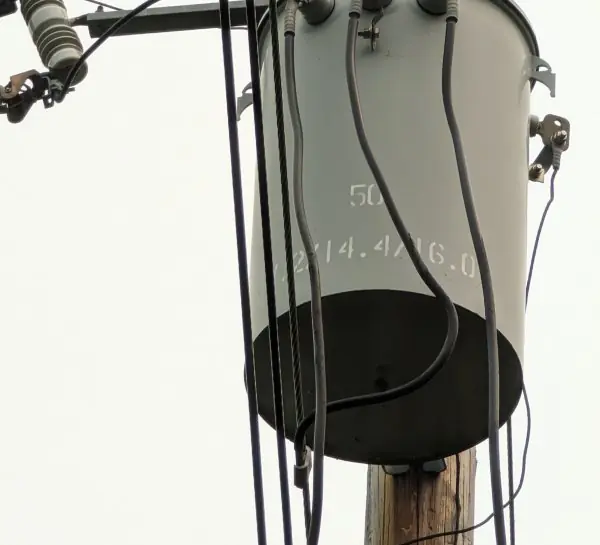
Transformer (ideal): \frac{V_s}{V_p}=\frac{N_s}{N_p}=\frac{I_p}{I_s}; step-up raises voltage and lowers current; losses: copper, iron (eddy, hysteresis), flux leakage; efficiency \frac{P_s}{P_p}.
High-voltage transmission lowers I^2R loss.
5.7 Alternating currents
I=I_0\sin\omega t; I_{rms}=\frac{I_0}{\sqrt{2}}=0.707I_0 (220 V mains has a peak of 311 V; Nepal's supply is 220 V, 50 Hz); mean value over a half cycle \frac{2I_0}{\pi}.
Reactances X_L=\omega L (the voltage leads current by 90^\circ), X_C=\frac{1}{\omega C} (the voltage lags by 90^\circ); resistor in phase. Series LCR: Z=\sqrt{R^2+(X_L-X_C)^2}, \tan\phi=\frac{X_L-X_C}{R}.
Resonance at \omega_0=\frac{1}{\sqrt{LC}} (L=1 mH, C=1\,\muF: 5 kHz): Z=R, current maximum, phase zero. Quality factor Q=\frac{\omega_0L}{R}=\frac{1}{R}\sqrt{\frac{L}{C}} (sharpness of resonance).
Power P=V_{rms}I_{rms}\cos\phi; power factor \cos\phi=\frac{R}{Z} (R = 30 Ω, X_L=60, X_C=20: Z=50, \cos\phi=0.6); a pure L or C draws no average power (wattless current).
Choke coil lowers current with little loss; the LC circuit oscillates with f=\frac{1}{2\pi\sqrt{LC}}.
Potential is a scalar and field a vector; when charges are shared, charge is conserved but energy is not. A dielectric inserted with the battery disconnected lowers V; with it connected raises Q.
In AC problems use rms values unless asked for the peak. The voltage rating of a ceramic capacitor is its limit; the force between parallel wires is attractive for parallel currents.

Formula and fact sheet
| Topic | Result |
|---|---|
| Coulomb | 9\times10^9\frac{q_1q_2}{r^2} |
| E, V (point) | \frac{kQ}{r^2}, \frac{kQ}{r} |
| capacitor | \frac{\varepsilon_0A}{d}; U=\frac{1}{2}CV^2 |
| internal resistance | V=\varepsilon-Ir |
| shunt | \frac{I_gG}{I-I_g} |
| wire / solenoid | \frac{\mu_0I}{2\pi r} / \mu_0nI |
| Lorentz radius | \frac{mv}{qB} |
| emf | N\frac{d\Phi}{dt}; Blv |
| transformer | \frac{V_s}{V_p}=\frac{N_s}{N_p} |
| RLC | Z=\sqrt{R^2+(X_L-X_C)^2}; \cos\phi=\frac{R}{Z} |
Chapter summary
- E=\frac{kQ}{r^2}, V=\frac{kQ}{r}; Gauss's law gives symmetric fields.
- Series capacitors share charge; parallel share voltage; energy \frac{1}{2}CV^2.
- Terminal voltage is \varepsilon-Ir; shunts go in parallel, multipliers in series.
- Moving charges in B go in circles; parallel currents attract.
- Para-, dia- and ferro-magnetism differ in sign and size of \chi.
- Induced emf opposes the change (Lenz); transformers trade voltage for current.
- RLC: Z, resonance at \frac{1}{2\pi\sqrt{LC}} and power factor \frac{R}{Z}.
Practice questions
Set A — Recall (12 questions)
- The force between two 1 µC charges 1 m apart in air isa9 Nb1 Nc9\times10^{-3} Nd9\times10^{-6} N
- Capacitors of 2 µF and 3 µF connected in series have a combined capacitance ofa1.2 µFb5 µFc1.5 µFd6 µF
- The energy stored in a 10 µF capacitor charged to 100 V isa0.5 Jb5 Jc0.5 mJd0.05 J
- The equivalent resistance of 6 Ω and 3 Ω in parallel isa9 Ωb2 Ωc3 Ωd4.5 Ω
- The resistance of a 220 V, 100 W bulb isa484 Ωb2.2 Ωc22000 Ωd220 Ω
- The magnetic field 0.1 m from a long straight wire carrying 5 A isa10^{-6} Tb10^{-4} Tc10^{-5} Td2\times10^{-6} T
- A 0.5 m conductor carrying 4 A is perpendicular to a 0.2 T field. The force on it isa0.1 Nb0.8 Nc1.6 Nd0.4 N
- A coil of 100 turns has its flux changed by 0.01 Wb in 0.1 s. The induced emf isa1 Vb10 Vc100 Vd0.1 V
- A transformer has 100 primary and 1000 secondary turns; 220 V is applied to the primary. The secondary voltage isa2200 Vb22 Vc22000 Vd220 V
- The rms value of an AC of peak voltage 311 V is nearlya311 Vb440 Vc220 Vd155 V
- The resonant frequency of a series LC circuit with L=1 mH and C=1\ \muF is nearlya159 Hzb1 kHzc31.6 kHzd5033 Hz
- A material with a small positive magnetic susceptibility isadiamagneticbparamagneticcferromagneticdsuperconducting
Answers and explanations — Set A
1. (c) — 9\times10^9\times10^{-12}/1.
2. (a) — \frac{2\times3}{2+3}=1.2.
3. (d) — \frac{1}{2}\times10^{-5}\times10^4=0.05 J.
4. (b) — \frac{6\times3}{9}=2.
5. (a) — R=\frac{V^2}{P}=\frac{48400}{100}.
6. (c) — \frac{\mu_0I}{2\pi r}=\frac{2\times10^{-7}\times5}{0.1}.
7. (d) — BIl=0.2\times4\times0.5.
8. (b) — N\frac{\Delta\Phi}{\Delta t}=100\times0.1.
9. (a) — 220\times\frac{1000}{100}.
10. (c) — \frac{311}{\sqrt{2}}.
11. (d) — \frac{1}{2\pi\sqrt{10^{-9}}}=5033 Hz.
12. (b) — paramagnetic; diamagnetic \chi<0, ferromagnetic \chi\gg1.
Set B — Understanding (8 questions)
- Charges +4\ \muC and +1\ \muC are 30 cm apart. The electric field is zero on the line between them at a distance from the 4\ \muC charge ofa10 cmb15 cmc25 cmd20 cm
- The potential at a distance of 0.9 m from a 2 µC point charge isa2\times10^4 Vb2\times10^3 Vc2\times10^5 Vd1.8\times10^4 V
- A parallel-plate capacitor has plate area 100 cm² and separation 1 mm in air (\varepsilon_0=8.85\times10^{-12}). Its capacitance isa8.85 pFb88.5 pFc885 pFd8.85 nF
- A cell of emf 2 V and internal resistance 0.5 Ω is connected to a 4.5 Ω resistor. The terminal voltage isa2.0 Vb1.6 Vc1.8 Vd0.2 V
- A galvanometer of 100 Ω and full-scale current 1 mA is to read 1 A. The shunt needed is abouta0.1 Ωb1 Ωc10 Ωd100 Ω
- A coil of 50 turns, area 0.02 m² carries 2 A in a 0.5 T field. The maximum torque isa0.5 N mb2 N mc10 N md1 N m
- A 2 H inductor's current rises from 0 to 5 A in 0.1 s. The average induced emf isa10 Vb100 Vc50 Vd200 V
- In a series circuit R=30\ \Omega, X_L=60\ \Omega, X_C=20\ \Omega. The power factor isa0.8b0.5c0.6d1
Answers and explanations — Set B
1. (d) — \frac{x}{0.3-x}=\sqrt{\frac{4}{1}}=2, x=0.2 m.
2. (a) — \frac{9\times10^9\times2\times10^{-6}}{0.9}.
3. (b) — \frac{8.85\times10^{-12}\times10^{-2}}{10^{-3}}=8.85\times10^{-11} F.
4. (c) — I=\frac{2}{5}=0.4 A; V=2-0.4\times0.5=1.8 V.
5. (a) — S=\frac{0.001\times100}{0.999}\approx0.1\ \Omega.
6. (d) — NIAB=50\times2\times0.02\times0.5.
7. (b) — L\frac{\Delta I}{\Delta t}=2\times50.
8. (c) — Z=\sqrt{30^2+40^2}=50; \cos\phi=\frac{30}{50}.
Set C — Application (6 questions)
- A 100 W, 220 V lamp is run on 110 V. Its power isa50 Wb100 Wc12.5 Wd25 W
- In a balanced Wheatstone bridge P=10\ \Omega, Q=20\ \Omega, R=30\ \Omega. The fourth arm S isa15 Ωb40 Ωc60 Ωd20 Ω
- Two long parallel wires 10 cm apart carry 10 A and 20 A in the same direction. The force per unit length isa4\times10^{-4} N m⁻¹, attractiveb4\times10^{-4} N m⁻¹, repulsivec2\times10^{-4} N m⁻¹, attractived4\times10^{-5} N m⁻¹, attractive
- A proton (m=1.67\times10^{-27} kg) moves at 10^6 m s⁻¹ perpendicular to a 0.1 T field. The radius of its path is nearlya1 cmb10 cmc1 md0.1 mm
- A series RLC circuit has R=10\ \Omega, L=0.1 H and C=100\ \muF. Its quality factor is nearlya31.6b316c3.16d0.316
- A 0.5 m rod moves at 4 m s⁻¹ perpendicular to a 0.2 T field. The emf across its ends isa0.1 Vb4 Vc0.8 Vd0.4 V
Answers and explanations — Set C
1. (d) — P\propto V^2, \frac{1}{4}\times100.
2. (c) — \frac{P}{Q}=\frac{R}{S}: S=\frac{RQ}{P}=60.
3. (a) — \frac{2\times10^{-7}\times10\times20}{0.1}=4\times10^{-4}; same-direction currents attract.
4. (b) — r=\frac{mv}{qB}=\frac{1.67\times10^{-27}\times10^6}{1.6\times10^{-19}\times0.1}=0.104 m.
5. (c) — \omega_0=316 rad s⁻¹, Q=\frac{\omega_0L}{R}=\frac{31.6}{10}.
6. (d) — Blv=0.2\times0.5\times4.
Group D — Model answers for long questions (10 marks each, for deeper revision)
- State Coulomb's law, define electric field and potential, and explain capacitors in series and parallel with the energy stored. [10]
- State Kirchhoff's laws; explain internal resistance, the Wheatstone bridge and the potentiometer, with numericals. [10]
- Explain electromagnetic induction, the transformer and the series LCR circuit with resonance and power factor. [10]
Model answer D1: Electrostatics and capacitors (10 marks)
Introduction. Coulomb's law: the force between two point charges in vacuum is F = \frac{1}{4\pi\varepsilon_0}\frac{q_1q_2}{r^2}, along the line joining them, with \frac{1}{4\pi\varepsilon_0} = 9\times10^9\ \text{N m}^2\text{C}^{-2}.
For 2\ \mu\text{C} and 3\ \mu\text{C} at 0.3\ \text{m}: F = 9\times10^9\times\frac{6\times10^{-12}}{0.09} = 0.6\ \text{N}.
Field and potential.
- Electric field E = F/q_0 = \frac{kQ}{r^2} (unit N C⁻¹ or V m⁻¹).
- Potential V = \frac{kQ}{r} (a scalar); E = -\frac{dV}{dr}.
- Gauss's law: \oint E\cdot dA = \frac{Q}{\varepsilon_0}; inside a charged conducting sphere the field is zero.
- Potential energy of two charges U = \frac{kq_1q_2}{r}.
Capacitor. C = \frac{Q}{V}; a parallel-plate capacitor has C = \frac{\varepsilon_0A}{d}, and a dielectric of constant K multiplies it by K.
| Arrangement | Equivalent capacitance | Charge and voltage |
|---|---|---|
| Series | \frac{1}{C} = \frac{1}{C_1} + \frac{1}{C_2} | Same Q, voltages add |
| Parallel | C = C_1 + C_2 | Same V, charges add |
For 4\ \mu\text{F} and 12\ \mu\text{F}: series = \frac{4\times12}{16} = 3\ \mu\text{F} and parallel = 16\ \mu\text{F}.
Energy stored. U = \frac{1}{2}CV^2 = \frac{Q^2}{2C} = \frac{1}{2}QV. For the 3\ \mu\text{F} combination charged to 12\ \text{V}: U = \frac{1}{2}\times3\times10^{-6}\times144 = 216\ \mu\text{J}. The energy density is \frac{1}{2}\varepsilon_0E^2.
Conclusion. Charges create fields and potentials, and capacitors store energy in the field between their plates.
Model answer D2: DC circuits (10 marks)
Introduction. Ohm's law (V = IR) is not enough for a network, so Kirchhoff's laws are used.
Kirchhoff's laws.
- Junction (current) law: the sum of currents entering a junction equals the sum leaving (\sum I = 0), which expresses conservation of charge.
- Loop (voltage) law: around a closed loop \sum E = \sum IR, which expresses conservation of energy.
Internal resistance. A cell of emf E and internal resistance r gives I = \frac{E}{R + r} and a terminal voltage V = E - Ir. For E = 12\ \text{V}, r = 1\ \Omega, R = 5\ \Omega: I = 2\ \text{A} and V = 10\ \text{V}. Maximum power goes to the load when R = r.
Wheatstone bridge. Four resistances P, Q, R, S are balanced when no current flows in the galvanometer: \frac{P}{Q} = \frac{R}{S}. For P = 10\ \Omega, Q = 15\ \Omega, R = 20\ \Omega: S = \frac{RQ}{P} = 30\ \Omega.
The meter bridge is the practical form, using S = R\,\frac{100 - l}{l}.
Potentiometer. A long uniform wire carries a steady current. A cell is balanced at length l where the potential difference equals its emf, so no current is drawn.
Uses: (a) compare emfs \frac{E_1}{E_2} = \frac{l_1}{l_2}; (b) find the internal resistance r = R\left(\frac{l_1}{l_2} - 1\right). It is more accurate than a voltmeter.
Series and parallel. Series: R = R_1 + R_2; parallel: \frac{1}{R} = \frac{1}{R_1} + \frac{1}{R_2}.
| Instrument | Principle | Advantage |
|---|---|---|
| Wheatstone bridge | Balanced ratio | Accurate R |
| Potentiometer | Null deflection | No current drawn from the cell |
| Voltmeter | Deflection | Draws some current |
Conclusion. Kirchhoff's laws solve any network, and null-deflection methods give accurate measurements.
Model answer D3: Electromagnetic induction, transformer and AC circuits (10 marks)
Introduction. Faraday's law: the induced emf is E = -\frac{d\Phi}{dt}, and Lenz's law (the minus sign) says that the induced current opposes the change that produces it, so energy is conserved.
Transformer. It has primary and secondary coils on a soft-iron core, and works only with AC. \frac{V_s}{V_p} = \frac{N_s}{N_p} = \frac{I_p}{I_s} (ideal).
A step-down transformer from 11{,}000\ \text{V} to 230\ \text{V} has turns ratio \frac{11000}{230} = 47.8. Losses: copper loss, eddy currents (laminated core), hysteresis and flux leakage.
Series LCR circuit. The reactances are X_L = \omega L and X_C = \frac{1}{\omega C}, so Z = \sqrt{R^2 + (X_L - X_C)^2} and \tan\phi = \frac{X_L - X_C}{R}. Numerical: R = 40\ \Omega, L = 0.2\ \text{H}, C = 100\ \mu\text{F}, 230\ \text{V}, 50\ \text{Hz}.
| Quantity | Working | Value |
|---|---|---|
| X_L | 2\pi\times50\times0.2 | 62.8\ \Omega |
| X_C | \frac{1}{2\pi\times50\times10^{-4}} | 31.8\ \Omega |
| Z | \sqrt{40^2 + 31.0^2} | 50.6\ \Omega |
| I_{rms} | 230/50.6 | 4.54\ \text{A} |
| Phase angle | \tan^{-1}(31.0/40) | 37.8^\circ (voltage leads) |
| Power factor | R/Z | 0.79 |
| Power | VI\cos\phi = I^2R | 826\ \text{W} |
Resonance. When X_L = X_C, Z = R (minimum), the current is maximum and the power factor is 1. The resonant frequency is f_0 = \frac{1}{2\pi\sqrt{LC}}; here f_0 = 35.6\ \text{Hz}. This is how a radio is tuned to a station.
Conclusion. Changing flux induces emf, transformers use it to change voltage, and in an AC circuit the average power depends on the power factor.