Unit 7 · Waves and Optics · 4 teaching hours · 23 min read
Mechanical waves
What the syllabus asks for 4
- Speed of wave motion; Velocity of sound in solid and liquid
- Velocity of sound in gas
- Laplace's correction
- Effect of temperature, pressure, humidity on velocity of sound
A mechanical wave carries energy through matter without carrying the matter along with it.
Sound is the mechanical wave you meet every day, and this short unit answers one question about it: what fixes its speed? The answer turns out to depend on only two properties of the medium — how stiff it is and how heavy it is — plus, for a gas, one subtlety about heat that took physics a century to get right.
Four things, over and over: the general formula v=\sqrt{E/\rho} applied to a named medium; the derivation of Newton's formula; Laplace's correction and why it was needed; and a numerical using v_t = v_0\sqrt{T/273}. Learn those four and the unit is finished.
7.1 Speed of wave motion; velocity of sound in solid and liquid
Every wave obeys the kinematic relation
but this only relates speed, frequency and wavelength — it does not say what the speed is. The speed is decided by the medium, not by the source. If you sound a horn louder or at a higher pitch, the sound still arrives at the same time.
A mechanical wave travels because a disturbed part of the medium pulls its neighbour back (elasticity) and because that neighbour resists being moved (inertia). Newton showed that these two combine as
where \rho is the density of the medium and E is the modulus of elasticity appropriate to the kind of deformation the wave produces. Choosing the right modulus is the whole skill.
| Medium and wave | Deformation | Modulus used | Speed |
|---|---|---|---|
| Long thin solid rod, longitudinal | stretch/squeeze along rod | Young's modulus Y | v=\sqrt{Y/\rho} |
| Liquid, longitudinal | change of volume | Bulk modulus B | v=\sqrt{B/\rho} |
| Gas, longitudinal | change of volume | Bulk modulus of gas | v=\sqrt{B/\rho} |
| Stretched string, transverse | change of shape | tension T, mass per length \mu | v=\sqrt{T/\mu} |
The speed of a mechanical wave in a medium is the square root of the ratio of the relevant elastic modulus of the medium to its density: v = \sqrt{E/\rho}.
A liquid and a gas have no rigidity, so they cannot be sheared: sound in a fluid is always longitudinal.
A solid resists both squeezing and shearing, so a solid carries both longitudinal and transverse waves — which is exactly why an earthquake such as Gorkha 2015 produces two body waves, the fast longitudinal P-wave and the slower transverse S-wave, and why seismologists at the National Seismological Centre can locate an epicentre from the gap between their arrivals.
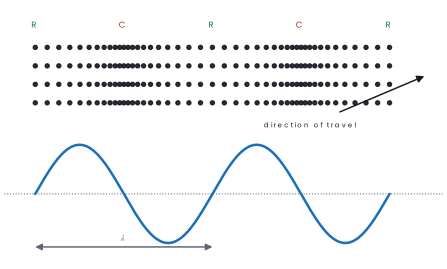
Notice from the table that steel is about eight times denser than water, yet sound goes more than three times faster in steel. Density alone never decides the answer: Young's modulus of steel is roughly a hundred times the bulk modulus of water, and stiffness wins.
Problem. Find the speed of sound(a) in a steel rail, for which Y = 2.0\times10^{11}\ \text{Pa} and \rho = 7800\ \text{kg m}^{-3}, and(b) in water, for which B = 2.2\times10^{9}\ \text{Pa} and \rho = 1000\ \text{kg m}^{-3}.
Solution.
(a) A rail is a long thin solid, so use Young's modulus:
(b) Water is a liquid, so use the bulk modulus:
So sound travels about 5060 m s⁻¹ in steel and 1480 m s⁻¹ in water, against roughly 340 m s⁻¹ in air. Put your ear to a rail and you hear the train long before the air carries the sound to you.
7.2 Velocity of sound in gas
For a gas the deformation is a change of volume, so the modulus needed is the bulk modulus
The minus sign is there because an increase in pressure produces a decrease in volume, and it makes B positive.
Newton (1686) now had to decide how the gas is compressed.
He argued that the compressions and rarefactions are slow enough, and the gas thin enough, for the heat generated in a compression to leak away at once, so the temperature of the gas stays constant. That is an isothermal change.
For an isothermal change of an ideal gas, Boyle's law gives
Differentiating the product,
The left-hand side is precisely the bulk modulus, so the isothermal bulk modulus is B_{iso} = P. Substituting in v = \sqrt{B/\rho}:
This is Newton's formula.
Test it at normal temperature and pressure, where P = 1.013\times10^{5}\ \text{Pa} and \rho = 1.293\ \text{kg m}^{-3} for air:
The measured value at 0 °C is about 332 m s⁻¹. Newton's answer is too small by 52 m s⁻¹ — an error of about 16 %. No experiment of that era was that bad, so the assumption, not the measurement, had to be wrong.
7.3 Laplace's correction
In 1816 Laplace located the faulty assumption. Sound of even the lowest audible frequency, 20 Hz, compresses a given layer of air 20 times a second; at 1000 Hz the compression lasts about half a millisecond.
Air is also a very poor conductor of heat. In that time practically no heat leaves a compression or enters a rarefaction. The changes are therefore not isothermal but adiabatic.
For an adiabatic change of an ideal gas,
Differentiating the product,
Dividing throughout by V^{\gamma-1} and rearranging,
The adiabatic bulk modulus is \gamma times the isothermal one. Hence the corrected speed is
For air \gamma = 1.4, so the corrected value at NTP is
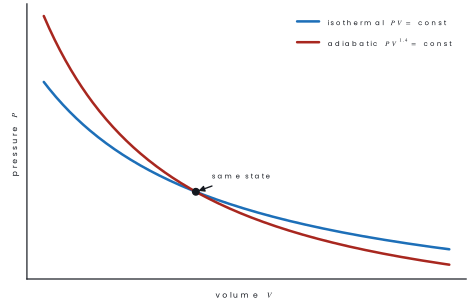
which agrees with experiment. The graph below shows why \gamma appears: an adiabatic curve through a given state is steeper than the isothermal curve through the same state, by exactly the factor \gamma, so the gas is harder to squeeze and the wave travels faster.
| Newton | Laplace | |
|---|---|---|
| Assumed process | isothermal | adiabatic |
| Reason given | heat escapes instantly | air is a bad conductor, changes are fast |
| Bulk modulus | B = P | B = \gamma P |
| Speed formula | v=\sqrt{P/\rho} | v=\sqrt{\gamma P/\rho} |
| Value for air at 0 °C | 280 m s⁻¹ | 331 m s⁻¹ |
| Agreement with experiment | 16 % too low | agrees |
A very common slip is to write "Laplace's correction is v=\sqrt{\gamma P/\rho} because sound is a longitudinal wave". The longitudinal nature has nothing to do with it.
The correction is only that the compressions are adiabatic, so the bulk modulus is \gamma P and not P. Say that sentence in the exam and the mark is yours.
Problem. Calculate the velocity of sound in hydrogen at 0 °C, given \gamma = 1.4, P = 1.013\times10^{5}\ \text{Pa} and density of hydrogen = 0.09\ \text{kg m}^{-3}. Compare it with the value in air.
Solution.
Since \gamma is the same for both diatomic gases, the ratio of speeds is
Sound travels about 3.8 times faster in hydrogen than in air, because hydrogen is far lighter while its stiffness \gamma P is the same.
7.4 Effect of temperature, pressure, humidity on velocity of sound
To see which quantities really matter, eliminate \rho using the ideal gas equation. For n moles of gas of molar mass M in volume V, \rho = nM/V and PV = nRT, so P/\rho = RT/M and
This single result settles every case, because it contains no pressure at all.
Pressure — no effect
At a fixed temperature, doubling the pressure of a gas doubles its density too (Boyle's law), so the ratio P/\rho is unchanged and the speed is unchanged.
This is why sound does not travel measurably faster at sea level in Biratnagar than high in Kathmandu valley for the same temperature — any difference you actually hear comes from the temperature difference, not the pressure.
Temperature — the one that matters
From v=\sqrt{\gamma RT/M}, at constant composition
So if v_0 is the speed at 0 °C (273 K) and v_t the speed at t °C,
For small t, using the binomial approximation (1+x)^{1/2}\approx 1+x/2,
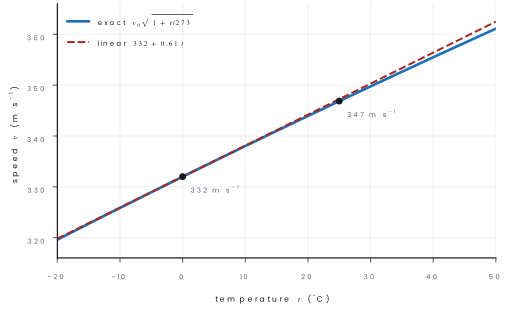
With v_0 = 332\ \text{m s}^{-1} this gives v_0/546 = 0.61, so
The velocity of sound in air increases by about 0.61 m s⁻¹ for each 1 °C rise in temperature. The graph shows how good the straight-line rule is over ordinary Nepali temperatures.
Humidity — a small increase
Water vapour has molar mass 18 g mol⁻¹ while dry air averages about 28.8 g mol⁻¹.
When water vapour is added to air it replaces some of the heavier nitrogen and oxygen molecules, so at the same pressure and temperature moist air is less dense than dry air. Since v\propto 1/\sqrt{\rho}, the speed rises.
The effect is small — a few metres per second between bone-dry and saturated air — but it is real, and it is one reason distant sounds seem to carry unusually well in the humid air just before a monsoon shower.
| Factor changed | Effect on v | Reason |
|---|---|---|
| Pressure (at constant T) | none | P/\rho fixed by Boyle's law |
| Temperature | increases, v\propto\sqrt{T} | v=\sqrt{\gamma RT/M} |
| Humidity | increases slightly | moist air is less dense than dry air |
| Wind | adds vectorially | the medium itself is moving |
| Amplitude (loudness) | none | speed is a property of the medium |
| Frequency (pitch) | none | air is non-dispersive for sound |
Wind does not change the speed relative to the air; it moves the air itself. If a wind of speed w blows at an angle \theta to the direction in which the sound travels, the speed relative to the ground is
Sound therefore carries further downwind than upwind.
Problem. The velocity of sound in air at 0 °C is 332 m s⁻¹. Find its value at 27 °C(a) exactly, and(b) using the linear rule.
Solution.
(a) T = 273+27 = 300\ \text{K}, so
(b) v_{27}\approx 332 + 0.61\times27 = 332+16.5 = 348.5\ \text{m s}^{-1}.
The two agree to within 0.5 m s⁻¹, so the linear rule is perfectly safe for everyday temperatures.
Problem. A trekker claps her hands facing a cliff across a valley in Godavari and hears the echo 3.0 s later. The air temperature is 15 °C and the speed of sound at 0 °C is 332 m s⁻¹. How far away is the cliff?
Solution. First correct the speed for temperature:
The sound travels to the cliff and back, so the path length is 2d:
The cliff is about 512 m away. Using the uncorrected 332 m s⁻¹ would have given 498 m — an error of 14 m, which is why the temperature correction is worth doing.

Chapter summary
- Every wave obeys v=f\lambda, but the speed itself is set by the medium: v=\sqrt{E/\rho}, elasticity over inertia.
- Solid rod: v=\sqrt{Y/\rho} (\approx 5060\ \text{m s}^{-1} in steel). Liquid: v=\sqrt{B/\rho} (\approx 1480\ \text{m s}^{-1} in water). Fluids carry only longitudinal sound; solids carry longitudinal and transverse waves.
- Newton's formula: assuming isothermal compressions, B_{iso}=P and v=\sqrt{P/\rho}, giving 280 m s⁻¹ for air — 16 % too low.
- Laplace's correction: the compressions are adiabatic, so B_{adi}=\gamma P and v=\sqrt{\gamma P/\rho} = 331\ \text{m s}^{-1}, which matches experiment.
- Eliminating density gives v=\sqrt{\gamma RT/M}: the speed depends on temperature and on the gas, never on the pressure.
- v_t=v_0\sqrt{1+t/273}\approx v_0+0.61t for air: +0.61 m s⁻¹ per °C.
- Humidity raises v slightly (moist air is lighter); wind adds vectorially, v_{eff}=v+w\cos\theta; amplitude and frequency have no effect.
Practice questions
Group A — Multiple choice (1 mark each)
- The velocity of sound in a gas is independent of [1]atemperaturebpressurecdensitydnature of the gas
- Laplace's correction to Newton's formula multiplies the velocity by [1]a\gammab\sqrt{\gamma}c1/\gammad\gamma^{2}
- Sound travels fastest in [1]avacuumbaircwaterdsteel
- If the absolute temperature of a gas is made four times, the velocity of sound in it becomes [1]ahalfbtwicecfour timesdunchanged
- The velocity of sound in moist air is [1]agreater than in dry airbless than in dry aircequal to that in dry airdzero
Answers to Group A
1. (b) — v=\sqrt{\gamma RT/M} contains no P; at constant T, P/\rho is fixed.
2. (b) — the modulus changes from P to \gamma P, so v changes by \sqrt{\gamma}.
3. (d) — Young's modulus of steel is enormous compared with the moduli of fluids.
4. (b) — v\propto\sqrt{T}, and \sqrt{4}=2.
5. (a) — water vapour (M = 18) is lighter than air (M = 28.8), so \rho falls and v rises.
Group B — Short answer (5 marks each)
- Derive Newton's formula for the velocity of sound in a gas and state the assumption on which it rests. Why does it fail? [5]
- State and explain Laplace's correction. Show that it raises the calculated velocity in air at NTP from about 280 m s⁻¹ to about 331 m s⁻¹. (Take P=1.013\times10^{5}\ \text{Pa}, \rho=1.293\ \text{kg m}^{-3}, \gamma=1.4.) [5]
- Show that the velocity of sound in air increases by about 0.61 m s⁻¹ for a rise of 1 °C, given that it is 332 m s⁻¹ at 0 °C. [5]
- The velocity of sound in a certain liquid is 1500 m s⁻¹ and its density is 1200 kg m⁻³. Find the bulk modulus of the liquid. [5]
- Explain why sound travels faster in solids than in liquids, and faster in liquids than in gases, even though solids are the densest of the three. [5]
Answers to Group B
1. Isothermal assumption, PV= const, P\,dV+V\,dP=0, hence B=P and v=\sqrt{P/\rho}. It gives 280 m s⁻¹ against a measured 332 m s⁻¹ — a 16 % error — because sound compressions are far too rapid, and air far too poor a conductor, for the heat to escape.
2. Adiabatic: PV^{\gamma}= const gives B=\gamma P, so v=\sqrt{\gamma P/\rho}. Numerically \sqrt{1.013\times10^{5}/1.293}=280\ \text{m s}^{-1}, and 280\times\sqrt{1.4}=280\times1.183=331\ \text{m s}^{-1}.
3. v_t=v_0(1+t/273)^{1/2}\approx v_0(1+t/546), so v_t-v_0 = v_0 t/546 = (332/546)t = 0.61t. For t=1\ ^{\circ}\text{C} the increase is 0.61 m s⁻¹.
4. v=\sqrt{B/\rho}\Rightarrow B=\rho v^{2}=1200\times(1500)^{2} = 1200\times2.25\times10^{6} = 2.7\times10^{9}\ \text{Pa}.
5. Speed is \sqrt{E/\rho}.
Going gas → liquid → solid the density rises by a factor of roughly 10^{3} and then 8, but the elastic modulus rises by a far larger factor (about 10^{4} from air to water and about 10^{2} again from water to steel).
Stiffness therefore wins over inertia.
Group C — Long answer (8 marks each)
- (a) Starting from v=\sqrt{E/\rho}, derive Newton's formula for the speed of sound in a gas and explain why it disagrees with experiment. [4](b) State Laplace's correction, derive the corrected formula, and hence show that v=\sqrt{\gamma RT/M}. Use this to explain the effect of pressure, temperature and humidity on the speed of sound. [4]
- (a) A gun is fired in a valley at Pokhara and the echo from a cliff is heard after 2.5 s on a day when the temperature is 20 °C. Taking the speed of sound at 0 °C as 332 m s⁻¹, find the distance of the cliff. [4](b) The same gun is fired when the temperature has fallen to 5 °C. By how much does the echo time change? [4]
Answer to Group C question 2
(a) v_{20} = 332 + 0.61\times20 = 332+12.2 = 344.2\ \text{m s}^{-1}. Path length =2d = 344.2\times2.5 = 860.5\ \text{m}, so d = 430\ \text{m}.
(b) v_{5} = 332 + 0.61\times5 = 335.05\ \text{m s}^{-1}. The cliff has not moved, so 2d = 860.5\ \text{m} still and
The echo now takes about 0.07 s longer — a small but measurable delay, and a reminder that any echo or resonance-tube measurement of v must record the air temperature.
Group D — Model answers for long questions (10 marks each, for deeper revision)
- Derive Newton's formula for the speed of sound in a gas, state its error and explain Laplace's correction. Calculate the speed of sound in air at NTP by both formulae. [10]
- Discuss the effect of temperature, pressure, humidity and wind on the speed of sound in air, with a numerical example. [10]
- Derive an expression for the speed of a longitudinal wave in a solid and in a liquid, and compare the speeds in steel, water and air. [10]
Model answer D1: Newton's formula and Laplace's correction (10 marks)
Introduction. Sound travels in a gas as a series of compressions and rarefactions. Newton (1687) tried to find its speed from the elasticity and density of the gas, but his answer disagreed with experiment. Laplace (1816) removed the error.
Newton's formula. The speed of a longitudinal wave is v = \sqrt{E/\rho}, where E is the modulus of elasticity of the medium and \rho is its density.
Newton assumed that the compressions and rarefactions are so slow that the temperature of the air stays constant (an isothermal change). For an isothermal change PV = constant, so the bulk modulus is E = P, the pressure. Hence
Numerical (Newton). At NTP P = 1.013\times10^{5}\ \text{Pa} and \rho = 1.293\ \text{kg m}^{-3}, so v = \sqrt{1.013\times10^{5}/1.293} = 280\ \text{m s}^{-1}. The measured value is 332\ \text{m s}^{-1}, so Newton's value is about 16% too low.
Laplace's correction. Laplace argued that:
- Sound vibrates the air so rapidly (hundreds of times each second) that the heat produced in a compression has no time to flow away to the rarefaction.
- Air is also a poor conductor of heat.
- So the change is adiabatic, not isothermal, and for an adiabatic change PV^{\gamma} = constant.
From PV^{\gamma} = constant, the adiabatic bulk modulus is E = \gamma P, where \gamma = C_{p}/C_{v}. The corrected formula is
Numerical (Laplace). For air \gamma = 1.4, so v = \sqrt{1.4}\times 280 = 1.183\times280 = 331\ \text{m s}^{-1}, in excellent agreement with the measured value.
| Quantity | Newton | Laplace |
|---|---|---|
| Assumption | Isothermal change | Adiabatic change |
| Bulk modulus | P | \gamma P |
| Formula | \sqrt{P/\rho} | \sqrt{\gamma P/\rho} |
| Value at NTP | 280\ \text{m s}^{-1} | 331\ \text{m s}^{-1} |
| Agreement with experiment | Poor | Very good |
Conclusion. The speed of sound depends on the elastic and inertial properties of the medium. Laplace's correction replaced the isothermal modulus P by the adiabatic modulus \gamma P, which makes the speed \sqrt{\gamma} = 1.18 times larger than Newton's value.
Model answer D2: effect of temperature, pressure, humidity and wind (10 marks)
Introduction. Since v = \sqrt{\gamma P/\rho} and the gas law gives P/\rho = RT/M, the speed of sound in air is determined by the properties of the air itself. We examine each factor in turn.
1. Effect of temperature. Because P/\rho = RT/M, we get v = \sqrt{\gamma RT/M}, so v \propto \sqrt{T}. For two temperatures,
For a small rise, v_{t} = v_{0} + 0.61\,t where t is in ^{\circ}C. The speed rises by about 0.61\ \text{m s}^{-1} for each degree, which is why the same horn sounds slightly higher in pitch on a hot day in the Terai than on a cold morning in Dolpa.
2. Effect of pressure. At a constant temperature, P/\rho is constant (Boyle's law: if P doubles, \rho doubles). Therefore the speed of sound is independent of pressure.
This is why the speed of sound does not change between the top of a hill and its foot, if the temperature is the same, though the temperature does change with altitude.
3. Effect of humidity. Water vapour has a molecular mass of 18, which is lighter than the 29 of the dry air. Moist air is therefore less dense than dry air at the same pressure, so v is larger.
Sound travels faster in humid air, and this is why distant sounds seem clearer in the humid monsoon.
4. Effect of wind. Sound moves faster along the wind and slower against it. If the wind speed is w, the speed relative to the ground is v + w downwind and v - w upwind. It also bends the wave fronts, so a speaker is heard better downwind.
5. Effect of the nature of gas. A lighter gas has a higher speed: v \propto 1/\sqrt{M}. In hydrogen the speed is about 1270 m/s, which is nearly four times that in air.
| Factor | Effect on speed of sound | Reason |
|---|---|---|
| Temperature rises | Increases, v \propto \sqrt{T} | Molecules move faster |
| Pressure changes at constant T | No effect | P/\rho stays constant |
| Humidity rises | Increases | Moist air is less dense |
| Wind along the wave | Increases by w | Medium itself moves |
| Gas of lower molar mass | Increases | \rho smaller at the same P |
Numerical. The speed of sound at 0^{\circ}C is 331\ \text{m s}^{-1}. At 27^{\circ}C (300\ \text{K}), v = 331\sqrt{300/273} = 347\ \text{m s}^{-1}. The formula 331 + 0.61\times27 = 347.5\ \text{m s}^{-1} agrees well.
The temperature at which the speed is double the value at 0^{\circ}C would be 4\times273 = 1092\ \text{K}.
Conclusion. The speed of sound in air rises with temperature and humidity, is independent of pressure, and is changed by wind. These facts are used in echo-sounding and weather instruments.
Model answer D3: speed of longitudinal waves in solids and liquids (10 marks)
Introduction. A longitudinal wave in any medium has the speed v = \sqrt{(\text{elastic modulus})/(\text{density})}. The modulus depends on how the medium resists deformation.
A solid rod resists a change of length (Young's modulus) while a liquid resists a change of volume (bulk modulus).
Derivation for a solid rod. Consider a thin rod of density \rho and Young's modulus Y, with a pulse travelling along it.
- A compression pulse of speed v passes a section of area A in a short time \Delta t and compresses a length v\,\Delta t by an amount \Delta x.
- The strain is \Delta x/(v\Delta t). The face of the rod moves with the particle speed u = \Delta x/\Delta t, so the strain is u/v.
- The stress is therefore Y u/v, and the force on the face is F = YAu/v.
- The momentum of the mass \rho A v\,\Delta t set moving at speed u is \rho A v u\,\Delta t, and the impulse is F\Delta t.
- Equating them, YAu\,\Delta t/v = \rho A v u\,\Delta t, which gives v^{2} = Y/\rho.
For a liquid. The same argument with the bulk modulus B = -\Delta P/(\Delta V/V) gives
For a gas, B is replaced by \gamma P.
Numerical comparison.
- Steel: Y = 2.0\times10^{11}\ \text{Pa}, \rho = 7800\ \text{kg m}^{-3}, so v = \sqrt{2.0\times10^{11}/7800} = 5.06\times10^{3}\ \text{m s}^{-1}.
- Water: B = 2.2\times10^{9}\ \text{Pa}, \rho = 1000\ \text{kg m}^{-3}, so v = \sqrt{2.2\times10^{6}} = 1.48\times10^{3}\ \text{m s}^{-1}.
- Air: v = 331\ \text{m s}^{-1} at 0^{\circ}C.
| Medium | Modulus (Pa) | Density (\text{kg m}^{-3}) | Speed (\text{m s}^{-1}) |
|---|---|---|---|
| Steel | 2.0\times10^{11} | 7800 | 5064 |
| Water | 2.2\times10^{9} | 1000 | 1483 |
| Air (adiabatic) | 1.4\times10^{5} | 1.29 | 331 |
Discussion. Steel is nearly eight times denser than water, yet sound is more than three times faster in it, because its modulus is about 90 times larger.
In general the speed in solids is greater than in liquids, and that in liquids is greater than in gases. A railway worker can hear an approaching train through the rails long before it is heard through the air.
Conclusion. The speed of a longitudinal wave is \sqrt{\text{modulus}/\text{density}}. A high modulus and a low density give a high speed, which explains the order solid > liquid > gas.
Practise more: Physics question bank