Unit 15 · Electricity and Magnetism · 3 teaching hours · 24 min read
Thermoelectric effects
What the syllabus asks for 2
- Seebeck effect; Thermocouples
- Peltier effect: Variation of thermoelectric e.m.f. with temperature; Thermopile
Heat and electricity are usually separate chapters, but at the junction of two different metals they are directly linked: a temperature difference produces an e.m.f., and a current produces a temperature difference.
These are the Seebeck and Peltier effects. They are the basis of the thermocouple thermometer used in every industrial furnace, of the thermopile that detects heat radiation, and of the solid-state coolers in portable fridges.
Three things, every year: the direction of the thermoelectric current (Seebeck series), the parabola E = \alpha\theta + \frac{1}{2}\beta\theta^{2} with its neutral and inversion temperatures, and the table of differences between Peltier and Joule heating.
The numericals are almost always about \theta_n and \theta_i.
15.1 Seebeck effect; Thermocouples
When two wires of different metals are joined to form a closed circuit and the two junctions are kept at different temperatures, an e.m.f. is set up in the circuit and a current flows round it.
The effect is called the Seebeck or thermoelectric effect, the e.m.f. is the thermo-e.m.f., and the pair of metals with its two junctions is a thermocouple.
Thomas Seebeck discovered it in 1821. The thermo-e.m.f. is small — of the order of tens of microvolts per degree — and it depends on only two things:
- the nature of the two metals, and
- the temperature difference between the two junctions.
It does not depend on the thickness of the wires, the length of the wires, or the shape of the junctions.
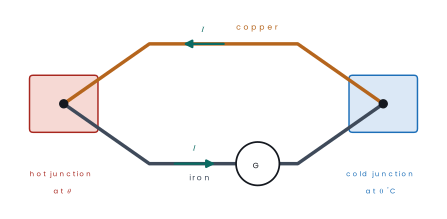
Direction of the thermoelectric current: the thermoelectric series
Arrange metals in the Seebeck (thermoelectric) series:
Sb, Fe, Cd, Zn, Ag, Au, Cr, Sn, Pb, Hg, Mn, Cu, Pt, Co, Ni, Bi
Two rules follow:
- Direction. In the thermocouple the current flows through the cold junction from the metal that comes earlier in the series to the metal that comes later. (Through the hot junction it therefore flows the other way.)
- Magnitude. The further apart the two metals are in the series, the larger the thermo-e.m.f. Antimony and bismuth stand at the two ends, so an Sb–Bi couple gives the biggest e.m.f. of all — which is why thermopiles are built from it.
"A–B–C" — Antimony to Bismuth through the Cold junction. "hot coffee" — Copper to Fe (iron) through the hot junction, and therefore iron to copper through the cold junction.
Why it happens. The free-electron concentration is different in the two metals.
Where they touch, electrons diffuse from the metal of higher concentration to the metal of lower concentration until a contact potential difference stops the flow. This contact p.d. depends on temperature.
If both junctions are at the same temperature the two contact p.d.s are equal and opposite and cancel round the loop; if the junctions are at different temperatures they no longer cancel, and the difference is the thermo-e.m.f.
Thermocouple thermometers
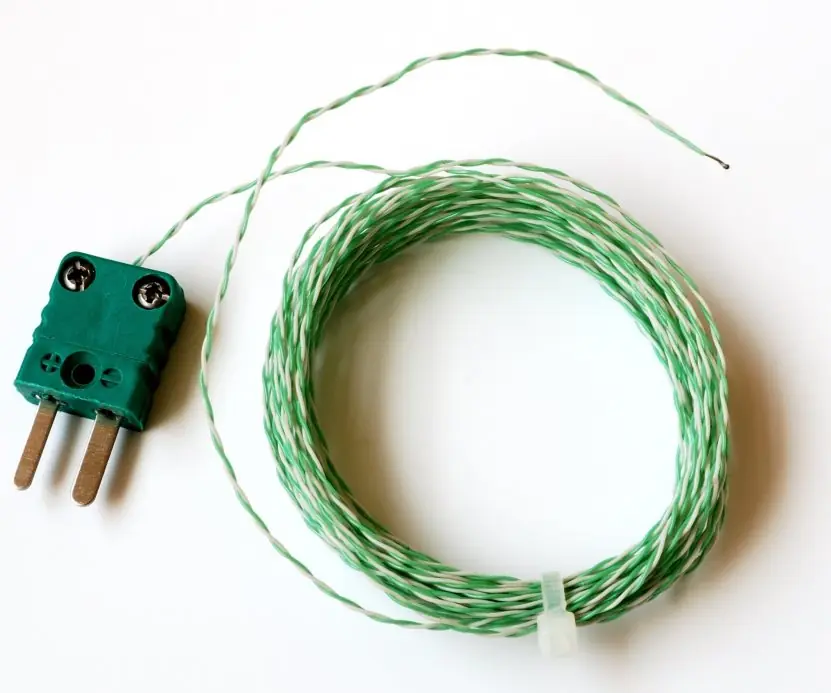
To use a thermocouple as a thermometer, keep the cold junction in melting ice (a fixed 0\,^{\circ}\text{C} reference) and put the hot junction where the temperature is wanted.
The galvanometer or potentiometer reading is converted to temperature from a calibration curve.
| Thermocouple | Useful range |
|---|---|
| Copper–constantan | -200\,^{\circ}C to 400\,^{\circ}C |
| Iron–constantan | -200\,^{\circ}C to 750\,^{\circ}C |
| Chromel–alumel | -200\,^{\circ}C to 1100\,^{\circ}C |
| Platinum–platinum/rhodium | 0\,^{\circ}C to 1600\,^{\circ}C |
Advantages: very wide range; the junction is tiny, so its heat capacity is small and it responds in a fraction of a second; it measures the temperature at a point; the reading can be taken hundreds of metres away, which is why the kilns of a brick factory or a cement plant in Hetauda are monitored this way.
Disadvantages: the e.m.f. is small, so a sensitive instrument is needed; the calibration is not linear; a reference junction must be maintained.
The Seebeck e.m.f. depends on the difference of junction temperatures. If the "cold" junction is allowed to drift to the temperature of the hot one, the e.m.f. falls to zero even though the furnace is white hot. Always check the reference junction first.
15.2 Peltier effect: Variation of thermoelectric e.m.f. with temperature; Thermopile
The Peltier effect
When an electric current is passed through the junction of two dissimilar metals, heat is evolved at one junction and absorbed at the other. If the direction of the current is reversed, the two junctions exchange roles. This is the converse of the Seebeck effect.
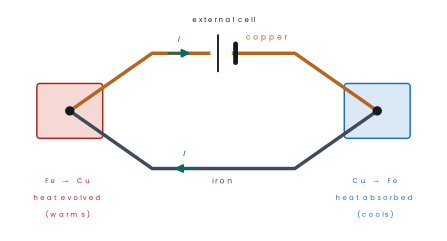
The Peltier coefficient \pi of a junction is the heat absorbed or evolved when unit charge crosses it. Since a current I carries a charge q = It in time t,
so \pi is measured in joule per coulomb, i.e. volts; for metal junctions it is of the order of millivolts.
| Peltier heat | Joule heat |
|---|---|
| Only at a junction of two different metals | In any conductor |
| H = \pi I t — proportional to I | H = I^{2}Rt — proportional to I^{2} |
| Reversible: reversing I turns evolution into absorption | Irreversible: heat is evolved whichever way I flows |
| Can cool a junction below room temperature | Always warms the conductor |
A junction that absorbs Peltier heat is one at which the current flows in the direction it would take through the hot junction of a Seebeck circuit of the same pair — for copper and iron, from copper to iron.
The reason is simply that a working thermocouple is a heat engine: it takes in heat at the hot junction and rejects it at the cold one.
Thomson effect (for completeness). Heat is also absorbed or evolved when a current flows along a single conductor whose two ends are at different temperatures.
It is positive for copper, silver and zinc, negative for iron, cobalt and nickel, and zero for lead — which is why lead is taken as the reference metal.
Variation of thermo-e.m.f. with temperature
Keep the cold junction at 0\,^{\circ}\text{C} and raise the hot junction to \theta. Experiment shows that the thermo-e.m.f. is not proportional to \theta; it follows a parabola:
where \alpha and \beta are constants of the pair of metals. For most couples \alpha is positive and \beta is small and negative, so the curve rises, turns over and comes back down.
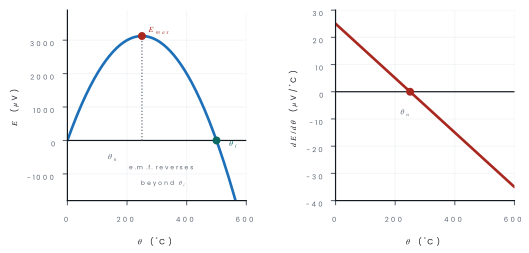
Thermoelectric power. Differentiating E = \alpha\theta + \frac{1}{2}\beta\theta^{2},
This is the thermoelectric power (or Seebeck coefficient) — the e.m.f. per degree. It falls linearly as \theta rises.
Neutral temperature \theta_n. The e.m.f. is a maximum where dE/d\theta = 0:
\theta_n contains only \alpha and \beta, so it depends only on the pair of metals — not on the temperature of the cold junction. The maximum e.m.f. is E_{max} = -\alpha^{2}/2\beta.
Temperature of inversion \theta_i. Beyond \theta_n the e.m.f. falls, and at some higher temperature it becomes zero and then reverses direction. Putting E = 0 with the cold junction at 0\,^{\circ}\text{C}:
If the cold junction is at \theta_c instead of 0\,^{\circ}\text{C}, the neutral temperature stays put but the inversion temperature shifts, because \theta_n always lies midway between \theta_c and \theta_i:
A very common error is to say that both temperatures depend on the cold junction. Only \theta_i does. Raise the cold junction by 10\,^{\circ}\text{C} and \theta_i falls by 10\,^{\circ}\text{C}, while \theta_n does not move at all.
Problem. For a thermocouple with its cold junction at 0\,^{\circ}\text{C}, the thermo-e.m.f. in microvolts is E = 25\theta - 0.05\theta^{2}. Find(a) \alpha and \beta,(b) the neutral temperature,(c) the temperature of inversion,(d) the maximum e.m.f.,(e) the thermoelectric power at 100\,^{\circ}\text{C}, and (f) the two hot-junction temperatures at which E = 3000\ \mu\text{V}.
Solution.
(a) Comparing with E = \alpha\theta + \frac{1}{2}\beta\theta^{2}: \alpha = 25\ \mu\text{V}\,^{\circ}\text{C}^{-1} and \frac{1}{2}\beta = -0.05, so \beta = -0.1\ \mu\text{V}\,^{\circ}\text{C}^{-2}.
(b) \theta_n = -\alpha/\beta = -25/(-0.1) = 250\,^{\circ}\text{C}.
(c) \theta_i = 2\theta_n - \theta_c = 2(250) - 0 = 500\,^{\circ}\text{C}.
(d) E_{max} = 25(250) - 0.05(250)^{2} = 6250 - 3125 = 3125\ \mu\text{V} = 3.125\ \text{mV}.
(e) S = \alpha + \beta\theta = 25 - 0.1(100) = 15\ \mu\text{V}\,^{\circ}\text{C}^{-1}.
(f) 25\theta - 0.05\theta^{2} = 3000 \Rightarrow \theta^{2} - 500\theta + 60000 = 0,
so \theta = 200\,^{\circ}\text{C} or 300\,^{\circ}\text{C} — one on each side of \theta_n, as the parabola requires.
Problem. The neutral temperature of a copper–iron thermocouple is 270\,^{\circ}\text{C}. Find its temperature of inversion when the cold junction is kept at(a) 0\,^{\circ}\text{C} and(b) 20\,^{\circ}\text{C}. If \alpha = 13.5\ \mu\text{V}\,^{\circ}\text{C}^{-1}, find \beta and the e.m.f. at \theta = 100\,^{\circ}\text{C} with the cold junction at 0\,^{\circ}\text{C}.
Solution.
(a) \theta_i = 2\theta_n - \theta_c = 540 - 0 = 540\,^{\circ}\text{C}.
(b) \theta_i = 540 - 20 = 520\,^{\circ}\text{C}.
From \theta_n = -\alpha/\beta:
Problem. The Peltier coefficient of a junction is 12\ \text{mV} and its resistance is 0.50\ \Omega. A current of 2.0\ \text{A} is passed for 5.0\ \text{minutes}. Find(a) the Peltier heat and(b) the Joule heat, and comment.
Solution. t = 5.0 \times 60 = 300\ \text{s}.
(a) H_P = \pi It = (12\times10^{-3})(2.0)(300) = 7.2\ \text{J}
(b) H_J = I^{2}Rt = (2.0)^{2}(0.50)(300) = 600\ \text{J}
The Joule heat is about 83 times larger, and it is always evolved. Reversing the current leaves the 600\ \text{J} of Joule heating unchanged but turns the 7.2\ \text{J} from evolved to absorbed.
This is why practical Peltier coolers use semiconductor pellets, whose Peltier coefficient is hundreds of times larger than that of a metal junction while their resistance stays small.
The thermopile
A single thermocouple gives only microvolts. A thermopile is a large number of thermocouples — usually antimony–bismuth, because that pair gives the largest e.m.f. — joined in series, so that their e.m.f.s add.
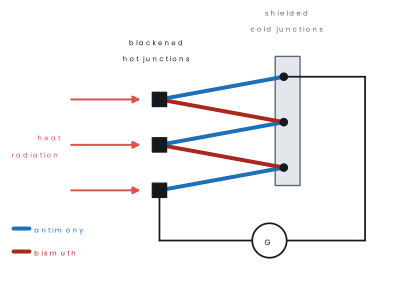
Alternate junctions are blackened and exposed at the front of a polished metal cone; the other set is shielded inside the case and stays at room temperature.
Radiation falling on the cone is absorbed by the black faces, raises their temperature, and the series e.m.f. drives a current through a sensitive galvanometer.
A thermopile is astonishingly sensitive: it will register the heat of a person standing a few metres away, or of the Moon.
Its uses include measuring radiant heat and comparing the heating effects of different sources, radiation pyrometers for furnaces, infrared detectors and burglar alarms, and — running the Peltier effect backwards — portable thermoelectric refrigerators and the radioisotope thermoelectric generators that power deep-space probes.
Problem. A copper–constantan thermocouple has a thermoelectric power of 42\ \mu\text{V}\,^{\circ}\text{C}^{-1} near room temperature. The galvanometer used with it can just detect 2.1\ \mu\text{V}.
What is the smallest temperature difference it can measure? What e.m.f. would a thermopile of 40 such couples in series give for a temperature difference of 0.50\,^{\circ}\text{C}?
Solution. Smallest detectable difference:
For 40 couples in series the e.m.f.s add:
— comfortably measurable, which is exactly the point of a thermopile.

Chapter summary
- Seebeck effect: two dissimilar metals, two junctions at different temperatures, an e.m.f. appears. It depends only on the metals and on the temperature difference.
- Seebeck series Sb, Fe, Cd, Zn, Ag, Au, Cr, Sn, Pb, Hg, Mn, Cu, Pt, Co, Ni, Bi: the current flows from the earlier metal to the later one through the cold junction, and the further apart the metals, the greater the e.m.f.
- Peltier effect: a current through a junction evolves heat at one junction and absorbs it at the other; H = \pi It, proportional to I and reversible, unlike Joule heat I^{2}Rt.
- E = \alpha\theta + \frac{1}{2}\beta\theta^{2} with the cold junction at 0\,^{\circ}\text{C}; thermoelectric power S = dE/d\theta = \alpha + \beta\theta.
- Neutral temperature \theta_n = -\alpha/\beta (where E is maximum, fixed by the metals alone); temperature of inversion \theta_i = 2\theta_n - \theta_c (where E returns to zero and reverses).
- E_{max} = -\alpha^{2}/2\beta, reached at \theta_n.
- A thermopile is many Sb–Bi couples in series, alternate junctions blackened, used to detect and measure heat radiation.
Practice questions
Group A — Multiple choice (1 mark each)
- The Seebeck effect converts [1]aelectrical energy into heatbheat into electrical energycchemical energy into heatdmagnetic energy into heat
- The neutral temperature of a thermocouple depends on [1]athe temperature of the cold junctionbthe nature of the two metals onlycthe current in the circuitdthe length of the wires
- The Peltier heat developed at a junction is proportional to [1]aI^{2}bIc\sqrt{I}d1/I
- The neutral temperature of a thermocouple is 270\,^{\circ}C. With the cold junction at 10\,^{\circ}C the temperature of inversion is [1]a260\,^{\circ}Cb280\,^{\circ}Cc530\,^{\circ}Cd550\,^{\circ}C
- In a thermopile the thermocouples are joined [1]ain parallelbin seriescin a bridgedback to back
- Antimony and bismuth are chosen for a thermopile because [1]athey are cheapbthey melt at a high temperaturecthey lie at opposite ends of the thermoelectric seriesdthey are black
Answers to Group A
1. (b) — a temperature difference produces an e.m.f.
2. (b) — \theta_n = -\alpha/\beta contains only constants of the metal pair.
3. (b) — H = \pi It; the I^{2} law belongs to Joule heating.
4. (c) — \theta_i = 2\theta_n - \theta_c = 540 - 10 = 530\,^{\circ}C.
5. (b) — in series so that the small e.m.f.s add.
6. (c) — the widest separation in the series gives the largest thermo-e.m.f.
Group B — Short answer (5 marks each)
- State the Seebeck effect. What is the thermoelectric series, and how is it used to find the direction of the thermoelectric current? State the direction in a copper–iron thermocouple. [5]
- Starting from E = \alpha\theta + \frac{1}{2}\beta\theta^{2}, define the thermoelectric power, and obtain expressions for the neutral temperature and the temperature of inversion. [5]
- For a thermocouple with its cold junction at 0\,^{\circ}C the thermo-e.m.f. in microvolts is E = 16\theta - 0.02\theta^{2}. Find \alpha, \beta, the neutral temperature, the temperature of inversion, the maximum e.m.f. and the thermoelectric power at 100\,^{\circ}C. [5]
- Distinguish between Peltier heating and Joule heating on four counts. A junction of Peltier coefficient 10\ \text{mV} carries 3.0\ \text{A} for 200\ \text{s}; find the Peltier heat. [5]
- Give four advantages and two disadvantages of a thermocouple thermometer over a mercury-in-glass thermometer. [5]
Answers to Group B
1. See §15.1. Series: Sb, Fe, Cd, Zn, Ag, Au, Cr, Sn, Pb, Hg, Mn, Cu, Pt, Co, Ni, Bi.
Current flows from the earlier metal to the later one through the cold junction; since Fe comes before Cu, the current flows from iron to copper through the cold junction and from copper to iron through the hot junction.
3. \alpha = 16\ \mu\text{V}\,^{\circ}\text{C}^{-1}; \frac{1}{2}\beta = -0.02 so \beta = -0.04\ \mu\text{V}\,^{\circ}\text{C}^{-2}. \theta_n = -\alpha/\beta = 16/0.04 = 400\,^{\circ}C; \theta_i = 2\theta_n - 0 = 800\,^{\circ}C; E_{max} = 16(400) - 0.02(400)^{2} = 6400 - 3200 = 3200\ \mu\text{V} = 3.2\ \text{mV}; S = 16 - 0.04(100) = 12\ \mu\text{V}\,^{\circ}\text{C}^{-1}.
4. Table in §15.2. H = \pi It = (10\times10^{-3})(3.0)(200) = 6.0\ \text{J}.
5. Advantages: very wide range; small heat capacity so fast response; measures temperature at a point; reading can be taken remotely (and recorded electrically).
Disadvantages: the e.m.f. is very small and needs a sensitive instrument; the calibration is non-linear and a reference junction must be maintained.
Group C — Long answer (8 marks each)
- (a) Describe the Seebeck effect and sketch the variation of thermo-e.m.f. with the temperature of the hot junction. Define and locate the neutral temperature and the temperature of inversion on your graph. [4](b) A copper–iron thermocouple has \alpha = 13.5\ \mu\text{V}\,^{\circ}\text{C}^{-1} and \beta = -0.05\ \mu\text{V}\,^{\circ}\text{C}^{-2} with the cold junction at 0\,^{\circ}C. Find the neutral temperature, the temperature of inversion, the maximum e.m.f., and the e.m.f. when the hot junction is at 200\,^{\circ}C. [4]
- (a) State the Peltier effect and explain, with a diagram, how it differs from Joule heating. [4](b) Describe the construction and working of a thermopile and give two of its uses. A thermopile of 50 antimony–bismuth couples, each of thermoelectric power 100\ \mu\text{V}\,^{\circ}\text{C}^{-1}, is connected to a galvanometer of total circuit resistance 25\ \Omega. Find the current when the junctions differ by 0.40\,^{\circ}C. [4]
Answers to Group C
1. (b) \theta_n = -\alpha/\beta = 13.5/0.05 = 270\,^{\circ}C; \theta_i = 2(270) - 0 = 540\,^{\circ}C;
2. (b) Total e.m.f. E = NS\,\Delta\theta = 50 \times 100 \times 0.40 = 2000\ \mu\text{V} = 2.0\times10^{-3}\ \text{V}. Hence
which a sensitive galvanometer reads easily.
Group D — Model answers for long questions (10 marks each, for deeper revision)
- What is the Seebeck effect? Explain the thermoelectric series, the neutral and inversion temperatures, and calculate the e.m.f. of a thermocouple. [10]
- Describe the Peltier and Thomson effects, and distinguish the Peltier effect from Joule heating. [10]
- What is a thermopile? Describe how thermocouples and thermopiles are used, and give eight applications of thermoelectric effects. [10]
Model answer D1: Seebeck effect, neutral and inversion temperatures (10 marks)
Introduction. In 1821 T. J. Seebeck found that if the two junctions of a circuit made from two different metals are kept at different temperatures, an e.m.f. (thermo-e.m.f.) appears and a current flows. This is the Seebeck effect, and the circuit is a thermocouple.
Explanation. Free-electron densities differ in the two metals. At the hot junction, electrons diffuse more rapidly across the interface than at the cold junction, so a net potential difference is set up around the circuit.
Its direction is reversed if the hot and cold ends are exchanged.
Thermoelectric series. The metals are arranged in a list such as Bi, Ni, Co, Pt, Hg, Al, Pb, Sn, Cu, Au, Ag, Zn, Fe, Sb.
At the hot junction the current flows from the metal earlier in the list to the metal later in the list (for a Cu-Fe couple, from copper to iron). The farther apart the metals are in the series, the larger the e.m.f.
(the bismuth-antimony pair gives the largest).
Variation of e.m.f. with temperature. If the cold junction is at 0^{\circ}C and the hot junction is at \theta, the e.m.f. is found by experiment to be a parabola:
where a and b are constants of the pair of metals. The thermoelectric power (Seebeck coefficient) is
- Neutral temperature \theta_{n}: the temperature of the hot junction at which the e.m.f. is a maximum, so de/d\theta = 0, giving \theta_{n} = -a/b.
- Inversion temperature \theta_{i}: the temperature at which the e.m.f. falls back to zero and then reverses; setting e = 0 gives \theta_{i} = -2a/b = 2\theta_{n}.
- \theta_{n} is independent of the cold-junction temperature, but \theta_{i} depends on it: it is as far above \theta_{n} as the cold junction is below it, \theta_{i} = 2\theta_{n} - \theta_{c}.
Numerical. For a Cu-Fe couple take a = 14\ \mu\text{V}\,{}^{\circ}\text{C}^{-1} and b = -0.035\ \mu\text{V}\,{}^{\circ}\text{C}^{-2}, with the cold junction at 0^{\circ}C.
- Neutral temperature: \theta_{n} = -14/(-0.035) = 400^{\circ}C.
- Inversion temperature: \theta_{i} = 2\times400 = 800^{\circ}C.
- E.m.f. at 200^{\circ}C: e = 14(200) + \tfrac{1}{2}(-0.035)(200)^{2} = 2800 - 700 = 2100\ \mu\text{V}.
- Maximum e.m.f. at 400^{\circ}C: 5600 - 2800 = 2800\ \mu\text{V}.
- Seebeck coefficient at 200^{\circ}C: 14 - 0.035\times200 = 7\ \mu\text{V}\,{}^{\circ}\text{C}^{-1}.
| Hot junction (^{\circ}C) | E.m.f. (\muV) | Remark |
|---|---|---|
| 100 | 1225 | Rising |
| 200 | 2100 | Rising |
| 400 | 2800 | Maximum, \theta_{n} |
| 800 | 0 | Inversion, \theta_{i} |
Conclusion. The thermo-e.m.f. is a parabolic function of temperature. For a precise thermometer one uses the range below the neutral temperature, where the e.m.f. rises steadily.
Model answer D2: Peltier and Thomson effects (10 marks)
Introduction. The Seebeck effect converts heat into electricity. Its reverse was found by Peltier (1834): a current through a junction of two different metals produces heating or cooling at the junction.
Peltier effect. When a current I is passed through a junction of two different metals, heat is absorbed at one junction and liberated at the other. Reversing the current reverses the effect.
The heat exchanged in time t is Q = \Pi I t, where \Pi is the Peltier coefficient: the heat absorbed or evolved per unit charge, in J/C (volt).
The Peltier and Seebeck coefficients are linked by \Pi = ST, where T is the absolute temperature of the junction.
Explanation. When electrons pass from a metal where their mean energy is low into one where it is high they absorb energy (cooling), and when they move the other way they give the energy up (heating).
Numerical. For a junction with S = 7\ \mu\text{V K}^{-1} at T = 300\ \text{K}: \Pi = 7\times10^{-6}\times300 = 2.1\times10^{-3}\ \text{V}. With I = 2\ \text{A} for 10 minutes the heat exchanged is Q = \Pi I t = 2.1\times10^{-3}\times2\times600 = 2.52\ \text{J}.
Thomson effect (1851). When a current flows along a single metal wire that has a temperature gradient, heat is absorbed or liberated along the wire in addition to Joule heating.
The heat per unit charge per unit temperature difference is the Thomson coefficient \sigma. In copper, the heat is absorbed when the current flows from cold to hot; in iron it is the reverse.
Thomson also linked all three effects with \sigma = T\,dS/dT.
Comparison of Peltier and Joule heating.
| Feature | Peltier effect | Joule heating |
|---|---|---|
| Occurs at | Junction of two different metals | Whole of the conductor |
| Depends on | I (first power) | I^{2} |
| Reversible? | Yes, heating or cooling | No, always heating |
| Formula | Q = \Pi I t | Q = I^{2}Rt |
| Use | Cooling, heat pumps | Heaters, fuses |
Applications of the Peltier effect. Small Peltier coolers (thermoelectric modules) with no moving parts cool CPUs, portable refrigerators, car cup-holders, and small vaccine boxes. Because the heat is moved by electric current, there is no noise or gas refrigerant.
Conclusion. The Seebeck, Peltier and Thomson effects are three aspects of the same coupling between heat and charge flow, and they are connected by the Kelvin relations. The Peltier effect is reversible and linear in the current, unlike Joule heating.
Model answer D3: thermocouple, thermopile and applications (10 marks)
Introduction. A single thermocouple gives only a few millivolts, so in a practical instrument several are combined.
A thermopile consists of a large number of thermocouples connected in series, with alternate junctions at the hot and cold ends. It gives the sum of the e.m.f.s and is much more sensitive.
Thermopile. Antimony and bismuth bars are soldered alternately in a compact box. All the odd junctions are blackened and exposed to the radiation, and all the even ones are shielded.
If one couple gives e, a pile of n couples gives E = ne. A pile of 40 Cu-Fe couples, each giving 1.225\ \text{mV} for a 100^{\circ}C difference, gives 40\times1.225 = 49\ \text{mV}.
Joined to a sensitive galvanometer, it can detect a rise of one-thousandth of a degree.
Thermocouple thermometer. One junction is kept at a known temperature (ice) and the other is placed where the temperature is required. The e.m.f. is read on a millivoltmeter calibrated in degrees.
Its advantages are a wide range (-200 to 1600 degrees C), small size, quick response and remote reading.
Eight applications of thermoelectric effects.
- Furnace and kiln thermometry: a Pt-Rh thermocouple measures the temperature of brick kilns in Bhaktapur and of cement furnaces.
- Measurement of radiant heat: a thermopile detects infrared radiation from the Sun and from stars.
- Thermoelectric generators: spacecraft such as Voyager use the heat of decaying plutonium in a thermopile to make electricity.
- Peltier cooling: compact refrigerators for medicines and vaccines in remote health posts.
- Fire safety: the pilot flame of a gas heater heats a thermocouple, whose e.m.f. holds the gas valve open and shuts it if the flame goes out.
- Temperature control: thermocouples in ovens, incubators and industrial boilers.
- Power from waste heat: modules on the exhaust pipe or on cooking stoves that charge a mobile phone in villages without electricity.
- Medical and scientific use: tiny thermocouples measure the temperature inside tissues and in the laboratory.
Limitations. The e.m.f. is small and not perfectly linear; the efficiency of the thermoelectric generators is low (around 5-8%), and the junctions need regular calibration.
Conclusion. The thermopile is a sensitive heat detector, and the thermocouple is a robust thermometer. With the Peltier effect they find uses from the kitchen to space.
Practise more: Physics question bank