Unit 21 · Modern Physics · 3 teaching hours · 16 min read
Photons
What the syllabus asks for 3
- Quantum nature of radiation
- Einstein's photoelectric equation; Stopping potential
- Measurement of Planck's constant
Interference and diffraction proved that light is a wave. Then, in 1887, Hertz noticed that ultraviolet light makes a spark jump more easily — light was knocking electrons out of metal. Nothing about that emission fitted wave theory.
Einstein's answer in 1905 was to say that light is delivered in indivisible packets of energy called photons, and that a single photon, not a whole wave, ejects a single electron.
This unit is that argument and the experiment that settles it.
Everything in this unit — threshold frequency, stopping potential, the straight line whose slope measures Planck's constant — is this equation read in a different way. Learn it first, then learn what each symbol is measured by.
21.1 Quantum nature of radiation
Classical physics treats a light beam as a continuous wave whose energy spreads smoothly over the wavefront.
Planck (1900), trying to explain the spectrum of a hot body, was forced to assume the opposite: that an oscillator of frequency f can only gain or lose energy in whole lumps of size hf.
Einstein went further and said the lumps are real, and travel through space as particles of light.
A photon is a quantum of electromagnetic radiation: a packet carrying energy E = hf = hc/\lambda that is emitted, travels and is absorbed as a single indivisible unit. Here h = 6.63\times10^{-34}\ \text{J s} is Planck's constant.
Properties of a photon, as the NEB expects them listed:
- Energy E = hf = hc/\lambda; momentum p = E/c = h/\lambda.
- Rest mass zero; it travels at c = 3\times10^{8}\ \text{m s}^{-1} in vacuum and cannot exist at rest. Its effective mass is E/c^{2} = hf/c^{2}.
- Electrically neutral, so unaffected by electric and magnetic fields.
- Energy does not change with the brightness of the beam; intensity means the number of photons crossing unit area per second, not the size of each one.
- In a collision with an electron, total energy and total momentum are conserved.
A useful shortcut: since hc = 1.99\times10^{-25}\ \text{J m}, the photon energy in electron-volts is
so visible light (400–700 nm) carries roughly 1.8–3.1 eV per photon — the right size to move an outer electron, which is exactly why chemistry and vision work with visible light.
Problem. A sodium street lamp radiates 40\ \text{W} of light of wavelength 589\ \text{nm}. Find the energy of one photon in joules and in eV, and the number of photons emitted per second.
Solution. The photon energy is
The number emitted per second is the power divided by the energy per photon:
More than 10^{20} photons a second — which is why a lamp looks continuous and the graininess of light never shows up in everyday life.
The photoelectric effect
When light of high enough frequency falls on a clean metal surface, electrons (called photoelectrons) are emitted at once.
The apparatus is a photocell: an evacuated tube with a large emitting cathode C and a small collecting anode A, connected to a variable pd that can be reversed.
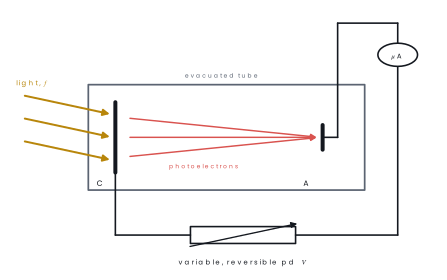
Four experimental facts come out, and not one of them is what a wave theory predicts.
| Observation | Wave theory predicts | What actually happens |
|---|---|---|
| Effect of frequency | any frequency works if you wait | below a threshold frequency f_0 there is no emission at all, however bright |
| Effect of intensity | brighter light gives faster electrons | brighter light gives more electrons, each with the same maximum energy |
| Maximum kinetic energy | depends on intensity | depends only on frequency, increasing linearly with f |
| Time lag | seconds to hours for a dim source | emission within 10^{-9}\ \text{s}, however dim |
Doubling the intensity doubles the number of photons, so it doubles the saturation current — but each photon still carries hf, so the maximum kinetic energy and the stopping potential do not change at all.
21.2 Einstein's photoelectric equation; Stopping potential
Einstein's picture: one photon is absorbed by one electron, all or nothing. Part of the energy hf is spent freeing the electron from the metal; the rest appears as kinetic energy.
The work function \phi_0 of a metal is the minimum energy needed to remove an electron from its surface.
An electron emitted from the surface itself loses only \phi_0 and so carries away the maximum kinetic energy; electrons from deeper down lose more and come out slower.
Writing \phi_0 = hf_0, where f_0 is the threshold frequency,
- If f < f_0 then hf < \phi_0: no electron can escape, whatever the intensity. Threshold frequency explained.
- Intensity = number of photons per second, so it fixes the number of photoelectrons (the saturation current) and nothing else.
- K_{max} = hf - \phi_0 is a straight line in f with slope h — independent of intensity.
- Absorption is a single one-photon event, so there is no waiting time.
Stopping potential. To measure K_{max}, make the anode negative with respect to the cathode. Electrons are then decelerated, and slower ones turn back before arriving.
Make the reverse pd large enough and even the fastest electron is stopped: the current falls to zero. That value V_0 is the stopping potential, and
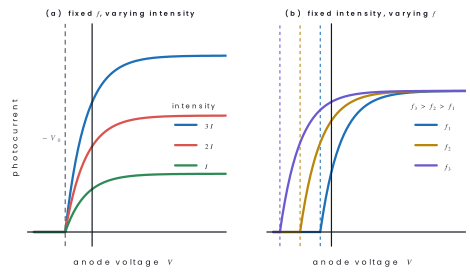
Two features of these graphs are examined constantly. The current does not fall to zero at V = 0: some electrons leave the cathode with enough energy to reach the anode unaided.
And the current levels off at a saturation value when the anode voltage is high enough to collect every emitted electron.
Problem. Light of wavelength 400\ \text{nm} falls on a metal of work function 2.0\ \text{eV}. Find(a) the photon energy,(b) the maximum kinetic energy of the photoelectrons,(c) the stopping potential,(d) the maximum speed of the electrons, and(e) the threshold wavelength of the metal.
Solution.
(a) E = \dfrac{hc}{\lambda} = \dfrac{6.63\times10^{-34}\times3.0\times10^{8}}{4.0\times10^{-7}} = 4.97\times10^{-19}\ \text{J} = 3.11\ \text{eV}.
(b) K_{max} = hf - \phi_0 = 3.11 - 2.0 = 1.11\ \text{eV} = 1.11\times1.6\times10^{-19} = 1.78\times10^{-19}\ \text{J}.
(c) V_0 = K_{max}/e = 1.11\ \text{V} (the number of eV read as volts).
(d) From K_{max} = \frac{1}{2}mv_{max}^{2},
(e) \lambda_0 = \dfrac{hc}{\phi_0} = \dfrac{1.989\times10^{-25}}{2.0\times1.6\times10^{-19}} = 6.2\times10^{-7}\ \text{m} = 620\ \text{nm} — in the orange, so red light would not work on this metal at all.
21.3 Measurement of Planck's constant
The relation V_0 = (h/e)f - \phi_0/e is the equation of a straight line in f. Millikan measured it point by point in 1916 — ironically, trying to disprove Einstein — and got a value of h agreeing with Planck's to better than 1%.
Procedure. Monochromatic light of known frequency f is obtained from a mercury lamp with a set of filters or a monochromator. For each frequency the reverse pd is increased until the microammeter reads zero, giving V_0. The points (f, V_0) are plotted.
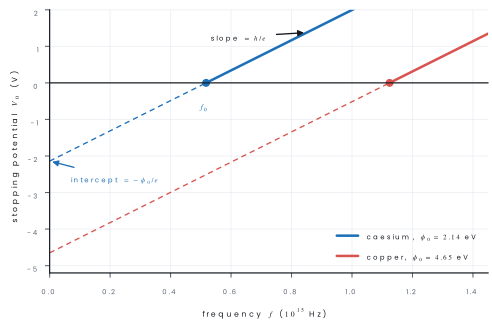
Reading the graph:
| Feature of the graph | What it gives |
|---|---|
| Slope | h/e, hence h = e \times \text{slope} |
| Intercept on the V_0 axis | -\phi_0/e, hence the work function |
| Intercept on the f axis | the threshold frequency f_0 |
| Lines for different metals | parallel — the slope h/e is a universal constant |
That last row is the deep result. The slope does not depend on the metal, on the intensity or on the apparatus. Planck's constant is a property of nature, not of the experiment.
If only two readings are available, the graph reduces to two equations:
| Metal | \phi_0 (eV) | \lambda_0 (nm) |
|---|---|---|
| Caesium | 2.14 | 580 |
| Potassium | 2.30 | 540 |
| Sodium | 2.75 | 452 |
| Copper | 4.65 | 267 |
| Platinum | 5.65 | 220 |
Caesium works with ordinary yellow light, which is why photocells and older TV camera tubes used caesium-coated cathodes; copper and platinum need ultraviolet.
Problem. In a photoelectric experiment the stopping potential is 1.85\ \text{V} for light of wavelength 300\ \text{nm} and 0.82\ \text{V} for 400\ \text{nm}. Find Planck's constant and the work function of the cathode.
Solution. The frequencies are
Subtracting the two photoelectric equations removes \phi_0:
within 1% of the accepted 6.63\times10^{-34}\ \text{J s}. The work function follows from either reading:
Work in electron-volts when the data is in eV and volts — then K_{max} in eV is numerically the stopping potential in volts, and you need no conversions at all. Convert to joules only at the last step, when a speed is asked for.


Chapter summary
- Radiation is emitted and absorbed in quanta: a photon has E = hf = hc/\lambda, p = h/\lambda, zero rest mass, and travels at c.
- Intensity fixes the number of photons per second; frequency fixes the energy of each one.
- Photoelectric emission occurs only above a threshold frequency f_0, is instantaneous, gives a current proportional to intensity, and gives a maximum kinetic energy proportional to (f-f_0).
- Einstein's equation: hf = \phi_0 + K_{max}, with \phi_0 = hf_0 = hc/\lambda_0.
- Stopping potential: eV_0 = K_{max}, so V_0 = (h/e)f - \phi_0/e; V_0 is independent of intensity.
- A graph of V_0 against f is a straight line of slope h/e, intercept -\phi_0/e and f-intercept f_0; the slope is the same for every metal, giving h = 6.63\times10^{-34}\ \text{J s}.
Practice questions
Group A — Multiple choice (1 mark each)
- The momentum of a photon of wavelength \lambda is [1]ah\lambdabh/\lambdachc/\lambdad\lambda/h
- The stopping potential in a photoelectric experiment depends on [1]athe intensity onlybthe frequency onlycthe distance of the sourcedthe area of the cathode
- The slope of a stopping potential versus frequency graph equals [1]ahbh/ece/hd\phi_0
- If the intensity of the incident light is doubled at constant frequency, the saturation current [1]ahalvesbis unchangedcdoublesdbecomes zero
- The rest mass of a photon is [1]a9.1\times10^{-31}\ \text{kg}b1.67\times10^{-27}\ \text{kg}chf/c^{2}dzero
Answers to Group A
1. (b) — p = E/c = hf/c = h/\lambda.
2. (b) — eV_0 = hf - \phi_0 contains no intensity term.
3. (b) — V_0 = (h/e)f - \phi_0/e, so the slope is h/e.
4. (c) — twice as many photons eject twice as many electrons.
5. (d) — a photon has zero rest mass; hf/c^{2} is its effective mass.
Group B — Short answer (5 marks each)
- State Einstein's photoelectric equation and use it to explain the existence of a threshold frequency and the failure of intensity to change the maximum kinetic energy. [5]
- Light of wavelength 3000\ \text{Å} falls on a metal whose threshold wavelength is 5000\ \text{Å}. Find the work function and the stopping potential. [5]
- Explain, with sketches, how the photocurrent varies with the anode voltage for (i) two different intensities at the same frequency and (ii) two different frequencies at the same intensity. [5]
- Ultraviolet light of wavelength 300\ \text{nm} falls on a sodium surface of work function 2.28\ \text{eV}. Calculate the maximum kinetic energy of the photoelectrons in eV, the stopping potential, and the threshold frequency of sodium. [5]
- Give three observations of the photoelectric effect that the wave theory of light cannot explain, and say what the photon theory says about each. [5]
Answers to Group B
2. \phi_0 = hc/\lambda_0 = 1.989\times10^{-25}/(5.0\times10^{-7}) = 3.98\times10^{-19}\ \text{J} = 2.49\ \text{eV}. Photon energy = 1.989\times10^{-25}/(3.0\times10^{-7}) = 6.63\times10^{-19}\ \text{J} = 4.14\ \text{eV}.
So K_{max} = 4.14 - 2.49 = 1.65\ \text{eV} and V_0 = 1.65\ \text{V}.
4. Photon energy = 1.989\times10^{-25}/(3.0\times10^{-7}) = 6.63\times10^{-19}\ \text{J} = 4.14\ \text{eV}. K_{max} = 4.14 - 2.28 = 1.86\ \text{eV}, so V_0 = 1.86\ \text{V}.
Threshold frequency f_0 = \phi_0/h = (2.28\times1.6\times10^{-19})/(6.63\times10^{-34}) = 5.50\times10^{14}\ \text{Hz} (that is \lambda_0 = 545\ \text{nm}).
Group C — Long answer (8 marks each)
- (a) Describe, with a labelled diagram, an experiment to study the photoelectric effect, and define stopping potential. [4](b) Derive Einstein's photoelectric equation and explain how a graph of stopping potential against frequency is used to measure Planck's constant and the work function. [4]
- A photocell has a caesium cathode of work function 2.14\ \text{eV} and is illuminated with light of wavelength 400\ \text{nm}. Find(a) the energy of each photon in eV,(b) the maximum kinetic energy of the photoelectrons,(c) the stopping potential,(d) the maximum speed of the electrons, and(e) the longest wavelength that would still cause emission. State what happens to answers (c) and (e) if the intensity is doubled. [8]
Answer to Group C question 2
(a) E = hc/\lambda = 1.989\times10^{-25}/(4.0\times10^{-7}) = 4.97\times10^{-19}\ \text{J} = 3.11\ \text{eV}.
(b) K_{max} = 3.11 - 2.14 = 0.97\ \text{eV} = 0.97\times1.6\times10^{-19} = 1.55\times10^{-19}\ \text{J}.
(c) V_0 = 0.97\ \text{V}.
(d) v_{max} = \sqrt{2K_{max}/m} = \sqrt{2\times1.55\times10^{-19}/9.1\times10^{-31}} = \sqrt{3.41\times10^{11}} = 5.8\times10^{5}\ \text{m s}^{-1}.
(e) \lambda_0 = hc/\phi_0 = 1.989\times10^{-25}/(2.14\times1.6\times10^{-19}) = 5.8\times10^{-7}\ \text{m} = 580\ \text{nm}.
Doubling the intensity changes neither (c) nor (e): it only doubles the number of photoelectrons, and hence the saturation current.
Group D — Model answers for long questions (10 marks each, for deeper revision)
- Explain Einstein's photoelectric equation and use it to explain the laws of photoelectric emission. [10]
Model answer D1: Einstein's photoelectric equation (10 marks)
Introduction. The photoelectric effect is the emission of electrons from a metal surface when light of suitable frequency falls on it.
Classical wave theory could not explain it, and Einstein explained it in 1905 using Planck's idea that light travels as packets of energy called photons, each of energy E = hf.
Einstein's explanation. One photon is absorbed by one electron, and the photon gives all its energy to that electron. Part of the energy, the work function \phi, is used to free the electron from the metal, and the rest becomes its kinetic energy:
Threshold frequency. When K_{\max} = 0, hf_0 = \phi, so f_0 = \phi/h and \lambda_0 = hc/\phi. Light of a lower frequency, however bright, cannot cause emission.
Stopping potential. The reverse voltage V_s that just stops the fastest electrons satisfies eV_s = K_{\max}, so
A graph of V_s against f is a straight line with slope h/e and intercept on the f-axis equal to f_0 (Millikan's experiment).
Laws explained.
| Observation | Explanation by the photon theory |
|---|---|
| No emission below f_0 | A photon of lower energy than \phi cannot free an electron |
| Emission is instantaneous | One photon gives its energy to one electron at once; there is no waiting to collect energy |
| K_{\max} depends on frequency, not intensity | K_{\max} = hf - \phi; intensity only changes the number of photons |
| Photocurrent is proportional to intensity | More photons per second free more electrons |
| V_s depends on frequency | eV_s = K_{\max} |
Numerical. Ultraviolet light of \lambda = 250\ \text{nm} falls on a metal of work function 2.3\ \text{eV}.
The photon energy is 1240/250 = 4.96\ \text{eV}, so K_{\max} = 4.96 - 2.30 = 2.66\ \text{eV}, the stopping potential is 2.66\ \text{V}, and v_{\max} = \sqrt{2K_{\max}/m} = 9.7 \times 10^{5}\ \text{m s}^{-1}.
The threshold wavelength is \lambda_0 = 1240/2.3 = 539\ \text{nm}.
Applications. Photocells in automatic doors and street lights, light meters, solar cells and the sound track of films.
Conclusion. Einstein's equation hf = \phi + K_{\max} explains every feature of the photoelectric effect and shows that light has a particle nature.
Practise more: Physics question bank