Unit 10 · Waves and Optics · 3 teaching hours · 20 min read
Nature and propagation of light
What the syllabus asks for 2
- Huygen's principle
- Reflection and Refraction according to wave theory
Ray optics treats light as a straight line and gets mirrors and lenses right, but it cannot say why light bends, or what happens when it meets an obstacle only a few thousandths of a millimetre across. Wave optics can.
This unit replaces the ray by the wavefront, states Huygens' principle, and uses it to rebuild the two laws you already know — reflection and refraction — from scratch.
Everything in the next three units (interference, diffraction, polarization) stands on the geometry you learn here.
Two things, almost every year: state Huygens' principle and explain the construction, and prove the laws of reflection or Snell's law using Huygens' construction.
Both are pure marks if you can draw the diagram correctly, so practise the diagram until you can produce it from memory in ninety seconds.
10.1 Huygen's principle
A source of light sends energy out in all directions. At any instant, the points that the disturbance has just reached all started vibrating at the same moment, so they are all vibrating in step.
A wavefront is the locus of all points of a medium that are vibrating in the same phase. The perpendicular drawn to a wavefront, in the direction in which the wave advances, is a ray. The speed with which a wavefront advances is the speed of the wave in that medium.
Close to a point source the wavefronts are spheres; close to a long thin slit they are cylinders.
Very far from any source a small patch of the sphere is indistinguishable from a flat plane, so sunlight reaching the Earth arrives as plane wavefronts.
A converging lens turns an incoming plane wavefront into a spherical wavefront that shrinks onto the focus.
| Type of wavefront | Shape | Source | Amplitude falls as |
|---|---|---|---|
| Spherical | sphere | point source | 1/r |
| Cylindrical | cylinder | linear source (slit) | 1/\sqrt{r} |
| Plane | plane | very distant source | constant |
Statement of the principle
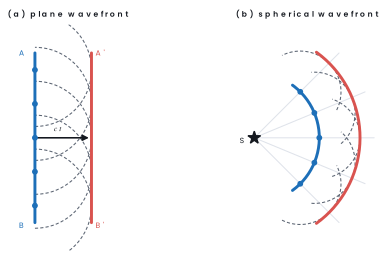
Christiaan Huygens (1678) gave a rule for advancing a wavefront from one instant to the next. It has two parts:
- Every point on a wavefront acts as a fresh source of secondary wavelets, which spread out in all forward directions with the speed of the wave in that medium.
- The new wavefront, after a time t, is the surface that touches all these secondary wavelets — their forward envelope or common tangent surface.
If the wave speed in the medium is v, every secondary wavelet drawn from the old wavefront is a sphere of radius
So to advance a wavefront you take a compass, set it to vt, strike arcs from a row of points on the old wavefront, and draw the tangent.
Why there is no backward wave
Drawn honestly, the secondary wavelets are complete spheres, so they also have a backward envelope — a wavefront travelling back towards the source. We never observe one.
Huygens simply asserted that the wavelets have zero intensity in the backward direction.
Fresnel and later Kirchhoff showed the amplitude of a secondary wavelet actually varies with the angle \theta measured from the forward direction as the obliquity factor
which equals 1 straight ahead and 0 straight backwards. That is why only the forward envelope survives. For NEB purposes it is enough to say: secondary wavelets are effective only in the forward direction.
A secondary wavelet is a tiny spherical wave, not a ray. Drawing straight arrows from points on the wavefront instead of arcs earns no marks — the whole proof depends on the arcs and on their common tangent.
10.2 Reflection and Refraction according to wave theory
Reflection at a plane surface
Let a plane wavefront AB travel through a medium in which light has speed c and strike a plane mirror.
Take the moment when the end A has just touched the mirror at A while the other end is still at B. Let the wavefront meet the mirror again at C after a further time t.
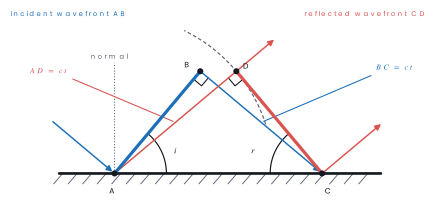
While B travels the distance BC, every point of the mirror between A and C has in turn started a secondary wavelet. The wavelet from A, which started earliest, has had the full time t to grow, so it is a hemisphere of radius AD = ct.
The wavelet from C has just started and has zero radius. The tangent drawn from C to the wavelet centred on A is the reflected wavefront CD.
In the right-angled triangles ABC and ADC:
- BC = ct is the distance travelled by B in the medium, and AD = ct is the radius of the wavelet from A. Hence BC = AD.
- AC is common, and angle ABC = angle ADC = 90^\circ (a wavefront is always perpendicular to its ray).
From triangle ABC: \sin i = \dfrac{BC}{AC}, and from triangle ADC: \sin r = \dfrac{AD}{AC}.
That is the second law of reflection. Also, the incident wavefront, the mirror and the reflected wavefront are all built on the same plane of the diagram, so the incident ray, the reflected ray and the normal are coplanar — the first law.
Refraction at a plane surface
Now let the same plane wavefront AB fall on the flat surface separating medium 1 (speed v_1) from a denser medium 2 (speed v_2 < v_1). Again A touches the surface first, and B reaches C after time t, so BC = v_1 t.
In that same time the wavelet that started at A has spread into medium 2 and has grown only to radius AD = v_2 t, which is smaller. The tangent CD from C to this wavelet is the refracted wavefront, and it is tilted towards the normal.
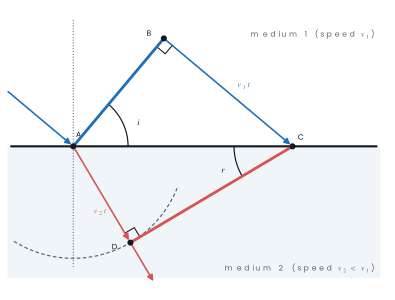
From the right-angled triangle ABC, with the angle at A equal to i:
From the right-angled triangle ADC, with the angle at C equal to r:
Dividing, the common factors AC and t cancel:
The right-hand side depends only on the two media, not on i. So the ratio \sin i/\sin r is a constant — Snell's law.
Writing the absolute refractive index of a medium as n = c/v, we get v_1 = c/n_1 and v_2 = c/n_2, so
Frequency, wavelength and optical path
The secondary wavelets in medium 2 are started by the vibrations arriving from medium 1, so they must vibrate at the same rate. Frequency does not change on refraction — it is fixed by the source. Since v = f\lambda and v falls,
Light slows down and its wavelength shrinks, but its colour (frequency) is unchanged. A path of geometrical length x inside a medium of index n holds the same number of waves as a length nx in vacuum, so we define the optical path
This single idea is used constantly in the next two units: whenever light passes through glass or water, replace the real distance by the optical path.
| Prediction | Newton's corpuscular theory | Huygens' wave theory |
|---|---|---|
| Nature of light | stream of tiny particles | disturbance spreading as wavefronts |
| Speed in water compared with air | greater | smaller |
| Reflection | explained | explained |
| Refraction | explained, wrong speed | explained, correct speed |
| Interference, diffraction, polarization | not explained | explained |
| Experimental verdict | disproved by Foucault (1850) | confirmed |
Foucault's rotating-mirror measurement in 1850 showed that light travels more slowly in water than in air. That single result killed the corpuscular theory and established the wave picture used in Units 11–13.
Problem. Light strikes a glass block of refractive index 1.5 at an angle of incidence of 60^\circ. Take c = 3\times10^{8}\ \text{m s}^{-1} and a vacuum wavelength of 600\ \text{nm}. Find(a) the angle of refraction,(b) the speed of light in the glass,(c) the wavelength in the glass.
Solution.
(a) \sin r = \dfrac{\sin 60^\circ}{1.5} = \dfrac{0.8660}{1.5} = 0.5774, so r = 35.3^\circ.
(b) v = \dfrac{c}{n} = \dfrac{3\times10^{8}}{1.5} = 2.0\times10^{8}\ \text{m s}^{-1}.
(c) \lambda_g = \dfrac{\lambda_0}{n} = \dfrac{600}{1.5} = 400\ \text{nm}.
The frequency stays at f = c/\lambda_0 = 5.0\times10^{14}\ \text{Hz} in both media.
Problem. A beam of frequency 5.0\times10^{14}\ \text{Hz} passes from air into a liquid in which its wavelength is 375\ \text{nm}. Find the refractive index of the liquid and the speed of light in it.
Solution. Frequency is unchanged, so in the liquid
Check with wavelengths: \lambda_0 = c/f = 600\ \text{nm}, and \lambda_0/\lambda_m = 600/375 = 1.6. The two routes agree.
Problem. A glass plate of thickness 2.0\ \text{mm} and refractive index 1.5 is placed in a beam of light of vacuum wavelength 500\ \text{nm}. Find(a) the optical path through the plate,(b) the number of waves contained in the plate,(c) the extra time the light takes compared with travelling the same 2.0\ \text{mm} in vacuum.
Solution.
(a) \Delta_{\text{opt}} = nx = 1.5 \times 2.0\times10^{-3} = 3.0\times10^{-3}\ \text{m}.
(b) The number of waves is the optical path divided by the vacuum wavelength:
(c) Time in glass = nx/c, time in vacuum = x/c, so the delay is

Chapter summary
- A wavefront is the locus of points vibrating in the same phase; a ray is the normal to the wavefront. Wavefronts may be spherical, cylindrical or plane.
- Huygens' principle: every point of a wavefront is a source of secondary wavelets of radius vt; the new wavefront is their forward envelope. Backward wavelets are suppressed by the obliquity factor K = \frac{1}{2}(1+\cos\theta).
- Reflection: BC = AD = ct gives \sin i/\sin r = 1, so i = r, and the incident ray, reflected ray and normal are coplanar.
- Refraction: BC = v_1t, AD = v_2t give \dfrac{\sin i}{\sin r} = \dfrac{v_1}{v_2} = \dfrac{n_2}{n_1}, i.e. n_1\sin i = n_2\sin r.
- On refraction the frequency is unchanged; the speed and wavelength both fall by the factor n: v = c/n and \lambda_m = \lambda_0/n.
- Optical path = n \times geometrical path; it is the vacuum distance holding the same number of waves.
- The wave theory predicts v_{\text{water}} < v_{\text{air}}, confirmed by Foucault in 1850; the corpuscular theory predicted the opposite and failed.
Practice questions
Group A — Multiple choice (1 mark each)
- A wavefront is a surface on which all points have the same [1]aamplitudebphasecwavelengthdintensity
- When light travels from air into glass, the quantity that does not change is [1]aspeedbwavelengthcfrequencyddirection
- Secondary wavelets in Huygens' construction travel with [1]athe speed of the sourcebthe speed of light in that mediumcinfinite speeddhalf the wave speed
- According to the wave theory of light, the speed of light in water is [1]agreater than in airbless than in aircequal to that in airdzero
- The optical path of a ray covering 4\ \text{cm} in a medium of index 1.5 is [1]a2.67 cmb4 cmc6 cmd9 cm
Answers to Group A
1. (b) — a wavefront is by definition a surface of constant phase.
2. (c) — frequency is set by the source and is not altered by the medium.
3. (b) — each wavelet expands at the wave speed v = c/n of that medium.
4. (b) — the wave theory needs v_2 < v_1 to bend light towards the normal; Foucault confirmed it.
5. (c) — optical path = nx = 1.5\times4 = 6\ \text{cm}.
Group B — Short answer (5 marks each)
- Define a wavefront and state Huygens' principle. Using it, show how a plane wavefront and a spherical wavefront advance. [5]
- Using Huygens' construction, prove the laws of reflection of light at a plane surface. [5]
- Light of wavelength 600\ \text{nm} in vacuum enters a medium of refractive index 1.25. Find its speed, frequency and wavelength in the medium. [5]
- Explain why the frequency of light does not change on refraction while its wavelength does. Hence define optical path. [5]
Answers to Group B
1. Outline: wavefront = locus of points in the same phase; each point emits secondary wavelets of radius vt; new wavefront = forward envelope. A plane wavefront gives a plane envelope, a spherical one a larger sphere (Figure 1).
3. v = c/n = 3\times10^{8}/1.25 = 2.4\times10^{8}\ \text{m s}^{-1}. Frequency is unchanged: f = c/\lambda_0 = 3\times10^{8}/600\times10^{-9} = 5.0\times10^{14}\ \text{Hz}.
Wavelength: \lambda_m = v/f = 2.4\times10^{8}/5.0\times10^{14} = 4.8\times10^{-7}\ \text{m} = 480\ \text{nm} (equivalently 600/1.25).
4. Outline: the vibrations in medium 2 are driven by those arriving from medium 1, so they repeat at the same rate — f is fixed. Since v = f\lambda and v falls to c/n, the wavelength falls to \lambda_0/n.
Optical path = n \times geometrical path is the equivalent vacuum distance containing the same number of waves.
Group C — Long answer (8 marks each)
- (a) State Huygens' principle and explain the meaning of a secondary wavelet. [3](b) Using Huygens' construction, derive Snell's law of refraction and hence show that the refractive index of a medium equals c/v. [5]
- A ray of light is incident at 45^\circ on a parallel-sided glass slab of refractive index 1.5 and thickness 6.0\ \text{cm}. Find(a) the angle of refraction,(b) the speed of light inside the slab,(c) the time taken to cross the slab, and(d) the lateral displacement of the emergent ray. [8]
Answer to Group C question 2
(a) \sin r = \sin 45^\circ/1.5 = 0.7071/1.5 = 0.4714, so r = 28.1^\circ.
(b) v = c/n = 3\times10^{8}/1.5 = 2.0\times10^{8}\ \text{m s}^{-1}.
(c) Path length inside the slab = t/\cos r = 6.0/0.8819 = 6.80\ \text{cm}, so
(d) Lateral displacement
Group D — Model answers for long questions (10 marks each, for deeper revision)
- State Huygens' principle. Using it, prove the law of reflection of a plane wave at a plane surface. [10]
- Using Huygens' wave theory, explain refraction of light at a plane surface and derive Snell's law and the relation n = c/v. Give a numerical example. [10]
Model answer D1: Huygens' principle and the law of reflection (10 marks)
Introduction. A wavefront is the locus of all points that vibrate in the same phase at an instant. Wavefronts are spherical from a point source, cylindrical from a line source and plane from a very distant source such as the Sun. A ray is the normal to the wavefront.
Huygens' principle (1678).
- Every point on a wavefront acts as a new source of secondary wavelets, which spread out in all directions with the speed of light in that medium.
- The new wavefront after a time t is the forward envelope (the common tangent) of these secondary wavelets. This allows us to find the shape of a wavefront at a later time from its shape now.
Limitation. The principle does not explain why the wavelets do not go backwards (the "back-wave" problem). It was improved by Fresnel, who added interference of the wavelets.
Proof of the law of reflection. Let a plane wavefront AB fall obliquely on a plane reflecting surface MN in air, with the speed of light c.
- At t = 0 the point A of the wavefront touches the surface at A, while B is at a distance BC from the surface.
- The point B reaches the surface at C after a time t = BC/c. During this time the secondary wavelet from A spreads in the same medium by a distance AD = ct, which is a hemisphere of radius ct about A.
- The reflected wavefront is the tangent from C to this hemisphere, touching it at D.
- Consider the right-angled triangles ABC and ADC. They have a common hypotenuse AC, and BC = AD = ct.
- So the triangles are congruent, giving \angle BAC = \angle DCA.
- The angle of incidence i is the angle between the incident wavefront and the surface, which equals \angle BAC, and the angle of reflection r is \angle DCA. Hence
- The incident ray, the reflected ray and the normal lie in one plane, because all the construction is in the plane of the figure.
| Item | Incident wavefront | Reflected wavefront |
|---|---|---|
| Speed | c | c (same medium) |
| Wavelength | \lambda | \lambda (unchanged) |
| Frequency | f | f (unchanged) |
| Angle | i | r = i |
Conclusion. Huygens' construction shows that reflection leaves the speed, frequency and wavelength unchanged and makes the angle of reflection equal to the angle of incidence. The result also holds for curved mirrors if the surface is small enough to be called plane.
Model answer D2: refraction by wave theory and Snell's law (10 marks)
Introduction. When light passes from one medium to another its speed changes, and a slanting wavefront changes direction, which is called refraction.
The wave theory gives a clear reason for this, and it predicts that light moves slower in a denser medium, which the particle theory of Newton got wrong.
Derivation. Let a plane wavefront AB travelling in air with speed v_{1} = c meet a plane glass surface MN, in which the speed is v_{2} (with v_{2} < v_{1}).
- At t = 0 the wavefront touches the surface at A, with B at a distance BC away.
- Point B reaches the surface at C after a time t = BC/v_{1}.
- In the same time t the secondary wavelet from A travels in glass a distance AE = v_{2}t, a hemisphere of smaller radius than BC = v_{1}t.
- The refracted wavefront is the tangent CE from C to this hemisphere.
- The angle of incidence i = \angle BAC and the angle of refraction r = \angle ACE. In the right-angled triangles ABC and AEC:
- Dividing,
This is Snell's law. Since the refractive index of a medium is n = c/v, we also have n_{1}\sin i = n_{2}\sin r.
Consequences.
- If v_{2} < v_{1}, then r < i and the ray bends towards the normal in the denser medium.
- The frequency does not change, as it is fixed by the source; so \lambda_{2}/\lambda_{1} = v_{2}/v_{1} = 1/n, and the wavelength is shorter in the denser medium.
- Rays are reversible, so the path from glass to air bends away from the normal.
- The ratio of the speeds gives the relative refractive index {}_{1}n_{2} = n_{2}/n_{1}.
| Quantity | Air to glass | Change |
|---|---|---|
| Speed | c to c/n | Decreases |
| Wavelength | \lambda to \lambda/n | Decreases |
| Frequency | f | Unchanged |
| Direction | Bends | Towards the normal |
Numerical. Light of wavelength 600\ \text{nm} in air enters glass of refractive index n = 1.5 at an angle of incidence 45^{\circ}. Then
- the speed in glass is v = c/n = 3\times10^{8}/1.5 = 2.0\times10^{8}\ \text{m s}^{-1};
- the wavelength in glass is \lambda' = 600/1.5 = 400\ \text{nm};
- the frequency is f = c/\lambda = 5\times10^{14}\ \text{Hz} in both media;
- the angle of refraction is \sin r = \sin45^{\circ}/1.5 = 0.4714, so r = 28.1^{\circ}. The critical angle for glass to air is \sin^{-1}(1/1.5) = 41.8^{\circ}.
Conclusion. Huygens' theory explains refraction through the change of speed, derives Snell's law from it, and shows that the frequency stays the same while the wavelength changes.
The prediction that light is slower in water than in air was confirmed by Foucault in 1850.
Practise more: Physics question bank