Unit 3 · 9 teaching hours · 22 min read
Symmetric Ciphers - Feistel, DES, AES and Modes of Operation
What the syllabus asks for 7
- Block and stream ciphers, confusion and diffusion
- The Feistel structure
- DES
- AES
- Modes of operation
- Comparison
- Seeing symmetric ciphers: hardware, rounds and chaining
Almost every byte that crosses the Internet in bulk, from video calls to file transfers, is protected by a symmetric cipher: one key shared by both ends, fast enough to encrypt gigabits a second.
This unit explains the design principles (confusion, diffusion, the Feistel structure), the historic DES and its replacement AES, and the modes of operation that turn a block cipher into something safe to use on real data.
To show that the descriptions are not hand-waving, the unit contains a complete AES-128 implementation in 40 lines of Python built from the Galois-field arithmetic it explains.
It is executed and its output is compared with the official test vector of the AES standard (FIPS-197) and with the cryptography library.
- Stream and block ciphers; Shannon's confusion and diffusion; the Feistel network (a working toy).
- DES: structure, S-boxes, key size and brute-force time; 3DES.
- AES: GF(2⁸) arithmetic, SubBytes, ShiftRows, MixColumns, AddRoundKey, key expansion; a verified implementation.
- Modes: ECB, CBC, CTR and GCM; padding; why ECB leaks patterns.
3.1 Block and stream ciphers, confusion and diffusion
A block cipher encrypts fixed-size blocks (64 bits for DES, 128 for AES) under a key; a stream cipher produces a keystream that is XORed with the data bit by bit (RC4 historically; ChaCha20 today).
Claude Shannon (1949) gave two design goals. Confusion makes the relationship between key and ciphertext as complicated as possible (achieved by substitution, the S-boxes).
Diffusion spreads the influence of each plaintext bit over many ciphertext bits (achieved by permutation and mixing), so that flipping one input bit changes about half the output bits (the avalanche effect).
Modern ciphers are product ciphers: they repeat rounds of substitution and permutation, with a different round key derived from the master key in each round.
3.2 The Feistel structure
A Feistel network splits the block into halves L and R and, in each round, computes L′ = R, R′ = L ⊕ F(R, K), where F is any function (it need not be invertible) of one half and the round key.
Decryption uses the same circuit with the round keys in reverse order, because each round can be undone: L = R′ ⊕ F(L′, K). This elegant property halves the design effort, and DES uses it.
The toy below has a 16-bit block, F(R, k) = (R·k + 7) mod 256 and four rounds with keys 3, 5, 7, 11; the final swap makes decryption identical to encryption.
def feistel(block, keys):
    L, R = block >> 8, block & 0xFF
    for k in keys:
        L, R = R, L ^ ((R * k + 7) % 256)
    return (R << 8) | L

keys = [3, 5, 7, 11]
c = feistel(0x1234, keys)
print("cipher = %04x, decrypted = %04x" % (c, feistel(c, keys[::-1])))
cipher = 294e, decrypted = 1234
The decrypted value is 1234 again, even though F is not invertible. (This toy is for illustration; its tiny block and trivial F offer no security.)
3.3 DES
The Data Encryption Standard (1977) is a 16-round Feistel cipher with a 64-bit block and a 56-bit key (a 64-bit key with 8 parity bits). The block passes through an initial permutation (IP), 16 rounds, and the inverse permutation.
In each round the 32-bit right half is expanded to 48 bits, XORed with a 48-bit subkey (from the key schedule: permutation, rotations and compression), split into eight 6-bit pieces and passed through eight S-boxes, each mapping 6 bits to 4 bits, then through a 32-bit P-permutation, and XORed with the left half.
The S-boxes are the only non-linear part, so they carry the confusion. To read an S-box, the outer two bits of the 6-bit input select a row (0 to 3) and the middle four bits select a column (0 to 15).
For S₁, input 011011 has outer bits 0 and 1, so row 01 = 1, and middle bits 1101 = column 13; S₁ row 1 is 0, 15, 7, 4, 14, 2, 13, 1, 10, 6, 12, 11, 9, 5, 3, 8, so the output is 5 = 0101.
The weakness is the key length. The key space is 2⁵⁶ = 72,057,594,037,927,936.
A machine testing 10¹² keys a second exhausts it in 72,058 seconds, which is 20.0 hours, or about 10.0 hours on average; special-purpose machines broke DES in 1998 in days.
Triple DES (3DES) applies DES three times (encrypt with K₁, decrypt with K₂, encrypt with K₃: "EDE"), giving up to 112 bits of effective security but a slow 64-bit block (vulnerable to birthday attacks on large data, Unit 5); it is deprecated. AES replaced it.
3.4 AES
The Advanced Encryption Standard (Rijndael, selected 2001, FIPS-197) has a 128-bit block and keys of 128, 192 or 256 bits, with 10, 12 or 14 rounds. The block is a 4 × 4 matrix of bytes (the state, filled column by column). A round has four steps:
- SubBytes: every byte is replaced through the S-box (confusion).
- ShiftRows: row r of the state is rotated left by r positions (diffusion between columns).
- MixColumns: each column is multiplied by a fixed matrix over GF(2⁸) (diffusion within columns); omitted in the last round.
- AddRoundKey: the state is XORed with the round key.
An initial AddRoundKey comes first. The key expansion derives 11 round keys (for AES-128) from the key with rotation, S-box substitution and round constants. Decryption runs the inverse steps in reverse.
Arithmetic in GF(2⁸)
AES bytes are elements of the finite field GF(2⁸): a byte b₇…b₀ is the polynomial b₇x⁷ + … + b₀. Addition is XOR. Multiplication is polynomial multiplication reduced modulo the irreducible polynomial m(x) = x⁸ + x⁴ + x³ + x + 1 (0x11B).
Multiplying by x ("xtime") is a left shift, XORing 0x1B if the top bit was set. Every non-zero element has an inverse, which the S-box uses: S(x) = affine transform of x⁻¹ (with 0 mapped to 0).
The FIPS-197 examples: {57} • {83} = {c1} and {57} • {13} = {fe}, and S({53}) = {ed}.
The MixColumns example from the standard turns the column (db, 13, 53, 45) into (8e, 4d, a1, bc), using coefficients 2 and 3 (2 = xtime, 3 = xtime ⊕ identity).
A complete AES-128 in Python
The program builds the S-box from the field arithmetic, expands the key, encrypts a block, and checks the FIPS-197 Appendix C.1 vector (key 000102…0f, plaintext 00112233…ff, ciphertext 69c4e0d86a7b0430d8cdb78070b4c55a).
It then encrypts a 48-byte message whose first two blocks are identical in three modes, which is the subject of section 3.5.
def xtime(a):
    return ((a << 1) ^ 0x11B) & 0xFF if a & 0x80 else a << 1

def gmul(a, b):
    r = 0
    while b:
        if b & 1:
            r ^= a
        a = xtime(a)
        b >>= 1
    return r

def make_sbox():
    sbox = []
    for x in range(256):
        inv = 0 if x == 0 else next(y for y in range(1, 256) if gmul(x, y) == 1)
        s = inv
        for i in range(1, 5):
            s ^= ((inv << i) | (inv >> (8 - i))) & 0xFF
        sbox.append(s ^ 0x63)
    return sbox

SBOX = make_sbox()

def expand(key):
    w = [list(key[4 * i:4 * i + 4]) for i in range(4)]
    rcon = 1
    for i in range(4, 44):
        t = list(w[i - 1])
        if i % 4 == 0:
            t = [SBOX[b] for b in t[1:] + t[:1]]
            t[0] ^= rcon
            rcon = xtime(rcon)
        w.append([a ^ b for a, b in zip(w[i - 4], t)])
    return [sum(w[4 * r:4 * r + 4], []) for r in range(11)]

def mix_column(a):
    return [gmul(a[0], 2) ^ gmul(a[1], 3) ^ a[2] ^ a[3],
            a[0] ^ gmul(a[1], 2) ^ gmul(a[2], 3) ^ a[3],
            a[0] ^ a[1] ^ gmul(a[2], 2) ^ gmul(a[3], 3),
            gmul(a[0], 3) ^ a[1] ^ a[2] ^ gmul(a[3], 2)]

def encrypt_block(block, rk):
    s = [b ^ k for b, k in zip(block, rk[0])]
    for rnd in range(1, 11):
        s = [SBOX[b] for b in s]
        s = [s[r + 4 * ((c + r) % 4)] for c in range(4) for r in range(4)]
        if rnd != 10:
            s = sum((mix_column(s[4 * c:4 * c + 4]) for c in range(4)), [])
        s = [b ^ k for b, k in zip(s, rk[rnd])]
    return bytes(s)

key = bytes(range(16))
rk = expand(key)
print("S-box[53] = %02x, 57*83 = %02x, 57*13 = %02x" % (SBOX[0x53], gmul(0x57, 0x83), gmul(0x57, 0x13)))
print("MixColumns(db 13 53 45) =", " ".join("%02x" % x for x in mix_column([0xDB, 0x13, 0x53, 0x45])))
print("AES-128:", encrypt_block(bytes.fromhex("00112233445566778899aabbccddeeff"), rk).hex())

msg = b"ATTACK AT DAWN!!" * 2 + b"RETREAT AT DUSK!"
iv = bytes(range(16))
ecb = b"".join(encrypt_block(msg[i:i + 16], rk) for i in range(0, 48, 16))
cbc, prev = b"", iv
for i in range(0, 48, 16):
    prev = encrypt_block(bytes(a ^ b for a, b in zip(msg[i:i + 16], prev)), rk)
    cbc += prev
ctr = b"".join(bytes(a ^ b for a, b in zip(msg[i:i + 16], encrypt_block(
    (int.from_bytes(iv, "big") + i // 16).to_bytes(16, "big"), rk))) for i in range(0, 48, 16))
for name, ct in (("ECB", ecb), ("CBC", cbc), ("CTR", ctr)):
    print(name, "blocks 1 and 2 equal:", ct[:16] == ct[16:32], ct.hex()[:32])
S-box[53] = ed, 57*83 = c1, 57*13 = fe
MixColumns(db 13 53 45) = 8e 4d a1 bc
AES-128: 69c4e0d86a7b0430d8cdb78070b4c55a
ECB blocks 1 and 2 equal: True 8a21cef935d8587bea999da471a91c41
CBC blocks 1 and 2 equal: False 1fbe05c8b75b552eaeab4bf984198fd0
CTR blocks 1 and 2 equal: False 4bc05ff40225d004a5e3d019911dcb7b
The ciphertext matches the standard's vector, so the S-box, ShiftRows, MixColumns, key schedule and round order are all correct; the checker also encrypts the same data with the cryptography library in the three modes and every printed hex string agrees.
AES has no known practical attack: a 128-bit key has 2¹²⁸ = 3.40 × 10^{38} values, so at 10¹² keys per second an exhaustive search would take about 1.08 × 10^{19} years.
3.5 Modes of operation
A block cipher encrypts one block; real messages are longer, so a mode says how to chain blocks. The notation: Pᵢ plaintext block, Cᵢ ciphertext block, E the block encryption with key K.
| Mode | Encryption | Properties |
|---|---|---|
| ECB (electronic codebook) | Cᵢ = E(Pᵢ) | Identical plaintext blocks give identical ciphertext blocks, so patterns leak: never use it for data of more than one block |
| CBC (cipher block chaining) | Cᵢ = E(Pᵢ ⊕ Cᵢ₋₁), C₀ = IV | Random, unpredictable IV per message; encryption is sequential; needs padding; no integrity |
| CTR (counter) | Cᵢ = Pᵢ ⊕ E(nonce ‖ counter) | A stream cipher built from the block cipher; parallel; no padding; never reuse a nonce with the same key |
| GCM (Galois/counter) | CTR encryption plus a GHASH authenticator | Authenticated encryption (AEAD): gives confidentiality and integrity, with optional authenticated associated data; the standard in TLS 1.3 |
In the program output, ECB's first two ciphertext blocks are equal (the repeated plaintext "ATTACK AT DAWN!!" shows through, the famous "ECB penguin" effect on images), while CBC and CTR hide the repetition.
Padding (PKCS#7) extends the last block with bytes whose value equals the pad length, so removal is unambiguous; CBC without authentication is vulnerable to padding-oracle attacks, which is why modern protocols use AEAD modes (AES-GCM, ChaCha20-Poly1305).
Key points for engineers: use a vetted library, never invent a cipher or a mode; use AEAD; generate IVs and nonces correctly; and manage keys (Unit 7).
3.6 Comparison
| DES | 3DES | AES-128 | |
|---|---|---|---|
| Block | 64 bits | 64 bits | 128 bits |
| Key | 56 bits | 112–168 bits (112 effective) | 128, 192, 256 bits |
| Rounds | 16 | 48 | 10, 12, 14 |
| Structure | Feistel | Feistel ×3 | Substitution–permutation |
| Status | Broken (brute force) | Deprecated | Standard |
3.7 Seeing symmetric ciphers: hardware, rounds and chaining
Symmetric ciphers are built from a few repeated pieces, and they are easier to understand when drawn as machines.
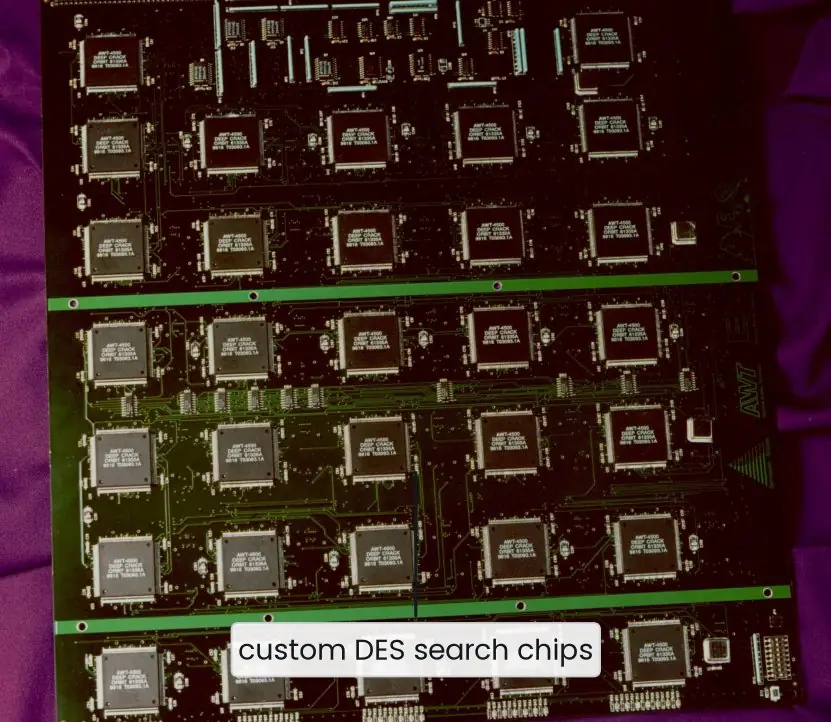
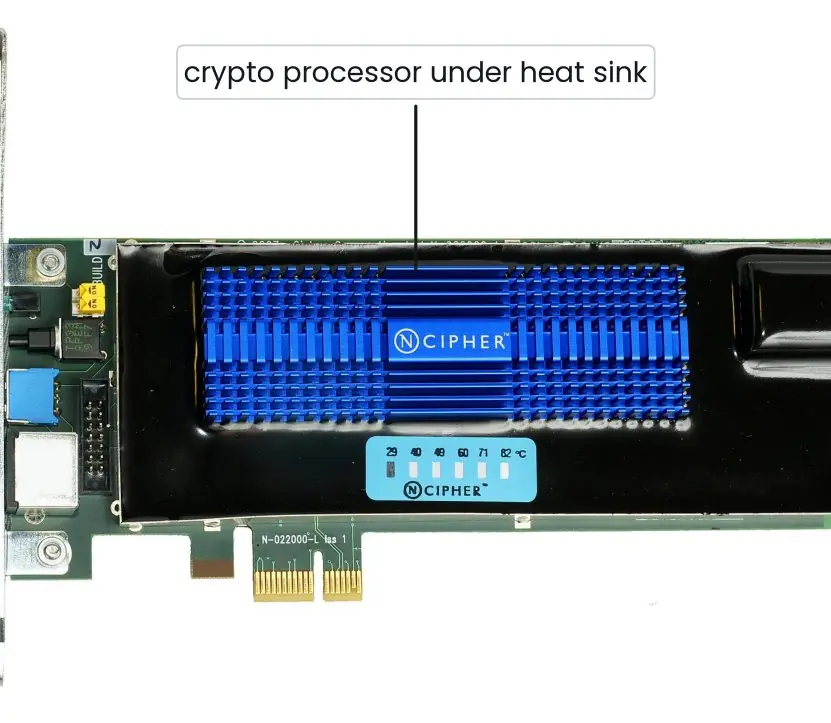
The plate shows real hardware that attacked DES and hardware that now stores keys, and the figures draw the Feistel round, the DES frame, the four steps of an AES round, the CBC chain and the time needed to search each key space.


3.7.1 Eight reasons AES replaced DES
- A longer key. DES has a 56-bit key, so 2 to the power 56 (about 7.2 x 10 to the power 16) keys exist. A search at 90 billion keys per second, the speed of Deep Crack, exhausts them in about 9 days. AES-128 has 2 to the power 128 keys, which at the same speed would need about 1.2 x 10 to the power 20 years.
- A larger block. DES encrypts 64-bit blocks, so after about 2 to the power 32 blocks (32 GB of data) repeated blocks become likely and leak information. AES uses 128-bit blocks, which pushes that limit far beyond any real file. This matters for video, disk images and bank backups.
- Speed in software. AES uses simple byte operations and table lookups, and modern processors have special AES instructions. A laptop can encrypt data at several gigabytes per second. DES was designed for 1970s hardware and is slow in software.
- Strong, open design. AES was chosen in 2001 after a public competition in which cryptographers from many countries tried to break the candidates. Rijndael won on security, speed and simplicity. DES was designed with S-boxes whose design reasons were not published for years, which raised doubts.
- Flexible key sizes. AES offers 128, 192 and 256 bits with 10, 12 or 14 rounds. A bank can choose 256 bits for long-term secrets and 128 bits for ordinary traffic. DES offered one choice only.
- No weak keys of concern. DES has a few weak and semi-weak keys, and its complementation property halves some searches. AES has a clean algebraic structure with no known weak keys in normal use. This makes key generation simple: any random key is acceptable.
- Easy hardware and small devices. AES can be built in a few thousand gates, so smart cards, SIM cards and IoT sensors can encrypt cheaply. A phone SIM in Nepal and a bank card chip both use such circuits. Triple DES needed three times the work for the same strength.
- Wide standards support. AES is the standard cipher in TLS, Wi-Fi (WPA2 and WPA3), disk encryption, messaging apps and cloud storage. A programmer rarely needs to implement it, because every library provides it. This common support makes systems from different vendors work together.
Chapter summary
- Confusion (substitution) and diffusion (permutation) are combined over many rounds; a Feistel network's rounds are invertible even if F is not.
- DES: 64-bit block, 56-bit key, 16 rounds, 8 S-boxes; exhaustive search takes 20.0 hours at 10¹² keys/s, so it is obsolete; 3DES is deprecated.
- AES: 128-bit block, 10/12/14 rounds of SubBytes, ShiftRows, MixColumns, AddRoundKey over GF(2⁸); {57}•{83} = {c1}; verified here against the FIPS-197 vector.
- ECB leaks patterns (equal blocks → equal ciphertext); CBC needs a random IV; CTR needs a unique nonce; GCM adds authentication and is the modern default.
Practice
- Define confusion and diffusion and name the AES step that provides each.
- Perform one Feistel round: L = 0x12, R = 0x34, F(R, k) = (R·k + 7) mod 256 with k = 3. Give the new (L, R).
- How many possible keys does DES have and how long would 2⁵⁵ trials take at 10⁹ keys per second (in days)?
- Why is decryption in a Feistel cipher the same circuit with reversed keys?
- Compute {57} • {02} in GF(2⁸).
- List AES-128's rounds and the number of round keys.
- What is the avalanche effect?
- Why is ECB unsuitable for encrypting an image?
- What must never be repeated in CTR mode with the same key?
- What does GCM provide that CBC does not?
Answers and worked solutions
1. Confusion hides the key–ciphertext relation (SubBytes); diffusion spreads each bit's influence (ShiftRows and MixColumns).
2. F = (0x34 × 3 + 7) mod 256 = (52 × 3 + 7) = 163 = 0xA3. L′ = R = 0x34; R′ = L ⊕ F = 0x12 ⊕ 0xA3 = 0xB1. New (L, R) = (0x34, 0xB1).
3. 2⁵⁶ keys; 2⁵⁵ trials / 10⁹ per second = 3.6 × 10⁷ s = about 417 days (3.6029 × 10⁷ s / 86,400).
4. Each round L′ = R, R′ = L ⊕ F(R, K) can be undone as L = R′ ⊕ F(L′, K) without inverting F, so running the same rounds with the keys in reverse order restores the plaintext.
5. 0x57 = 01010111; shifted left is 0xAE (top bit was 0, no reduction): {ae}.
6. 10 rounds (9 full plus a final without MixColumns), 11 round keys.
7. A one-bit change in the input or key changes about half of the output bits.
8. Equal blocks of pixels give equal ciphertext blocks, so the image's outline remains visible.
9. The (nonce, counter) pair: reuse produces the same keystream, and XORing two ciphertexts removes it.
10. Authentication (integrity of the ciphertext and associated data), not only confidentiality.
Model answers: medium (5 marks) and long (10 marks) questions
Q1 (5 marks). Explain the Feistel structure. Why can the same circuit encrypt and decrypt?
Introduction. A Feistel network (used in DES) builds a strong block cipher from a round function that does not need to be invertible (section 3.2, Figure 3.1).
- Split. The n-bit block is divided into a left half L and a right half R.
- One round. The new halves are L(i) = R(i-1) and R(i) = L(i-1) XOR F(R(i-1), K(i)), where K(i) is the round key.
- Many rounds. DES applies 16 rounds, and the halves are swapped after the last round.
- Decryption. From L(i) and R(i) we can recover L(i-1) = R(i) XOR F(L(i), K(i)) and R(i-1) = L(i), because XOR with the same value twice cancels. So the same rounds with the keys in reverse order K16 to K1 undo encryption.
- Consequence. F can use non-invertible S-boxes and expansions freely; only the XOR and swap structure guarantees reversibility. The design principles are Shannon's confusion (S-boxes hide the key relation) and diffusion (permutations spread each bit).
| Feature | Feistel (DES) | AES (SPN) |
|---|---|---|
| Structure | Halves, XOR | Whole-state substitution-permutation |
| Round function | Need not be invertible | Every step invertible |
| Decryption | Same circuit, keys reversed | Inverse steps |
Q2 (5 marks). Compare the ECB, CBC and CTR modes of operation.
Introduction. A block cipher encrypts one block of 128 bits (AES) or 64 bits (DES). A mode of operation defines how longer messages are encrypted block by block (section 3.5, Figure 3.3).
- ECB (electronic codebook). Each block is encrypted separately: C(i) = E(K, P(i)). Equal plaintext blocks give equal ciphertext blocks, so patterns in images and tables remain visible. It should not be used for real data.
- CBC (cipher block chaining). C(i) = E(K, P(i) XOR C(i-1)) with a random IV for the first block. Equal blocks give different ciphertext. Encryption is sequential and padding is needed.
- CTR (counter). The cipher encrypts a counter value, and the result is XORed with the plaintext: C(i) = P(i) XOR E(K, nonce || i). It turns the block cipher into a stream cipher, needs no padding, and both encryption and decryption run in parallel. A nonce and counter must never repeat under one key.
- Integrity. None of these three modes detects changes; GCM adds an authentication tag to CTR and is preferred in TLS.
| Mode | Parallel encryption | Padding | Pattern leak | Note |
|---|---|---|---|---|
| ECB | Yes | Yes | Yes | Avoid |
| CBC | No | Yes | No | Random IV |
| CTR | Yes | No | No | Never reuse nonce |
Q3 (10 marks). Describe the AES algorithm: its structure, the four round transformations, the key sizes and how it compares with DES.
Introduction. The Advanced Encryption Standard (FIPS-197, 2001) is the Rijndael cipher of Daemen and Rijmen. It replaced DES because DES's 56-bit key had become breakable by search (Deep Crack, 1998).
AES is a substitution-permutation network that encrypts a 128-bit block with a 128-, 192- or 256-bit key (section 3.4, Figures 3.1 to 3.2).
- State. The 16 bytes of a block are arranged in a 4 x 4 matrix called the state, filled column by column.
- Initial step. AddRoundKey XORs the first round key with the state.
- SubBytes. Each byte is replaced using a fixed S-box built from the multiplicative inverse in GF(2 to the 8) followed by an affine map. This gives confusion and resists linear and differential attack.
- ShiftRows. Row r is rotated left by r bytes (0, 1, 2, 3), moving bytes between columns.
- MixColumns. Each column is multiplied by a fixed matrix over GF(2 to the 8), with entries 2, 3, 1, 1 in rotated rows. Together with ShiftRows, this gives diffusion: after two rounds every output byte depends on every input byte.
- AddRoundKey. The state is XORed with the round key, the only step that uses the key.
- Rounds and key schedule. There are 10, 12 or 14 rounds for 128-, 192- or 256-bit keys. The last round omits MixColumns. A key schedule expands the key into 11, 13 or 15 round keys.
- Test vector. With key 000102...0f and plaintext 00112233...ff the ciphertext is 69c4e0d86a7b0430d8cdb78070b4c55a (the FIPS-197 example, reproduced by the program in section 3.4).
| Feature | DES | AES |
|---|---|---|
| Block size | 64 bits | 128 bits |
| Key size | 56 bits | 128, 192 or 256 bits |
| Rounds | 16 | 10, 12 or 14 |
| Structure | Feistel | Substitution-permutation |
| Status | Broken by search (1998) | Secure, standard |
| Search time at 9 x 10 to the 10 keys/s | about 9 days | about 1.2 x 10 to the 20 years |
Conclusion. AES is fast, flexible and carefully analysed. It is used in HTTPS, Wi-Fi, disk and file encryption, and the right way to use it is a standard mode such as GCM from a vetted library, never a home-made program.