Unit 8 · Mechanics · 5 teaching hours · 25 min read
Elasticity
What the syllabus asks for 5
- Hooke's law: Force constant
- Stress, Strain, Elasticity and plasticity
- Elastic modulus: Young modulus, bulk modulus, shear modulus
- Poisson's ratio
- Elastic potential energy
Every solid changes shape a little when you push or pull it. A bridge deck sags under a loaded truck on the Prithvi Highway, a steel cable in a Trishuli suspension bridge stretches, a rubber band grows longer.
Elasticity asks two questions: how much does a body deform under a given force, and does it come back when the force is removed?
The whole unit is built on two quantities — stress (force per unit area) and strain (fractional change in size) — and on the constants that link them.
Group B nearly always carries one definition set (stress, strain, Hooke's law, modulus) plus one numerical on Young modulus or stored energy. Group C favours "define the three moduli and derive the energy stored in a stretched wire".
Master the four boxed formulas in the summary and you cover most of the marks.
8.1 Hooke's law: force constant
When an external force acts on a body, its molecules are pulled apart from (or pushed towards) their equilibrium separations. The inter-molecular forces then act to restore the original spacing.
The external force is called the deforming force; the internal force that opposes it is the restoring force. As long as the deformation is small, the two are equal in magnitude.
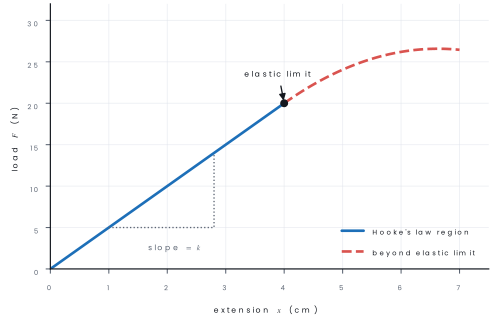
Robert Hooke stated the experimental law in 1678: for small deformations the extension is proportional to the load.
Within the elastic limit, the extension produced in a body is directly proportional to the deforming force applied, the temperature remaining constant.
The constant k is the force constant (also called stiffness, or spring constant for a spring). It is the force needed to produce unit extension:
The force constant is not a property of the material alone. For a wire of length L and area of cross-section A made of a material of Young modulus Y (section 8.3),
so a short thick wire is stiffer than a long thin one of the same metal. When springs of constants k_1 and k_2 are joined in series the combination is softer, 1/k = 1/k_1 + 1/k_2; joined side by side in parallel it is stiffer, k = k_1 + k_2.
Problem. A spring of natural length 20\ \text{cm} stretches to 24\ \text{cm} when a load of 20\ \text{N} hangs from it. Find its force constant and the length of the spring when the load is 35\ \text{N}.
Solution. Extension x = 24 - 20 = 4\ \text{cm} = 0.04\ \text{m}.
For F = 35\ \text{N}, x = F/k = 35/500 = 0.07\ \text{m} = 7\ \text{cm}, so the spring is 20 + 7 = 27\ \text{cm} long (assuming the elastic limit is not exceeded).
8.2 Stress, Strain, Elasticity and plasticity
Stress is the restoring force set up per unit area of cross-section of a deformed body: \ \text{stress} = F/A. SI unit N m⁻² or pascal (Pa), dimensional formula [ML^{-1}T^{-2}].
Strain is the ratio of the change in a dimension to the original value of that dimension. It is a pure number with no unit and no dimensions.
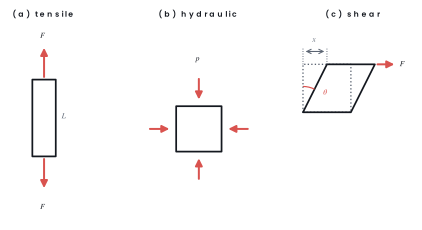
Stress has the same dimensions as pressure, but the two are not the same thing: pressure in a fluid always acts normal to a surface, while stress may act along a surface (shear). There are three kinds of stress and a matching strain for each.
| Stress | How the force acts | Strain produced | Modulus |
|---|---|---|---|
| Tensile / compressive (longitudinal) | normal to the end faces, along the length | \text{longitudinal strain} = e/L | Young modulus Y |
| Hydraulic (volume) | normal and equal on every face | \text{volume strain} = \Delta V/V | Bulk modulus B |
| Tangential (shear) | parallel to one face, the opposite face fixed | \text{shear strain} = \theta = x/L | Shear modulus \eta |
Elasticity is the property by which a body regains its original shape and size after the deforming force is removed. Plasticity is the opposite property: the body keeps the new shape.
No real material is perfectly elastic or perfectly plastic; a quartz fibre is the nearest to perfectly elastic and wet clay or putty the nearest to perfectly plastic.
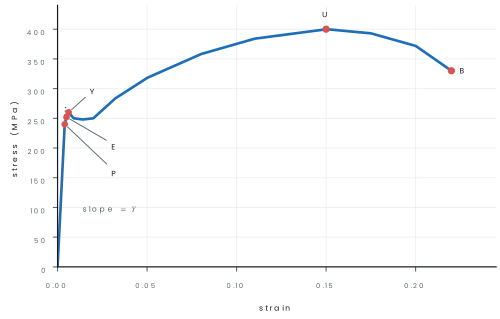
Reading the curve from the origin:
- O to P — proportional limit. Stress is proportional to strain; Hooke's law holds and the slope of this line is the Young modulus.
- P to E — elastic limit. The graph bends, so Hooke's law fails, but the wire still returns exactly to its original length when unloaded.
- Beyond E — permanent set. Unloading now leaves the wire longer than it started. At the yield point Y the wire begins to extend with almost no extra load.
- U — ultimate tensile stress, the largest stress the material can take. After U the wire develops a local neck, so the true area falls and the curve drops until the wire snaps at the breaking point B.
A material that stretches a great deal between Y and B (copper, mild steel, gold) is ductile; one that breaks very soon after the elastic limit (glass, cast iron, ceramic tile) is brittle.
Breaking stress depends only on the material. Breaking force = breaking stress \times area, so it depends on the thickness of the wire but not on its length. A 10 m wire and a 1 m wire of the same metal and diameter snap under exactly the same load.
Two related effects are worth naming. Elastic after-effect is the delay some materials (glass, rubber) show in returning to their original size.
Elastic fatigue is the loss of elastic strength when a body is subjected to repeated cycles of stress — the reason a wire finally breaks after being bent back and forth many times, and why bridges and aircraft parts are replaced long before they look worn.
8.3 Elastic modulus: Young modulus, bulk modulus, shear modulus
Within the elastic limit, the modulus of elasticity of a material is the ratio of the stress applied to the strain produced: \ \text{modulus} = \text{stress}/\text{strain}.
Because strain has no unit, a modulus has the unit of stress, N m⁻² (Pa). A large modulus means a stiff material.
Young modulus
where e is the extension of a wire of original length L and area A under a load F. Rearranging gives F = (YA/L)e, which compared with F = kx proves the result k = YA/L quoted in section 8.1.
Only solids have a Young modulus, because only a solid can be pulled into a wire.
Problem. A steel wire of length 2.0\ \text{m} and diameter 1.0\ \text{mm} carries a load of 50\ \text{N}. Taking Y = 2.0 \times 10^{11}\ \text{Pa}, find the stress, the strain and the extension.
Solution. Area of cross-section:
Bulk modulus
If a uniform increase of pressure p on all sides reduces a volume V by \Delta V, then
The minus sign is there because \Delta V is negative when p increases, so that B comes out positive. Solids, liquids and gases all have a bulk modulus. Its reciprocal is the compressibility, K = 1/B, measured in Pa⁻¹.
Problem. The pressure on 1.0\ \text{m}^{3} of water is increased by 2.2\times10^{7}\ \text{Pa}. If the bulk modulus of water is 2.2\times10^{9}\ \text{Pa}, find the change in volume and the compressibility of water.
Solution.
The volume falls by 0.010\ \text{m}^{3}, i.e. by 1.0\ \% — water is very nearly incompressible. The compressibility is
Shear modulus (modulus of rigidity)
A tangential force F on the top face of area A of a block of height L slides that face sideways by x, turning the vertical edges through a small angle \theta = x/L radians. Then
Only solids have a shear modulus: a liquid or a gas cannot sustain a tangential stress — it simply flows. For most metals \eta is roughly Y/3.
Problem. A rubber block of square face 10\ \text{cm}\times10\ \text{cm} and height 5.0\ \text{cm} is fixed at the bottom. A tangential force of 100\ \text{N} is applied to the top face.
If \eta = 2.0\times10^{6}\ \text{Pa}, find the shear strain and the sideways displacement of the top face.
Solution. A = 0.10\times0.10 = 1.0\times10^{-2}\ \text{m}^{2}.
Approximate room-temperature values (1 GPa = 10^{9} Pa):
| Material | Y (GPa) | B (GPa) | \eta (GPa) | Poisson ratio \sigma |
|---|---|---|---|---|
| Steel | 200 | 160 | 84 | 0.29 |
| Copper | 110 | 140 | 44 | 0.34 |
| Brass | 91 | 61 | 35 | 0.34 |
| Aluminium | 70 | 70 | 25 | 0.33 |
| Glass | 55 | 37 | 23 | 0.25 |
| Water | — | 2.2 | 0 | — |
| Rubber | 0.0005 – 0.05 | ≈ 2 | ≈ 0.0007 | ≈ 0.50 |
8.4 Poisson's ratio
A stretched wire does not only get longer — it also gets thinner. If a wire of length L and diameter d stretches by e and its diameter shrinks by \Delta d, then
Poisson's ratio \sigma is the ratio of the lateral strain to the longitudinal strain, within the elastic limit:
It is a pure number with no unit and no dimensions, and it is a constant of the material.
Theory allows \sigma to lie between -1 and +0.5. For all common materials it is positive and lies between about 0.2 and 0.4; rubber is the extreme case at nearly 0.5. The upper bound has a simple physical meaning. For a wire of volume V = \pi r^{2}L, small changes give
If \sigma = 0.5 the volume does not change at all when the wire is stretched; \sigma larger than 0.5 would mean the volume shrinks on stretching, which no material does.
Problem. A wire of length 3.0\ \text{m} and diameter 2.0\ \text{mm} is stretched by 1.5\ \text{mm}. If Poisson's ratio for the material is 0.30, find the decrease in diameter and the fractional change in volume.
Solution.
So the diameter falls by 0.30\ \mu\text{m}. The volume change is
an increase of 0.02\ \%.
8.5 Elastic potential energy
Stretching a wire takes work, and that work is stored in the wire as elastic potential energy. It is recovered when the wire is released — this is how a catapult, a bow and a clock spring work.
We start from the work done by the stretching force and reach the energy stored in the wire, and then the energy stored in each cubic metre of it.
Setting up. A wire of original length L and cross-section area A is slowly stretched. Let x be the extension so far, and let e be the final extension when the full load F is on. The wire obeys Hooke's law throughout.
Step 1 — the force needed at extension x. The definition of Young modulus, Y = \dfrac{F_x L}{A x}, rearranged for the force, says that the force which holds the wire at extension x is
This is the key point: the force is not constant. It grows as the wire stretches, so we cannot just write work = force \times distance.
Step 2 — take a stretch so small the force cannot change. Let the wire stretch a further tiny amount dx. Over such a small distance F_x is effectively constant, so the small work done is
Step 3 — add up all the small bits. Adding up infinitely many small pieces means integrating, from no extension (x = 0) to the final extension (x = e):
Step 4 — take the constants outside. Y, A and L do not change during the stretch:
Step 5 — do the integral. Using \int x\,dx = x^{2}/2:
Step 6 — put in the limits. At x = e we get e^{2}/2; at x = 0 we get 0:
Step 7 — split one factor of e off, ready for the next step:
Step 8 — recognise the bracket. Putting x = e in Step 1 gives the final load, F = YAe/L. So the bracket is F:
Step 9 — the work is stored, not lost. The stretching is slow and the wire stays elastic, so all this work is stored as elastic potential energy U:
Now the energy per unit volume.
Step 10 — divide by the volume. The wire's volume is A \times L:
Step 11 — split the fraction so that F pairs with A and e pairs with L:
Step 12 — name the two factors. F/A is the stress and e/L is the strain:
Step 13 — two other forms. Since stress = Y \times strain, we may replace either factor. Writing \varepsilon for the strain:
Result.
What it means. The \frac{1}{2} is the whole physical story: the force starts at zero and ends at F, so on average only F/2 acted over the distance e.
Graphically, U is the area under the load–extension line — a triangle of base e and height F.
The second result says the energy stored in each cubic metre depends only on how hard the material is squeezed and how much it gives, not on the size of the wire.
Conditions used. Hooke's law holds (we are below the elastic limit, so the graph is a straight line), the load is applied slowly so nothing vibrates, and no energy is lost as heat.
- The statement that the force is variable, F_x = (YA/L)x — full marks are rarely given without it.
- The element of work dW = F_x\,dx.
- The integral \int_{0}^{e}(YA/L)x\,dx with correct limits.
- The step that turns YAe/L back into F, giving U = \frac{1}{2}Fe.
- For the energy-density part: dividing by volume AL and regrouping into \frac{1}{2}\,\text{stress}\times\text{strain}.
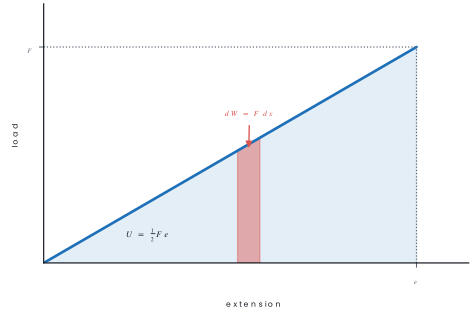
The energy is \frac{1}{2}Fe, not Fe. The load is built up gradually from zero to F, so the average force during the stretch is F/2.
If instead the full load F is hung on suddenly, it does work Fe — twice the stored energy — and the extra \frac{1}{2}Fe appears as vibration and heat.
Problem. A steel wire of length 4.0\ \text{m} and cross-sectional area 2.0\ \text{mm}^{2} is stretched by 2.0\ \text{mm}. Taking Y = 2.0\times10^{11}\ \text{Pa}, find the load applied, the energy stored and the energy stored per unit volume.
Solution. With A = 2.0\times10^{-6}\ \text{m}^{2} and e = 2.0\times10^{-3}\ \text{m}:
Volume = AL = 2.0\times10^{-6}\times4.0 = 8.0\times10^{-6}\ \text{m}^{3}, so

Chapter summary
- Hooke's law: within the elastic limit F = kx, where the force constant k = F/x (N m⁻¹). For a wire k = YA/L, so k depends on shape as well as material.
- Stress = F/A (Pa, [ML^{-1}T^{-2}]); strain = change ÷ original value (no unit). Modulus = stress ÷ strain.
- The stress–strain curve runs: proportional limit P, elastic limit E, yield point Y, ultimate stress U, breaking point B. Ductile materials have a long Y–B stretch; brittle ones break just after E.
- Young modulus Y = FL/Ae; bulk modulus B = -pV/\Delta V with compressibility K = 1/B; shear modulus \eta = F/(A\theta) with \theta = x/L. Only B applies to liquids and gases.
- Poisson's ratio \sigma = (\Delta d/d)\div(e/L); no unit, theoretical range -1 to 0.5, real materials 0.2–0.4. Also \Delta V/V = (1-2\sigma)e/L.
- Elastic potential energy U = \frac{1}{2}Fe = \frac{1}{2}\dfrac{YAe^{2}}{L}, and energy per unit volume u = \frac{1}{2}\times stress \times strain = \frac{1}{2}Y\varepsilon^{2}.
- Breaking force depends on the area of cross-section, never on the length.
Practice questions
Group A — Multiple choice (1 mark each)
- The SI unit of stress is [1]aN mbN m⁻²cN m⁻¹dit has no unit
- Strain is [1]ameasured in N m⁻²bmeasured in mca pure numberdmeasured in N
- For a perfectly rigid body the Young modulus is [1]azerobinfinitecunitydnegative
- The theoretical limits of Poisson's ratio are [1]a0 to 1b-1 to 0.5c-0.5 to 1d0 to 0.25
- The energy stored per unit volume of a stretched wire equals [1]astress × strainb½ × stress × straincstress ÷ straind½ × stress ÷ strain
Answers to Group A
1. (b) — stress is force per unit area, N m⁻² = Pa.
2. (c) — it is a ratio of two lengths (or two volumes), so it has no unit.
3. (b) — a rigid body has zero strain, and Y = \text{stress}/\text{strain} \to \infty.
4. (b) — \sigma larger than 0.5 would make the volume fall on stretching.
5. (b) — the area under the stress–strain line is \frac{1}{2}\times stress \times strain.
Group B — Short answer (5 marks each)
- Define stress and strain and state their units. State Hooke's law and hence define modulus of elasticity. [5]
- Draw a stress–strain curve for a ductile material and mark the proportional limit, elastic limit, yield point and breaking point. Distinguish between elasticity and plasticity. [5]
- Define Young modulus. A steel wire 3.0\ \text{m} long with cross-sectional area 2.0\ \text{mm}^{2} stretches by 1.5\ \text{mm} under a load W. Find W, given Y = 2.0\times10^{11}\ \text{Pa}. [5]
- Define bulk modulus and compressibility. The pressure on a sample of water is increased by 4.4\times10^{7}\ \text{Pa}. Find the percentage decrease in its volume if B = 2.2\times10^{9}\ \text{Pa}. [5]
- Show that the energy stored per unit volume of a stretched wire is \frac{1}{2}\times stress \times strain. A wire of volume 1.0\times10^{-6}\ \text{m}^{3} is stretched so that its strain is 1.0\times10^{-3}. Find the energy stored if Y = 2.0\times10^{11}\ \text{Pa}. [5]
Answers to Group B
3. F = \dfrac{YAe}{L} = \dfrac{2.0\times10^{11}\times2.0\times10^{-6}\times1.5\times10^{-3}}{3.0} = 200\ \text{N}.
4. \dfrac{\Delta V}{V} = \dfrac{p}{B} = \dfrac{4.4\times10^{7}}{2.2\times10^{9}} = 0.020, i.e. a decrease of 2.0\ \%.
5. Outline: work done = \int_0^e (YA/L)x\,dx = \frac{1}{2}Fe; divide by volume AL to get u = \frac{1}{2}(F/A)(e/L). Numerically U = \frac{1}{2}Y\varepsilon^{2}V = \frac{1}{2}\times2.0\times10^{11}\times(1.0\times10^{-3})^{2}\times1.0\times10^{-6} = 0.10\ \text{J}.
Group C — Long answer (8 marks each)
- (a) Define the three elastic moduli and write the expression for each. [3](b) Derive an expression for the elastic potential energy stored in a stretched wire and hence for the energy per unit volume. [3](c) A wire of length 2.0\ \text{m} and area 1.0\ \text{mm}^{2} is stretched by 1.0\ \text{mm} with Y = 1.1\times10^{11}\ \text{Pa}. Find the energy stored. [2]
- A copper wire and a steel wire, each 2.0\ \text{m} long and 1.0\ \text{mm} in diameter, are joined end to end and a force of 100\ \text{N} is applied to the free ends. Given Y_{Cu} = 1.1\times10^{11}\ \text{Pa} and Y_{St} = 2.0\times10^{11}\ \text{Pa}, find the stress in each wire, the extension of each wire and the total extension. [8]
Answers to Group C
1. (c) F = YAe/L = (1.1\times10^{11}\times1.0\times10^{-6}\times1.0\times10^{-3})/2.0 = 55\ \text{N}, so U = \frac{1}{2}Fe = \frac{1}{2}\times55\times1.0\times10^{-3} = 2.75\times10^{-2}\ \text{J}.
2. The two wires are in series, so each carries the same force 100\ \text{N} and, having the same diameter, the same stress.
A = \pi d^{2}/4 = 7.854\times10^{-7}\ \text{m}^{2}, hence stress = 100/7.854\times10^{-7} = 1.273\times10^{8}\ \text{Pa} in both.
Copper: e = \text{stress}\times L / Y = (1.273\times10^{8}\times2.0)/1.1\times10^{11} = 2.32\times10^{-3}\ \text{m} = 2.32\ \text{mm}.
Steel: e = (1.273\times10^{8}\times2.0)/2.0\times10^{11} = 1.27\times10^{-3}\ \text{m} = 1.27\ \text{mm}.
Total extension = 2.32 + 1.27 = 3.59\ \text{mm}. The copper wire stretches nearly twice as much because its Young modulus is about half that of steel.
Group D — Model answers for long questions (10 marks each, for deeper revision)
- State Hooke's law. Define stress, strain and the three moduli of elasticity, and explain the stress-strain graph of a ductile wire. [10]
- Derive an expression for the elastic potential energy stored in a stretched wire, and solve a numerical. [10]
Model answer D1: Hooke's law, moduli and the stress-strain curve (10 marks)
Introduction. A body that returns to its original shape after the deforming force is removed is elastic, and one that does not is plastic. Elasticity is the reason a steel cable of a Nepali suspension bridge can carry the weight of people without permanent stretching.
Stress and strain.
- Stress = restoring force per unit area, \sigma = F/A (N m^{-2} or Pa). It may be tensile, compressive or shear.
- Strain = fractional change in dimension (no unit): longitudinal strain = \Delta L/L, volume strain = \Delta V/V, shear strain = \tan\theta \approx \theta.
Hooke's law. Within the elastic limit, stress is directly proportional to strain: stress = E\times strain, where E is the modulus of elasticity.
The three moduli.
- Young's modulus Y = \dfrac{F/A}{\Delta L/L} = \dfrac{FL}{A\,\Delta L} for a change in length.
- Bulk modulus B = \dfrac{-\Delta P}{\Delta V/V} for a change in volume. Its reciprocal is the compressibility.
- Modulus of rigidity (shear modulus) \eta = \dfrac{F/A}{\theta} for a change in shape.
| Modulus | Type of stress | Strain | Applies to |
|---|---|---|---|
| Young's | Longitudinal | Change in length | Solids |
| Bulk | Volume (pressure) | Change in volume | Solids, liquids, gases |
| Rigidity | Shear (tangential) | Angle of shear | Solids only |
Stress-strain graph for a ductile wire (such as steel or copper).
- OA (proportional limit): a straight line, so Hooke's law is obeyed.
- AB (elastic limit): the wire still returns to its original length, but the stress is no longer proportional to strain.
- B (yield point): beyond this the wire stretches a lot even for little extra stress, and permanent (plastic) deformation begins.
- BC (plastic region): the wire is permanently lengthened, and the graph rises to the ultimate tensile strength at C.
- CD: the wire necks (thins at one place), and at D the wire breaks (fracture point). A brittle material, such as glass, breaks soon after the elastic limit; an elastomer, such as rubber, shows large strains with no proportionality.
Numerical. A steel wire 2\ \text{m} long, of area 1\ \text{mm}^{2} (10^{-6}\ \text{m}^{2}), carries a load of 100\ \text{N}.
With Y = 2\times10^{11}\ \text{Pa}, the stress is 10^{8}\ \text{Pa}, the strain is 10^{8}/(2\times10^{11}) = 5\times10^{-4} and the extension is \Delta L = 5\times10^{-4}\times2 = 1\ \text{mm}.
Conclusion. Hooke's law holds within the elastic limit, and each type of deformation has its own modulus. The stress-strain curve shows the elastic, plastic and breaking behaviour of a material, which engineers use to choose safe materials.
Model answer D2: elastic potential energy (10 marks)
Introduction. When a wire is stretched, work is done against the inter-atomic forces, and this is stored in the wire as elastic potential energy. It is given back when the wire is released.
Derivation. Consider a wire of length L and cross-section A and Young's modulus Y, loaded gradually so that it stretches by x at a stage when the force is F.
- From Y = FL/(Ax) the force is F = \dfrac{YA}{L}\,x, proportional to the extension.
- The work done to stretch it by a further small amount dx is dW = F\,dx = \dfrac{YA}{L}\,x\,dx.
- The total work done from x = 0 to the final extension \ell is
- Since the final force is F = YA\ell/L, this can be written as
that is, the average force (F/2) times the extension, which is also the area under the force-extension graph (a triangle).
Energy per unit volume. The volume of the wire is AL, so
| Quantity | Formula |
|---|---|
| Force at extension x | F = (YA/L)\,x |
| Work done | U = \tfrac{1}{2}F\ell = \dfrac{YA\ell^{2}}{2L} |
| Energy density | \tfrac12\times\text{stress}\times\text{strain} |
Numerical. For the steel wire above (L = 2\ \text{m}, A = 10^{-6}\ \text{m}^{2}, F = 100\ \text{N}, \ell = 1\ \text{mm}):
- Energy stored U = \tfrac12\times100\times10^{-3} = 0.05\ \text{J}.
- Energy per unit volume = 0.05/(10^{-6}\times2) = 2.5\times10^{4}\ \text{J m}^{-3}. Check: \tfrac12\times10^{8}\times5\times10^{-4} = 2.5\times10^{4}\ \text{J m}^{-3}. ✓
Applications. The energy stored in a stretched spring or bowstring drives a watch spring, a bow-and-arrow and a catapult. A material that can store much elastic energy per unit volume is used for springs and shock absorbers.
The work done on a wire beyond the elastic limit is lost as heat.
Conclusion. The energy stored in a stretched wire is \tfrac12F\ell, which is half of the product of the final force and the extension, because the force grows from zero to F.
Practise more: Physics question bank