Unit 3 · Mechanics · 5 teaching hours · 28 min read
Kinematics
What the syllabus asks for 5
- Instantaneous velocity and acceleration
- Relative velocity
- Equation of motion (graphical treatment)
- Motion of a freely falling body
- Projectile motion and its applications
Kinematics is the description of motion — where a body is, how fast it moves and how that speed changes — without asking why it moves. The "why" is dynamics, the next unit.
Everything here rests on three quantities: displacement, velocity and acceleration, and on the two operations that connect them, differentiation and integration.
Almost every Group A and Group B kinematics question in recent NEB papers is either a graph-reading question or a projectile question. Learn to read a motion graph and half the unit is already done.
3.1 Instantaneous velocity and acceleration
If a particle moves along the x-axis and is at x_1 at time t_1 and at x_2 at t_2, its average velocity over that interval is
Average velocity tells you nothing about what happened inside the interval. To get the velocity at one instant we shrink the interval to zero. The limit is the instantaneous velocity:
The instantaneous velocity of a particle is the first derivative of its position with respect to time. Its magnitude is the instantaneous speed, and its direction is the direction of motion at that instant — i.e. along the tangent to the path.
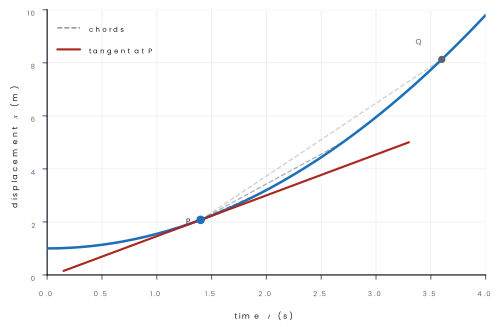
Geometrically, on a displacement–time graph the average velocity is the slope of the chord joining two points, and the instantaneous velocity is the slope of the tangent at a point. As the second point slides back towards the first, the chord rotates into the tangent.
In the same way, acceleration is the rate of change of velocity:
We start from the definition a = dv/dt and reach a form of acceleration with no time in it at all — useful whenever a question gives you velocity as a function of position.
Step 1 — the definition. Acceleration is the rate of change of velocity with time:
Step 2 — bring in x. The velocity v changes with time only because the particle has moved to a new position x, and x itself changes with time. So v depends on t through x. The chain rule of differentiation lets us insert dx on the top and bottom:
(Think of it as \dfrac{dv}{dt} = \dfrac{dv}{dx}\times\dfrac{dx}{dt} — the two dx factors formally cancel.)
Step 3 — recognise the second factor. By definition dx/dt is the velocity:
Step 4 — substitute. Replacing dx/dt by v:
Result.
What it means. Both forms describe the same acceleration. The first is "how fast does the speed change each second", the second is "how fast does the speed change each metre, multiplied by how many metres you cover per second".
Condition used. The particle must move along a single line (one dimension) and v must be a well-defined function of x. If the particle turns back and passes the same x at two different speeds, you must treat each part of the journey separately.
For "show that a = v\,dv/dx": start from a = dv/dt, write the chain rule step explicitly, state that dx/dt = v, then substitute. Three lines, three marks — do not skip the chain-rule line.
Use a = dv/dt when the data is velocity against time; use a = v\,dv/dx when it is velocity against position. Choosing the wrong one turns a two-line problem into a page of algebra.
| Quantity | Defining relation | SI unit | Dimensional formula |
|---|---|---|---|
| Displacement | \vec{s} = \vec{r}_2 - \vec{r}_1 | m | [L] |
| Velocity | \vec{v} = d\vec{r}/dt | m s⁻¹ | [LT^{-1}] |
| Acceleration | \vec{a} = d\vec{v}/dt | m s⁻² | [LT^{-2}] |
Problem. A particle moves so that x = 3t^{3} - 4t^{2} + 2t (metres, seconds). Find(a) its velocity and acceleration at t = 2\ \text{s}, and(b) the time at which the acceleration is zero.
Solution.
(a) Differentiating once and twice,
At t = 2\ \text{s}: v = 9(4) - 8(2) + 2 = 22\ \text{m s}^{-1} and a = 18(2) - 8 = 28\ \text{m s}^{-2}.
(b) Setting a = 0 gives 18t - 8 = 0, so t = 4/9 \approx 0.44\ \text{s}.
3.2 Relative velocity
All velocity is measured with respect to some frame. If two bodies A and B have velocities \vec{v}_A and \vec{v}_B measured in the same frame, the velocity of A relative to B is
Read the subscripts as "A with respect to B". Reversing them reverses the vector: \vec{v}_{BA} = -\vec{v}_{AB}.
For motion along one line the vector subtraction is just a signed subtraction. In two dimensions, subtract the components, or use the parallelogram rule with -\vec{v}_B. If \theta is the angle between \vec{v}_A and \vec{v}_B, the magnitude is
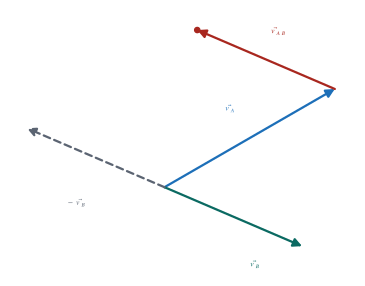
Problem. Rain falls vertically at 4\ \text{m s}^{-1}. A cyclist rides due east at 3\ \text{m s}^{-1}. At what angle to the vertical must the cyclist tilt an umbrella?
Solution. The rain's velocity relative to the cyclist is \vec{v}_{rc} = \vec{v}_r - \vec{v}_c. Taking east as +x and up as +y, \vec{v}_r = (0,-4) and \vec{v}_c = (3,0), so \vec{v}_{rc} = (-3,-4).
Its magnitude is \sqrt{3^2+4^2} = 5\ \text{m s}^{-1} and it makes an angle \theta with the vertical given by \tan\theta = 3/4, so \theta = 36.87^{\circ}. The umbrella must be tilted about 37^{\circ} forward, towards the east.
Students subtract the speeds instead of the vectors. Velocity is a vector: always resolve into components, subtract componentwise, then recombine.
3.3 Equations of motion — graphical treatment
For uniform acceleration a, with initial velocity u and velocity v after time t, the velocity–time graph is a straight line of slope a and intercept u.
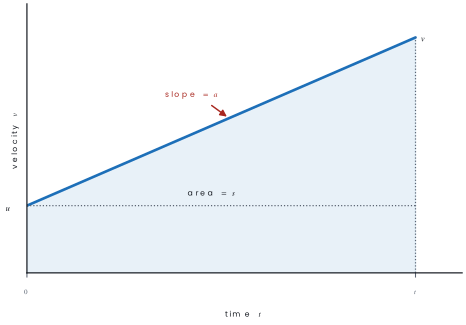
We start from just two facts about a velocity–time graph — its slope is the acceleration and the area under it is the displacement — and we reach all three equations of uniformly accelerated motion.
Read the graph above: at t = 0 the velocity is u (the intercept), at time t it is v, and because the acceleration is constant the line is straight.
First equation: v = u + at
Step 1. The acceleration is the slope of the straight line. Slope means "rise divided by run". The rise is the velocity gained, v - u; the run is the time taken, t - 0 = t:
Step 2. Multiply both sides by t to clear the fraction:
Step 3. Add u to both sides to make v the subject:
Second equation: s = ut + \frac{1}{2}at^{2}
Step 1. The displacement is the area between the line and the time axis. That shape is a trapezium. Cut it with a horizontal line at height u: below the cut is a rectangle, above it a triangle.
Step 2. The rectangle has height u and width t, so its area is length \times breadth:
Step 3. The triangle has base t and height (v - u), and the area of a triangle is \frac{1}{2}\times base \times height:
Step 4. From the first equation, v - u = at. Substitute it:
Step 5. Add the two areas:
Third equation: v^{2} = u^{2} + 2as
Step 1. Take the trapezium area in one go. The area of a trapezium is \frac{1}{2}\times(sum of the two parallel sides)\times(distance between them). The parallel sides are u and v, and the distance between them is t:
Step 2. We want no t in the answer, so get t from the first equation. Starting from v = u + at, subtract u and divide by a:
Step 3. Substitute this t into the expression for s:
Step 4. Multiply the two brackets. (u+v)(v-u) = v^{2} - u^{2}, the difference-of-squares identity:
Step 5. Multiply both sides by 2a:
Step 6. Add u^{2} to both sides:
Result.
What it means. The first links velocity to time, the second links position to time, and the third links velocity to position with no time involved — so you pick the one that avoids the quantity you were not given.
Condition used. All three need the acceleration a to be constant; that is what makes the graph a straight line. They also need motion in a straight line, with one fixed positive direction chosen before you start.
They do not apply to circular motion, or to a car whose acceleration is changing.
A 5-mark "derive the three equations graphically" answer must contain: (i) a labelled v–t graph with u, v, t marked; (ii) the sentence "slope = acceleration" and the sentence "area = displacement"; (iii) the algebra for each of the three, with the trapezium split into rectangle + triangle shown; (iv) the substitution v - u = at in the second, and t = (v-u)/a in the third.
No graph means you cannot score the "graphical treatment" marks even if the algebra is perfect.
A fourth relation gives the distance travelled in the n^{th} second:
s_n is the distance covered during the n^{\text{th}} second, i.e. between t=n-1 and t=n. Its unit is the metre, not m s⁻¹, even though the formula looks like a velocity.
| Graph | Slope represents | Area under it represents |
|---|---|---|
| Displacement–time | velocity | — (no physical meaning) |
| Velocity–time | acceleration | displacement |
| Acceleration–time | jerk (not in syllabus) | change in velocity |
3.4 Motion of a freely falling body
A body falling freely near the Earth's surface, with air resistance neglected, has constant acceleration g \approx 9.8\ \text{m s}^{-2} directed downwards. The three equations apply unchanged with a replaced by g — you only have to be consistent about signs.
Fix upward as positive before you write anything. Then a = -g always, an upward throw has u > 0, and a downward throw has u < 0. Never change the convention halfway through a problem.
For a body projected vertically upwards with speed u:
and it returns to the point of projection with speed u — equal in magnitude, opposite in direction. Time of ascent equals time of descent.
Problem. A stone is dropped from a balloon rising at 5\ \text{m s}^{-1} when the balloon is at 60\ \text{m}. How long does the stone take to reach the ground? Take g = 10\ \text{m s}^{-2}.
Solution. The stone starts with the balloon's velocity: u = +5\ \text{m s}^{-1} (upward positive). Displacement to the ground is s = -60\ \text{m}, and a = -10\ \text{m s}^{-2}.
So 5t^{2} - 5t - 60 = 0, i.e. t^{2} - t - 12 = 0, giving (t-4)(t+3)=0. Taking the positive root, t = 4\ \text{s}.
Note the stone first rises for 0.5\ \text{s} — forgetting its initial upward velocity is the standard trap in this question.
3.5 Projectile motion and its applications
A projectile is a body given an initial velocity and then left to move under gravity alone. The whole subject reduces to one idea:
The horizontal and vertical motions are completely independent. Horizontally there is no acceleration, so x-motion is uniform; vertically the acceleration is -g, so y-motion is uniformly accelerated. Solve them separately and link them only through the common time t.
We start from the two separate equations of motion, one for the horizontal direction and one for the vertical, and we reach a single equation linking y to x with no time in it. Its shape is what we want to identify.
Step 1 — split the initial velocity. A speed u at angle \theta to the horizontal has a horizontal part and a vertical part, found by resolving:
Step 2 — horizontal motion. There is no horizontal force (we ignore air resistance), so there is no horizontal acceleration and the horizontal velocity stays u\cos\theta for ever. Distance = speed \times time:
Step 3 — vertical motion. Vertically the acceleration is g downwards. Using s = ut + \frac{1}{2}at^{2} with u \to u\sin\theta and a \to -g (taking up as positive):
Step 4 — make t the subject of the horizontal equation. Divide both sides of Step 2 by u\cos\theta:
Step 5 — substitute this t into the vertical equation. This is legal because it is the same t in both — the two motions share one clock:
Step 6 — tidy the first term. The u cancels, and \sin\theta/\cos\theta = \tan\theta:
Step 7 — square the bracket in the second term. Squaring top and bottom:
Step 8 — read off the shape. For a given launch, u and \theta are fixed numbers, so we may write A = \tan\theta and B = g/(2u^{2}\cos^{2}\theta), both constants:
Result. The trajectory equation is
and since y is a quadratic in x with a negative x^{2} coefficient, the path is a parabola opening downwards.
What it means. Gravity pulls the projectile below the straight line it would have followed, and the amount it falls behind grows as t^{2} — that x^{2} term is exactly the free fall the body would have had.
Assumptions used. Air resistance is neglected, g is constant in size and direction over the flight, and the Earth's curvature and rotation are ignored.
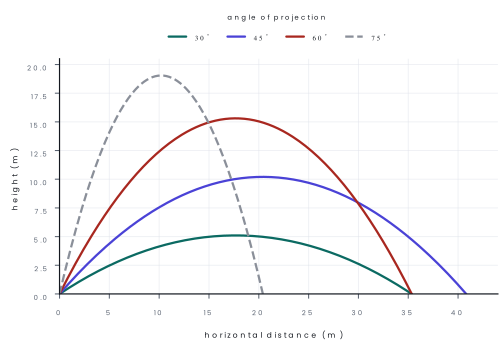
We start from the same two motion equations, x = (u\cos\theta)t and y = (u\sin\theta)t - \frac{1}{2}gt^{2}, and reach the three numbers a question always asks for: how long the flight lasts, how high it goes, and how far it lands.
Time of flight T
Step 1. The projectile is back on the ground when its height is zero again, so put y = 0 and t = T:
Step 2. Take out the common factor T:
Step 3. A product is zero when one factor is zero. So either T = 0 (that is the launch instant, which we do not want) or the bracket is zero:
Step 4. Move the second term across:
Step 5. Multiply both sides by 2 and divide by g:
Maximum height H
Step 1. At the highest point the projectile has stopped rising and has not yet started falling, so its vertical velocity is zero there.
Apply v^{2} = u^{2} + 2as to the vertical direction only, with initial vertical velocity u\sin\theta, final vertical velocity 0, acceleration -g and displacement H:
Step 2. Write out the squares and the product:
Step 3. Move 2gH to the left:
Step 4. Divide both sides by 2g:
Horizontal range R
Step 1. Horizontally there is no acceleration, so the range is just the constant horizontal speed multiplied by the whole time of flight:
Step 2. Put in T = 2u\sin\theta/g from above:
Step 3. Multiply the two u factors together:
Step 4. Use the double-angle identity 2\sin\theta\cos\theta = \sin 2\theta:
Maximum range
Step 1. In R = u^{2}\sin 2\theta/g, only \sin 2\theta can change if u is fixed. The largest value of a sine is 1:
Step 2. This happens when \sin 2\theta = 1, i.e. when 2\theta = 90^{\circ}:
Result.
What it means. Time of flight and height depend only on the vertical component u\sin\theta; the range needs both components, which is why there is a best compromise angle of 45^{\circ}. Note also T = 2\times(time to reach the top), so rise time equals fall time.
Assumptions used. No air resistance, constant g, and — important — the landing point is at the same height as the launch point. If the ground is lower (a ball thrown off a cliff), T and R must be recalculated from y = -h instead of y = 0.
(i) Resolve u into u\cos\theta and u\sin\theta and say the two motions are independent; (ii) for T, set y = 0 and reject the root t = 0 with a reason; (iii) for H, state that the vertical velocity is zero at the top; (iv) for R, use R = u\cos\theta\times T and show the 2\sin\theta\cos\theta = \sin2\theta step; (v) state the same-level assumption.
The rejected root and the double-angle step are the two places marks are usually dropped.
Three consequences follow at once and are examined constantly:
- R is maximum when \sin 2\theta = 1, i.e. \theta = 45^{\circ}, giving R_{\max} = u^{2}/g.
- Angles \theta and (90^{\circ}-\theta) give the same range, because \sin 2\theta = \sin(180^{\circ} - 2\theta). This is why 30^{\circ} and 60^{\circ} land together.
- At the highest point the velocity is not zero — it is horizontal, of magnitude u\cos\theta.
"The velocity at the maximum height is zero" is wrong for a projectile. Only the vertical component vanishes. The speed there is u\cos\theta.
Horizontal projection. If a body is projected horizontally with speed u from height h, then \theta = 0 and
The time of fall does not depend on u: a bullet fired horizontally and one dropped from the same height hit the ground together.
Problem. A ball is thrown at 25\ \text{m s}^{-1} at 53^{\circ} to the horizontal. Taking g = 10\ \text{m s}^{-2}, \sin 53^{\circ} = 0.8 and \cos 53^{\circ} = 0.6, find the time of flight, maximum height, range, and the speed at the highest point.
Solution. Components: u_x = 25(0.6) = 15\ \text{m s}^{-1}, u_y = 25(0.8) = 20\ \text{m s}^{-1}.
At the highest point the velocity is purely horizontal, so the speed is u_x = 15\ \text{m s}^{-1}.

Chapter summary
- Instantaneous velocity is v = dx/dt (slope of the tangent to the x–t graph); acceleration is a = dv/dt = v\,dv/dx.
- On a v–t graph, slope is acceleration and area is displacement.
- For uniform acceleration: v = u+at, s = ut + \frac{1}{2}at^{2}, v^{2} = u^{2}+2as, s_n = u + \frac{a}{2}(2n-1).
- Free fall is uniform acceleration with a = -g (upward positive). Time up equals time down; the landing speed equals the launch speed.
- Projectile motion = uniform horizontal motion + free vertical fall. The path is a parabola, T = 2u\sin\theta/g, H = u^2\sin^2\theta/2g, R = u^2\sin 2\theta/g.
- Range is maximum at 45^\circ; complementary angles give equal ranges; the speed at the top is u\cos\theta, not zero.
Practice questions
Group A — Multiple choice (1 mark each)
- The slope of a displacement–time graph gives [1]aaccelerationbvelocitycdistancedjerk
- A projectile has maximum range when the angle of projection is [1]a30^{\circ}b45^{\circ}c60^{\circ}d90^{\circ}
- At the highest point of its path a projectile's velocity is [1]azerobverticalchorizontaldalong the tangent to the vertical
Answers to Group A
1. (b) — slope of x–t is dx/dt = v.
2. (b) — R = u^2\sin2\theta/g is maximum when 2\theta = 90^{\circ}.
3. (c) — only the vertical component vanishes; the horizontal component u\cos\theta survives.
Group B — Short answer (5 marks each)
- Define instantaneous velocity and acceleration. Show that a = v\,\dfrac{dv}{dx}. [5]
- Derive the three equations of uniformly accelerated motion from a velocity–time graph. [5]
- A car accelerates uniformly from rest and covers 100\ \text{m} in 5\ \text{s}. Find its acceleration and the distance covered in the 5^{\text{th}} second. [5]
- Rain falls vertically at 6\ \text{m s}^{-1} while a man walks east at 8\ \text{m s}^{-1}. Find the magnitude and direction of the rain relative to the man. [5]
Answers to Group B
3. From s = ut+\frac12at^2 with u=0: 100 = \frac12a(25), so a = 8\ \text{m s}^{-2}. Then s_5 = u + \frac{a}{2}(2\times5-1) = 0 + 4(9) = 36\ \text{m}.
4. \vec{v}_{rm} = (0,-6)-(8,0) = (-8,-6); magnitude \sqrt{64+36} = 10\ \text{m s}^{-1}, at \tan^{-1}(8/6) = 53.1^{\circ} to the vertical, tilted towards the west (i.e. the man must tilt his umbrella 53^{\circ} forward, to the east).
Group C — Long answer (8 marks each)
- (a) Show that the trajectory of a projectile is a parabola. [4](b) Derive expressions for its time of flight, maximum height and horizontal range, and hence show that the range is maximum at 45^{\circ}. [4]
- A body is projected at u = 40\ \text{m s}^{-1} at 30^{\circ} from the top of a tower 50\ \text{m} high. Taking g = 10\ \text{m s}^{-2}, find(a) the time to reach the ground,(b) the horizontal distance from the foot of the tower, and(c) the speed on landing. [8]
Answer to Group C question 2
u_x = 40\cos30^{\circ} = 34.64\ \text{m s}^{-1}, u_y = 40\sin30^{\circ} = 20\ \text{m s}^{-1}.
(a) Taking upward positive, -50 = 20t - 5t^{2}, so 5t^{2}-20t-50 = 0, i.e. t^{2}-4t-10=0, giving t = 2+\sqrt{14} = 5.74\ \text{s}.
(b) x = u_xt = 34.64 \times 5.74 = 198.8\ \text{m}.
(c) v_y = u_y - gt = 20 - 57.4 = -37.4\ \text{m s}^{-1}, so v = \sqrt{34.64^{2}+37.4^{2}} = 51.0\ \text{m s}^{-1}.
Group D — Model answers for long questions (10 marks each, for deeper revision)
- Derive the three equations of uniformly accelerated motion by the graphical method, and solve a numerical. [10]
- What is a projectile? Derive expressions for the path, time of flight, maximum height and range, and find the angle of maximum range. [10]
- Describe the motion of a body under gravity. Derive the distance travelled in the nth second, and solve a numerical. [10]
Model answer D1: equations of motion by the graphical method (10 marks)
Introduction. A body moves with uniform acceleration if its velocity changes by equal amounts in equal intervals of time. Let the initial velocity be u, the final velocity be v after a time t, the acceleration be a and the displacement be s.
Graph. In the velocity-time graph the line AB starts at height OA = u at t = 0 and rises to BC = v at time t. The area under the line is the displacement, and the slope is the acceleration.
1. First equation (v = u + at). The slope of the graph is the acceleration:
2. Second equation (s = ut + ½at²). The displacement is the area of the trapezium OABC, which is the sum of the rectangle OADC (area ut) and the triangle ABD (area \tfrac{1}{2}\times t\times(v-u)):
3. Third equation (v² = u² + 2as). The area of the trapezium is also (average of the parallel sides) times the base: s = \tfrac{1}{2}(u + v)t. From the first equation t = (v - u)/a, so
| Equation | Missing quantity | Use when |
|---|---|---|
| v = u + at | s | Time and velocity needed |
| s = ut + \tfrac12 at^{2} | v | Displacement from time |
| v^{2} = u^{2} + 2as | t | Time is not given |
| s = \tfrac12(u+v)t | a | Average velocity known |
Numerical. A minibus on the Prithvi Highway speeds up from 10\ \text{m s}^{-1} to 30\ \text{m s}^{-1} in 8\ \text{s}. Then a = (30 - 10)/8 = 2.5\ \text{m s}^{-2} and s = \tfrac12(10 + 30)\times8 = 160\ \text{m}.
Check v^{2} = 100 + 2(2.5)(160) = 900, so v = 30\ \text{m s}^{-1}. ✓
Conclusion. These equations hold only for constant acceleration in a straight line. For variable acceleration, calculus or the graph must be used instead.
Model answer D2: projectile motion (10 marks)
Introduction. A projectile is a body thrown into the air that then moves under gravity alone (air resistance is neglected). Its path is a parabola. A kicked football, a javelin and water from a hose are examples.
The key idea is that the horizontal and vertical motions are independent.
Resolution. Let the body be thrown with speed u at an angle \theta above the horizontal.
- Horizontal: u_{x} = u\cos\theta, with a_{x} = 0 (uniform velocity).
- Vertical: u_{y} = u\sin\theta, with a_{y} = -g (uniformly decelerated going up).
Path. After time t: x = u\cos\theta\,t and y = u\sin\theta\,t - \tfrac{1}{2}gt^{2}. Eliminating t,
This is of the form y = bx - cx^{2}, a parabola.
Time of flight. The body returns to the ground when y = 0: 0 = u\sin\theta\,T - \tfrac{1}{2}gT^{2}, so T = \dfrac{2u\sin\theta}{g}.
Maximum height. At the top, v_{y} = 0; with v^{2} = u^{2} + 2as, 0 = u^{2}\sin^{2}\theta - 2gH, so H = \dfrac{u^{2}\sin^{2}\theta}{2g}.
Horizontal range. R = u\cos\theta\times T = \dfrac{2u^{2}\sin\theta\cos\theta}{g}, that is
Angle of maximum range. R is maximum when \sin2\theta = 1, so \theta = 45^{\circ} and R_{max} = u^{2}/g. Angles \theta and (90^{\circ} - \theta) give the same range, because \sin2\theta = \sin(180^{\circ} - 2\theta).
| Quantity | Formula | At \theta = 30^{\circ}, u = 50\ \text{m s}^{-1} |
|---|---|---|
| Time of flight | 2u\sin\theta/g | 5.10\ \text{s} |
| Maximum height | u^{2}\sin^{2}\theta/2g | 31.9\ \text{m} |
| Range | u^{2}\sin2\theta/g | 220.9\ \text{m} |
| Maximum possible range | u^{2}/g | 255.1\ \text{m} |
Numerical. A stone is thrown at 50\ \text{m s}^{-1} at 30^{\circ} to the ground, with g = 9.8\ \text{m s}^{-2}. The values are in the table above: for example R = 2500\sin60^{\circ}/9.8 = 220.9\ \text{m}. The same range is obtained at 60^{\circ}.
Conclusion. A projectile follows a parabola, with a uniform horizontal velocity and a vertical motion governed by g. The ranges at complementary angles are equal and the maximum is at 45^{\circ}.
Model answer D3: motion under gravity and distance in the nth second (10 marks)
Introduction. A body moving only under the pull of the Earth has the constant acceleration g = 9.8\ \text{m s}^{-2} downwards, independent of its mass (in the absence of air).
Galileo showed this at Pisa; Apollo 15 astronaut David Scott showed a hammer and a feather landing together on the Moon.
Sign convention. Take upward as positive. For a body thrown up, a = -g; for a body dropped from rest, taking down as positive, u = 0 and a = +g.
Equations of free fall (from rest).
Body thrown vertically upward with speed u.
- Time to the top: 0 = u - gt, so t = u/g.
- Maximum height: H = u^{2}/2g.
- Total time of flight: T = 2u/g (time up equals time down).
- Speed on return to the starting point is u downward.
Distance travelled in the nth second. The distance in the nth second is the difference of the distances in n seconds and (n-1) seconds:
For a body falling from rest, s_{n} = \tfrac{g}{2}(2n-1). The distances in successive seconds are in the ratio 1 : 3 : 5 : 7 \ldots.
| Second | Distance fallen (g = 9.8) |
|---|---|
| 1st | 4.9\ \text{m} |
| 2nd | 14.7\ \text{m} |
| 3rd | 24.5\ \text{m} |
| 5th | 44.1\ \text{m} |
Numerical. A ball is thrown vertically up at 20\ \text{m s}^{-1}. The maximum height is H = 400/(2\times9.8) = 20.4\ \text{m}, the time to the top is 20/9.8 = 2.04\ \text{s}, and the total time of flight is 4.08\ \text{s}.
A stone dropped from a bridge covers \tfrac{9.8}{2}(2\times5 - 1) = 44.1\ \text{m} in its 5th second.
Conclusion. For vertical motion all that changes from the straight-line equations is a = \pm g. The symmetry (equal times up and down, equal speeds at equal heights) simplifies many problems.
Practise more: Physics question bank