Unit 10 · Heat and Thermodynamics · 4 teaching hours · 27 min read
Thermal Expansion
What the syllabus asks for 4
- Linear expansion and its measurement
- Cubical expansion, superficial expansion and relation with linear expansion
- Liquid Expansion: Absolute and apparent
- Dulong and Petit method of determining expansivity of liquid
Heat a solid and its molecules vibrate through wider swings about their lattice positions, so their average separation grows and the body gets bigger.
That one sentence explains the gaps left between rails on the Janakpur railway, the rollers under a bridge girder, the sag designed into transmission lines, and the fact that a mercury thermometer works at all.
In this unit we put numbers on the effect: one coefficient for length, one for area, one for volume, and a special treatment for liquids, which cannot be heated without a container that expands too.
\alpha, \beta and \gamma describe expansion in one, two and three dimensions, and for an isotropic solid they are in the ratio 1:2:3.
Learn the derivation of \beta = 2\alpha and \gamma = 3\alpha — it is a standard Group B question — and learn why a liquid has two expansivities.
10.1 Linear expansion and its measurement
When a rod of length l_1 at temperature \theta_1 is heated to \theta_2, its length becomes l_2. Experiment shows the increase is proportional to the original length and to the temperature rise.
The coefficient of linear expansion (linear expansivity) \alpha of a material is the increase in length per unit original length per unit rise in temperature:
Its SI unit is K⁻¹ (numerically the same as °C⁻¹) and it has no dimensions of length: [\alpha] = [K^{-1}].
Strictly l_1 should be the length at 0\ ^{\circ}\text{C}, but because \alpha is of order 10^{-5} the difference between "length at 0\ ^{\circ}C" and "length at room temperature" changes the answer only in the fifth decimal place, so any convenient starting length is used.
| Material | \alpha (\times 10^{-6} K⁻¹) | Material | \alpha (\times 10^{-6} K⁻¹) |
|---|---|---|---|
| Invar | 1.2 | Copper | 17 |
| Pyrex glass | 3.2 | Brass | 19 |
| Ordinary glass | 9 | Aluminium | 23 |
| Steel / iron / concrete | 12 | Lead | 29 |
Invar (an iron–nickel alloy) expands so little that it is used for pendulum rods and survey tapes. Steel and concrete happen to have almost the same \alpha — which is the reason reinforced concrete does not tear itself apart in the Terai summer.
Measurement: Pullinger's apparatus
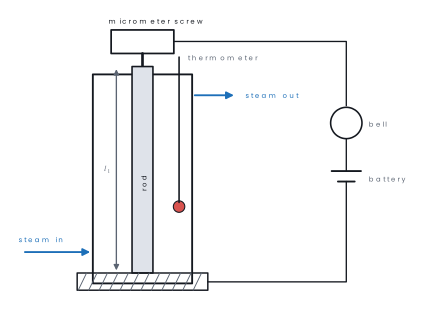
The rod under test stands on a fixed base inside a hollow steam jacket. Its upper end is just below the tip of a micrometer screw carried on a rigid frame.
The screw, the rod and a battery with an electric bell are connected in series, so the bell rings the instant the screw touches the rod.
- With the rod at room temperature \theta_1 (read on the thermometer in the jacket), turn the screw down until the bell just rings; record the reading a_1. Measure the length l_1 of the rod with a metre rule.
- Raise the screw well clear of the rod.
- Pass steam through the jacket until the thermometer is steady at \theta_2. The rod has now expanded.
- Turn the screw down again until the bell just rings; record a_2.
The expansion is \delta l = a_1 - a_2 (the screw has less distance to travel), so
Problem. A steel railway rail is 30.0\ \text{m} long at 10\ ^{\circ}\text{C}. What gap must be left at each joint if the rail temperature can rise to 45\ ^{\circ}\text{C}? Take \alpha_{\text{steel}} = 1.2\times10^{-5}\ \text{K}^{-1}.
Solution. Temperature rise \Delta\theta = 45 - 10 = 35\ \text{K}.
So a gap of about 12.6\ \text{mm} is needed. (A gap smaller than this and the rails push against each other and buckle in hot weather.)
Problem. A pendulum clock with a steel pendulum keeps correct time at 15\ ^{\circ}\text{C}. How much time does it lose per day when the temperature rises to 35\ ^{\circ}\text{C}? Take \alpha = 1.2\times10^{-5}\ \text{K}^{-1}.
Solution. For a simple pendulum T = 2\pi\sqrt{l/g}, so T \propto \sqrt{l}. With l' = l(1+\alpha\Delta\theta),
The fractional gain in the period is \frac{1}{2}\alpha\Delta\theta, so in one day of 86400\ \text{s} the clock loses
A longer pendulum swings more slowly, so the clock runs slow in hot weather.
10.2 Cubical expansion, superficial expansion and relation with linear expansion
Superficial expansivity \beta is the increase in area per unit original area per unit rise in temperature: A_2 = A_1(1+\beta\Delta\theta).
Cubical (volume) expansivity \gamma is the increase in volume per unit original volume per unit rise in temperature: V_2 = V_1(1+\gamma\Delta\theta).
Both have the unit K⁻¹.
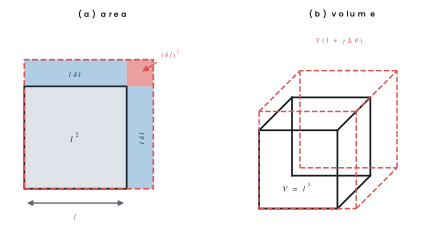
We start from the definition of linear expansivity applied to every edge of a body, and reach the two relations connecting the three expansivities.
Setting up. Everything rests on one fact: when the temperature rises by \Delta\theta, every length in the body grows by the same fraction, so a length l becomes l(1 + \alpha\Delta\theta).
Part (a): \beta = 2\alpha
Step 1 — start with a square plate. Let it have side l, so its area at the start is
Step 2 — find the new side. Each side is a length, so it grows by the fraction \alpha\Delta\theta:
Step 3 — square it to get the new area:
Step 4 — expand the bracket. Using (1+x)^{2} = 1 + 2x + x^{2}:
Step 5 — throw away the tiny term. For solids \alpha is about 10^{-5}\ \text{K}^{-1}, so \alpha^{2} is about 10^{-10} — ten thousand times smaller than \alpha itself. Dropping it changes nothing we could measure:
Step 6 — put A_1 back in, since l^{2} = A_1:
Step 7 — compare with the definition of \beta, which says A_2 = A_1(1 + \beta\Delta\theta). The two right-hand sides must agree for every \Delta\theta, so the coefficients of \Delta\theta must match:
Part (b): \gamma = 3\alpha
Step 8 — start with a cube of side l, so its volume at the start is
Step 9 — cube the new side l(1+\alpha\Delta\theta) from Step 2:
Step 10 — expand, using (1+x)^{3} = 1 + 3x + 3x^{2} + x^{3}:
Step 11 — drop the \alpha^{2} and \alpha^{3} terms for the same reason as in Step 5:
Step 12 — compare with V_2 = V_1(1 + \gamma\Delta\theta):
Result.
What it means. The numbers 1, 2, 3 are simply the number of directions involved: a line stretches in one direction, an area in two, a volume in three. So you never need to look up \beta or \gamma in a table — one number per material is enough.
Conditions used. \alpha\Delta\theta \ll 1, so that the squared and cubed terms can be neglected; and \alpha is the same in all directions (true for metals and glass, not for wood or crystals like calcite).
The shape does not matter: any body can be imagined as built from small cubes, each expanding this way, so the result holds equally for a sphere, a rod or an irregular casting.
- "Each side becomes l(1+\alpha\Delta\theta)" — stated, not assumed silently.
- The binomial expansion written out in full.
- An explicit sentence saying why the \alpha^{2} term is dropped (because \alpha \approx 10^{-5}), not just a quiet disappearance.
- The comparison with the defining equation for \beta or \gamma.
- The assumption that expansion is the same in all directions.
Students often expect a hole in a heated metal plate to get smaller. It does not.
Imagine the disc of metal that was cut out to make the hole: on heating, that disc would grow by \gamma\Delta\theta per unit volume, and the hole must grow with it so that the disc would still fit.
A cavity expands exactly as if it were filled with the material of the body. This is why a tight metal lid loosens when held under hot water.
Problem. A brass plate has a circular hole of diameter 5.000\ \text{cm} at 20\ ^{\circ}\text{C}. Find the diameter of the hole and the area of the hole at 220\ ^{\circ}\text{C}. Take \alpha_{\text{brass}} = 1.9\times10^{-5}\ \text{K}^{-1}.
Solution. The hole expands like the metal, with \Delta\theta = 200\ \text{K}.
Original area A_1 = \pi d_1^{2}/4 = \pi(5.000)^{2}/4 = 19.635\ \text{cm}^{2}. Using \beta = 2\alpha = 3.8\times10^{-5}\ \text{K}^{-1},
10.3 Liquid Expansion: Absolute and apparent
A liquid has no shape of its own, so only its volume expansion is defined — there is no \alpha or \beta for a liquid. But a liquid must be held in a vessel, and when the vessel is heated it expands too.
The level in the vessel therefore rises by less than the liquid's true expansion. Two coefficients are needed.
Real (absolute) expansivity \gamma_r is the true increase in volume of the liquid per unit volume per unit rise in temperature.
Apparent expansivity \gamma_a is the observed increase in volume per unit volume per unit rise in temperature, measured relative to the vessel.
We start from the fact that the vessel expands too, and reach the correction that must be added to every measured value.
Setting up. A vessel of volume V is filled to the brim with liquid at temperature \theta_1. Both are heated to \theta_2, a rise of \Delta\theta. Let \gamma_r be the real expansivity of the liquid and \gamma_g the cubical expansivity of the vessel's material.
Step 1 — the true new volume of the liquid. By the definition of \gamma_r:
Step 2 — the new volume of the vessel. The vessel is made of a solid, and its inside volume expands by its own cubical expansivity:
Step 3 — only the difference can escape. The liquid that will not fit inside the enlarged vessel spills out over the top:
Step 4 — take out the common factor V and remove the brackets. The two 1's cancel:
Step 5 — take out \Delta\theta as well:
Step 6 — say what we actually observe. All an experimenter sees is the spilt liquid, and that overflow is exactly what the apparent expansivity is defined by:
Step 7 — set Step 5 equal to Step 6. Both describe the same spilt liquid:
Step 8 — cancel V and \Delta\theta, which appear on both sides:
Step 9 — rearrange for the real expansivity:
Step 10 — express the vessel's part through \alpha, since tables list the linear expansivity \alpha_g of glass, and \gamma = 3\alpha:
Result.
What it means. The measured (apparent) expansion is always smaller than the real one, because the container quietly makes room for part of the liquid's growth. So the correction is always an addition.
If the vessel could somehow not expand (\gamma_g = 0), apparent and real expansion would be the same.
Conditions used. The vessel is full to the brim at the start, nothing evaporates, and the liquid and vessel reach the same temperature.
In the weight-thermometer (specific-gravity bottle) method the bulb is filled with liquid of mass M at \theta_1, heated to \theta_2, and the mass m expelled is weighed. Since apparent expansion is measured by the liquid that leaves,
where M-m is the mass still filling the bulb at the higher temperature. Adding 3\alpha_g for the glass then gives the real expansivity.
| Liquid | \gamma_r (K⁻¹) |
|---|---|
| Mercury | 1.8\times10^{-4} |
| Water (near 20 °C) | 2.1\times10^{-4} |
| Glycerine | 5.3\times10^{-4} |
| Ethanol | 1.1\times10^{-3} |
Because \gamma_{\text{glass}} = 3\times(9\times10^{-6}) = 2.7\times10^{-5}\ \text{K}^{-1} is small compared with these, the apparent expansivity is usually only a little less than the real one — but the difference is easily measurable and must never be ignored in a calculation.
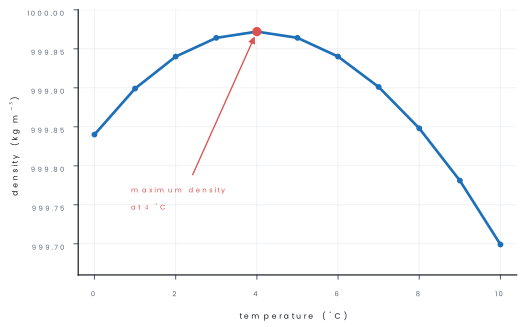
Water is the famous exception. From 0\ ^{\circ}C to 4\ ^{\circ}C it contracts on heating, and only above 4\ ^{\circ}C does it expand normally. Its density is therefore a maximum at 4\ ^{\circ}C.
This anomalous expansion is why ice floats, and why a lake such as Rara freezes from the surface downwards in winter, leaving water at 4\ ^{\circ}C at the bottom in which fish survive.
Problem. A glass flask of volume 1000\ \text{cm}^{3} is filled completely with mercury at 0\ ^{\circ}\text{C} and heated to 100\ ^{\circ}\text{C}.
Given \gamma_{\text{Hg}} = 1.8\times10^{-4}\ \text{K}^{-1} and \alpha_{\text{glass}} = 9\times10^{-6}\ \text{K}^{-1}, find the volume of mercury that overflows.
Solution. Cubical expansivity of glass:
Had we forgotten the flask, we would have said 18.0\ \text{cm}^{3} — an error of almost 18\ \%.
10.4 Dulong and Petit method of determining expansivity of liquid
Every method that uses a vessel gives the apparent expansivity first, and the real value only after the vessel's own expansion is known.
Dulong and Petit (1817) found a way to measure the real expansivity directly, using the fact that pressure, not volume, is what balances in a connected liquid.
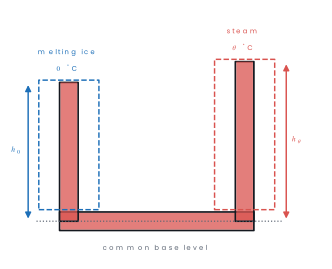
Apparatus. The liquid fills a U-shaped glass tube whose two vertical limbs are joined by a narrow horizontal tube at the bottom.
One limb is surrounded by a jacket of melting ice at 0\ ^{\circ}\text{C}; the other is surrounded by a steam jacket at \theta\ ^{\circ}\text{C}.
The heights of the two columns above the common horizontal base are measured with a travelling microscope, so nothing touches the liquid.
We start from the balance of pressures in the two columns and reach a formula for the real expansivity in terms of two measured heights.
Setting up. The two vertical columns of the same liquid are joined at the bottom by a horizontal tube. One column is kept at 0\ ^{\circ}C and stands at height h_0; the other is kept at \theta\ ^{\circ}C and stands at height h_\theta.
Let \rho_0 and \rho_\theta be the densities at those two temperatures.
Step 1 — the liquid is at rest. Nothing flows through the horizontal tube, so the two columns must push on it equally hard. Pressure of a column of height h and density \rho is h\rho g:
Step 2 — cancel g, which is the same on both sides:
Step 3 — now find \rho_\theta. Take a fixed mass M of the liquid. At 0\ ^{\circ}C it occupies V_0, so
Step 4 — the same mass at \theta occupies a bigger volume. By the definition of cubical expansivity, the volume becomes V_0(1 + \gamma\theta):
Step 5 — replace M/V_0 by \rho_0 using Step 3. This is the "density falls because the same mass spreads out" step:
Step 6 — substitute this into Step 2:
Step 7 — cancel \rho_0 from both sides:
Step 8 — multiply both sides by (1 + \gamma\theta):
Step 9 — expand the left side:
Step 10 — move h_0 across:
Step 11 — divide both sides by h_0\theta:
Result.
What it means. Only two heights and one temperature are needed — no masses, no volumes, no weighing. The hot column stands taller because the same mass has become less dense and so needs more height to produce the same pressure.
Conditions used. The liquid is in equilibrium (not flowing), the two columns are at steady, uniform temperatures, and the heights are measured from the level of the horizontal joining tube.
- The pressure-balance equation h_0\rho_0 g = h_\theta\rho_\theta g with a reason.
- \rho_\theta = \rho_0/(1+\gamma\theta), derived from a fixed mass.
- The substitution and the cancellation of \rho_0.
- The final rearrangement to \gamma = (h_\theta - h_0)/h_0\theta.
- The explanation of why no vessel correction is needed.
The result contains only heights, temperatures and the liquid's own densities.
The glass tube does expand, but its expansion changes neither the density of the liquid nor the measured heights, which are read from outside with a microscope against a fixed scale.
So Dulong and Petit's method needs no correction for the vessel and gives \gamma_r directly — its great advantage over the weight-thermometer method.
Problem. In a Dulong and Petit experiment the cold column of mercury stands 75.00\ \text{cm} high at 0\ ^{\circ}\text{C} while the hot column stands 76.35\ \text{cm} high at 100\ ^{\circ}\text{C}. Find the real expansivity of mercury.
If the tube is glass with \alpha = 9\times10^{-6}\ \text{K}^{-1}, what apparent expansivity would a glass-vessel experiment have given?
Solution.
For glass, \gamma_g = 3\alpha = 2.7\times10^{-5}\ \text{K}^{-1}, so

Chapter summary
- Linear expansivity \alpha = \dfrac{l_2-l_1}{l_1\Delta\theta}, so l_2 = l_1(1+\alpha\Delta\theta); unit K⁻¹.
- Pullinger's apparatus measures \alpha: rod in a steam jacket, expansion read on a micrometer screw that completes a bell circuit; \alpha = \delta l / (l_1\Delta\theta).
- A_2 = A_1(1+\beta\Delta\theta) and V_2 = V_1(1+\gamma\Delta\theta), with \beta = 2\alpha, \gamma = 3\alpha and \alpha:\beta:\gamma = 1:2:3.
- A cavity or hole expands exactly as if it were filled with the surrounding material.
- A liquid has two expansivities: real \gamma_r and apparent \gamma_a, with \gamma_r = \gamma_a + \gamma_g where \gamma_g = 3\alpha_g for the vessel. By the weight thermometer, \gamma_a = m/[(M-m)\Delta\theta].
- Water expands anomalously: it contracts from 0 to 4\ ^{\circ}C and has maximum density at 4\ ^{\circ}C.
- Dulong and Petit: balancing columns give h_\theta = h_0(1+\gamma\theta), so \gamma_r = (h_\theta-h_0)/(h_0\theta), with no correction for the vessel.
Practice questions
Group A — Multiple choice (1 mark each)
- For an isotropic solid the ratio \alpha : \beta : \gamma is [1]a1:2:3b3:2:1c1:3:2d2:3:1
- When a metal plate with a hole in it is heated, the hole [1]agets smallerbgets largercstays the samedfirst shrinks, then grows
- The SI unit of the coefficient of linear expansion is [1]ambK⁻¹cm K⁻¹dit has no unit
- The real expansivity of a liquid equals its apparent expansivity plus the [1]alinear expansivity of the vesselbcubical expansivity of the vesselcsuperficial expansivity of the vesseldnothing
- Dulong and Petit's method directly determines the [1]aapparent expansivitybreal expansivityclinear expansivitydsuperficial expansivity
Answers to Group A
1. (a) — from (1+\alpha\Delta\theta)^n for n = 1,2,3.
2. (b) — a cavity expands like the material that would fill it.
3. (b) — it is a fractional length change per kelvin, so only K⁻¹ is left.
4. (b) — \gamma_r = \gamma_a + \gamma_g, where \gamma_g = 3\alpha_g.
5. (b) — it balances pressures, so the vessel's expansion cancels out.
Group B — Short answer (5 marks each)
- Define the coefficient of linear expansion and show that \gamma = 3\alpha for an isotropic solid. [5]
- With a labelled diagram, describe how the linear expansivity of a metal rod is determined using Pullinger's apparatus. [5]
- Distinguish between the real and apparent expansivity of a liquid and show that \gamma_r = \gamma_a + \gamma_g. [5]
- A glass flask of volume 500\ \text{cm}^{3} is completely filled with mercury at 0\ ^{\circ}\text{C}. On heating to 80\ ^{\circ}\text{C}, 6.0\ \text{cm}^{3} of mercury overflows. If \gamma_{\text{Hg}} = 1.8\times10^{-4}\ \text{K}^{-1}, find the coefficient of linear expansion of the glass. [5]
- A brass scale is correct at 15\ ^{\circ}\text{C}. It is used at 35\ ^{\circ}\text{C} and reads a length of 50.00\ \text{cm}. What is the true length? Take \alpha_{\text{brass}} = 1.9\times10^{-5}\ \text{K}^{-1}. [5]
Answers to Group B
4. \gamma_a = \dfrac{6.0}{500\times80} = 1.5\times10^{-4}\ \text{K}^{-1}. Then \gamma_g = \gamma_r - \gamma_a = 1.8\times10^{-4} - 1.5\times10^{-4} = 3.0\times10^{-5}\ \text{K}^{-1}, so \alpha_g = \gamma_g/3 = 1.0\times10^{-5}\ \text{K}^{-1}.
5. At 35\ ^{\circ}C each scale division has grown, so every division now measures more than it claims. True length = 50.00\left(1 + 1.9\times10^{-5}\times20\right) = 50.00(1+3.8\times10^{-4}) = 50.019\ \text{cm}.
Group C — Long answer (8 marks each)
- (a) Derive the relations \beta = 2\alpha and \gamma = 3\alpha, stating clearly the approximation used. [4](b) Describe Dulong and Petit's method for the absolute expansivity of a liquid and derive \gamma = \dfrac{h_\theta - h_0}{h_0\theta}. Explain why no correction for the expansion of the glass is needed. [4]
- (a) An iron rim of diameter 79.80\ \text{cm} at 20\ ^{\circ}\text{C} is to be fitted on a wooden cart wheel of diameter 80.00\ \text{cm}. To what temperature must the rim be heated? Take \alpha_{\text{iron}} = 1.2\times10^{-5}\ \text{K}^{-1}. [4](b) In a Dulong and Petit experiment on a liquid, the column at 0\ ^{\circ}\text{C} is 60.00\ \text{cm} high and the column at 100\ ^{\circ}\text{C} is 61.20\ \text{cm} high. Find the real expansivity of the liquid, and its apparent expansivity when it is kept in a glass vessel with \alpha = 9\times10^{-6}\ \text{K}^{-1}. [4]
Answers to Group C
2. (a) The rim must expand from 79.80 to 80.00\ \text{cm}, so \Delta d = 0.20\ \text{cm} and
The rim must be heated to 20 + 208.9 \approx 229\ ^{\circ}\text{C}. On cooling it grips the wheel tightly — the standard way a wheelwright fits a tyre.
(b) \gamma_r = \dfrac{61.20-60.00}{60.00\times100} = \dfrac{1.20}{6000} = 2.0\times10^{-4}\ \text{K}^{-1}.
\gamma_g = 3\times9\times10^{-6} = 2.7\times10^{-5}\ \text{K}^{-1}, so \gamma_a = 2.0\times10^{-4} - 0.27\times10^{-4} = 1.73\times10^{-4}\ \text{K}^{-1}.
Group D — Model answers for long questions (10 marks each, for deeper revision)
- Define the coefficients of linear, area and volume expansion of solids and prove that \alpha : \beta : \gamma = 1 : 2 : 3. Give a numerical and eight applications. [10]
- Distinguish between real and apparent expansion of a liquid, derive the relation between them, and explain the anomalous expansion of water. [10]
Model answer D1: expansion of solids (10 marks)
Introduction. Most solids expand on heating because the atoms vibrate more strongly and the average spacing between them grows. The change can be in length, area or volume.
Coefficients.
- Linear expansivity \alpha: the increase in length per unit original length per degree rise, \alpha = \dfrac{\Delta L}{L_{0}\,\Delta\theta} (unit K⁻¹).
- Areal expansivity \beta = \dfrac{\Delta A}{A_{0}\,\Delta\theta}.
- Volume expansivity \gamma = \dfrac{\Delta V}{V_{0}\,\Delta\theta}.
Proof that \alpha : \beta : \gamma = 1 : 2 : 3. Take a cube of side L_{0} heated through \Delta\theta.
- New side L = L_{0}(1 + \alpha\Delta\theta).
- Area of a face: A = L^{2} = L_{0}^{2}(1 + \alpha\Delta\theta)^{2} = A_{0}(1 + 2\alpha\Delta\theta + \alpha^{2}\Delta\theta^{2}). As \alpha is of the order 10^{-5}, the square term is negligible: A = A_{0}(1 + 2\alpha\Delta\theta), so \beta = 2\alpha.
- Volume: V = L^{3} = V_{0}(1 + \alpha\Delta\theta)^{3} \approx V_{0}(1 + 3\alpha\Delta\theta), so \gamma = 3\alpha.
- Hence \alpha : \beta : \gamma = 1 : 2 : 3.
| Material | \alpha (10^{-6}\ \text{K}^{-1}) |
|---|---|
| Aluminium | 23 |
| Copper | 17 |
| Steel / iron | 12 |
| Glass (ordinary) | 9 |
| Pyrex | 3 |
| Invar | 1 |
Numerical. A steel railway rail 30\ \text{m} long is laid at 20^{\circ}C. In summer the temperature rises to 50^{\circ}C (\alpha = 1.2\times10^{-5}\ \text{K}^{-1}).
Then \Delta L = 30\times1.2\times10^{-5}\times30 = 1.08\times10^{-2}\ \text{m} = 10.8\ \text{mm}.
If there were no gap, the rail would exert an enormous thermal stress: Y\alpha\Delta\theta = 2\times10^{11}\times1.2\times10^{-5}\times30 = 7.2\times10^{7}\ \text{Pa}.
Eight applications (and precautions).
- Expansion gaps between rails, so that tracks do not buckle in the summer sun.
- Expansion joints in bridges and concrete roads, like the metal combs on the Kathmandu flyovers.
- Bimetallic strip (brass and iron): brass expands more, so the strip bends; it is used in thermostats in irons and heaters and in fire alarms.
- Shrink fitting: a steel tyre is heated, slipped over a wheel and cooled so that it grips it tightly.
- Riveting: hot rivets contract on cooling and pull the plates tight.
- Pyrex and Invar: laboratory glassware and clock pendulums are made of low-expansion materials to avoid cracking and keep time.
- Sagging of power lines in summer: the Nepal Electricity Authority leaves slack in the transmission lines.
- Pendulum and balance wheels of watches are compensated for the temperature.
Conclusion. The three coefficients are in the ratio 1 : 2 : 3. Expansion is useful in thermostats and fittings, but its effects must be allowed for in engineering.
Model answer D2: expansion of liquids and anomalous expansion of water (10 marks)
Introduction. Liquids expand much more than solids (\gamma about 10 times larger) and have no shape of their own, so only volume expansion is meaningful. A liquid is always kept in a container which also expands, and that complicates the measurement.
Real and apparent expansion.
- Real (absolute) expansion \gamma_{r}: the actual increase in the volume of the liquid, the expansion of the container being taken into account.
- Apparent expansion \gamma_{a}: the expansion as it appears, when the expansion of the container is ignored; it is the visible rise in the liquid level.
Relation. Let a vessel of volume V_{0} be full of liquid at 0^{\circ}C and heated through \Delta\theta.
- The vessel's volume increases by V_{0}\gamma_{g}\Delta\theta.
- The liquid's true volume increases by V_{0}\gamma_{r}\Delta\theta.
- The liquid that overflows (the apparent increase) is the difference: V_{0}\gamma_{a}\Delta\theta = V_{0}\gamma_{r}\Delta\theta - V_{0}\gamma_{g}\Delta\theta.
- Therefore
Numerical. For mercury, \gamma_{r} = 1.8\times10^{-4}\ \text{K}^{-1}, and for the glass \gamma_{g} = 3\alpha = 3\times9\times10^{-6} = 2.7\times10^{-5}\ \text{K}^{-1}.
The apparent expansion is \gamma_{a} = 1.8\times10^{-4} - 0.27\times10^{-4} = 1.53\times10^{-4}\ \text{K}^{-1}. That is why mercury rises visibly in a glass thermometer.
Anomalous expansion of water. Most liquids expand regularly, but water contracts when heated from 0^{\circ}C to 4^{\circ}C, and expands only above 4^{\circ}C.
- The volume is a minimum and the density is a maximum (1000 kg m⁻³) at 4^{\circ}C.
- Reason: below 4^{\circ}C, there are ice-like clusters of water molecules held by hydrogen bonds in an open structure. As the temperature rises the clusters break and the molecules pack closer, which outweighs the normal expansion. Above 4^{\circ}C the normal expansion dominates.
| Temperature (^{\circ}C) | Density of water (\text{kg m}^{-3}) |
|---|---|
| 0 | 999.84 |
| 4 | 999.97 (maximum) |
| 10 | 999.70 |
| 100 | 958.4 |
Consequences. In winter, the surface water of a lake cools to 4^{\circ}C, becomes denser and sinks. The colder water (below 4^{\circ}C) is lighter and stays at the top and freezes.
Ice floats, so the lake freezes from the top downward, and the water at the bottom stays at 4^{\circ}C, saving the fish and plants, as in the lakes of Gosaikunda and Rara.
Conclusion. Real expansion is the sum of apparent expansion and the expansion of the vessel. The anomalous expansion of water, with its maximum density at 4^{\circ}C, protects aquatic life in the cold.
Practise more: Physics question bank