Chapter 1 · Chemistry · 9 questions in the paper · 21 min read
Physical Chemistry
What the syllabus asks for 8
- Chemical arithmetic: Dalton's theory, laws of stoichiometry, atomic and molecular mass, empirical and molecular formula, limiting reactant, Avogadro's hypothesis, equivalent masses
- States of matter: gaseous, liquid and solid states
- Atomic structure and periodic classification of elements
- Oxidation, reduction and equilibrium
- Volumetric analysis
- Ionic equilibrium, acid, base and salt
- Electrochemistry
- Energetics of chemical reactions, chemical kinetics, chemical bonding and shape of molecules
Physical chemistry carries the largest share of the Chemistry paper (our estimate: about 9 of 22 questions) and is the most numerical part of it.
The eight syllabus topics reduce to a handful of calculation types: mole and stoichiometry, a gas-law problem, quantum numbers and configurations, oxidation numbers, pH and buffers, titration, Faraday and cell potential, and rate or equilibrium.
The official booklet's own chemistry samples (a limiting-reagent count of HCl molecules, the mass of copper deposited by 2 faradays, the number of electrons in a p-orbital) are all of these types.
- Mole concept: n=\frac{m}{M}=\frac{N}{N_A}=\frac{V}{22.4} (STP), limiting reagent, empirical formula, equivalent mass.
- Gas laws: PV=nRT, Dalton's partial pressures, Graham's law, kinetic-theory averages.
- Atom: quantum numbers, orbitals per subshell, configuration (Fe²⁺ is 3d⁶), periodic trends.
- Redox: oxidation numbers, balancing; volumetric titration N_1V_1=N_2V_2.
- Ionic equilibrium: pH, buffer (Henderson), K_{sp}, hydrolysis, common-ion effect.
- Electrochemistry: Faraday's laws, E^\circ_{cell}, Nernst, \Delta G=-nFE.
- Energetics and kinetics: Hess, \Delta H, \Delta G, order, half-life, Arrhenius; VSEPR shapes and hybridisation.
1.1 Chemical arithmetic
Dalton's atomic theory: atoms are indivisible (modified by subatomic particles and isotopes), atoms of one element are identical, compounds form in simple whole-number ratios.
Laws of chemical combination: conservation of mass (Lavoisier); definite proportions (Proust); multiple proportions (Dalton: CO and CO₂ have O in 1 : 2 for a fixed C); reciprocal proportions (Richter); Gay-Lussac's law of combining volumes; Avogadro's hypothesis: equal volumes of gases at the same T and P hold equal numbers of molecules.
Relative atomic mass is on the carbon-12 scale (1 u =\frac{1}{12} of C-12 =1.66\times10^{-27} kg).
Mole: 6.022\times10^{23} entities. n=\frac{m}{M}=\frac{N}{N_A}=\frac{V_{STP}}{22.4\ \text{L}}; molar volume 22.4 L at STP (0 °C, 1 atm; 22.7 L at 1 bar) and 24.6 L at 27 °C, 1 atm.
Gas density \rho=\frac{PM}{RT}; vapour density =\frac{M}{2}.
Empirical formula: divide the percentages by atomic masses, divide by the smallest, clear fractions. 40 % C, 6.7 % H, 53.3 % O gives CH₂O; molecular formula =n\times empirical, n=\frac{M}{\text{empirical mass}}.
Limiting reagent: compute the product from each reactant; the smaller yield decides. Percentage yield =\frac{\text{actual}}{\text{theoretical}}\times100.
Equivalent mass E=\frac{M}{n\text{-factor}}: element \frac{\text{atomic mass}}{\text{valency}}; acid \frac{M}{\text{basicity}} (H₂SO₄: 49); base \frac{M}{\text{acidity}}; oxidant/reductant \frac{M}{\text{electrons exchanged}} (KMnO₄ in acid: \frac{158}{5}=31.6).
Normality N=\frac{w}{E\,V(L)}, N=M\times n-factor. Concentration: molarity, molality \frac{n}{\text{kg solvent}}, mole fraction, % w/w, ppm.
Problem. 21 g of MgCO₃ is treated with 50 mL of 12 M HCl. How many molecules of HCl remain?
Solution. MgCO₃ + 2HCl → MgCl₂ + H₂O + CO₂. n(\text{MgCO}_3)=\frac{21}{84}=0.25 mol needs 0.50 mol HCl. Available 0.050\times12=0.60 mol, so 0.10 mol remains =0.10\times6.02\times10^{23}=6.02\times10^{22} molecules.
1.2 States of matter
Gas laws. Boyle P_1V_1=P_2V_2; Charles \frac{V_1}{T_1}=\frac{V_2}{T_2}; Gay-Lussac \frac{P}{T} constant; combined; ideal gas PV=nRT, R=0.0821 L atm K⁻¹ mol⁻¹ =8.314 J K⁻¹ mol⁻¹.
Dalton: P_{total}=\sum P_i, P_i=x_iP (2 mol He + 3 mol Ne at 5 atm: P_{He}=2 atm). Graham: \frac{r_1}{r_2}=\sqrt{\frac{M_2}{M_1}} (H₂ effuses \sqrt{8}=2.83 times as fast as CH₄).
Kinetic theory: \bar K=\frac{3}{2}kT; v_{rms}=\sqrt{\frac{3RT}{M}}; v_{mp}:v_{av}:v_{rms}=1:1.128:1.224.
Real gases: van der Waals \big(P+\frac{an^2}{V^2}\big)(V-nb)=nRT; a measures attraction, b the excluded volume; deviations are greatest at high P and low T; Z=\frac{PV}{nRT}; critical T_c=\frac{8a}{27Rb}; Joule–Thomson cooling.
Liquids: vapour pressure rises with T; boiling at P_{vap}=P_{ext}; surface tension and viscosity fall with T; strength of intermolecular forces (hydrogen bonding in H₂O, HF, NH₃) raises boiling points.
Solids: crystalline (ionic, covalent, metallic, molecular) and amorphous; unit cells: simple cubic (1 atom, 52 % packing), bcc (2 atoms, 68 %), fcc (4 atoms, 74 %); coordination 6, 8, 12; Bragg's n\lambda=2d\sin\theta; defects (Schottky, Frenkel).
1.3 Atomic structure and periodic classification
Subatomic particles: electron (Thomson), nucleus (Rutherford α-scattering), neutron (Chadwick). Bohr: E_n=-\frac{13.6}{n^2} eV, r_n=0.529\,n^2 Å.
Quantum numbers: n (shell, 1, 2, …), l=0\ldots n-1 (subshell s, p, d, f), m_l=-l\ldots+l (2l+1 orbitals: s 1, p 3, d 5, f 7), m_s=\pm\frac{1}{2}. A shell holds 2n^2 electrons; a p-orbital holds at most two electrons of opposite spin.
Radial nodes n-l-1, angular nodes l. de Broglie \lambda=\frac{h}{m}v, uncertainty principle.
Filling rules: Aufbau (n+l rule: 4s before 3d), Pauli (no two electrons with four equal quantum numbers), Hund (maximise unpaired spins in degenerate orbitals). Exceptions: Cr 3d⁵4s¹, Cu 3d¹⁰4s¹.
Cations lose 4s before 3d: Fe²⁺ = [Ar]3d⁶, Fe³⁺ = 3d⁵. Magnetic moment \sqrt{n(n+2)} BM.
Periodic table: modern law (atomic number). s, p, d, f blocks.
Trends: atomic radius falls across a period and rises down a group; ionisation energy rises across a period (exceptions Be > B, N > O) and falls down a group; electronegativity (Pauling) F 4.0 highest; electron affinity Cl > F; metallic character falls across.
Isoelectronic ions: radius falls as Z rises (N³⁻ > O²⁻ > F⁻ > Na⁺ > Mg²⁺). Diagonal relationships: Li–Mg, Be–Al, B–Si.
1.4 Oxidation, reduction and equilibrium
Oxidation number rules: free element 0; H +1 (hydrides -1); O -2 (peroxides -1, OF₂ +2); sum equals the charge. Mn in KMnO₄ +7; Cr in K₂Cr₂O₇ +6; S in H₂SO₄ +6, Na₂S₂O₃ +2; N in HNO₃ +5, NH₄⁺ -3.
Redox: oxidation is loss of electrons (increase in oxidation number); the oxidising agent is reduced. Disproportionation: Cl₂ + 2NaOH → NaCl + NaClO + H₂O. Balancing: ion-electron (half-reaction) or oxidation-number method. MnO₄⁻ + 8H⁺ + 5e⁻ → Mn²⁺ + 4H₂O.
Chemical equilibrium: K_c=\frac{[C]^c[D]^d}{[A]^a[B]^b}; K_p=K_c(RT)^{\Delta n_g}; reaction quotient Q vs K.
Le Chatelier: increasing pressure favours fewer gas moles (N₂ + 3H₂ ⇌ 2NH₃ shifts right); heating favours the endothermic direction; a catalyst changes the rate only.
N₂O₄ ⇌ 2NO₂ at 20 % dissociation of 1 mol L⁻¹: K_c=\frac{0.4^2}{0.8}=0.2.
1.5 Volumetric analysis
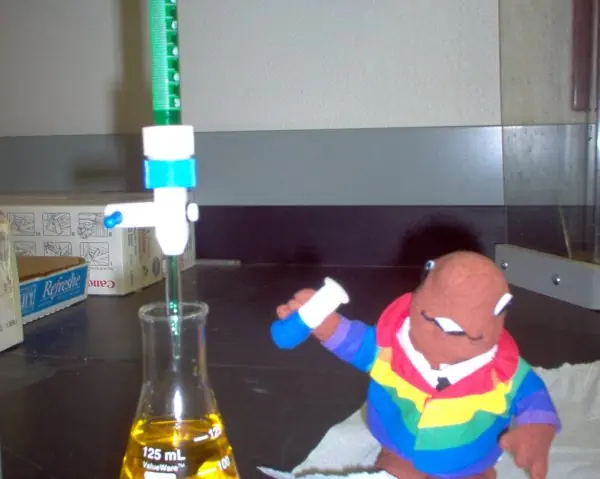
Titration finds an unknown concentration: N_1V_1=N_2V_2 (or M_1V_1n_1=M_2V_2n_2 by mole ratio). Primary standards: oxalic acid, Na₂CO₃, K₂Cr₂O₇.
Indicators: phenolphthalein (8.3–10, weak acid–strong base), methyl orange (3.1–4.4, strong acid–weak base), methyl red. KMnO₄ is a self-indicator (acidify with dilute H₂SO₄ only). Iodometry with starch (blue at the end point).
Example: 25 mL of 0.1 M NaOH neutralised by 20 mL H₂SO₄ means M\times20\times2=2.5, M=0.0625 M. Titration curve of a strong acid with a strong base has a sharp jump at pH 7. EDTA titrations measure hardness.
1.6 Ionic equilibrium, acid, base and salt
Theories: Arrhenius; Brønsted–Lowry (proton donor/acceptor, conjugate pairs); Lewis (electron-pair acceptor/donor). K_w=[H^+][OH^-]=10^{-14} at 25 °C; pH =-\log[H^+]; pH + pOH =14. 0.01 M HCl: pH 2.
Weak acid: K_a=\frac{[H^+][A^-]}{[HA]}, [H^+]=\sqrt{K_aC} (0.1 M CH₃COOH, K_a=1.8\times10^{-5}: pH 2.87); \alpha=\sqrt{\frac{K_a}{C}} (Ostwald).
Mixtures: compute excess moles: 100 mL 0.1 M HCl + 100 mL 0.05 M NaOH leaves 0.005 mol in 0.2 L, pH 1.6.
Buffer (weak acid + its salt): \text{pH}=\text{p}K_a+\log\frac{[\text{salt}]}{[\text{acid}]} (Henderson); with ratio 10 and pK_a=4.76: 5.76. Best at pH \approx pK_a; blood buffer H₂CO₃/HCO₃⁻.
Salt hydrolysis: strong acid + weak base gives acidic solution (NH₄Cl); weak acid + strong base basic (CH₃COONa); strong + strong neutral. Common-ion effect lowers solubility.
Solubility product K_{sp}: AgCl s=\sqrt{K_{sp}}=1.34\times10^{-5} M for K_{sp}=1.8\times10^{-10}; precipitate forms when ionic product >K_{sp}; for A₂B s=\sqrt{[}3]{K_{sp}/4}.
1.7 Electrochemistry
Faraday's laws: m=ZIt=\frac{E}{96500}It; one faraday (96 485 C) deposits one equivalent (so 2 F deposits 63.5 g of Cu from Cu²⁺; 3 F per mole of Al). 2 A for 965 s (0.02 F) gives 0.635 g Cu.
Electrolysis products: the species with the higher reduction potential is reduced at the cathode (copper over hydrogen from CuSO₄); in brine Cl₂ at the anode, H₂ at the cathode, NaOH in solution.
Conductance: \kappa, \Lambda_m=\frac{\kappa\times1000}{M}, Kohlrausch's law for weak electrolytes.
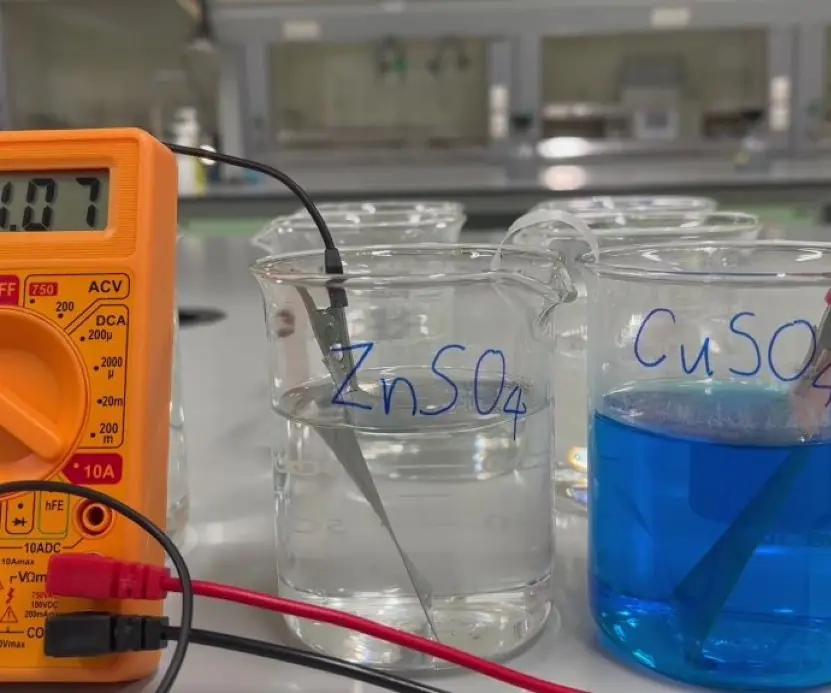
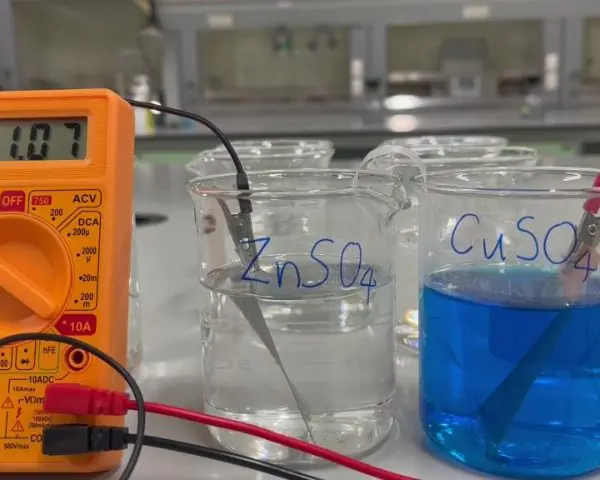
Galvanic cell: anode (oxidation, negative), cathode (reduction, positive), salt bridge. E^\circ_{cell}=E^\circ_{cathode}-E^\circ_{anode}: Zn–Cu (Daniell) =0.34-(-0.76)=1.10 V. Nernst: E=E^\circ-\frac{0.0591}{n}\log Q at 25 °C. \Delta G^\circ=-nFE^\circ (for n=2, 1.10 V: -212 kJ); \log K=\frac{nE^\circ}{0.0591}.
A more negative E^\circ means a stronger reducing agent (Li, K, Na, Zn, Fe, H₂, Cu, Ag, Au). Batteries: dry cell, lead-acid (PbSO₄), Li-ion; corrosion (rusting) and its prevention (galvanising, sacrificial anode); fuel cells.
1.8 Energetics, kinetics and bonding
First law, enthalpy: \Delta U=q+w; \Delta H=\Delta U+\Delta n_gRT; Hess's law (path independence); \Delta H^\circ_{rxn}=\sum\Delta H_f(\text{products})-\sum\Delta H_f(\text{reactants}); for CH₄ + 2O₂: -890=-393.5+2(-285.8)-\Delta H_f(\text{CH}_4), so \Delta H_f=-75 kJ mol⁻¹.
Bond-energy method \Delta H=\sum D(\text{broken})-\sum D(\text{formed}). Entropy and free energy: \Delta G=\Delta H-T\Delta S; spontaneous if \Delta G<0; \Delta G^\circ=-RT\ln K.
Kinetics: rate =k[A]^m[B]^n, order =m+n (rate =k[A]^2[B] is third order); molecularity is a whole number for an elementary step.
First order: [A]=[A]_0e^{-kt}, t_{1/2}=\frac{0.693}{k} (for k=10^{-3} s⁻¹: 693 s), independent of concentration; zero order t_{1/2}\propto[A]_0.
Arrhenius: k=Ae^{-E_a/RT}, \ln\frac{k_2}{k_1}=\frac{E_a}{R}\big(\frac{1}{T_1}-\frac{1}{T_2}\big); a catalyst lowers E_a; the rate roughly doubles per 10 K.
Bonding: ionic (lattice energy, Born–Haber), covalent (Lewis, octet and its exceptions: BF₃, PCl₅, SF₆), coordinate, metallic, hydrogen bond. VSEPR / hybridisation:
| Species | Electron pairs | Hybrid | Shape |
|---|---|---|---|
| BeCl₂, CO₂, C₂H₂ | 2 | sp | linear |
| BF₃, C₂H₄, SO₃ | 3 | sp² | trigonal planar |
| CH₄, NH₄⁺ | 4 | sp³ | tetrahedral |
| NH₃ | 3 + 1 lp | sp³ | pyramidal (107^\circ) |
| H₂O | 2 + 2 lp | sp³ | bent (104.5^\circ) |
| PCl₅ | 5 | sp³d | trigonal bipyramidal |
| SF₆ | 6 | sp³d² | octahedral |
Bond order from MO theory: O₂ has two unpaired electrons (paramagnetic), N₂ has the highest bond order (3). Ethyne has 3\sigma+2\pi bonds. Dipole moments: BF₃, CO₂, CH₄ are non-polar though bonds are polar; H₂O, NH₃ are polar.




Formula and fact sheet
| Topic | Result |
|---|---|
| mole | n=\frac{m}{M}=\frac{N}{N_A}=\frac{V}{22.4} |
| ideal gas | PV=nRT |
| Graham | \frac{r_1}{r_2}=\sqrt{M_2/M_1} |
| orbitals | s,p,d,f=1,3,5,7 |
| pH | -\log[H^+]; buffer pK_a+\log\frac{\text{salt}}{\text{acid}} |
| Faraday | m=\frac{E\,I\,t}{96500} |
| cell | E^\circ=E^\circ_c-E^\circ_a; \Delta G=-nFE |
| first-order | t_{1/2}=0.693/k |
| Gibbs | \Delta G=\Delta H-T\Delta S |
Chapter summary
- Convert everything to moles first; the limiting reagent decides the yield.
- Quantum numbers fix orbitals: 2l+1 per subshell; cations lose 4s before 3d.
- Count oxidation-number change to find n-factor and equivalent mass.
- For acid–base mixtures find the excess; weak acids use \sqrt{K_aC}; buffers use Henderson.
- One faraday = one equivalent; E^\circ_{cell} is cathode minus anode.
- Order is read from the rate law, not the equation; first-order half-life is constant.
- Shape comes from electron pairs including lone pairs.
Practice questions
Set A — Recall (16 questions)
- The number of moles in 36 g of water isa2b1c4d0.5
- The number of molecules in 0.5 mol of a substance isa6.02\times10^{23}b3.01\times10^{23}c1.5\times10^{23}d12.04\times10^{23}
- The volume occupied by one mole of an ideal gas at STP isa11.2 Lb24.5 Lc22.4 Ld44.8 L
- A compound has 40 % C, 6.7 % H and 53.3 % O. Its empirical formula isaCHObC₂H₄O₂cCH₄OdCH₂O
- The equivalent mass of H₂SO₄ (M = 98) as an acid isa49b98c32.7d24.5
- A gas occupies 4 L at 1 atm. At constant temperature and 2 atm it occupiesa8 Lb2 Lc4 Ld0.5 L
- The number of orbitals in a d subshell isa3b7c5d1
- The electronic configuration of Fe²⁺ (Z = 26) isa[Ar]3d⁵4s¹b[Ar]3d⁴4s²c[Ar]3d⁸d[Ar]3d⁶
- The pH of 0.01 M HCl isa2b1c12d0.01
- The oxidation number of Mn in KMnO₄ isa+2b+7c+4d+6
- The charge required to deposit one mole of aluminium from Al³⁺ isa1 Fb2 Fc3 Fd6 F
- For the rate law rate =k[A]^2[B], the overall order isa1b2c0d3
- The carbon atoms in ethene areasp² hybridisedbsp hybridisedcsp³ hybridiseddsp³d hybridised
- The shape of the NH₃ molecule isaplanarbpyramidalctetrahedraldlinear
- For an exothermic reaction \Delta H isapositivebzerocnegativedinfinite
- Increasing the pressure on N₂ + 3H₂ ⇌ 2NH₃ shifts the equilibrium to thealeftbno changecneither sidedright
Answers and explanations — Set A
1. (a) — \frac{36}{18}=2.
2. (b) — 0.5\times6.02\times10^{23}.
3. (c) — 22.4 L (24.5 L is at 25 °C, 1 atm).
4. (d) — C : H : O =\frac{40}{12}:\frac{6.7}{1}:\frac{53.3}{16}=3.33:6.7:3.33=1:2:1.
5. (a) — \frac{98}{2} (basicity 2).
6. (b) — P_1V_1=P_2V_2: V_2=\frac{4\times1}{2}.
7. (c) — 2l+1=5.
8. (d) — Fe is [Ar]3d⁶4s²; the 4s electrons go first.
9. (a) — -\log10^{-2}.
10. (b) — +1+x-8=0.
11. (c) — \text{Al}^{3+}+3e^-\to\text{Al}.
12. (d) — 2+1.
13. (a) — trigonal planar, three σ bonds around each carbon.
14. (b) — three bond pairs and one lone pair (trigonal pyramidal).
15. (c) — heat is released.
16. (d) — 4 mol of gas become 2 mol; Le Chatelier.
Set B — Understanding (10 questions)
- 21 g of MgCO₃ is treated with 50 mL of 12 M HCl. The number of molecules of unreacted HCl isa6.02\times10^{23}b6.02\times10^{22}c6.02\times10^{21}d6.02\times10^{19}
- 2 g of hydrogen and 16 g of oxygen react to form water. The mass of water formed isa9 gb20 gc36 gd18 g
- The number of radial nodes in a 3p orbital isa0b2c1d3
- 100 mL of 0.1 M HCl is mixed with 100 mL of 0.05 M NaOH. The pH of the mixture is nearlya1.6b1.0c2.0d7
- An acetic acid–acetate buffer (pK_a=4.76) has salt : acid =10:1. Its pH isa3.76b5.76c4.76d6.76
- For AgCl, K_{sp}=1.8\times10^{-10}. Its solubility in pure water is abouta1.8\times10^{-10} Mb9\times10^{-6} Mc1.8\times10^{-5} Md1.34\times10^{-5} M
- A first-order reaction has k=1\times10^{-3} s⁻¹. Its half-life isa69.3 sb6930 sc693 sd0.693 s
- Given E^\circ(\text{Zn}^{2+}/\text{Zn})=-0.76 V and E^\circ(\text{Cu}^{2+}/\text{Cu})=+0.34 V, the standard Daniell cell potential isa1.10 Vb0.42 Vc-1.10 Vd0.76 V
- The volume of one mole of an ideal gas at 27 °C and 1 atm isa22.4 Lb24.6 Lc27.3 Ld30 L
- The number of σ and π bonds in ethyne (C₂H₂) area3σ and 2πb5σ and 0πc2σ and 3πd4σ and 1π
Answers and explanations — Set B
1. (b) — 0.25 mol MgCO₃ uses 0.5 mol HCl of 0.6 mol: 0.1 mol =6.02\times10^{22} left.
2. (d) — 1 mol H₂ and 0.5 mol O₂ are in exact ratio 2 : 1: 1 mol H₂O = 18 g.
3. (c) — n-l-1=3-1-1.
4. (a) — excess H⁺ =0.010-0.005=0.005 mol in 0.2 L =0.025 M; pH =1.60.
5. (b) — 4.76+\log10.
6. (d) — s=\sqrt{1.8\times10^{-10}}=1.34\times10^{-5}.
7. (c) — \frac{0.693}{10^{-3}}.
8. (a) — 0.34-(-0.76).
9. (b) — \frac{nRT}{P}=\frac{0.0821\times300}{1}=24.6.
10. (a) — H–C≡C–H: two C–H σ, one C–C σ, two π.
Set C — Application (8 questions)
- Given \Delta H_c(\text{CH}_4)=-890, \Delta H_f(\text{CO}_2)=-393.5 and \Delta H_f(\text{H}_2\text{O}_l)=-285.8 kJ mol⁻¹, the enthalpy of formation of CH₄ isa+75 kJ mol⁻¹b-890 kJ mol⁻¹c-75 kJ mol⁻¹d-965 kJ mol⁻¹
- For a cell with n=2 and E^\circ=1.10 V, \Delta G^\circ is nearlya-106 kJb-212 kJc-424 kJd-96.5 kJ
- 1 mol of N₂O₄ in 1 L is 20 % dissociated into NO₂ at equilibrium. K_c isa0.05b0.4c0.8d0.2
- 25 mL of 0.1 M NaOH is neutralised by 20 mL of H₂SO₄. The molarity of the acid isa0.125 Mb0.0625 Mc0.25 Md0.05 M
- A current of 2 A is passed for 965 s through a copper(II) sulphate solution. The mass of copper deposited isa0.635 gb0.3175 gc1.27 gd6.35 g
- The pH of 0.1 M acetic acid (K_a=1.8\times10^{-5}) is abouta1.0b4.74c3.37d2.87
- The ratio of the rates of diffusion of H₂ to CH₄ under the same conditions isa2b4c2.83d8
- A mixture has 2 mol He and 3 mol Ne at a total pressure of 5 atm. The partial pressure of He isa2 atmb3 atmc2.5 atmd5 atm
Answers and explanations — Set C
1. (c) — -890=-393.5+2(-285.8)-\Delta H_f: \Delta H_f=-75.1.
2. (b) — -2\times96485\times1.10=-212 kJ.
3. (d) — [\text{N}_2\text{O}_4]=0.8, [\text{NO}_2]=0.4: \frac{0.16}{0.8}.
4. (b) — 2.5 mmol OH⁻ =2\times M\times20.
5. (a) — Q=1930 C =0.02 F \to0.01 mol Cu =0.635 g.
6. (d) — \sqrt{1.8\times10^{-6}}=1.34\times10^{-3}, pH 2.87.
7. (c) — \sqrt{\frac{16}{2}}.
8. (a) — \frac{2}{5}\times5.
Group D — Model answers for long questions (10 marks each, for deeper revision)
- Explain the mole concept, empirical and molecular formula and the gas laws (ideal gas equation, Graham's law), with numericals. [10]
- Explain ionic equilibrium: pH, weak acids, buffers, hydrolysis and solubility product, with numericals. [10]
- Explain electrochemistry (Daniell cell, Nernst equation, Faraday's laws), first-order kinetics and Hess's law, with numericals. [10]

Model answer D1: Chemical arithmetic and gases (10 marks)
Introduction. A mole is the amount of substance that contains 6.022\times10^{23} particles (Avogadro's number); it has a mass equal to the molar mass in grams, and a gas occupies 22.4\ \text{L} at STP.
Stoichiometry. \text{CaCO}_3 + 2\text{HCl} \rightarrow \text{CaCl}_2 + \text{H}_2\text{O} + \text{CO}_2. For 10\ \text{g} of \text{CaCO}_3 (M = 100): n = 0.1\ \text{mol}, so 0.1\ \text{mol} of \text{CO}_2 forms and its volume at STP is 0.1\times22.4 = 2.24\ \text{L}.
Empirical and molecular formula. A compound has C 40\%, H 6.7\%, O 53.3\%.
| Element | % | ÷ atomic mass | ÷ smallest | Ratio |
|---|---|---|---|---|
| C | 40.0 | 3.33 | 1 | 1 |
| H | 6.7 | 6.7 | 2 | 2 |
| O | 53.3 | 3.33 | 1 | 1 |
The empirical formula is \text{CH}_2\text{O} (mass 30). If M = 180 then n = 180/30 = 6, so the molecular formula is \text{C}_6\text{H}_{12}\text{O}_6 (glucose).
Gas laws.
- Boyle: PV = constant (at constant T). Charles: V/T = constant (at constant P). Avogadro: equal volumes of gases at the same T and P hold equal numbers of molecules.
- Ideal gas equation: PV = nRT, with R = 0.0821\ \text{L atm K}^{-1}\text{mol}^{-1} = 8.314\ \text{J K}^{-1}\text{mol}^{-1}. For 2\ \text{mol} at 300\ \text{K} and 2\ \text{atm}: V = \frac{2\times0.0821\times300}{2} = 24.6\ \text{L}.
- Dalton's law: P_{total} = p_1 + p_2 + \dots, with p_i = x_iP.
- Graham's law: the rate of diffusion is inversely proportional to the square root of the molar mass, so \frac{r_{H_2}}{r_{O_2}} = \sqrt{\frac{32}{2}} = 4.
- Real gases deviate at high pressure and low temperature; the van der Waals equation \left(P + \frac{an^2}{V^2}\right)(V - nb) = nRT corrects for attraction and molecular volume.
Conclusion. The mole links mass, number and gas volume, and the ideal gas equation describes gases when pressure is low and temperature is high.
Model answer D2: Ionic equilibrium (10 marks)
Introduction. In water, acids and bases ionise, and weak electrolytes reach an equilibrium. K_w = [\text{H}^+][\text{OH}^-] = 10^{-14} at 25^\circ\text{C} and \text{pH} = -\log[\text{H}^+].
1. Strong and weak acids. For 0.01\ \text{M} HCl, \text{pH} = 2.
For a weak acid [\text{H}^+] = \sqrt{K_aC}; for 0.1\ \text{M} acetic acid (K_a = 1.8\times10^{-5}): [\text{H}^+] = \sqrt{1.8\times10^{-6}} = 1.34\times10^{-3}, so \text{pH} = 2.87.
Ostwald's dilution law: the degree of ionisation \alpha = \sqrt{K_a/C} increases on dilution.
2. Buffer solutions. They resist a change of pH when a little acid or base is added. Henderson equation: \text{pH} = \text{p}K_a + \log\frac{[\text{salt}]}{[\text{acid}]}.
For 0.1\ \text{M} \text{CH}_3\text{COOH} with 0.1\ \text{M} \text{CH}_3\text{COONa}, \text{pH} = 4.74; with 0.2\ \text{M} salt, \text{pH} = 4.74 + 0.30 = 5.04. Blood is a buffer (\text{H}_2\text{CO}_3/\text{HCO}_3^-, pH 7.4).
3. Salt hydrolysis.
| Salt of | Example | Solution |
|---|---|---|
| Strong acid + strong base | NaCl | Neutral |
| Strong acid + weak base | \text{NH}_4\text{Cl} | Acidic |
| Weak acid + strong base | \text{CH}_3\text{COONa} | Basic |
For 0.1\ \text{M} \text{NH}_4\text{Cl} (K_b = 1.8\times10^{-5}): K_h = \frac{K_w}{K_b} = 5.56\times10^{-10}, [\text{H}^+] = \sqrt{K_hC} = 7.45\times10^{-6}, so \text{pH} = 5.13.
4. Solubility product. For \text{AgCl}, K_{sp} = [\text{Ag}^+][\text{Cl}^-] = 1.8\times10^{-10}, so the solubility is s = \sqrt{K_{sp}} = 1.34\times10^{-5}\ \text{M}. A salt precipitates when the ionic product exceeds K_{sp}.
The common-ion effect lowers its solubility.
Conclusion. The same equilibrium ideas explain pH, buffers, the acidity of salts and the formation of precipitates.
Model answer D3: Electrochemistry, kinetics and thermochemistry (10 marks)
Introduction. Electrochemistry links chemical change with electrical energy.
1. Daniell cell. \text{Zn}\,|\,\text{Zn}^{2+}\,\|\,\text{Cu}^{2+}\,|\,\text{Cu}: oxidation at the anode (\text{Zn} \rightarrow \text{Zn}^{2+} + 2e^-) and reduction at the cathode (\text{Cu}^{2+} + 2e^- \rightarrow \text{Cu}). E^\circ_{cell} = 0.34 - (-0.76) = 1.10\ \text{V}. The salt bridge completes the circuit. The Nernst equation: E = E^\circ - \frac{0.0592}{n}\log\frac{[\text{Zn}^{2+}]}{[\text{Cu}^{2+}]}; with 0.1\ \text{M} and 1.0\ \text{M}, E = 1.10 + 0.0296 = 1.13\ \text{V}. Also \Delta G^\circ = -nFE^\circ = -2\times96500\times1.10 = -212\ \text{kJ}.
2. Faraday's laws. The mass deposited is m = \frac{M\,I\,t}{nF}. A current of 0.5\ \text{A} for 1930\ \text{s} carries 965\ \text{C} = 0.01\ \text{mol} of electrons, so 0.005\ \text{mol} of copper (0.318 g) is deposited.
3. First-order kinetics. \ln\frac{[A]_0}{[A]} = kt and t_{1/2} = \frac{0.693}{k}, independent of concentration.
If k = 0.0693\ \text{min}^{-1}, then t_{1/2} = 10\ \text{min}, and after 30\ \text{min} the fraction left is \left(\frac12\right)^3 = \frac18. The Arrhenius equation k = Ae^{-E_a/RT} shows that a catalyst lowers E_a.
4. Hess's law. The heat of a reaction is the same by any route.
From \Delta H_c(\text{CH}_4) = -890.3, \Delta H_f(\text{CO}_2) = -393.5 and \Delta H_f(\text{H}_2\text{O}) = -285.8\ \text{kJ mol}^{-1}: \Delta H_f(\text{CH}_4) = -393.5 + 2(-285.8) + 890.3 = -74.8\ \text{kJ mol}^{-1}.
| Topic | Key equation | Result |
|---|---|---|
| Cell emf | E^\circ_{cathode} - E^\circ_{anode} | 1.10\ \text{V} |
| Faraday | m = MIt/nF | 0.318\ \text{g} Cu |
| First order | t_{1/2} = 0.693/k | 10\ \text{min} |
| Hess | Sum of steps | -74.8\ \text{kJ mol}^{-1} |
Conclusion. Cell potential, charge, rate and heat of reaction are all calculable from a few standard data and equations.