Unit 8 · Algebra · 4 teaching hours · 21 min read
Complex Numbers
What the syllabus asks for 4
- Imaginary unit; algebra of complex numbers
- Geometric representation
- Modulus and conjugate with properties
- Square root of a complex number
The equation x^{2}+1 = 0 has no real solution, because no real number squares to a negative.
Rather than stop there, mathematicians invented a new number whose square is -1 and found that the resulting system — the complex numbers — obeys all the usual rules of algebra, gives every quadratic two roots, and has a clean picture as points of a plane.
This unit sets up that arithmetic and that picture.
Powers of i; add, subtract, multiply and divide complex numbers; plot z on an Argand diagram and find |z| and \arg z; use the conjugate properties; and find \sqrt{a+ib} by the "let \sqrt{a+ib} = x+iy" method. Cube roots of unity appear in Group B.
8.1 Imaginary unit; algebra of complex numbers
A complex number is z = a + ib where a, b are real. a = \mathrm{Re}(z) is the real part and b = \mathrm{Im}(z) is the imaginary part (note: b itself is real). If b = 0, z is real; if a = 0 and b \ne 0, z is purely imaginary.
The set of all complex numbers is \mathbb{C}.
Two complex numbers are equal exactly when their real parts are equal and their imaginary parts are equal:
This single fact turns one complex equation into two real equations, and it is the engine behind almost every problem in this chapter.
Powers of i
After that the pattern repeats with period 4, so i^{n} depends only on the remainder when n is divided by 4.
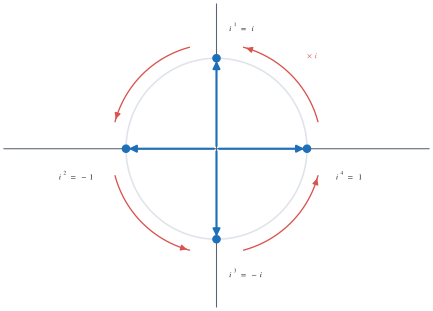
Problem. Evaluate(a) i^{2026},(b) i^{-35}.
Solution. (a) Divide the index by 4: 2026 = 4 \times 506 + 2, so
(b) \;-35 = 4\times(-9) + 1, so i^{-35} = \left(i^{4}\right)^{-9}\cdot i^{1} = i.
Alternatively i^{-35} = \dfrac{1}{i^{35}}; since 35 = 4\times 8 + 3, i^{35} = i^{3} = -i, and \dfrac{1}{-i} = \dfrac{-1}{i}\cdot\dfrac{i}{i} = \dfrac{-i}{-1} = i. Same answer.
The four operations
Add and subtract componentwise; multiply as ordinary binomials and replace i^{2} by -1:
Division is done by multiplying above and below by the conjugate of the denominator, which makes the denominator real:
\sqrt{-4}\times\sqrt{-9} = (2i)(3i) = 6i^{2} = -6, not \sqrt{36} = 6. Always convert each negative square root to i form first, then multiply.
Problem. Simplify (3+4i)(2-5i).
Solution. Expand as usual:
Since i^{2} = -1, the last term is -20(-1) = +20:
Problem. Express \dfrac{2+3i}{3-4i} in the form a+ib.
Solution. Multiply numerator and denominator by 3+4i, the conjugate of the denominator:
The denominator became (3)^{2}+(4)^{2} = 25 — a real number — because (c+id)(c-id) = c^{2}+d^{2}.
Problem. Find real x and y such that (x+iy)(3-2i) = 13+13i.
Solution. Expand the left side:
Equate real and imaginary parts with 13+13i:
Multiply the first by 3 and the second by 2, then add: 9x+6y = 39 and -4x+6y = 26; subtracting gives 13x = 13, so x = 1. Then 3(1)+2y = 13 gives y = 5.
Check. (1+5i)(3-2i) = 3-2i+15i-10i^{2} = 3+13i+10 = 13+13i. Correct.
8.2 Geometric representation
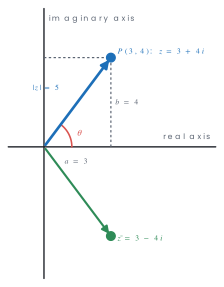
Because z = a+ib is fixed by the pair of real numbers (a, b), every complex number is a point of a plane. That plane is the Argand diagram: the horizontal axis carries the real part (the real axis), the vertical axis the imaginary part (the imaginary axis).
z = a+ib is plotted as the point P(a, b), or as the vector \vec{OP}.
- Modulus |z| = OP = \sqrt{a^{2}+b^{2}} — the distance from the origin.
- Argument \arg z = \theta, the angle \vec{OP} makes with the positive real axis, measured anticlockwise. The value in (-\pi, \pi] is the principal argument.
Polar (modulus–argument) form
From the right triangle in the figure, a = r\cos\theta and b = r\sin\theta where r = |z|. Hence
\tan\theta = b/a alone does not fix \theta — two angles a half-turn apart share a tangent. Always check which quadrant (a,b) lies in and adjust.
| Quadrant of (a,b) | Principal argument \theta, where \tan\alpha = |b/a|, 0 < \alpha < \pi/2 |
|---|---|
| I (a>0, b>0) | \theta = \alpha |
| II (a<0, b>0) | \theta = \pi - \alpha |
| III (a<0, b<0) | \theta = -(\pi - \alpha) |
| IV (a>0, b<0) | \theta = -\alpha |
Problem. Express z = -1 + i\sqrt{3} in polar form.
Solution. Here a = -1, b = \sqrt{3}.
Since a < 0 and b > 0, the point lies in the second quadrant, so
Check. 2\cos 120^{\circ} = 2(-\tfrac12) = -1 and 2\sin 120^{\circ} = 2\left(\tfrac{\sqrt{3}}{2}\right) = \sqrt{3}. Correct.
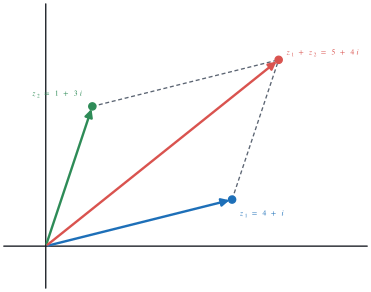
Addition is vector addition
z_1 + z_2 is the diagonal of the parallelogram on \vec{Oz_1} and \vec{Oz_2} — exactly the triangle law for vectors. One side of a triangle is never longer than the other two together, which gives the triangle inequality
8.3 Modulus and conjugate with properties
The conjugate of z = a+ib is \bar{z} = a - ib: the same point reflected in the real axis. Reflecting twice returns you to the start, so \overline{\left(\bar{z}\right)} = z.
For all z, z_1, z_2 \in \mathbb{C}:
| Conjugate | Modulus |
|---|---|
| \overline{z_1 \pm z_2} = \bar{z_1} \pm \bar{z_2} | |z_1 z_2| = |z_1||z_2| |
| \overline{z_1 z_2} = \bar{z_1}\,\bar{z_2} | |z_1/z_2| = \dfrac{|z_1|}{|z_2|} |
| \overline{\left(\dfrac{z_1}{z_2}\right)} = \dfrac{\bar{z_1}}{\bar{z_2}} | |z| = |\bar{z}| = |-z| |
| z + \bar{z} = 2\,\mathrm{Re}(z) | z\bar{z} = |z|^{2} |
| z - \bar{z} = 2i\,\mathrm{Im}(z) | |z_1+z_2| \le |z_1|+|z_2| |
z is real \Leftrightarrow z = \bar{z}; z is purely imaginary \Leftrightarrow z = -\bar{z}.
With z = a+ib,
and |z| = \sqrt{a^{2}+b^{2}}, so z\bar{z} = |z|^{2} — always a non-negative real number. This is precisely why multiplying by the conjugate clears a complex denominator, and it gives the reciprocal formula
Problem. Verify that |z_1 z_2| = |z_1||z_2| for z_1 = 3+4i and z_2 = 1-2i.
Solution.
And |z_1||z_2| = 5\sqrt{5}. The two agree.
Problem. If z = \dfrac{1+i}{1-i}, find z, |z| and \arg z.
Solution. Multiply above and below by 1+i:
So z = i = 0 + 1i, giving |z| = \sqrt{0+1} = 1 and, since the point (0,1) lies on the positive imaginary axis, \arg z = \dfrac{\pi}{2} = 90^{\circ}.
Problem. Evaluate (1+i)^{8}.
Solution. Square first and use the result repeatedly.
Modulus check. |1+i| = \sqrt{2}, so |(1+i)^{8}| = \left(\sqrt{2}\right)^{8} = 16, matching the real answer 16.
Cube roots of unity
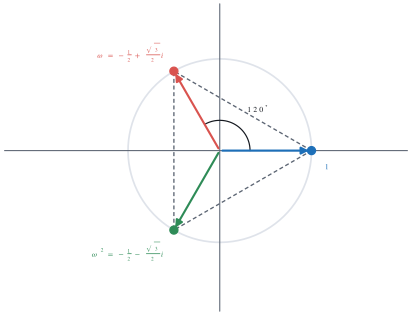
Solving z^{3} = 1, i.e. z^{3}-1 = (z-1)\left(z^{2}+z+1\right) = 0, gives z = 1 and the roots of z^{2}+z+1 = 0:
Write \omega = \dfrac{-1+i\sqrt{3}}{2}. Then the three cube roots of unity are 1, \omega, \omega^{2}.
Each has modulus 1, and their arguments are 0^{\circ}, 120^{\circ} and 240^{\circ} — they sit at the corners of an equilateral triangle on the unit circle. The first identity is just the coefficient relation for z^{2}+z+1 = 0 together with the root z = 1.
Problem. If \omega is a complex cube root of unity, evaluate \left(1+\omega-\omega^{2}\right)^{2}.
Solution. From 1+\omega+\omega^{2} = 0 we get 1+\omega = -\omega^{2}. Substituting,
With \omega = \dfrac{-1+i\sqrt{3}}{2} this is -2 + 2\sqrt{3}\,i.
8.4 Square root of a complex number
Every complex number has exactly two square roots, and they are negatives of each other. To find them, use the equality of complex numbers.
Let \sqrt{a+ib} = x+iy with x, y real. Squaring,
Equating real and imaginary parts gives two real equations:
Now use the identity \left(x^{2}+y^{2}\right)^{2} = \left(x^{2}-y^{2}\right)^{2} + (2xy)^{2}:
Adding and subtracting this with x^{2}-y^{2} = a gives x^{2} and y^{2}, hence x and y. The sign of 2xy = b decides which sign pairing is allowed: if b > 0, x and y have the same sign; if b < 0, opposite signs.
For small numbers, guess-and-fit is quicker: try (x+iy)^{2} = a+ib with small integer x, y satisfying 2xy = b. For 3+4i, 2xy = 4 means xy = 2, so try (2,1): 2^{2}-1^{2} = 3. Done — the root is \pm(2+i). Always state both signs.
Problem. Find the square roots of 3+4i.
Solution. Let \sqrt{3+4i} = x+iy. Then
Adding to x^{2}-y^{2} = 3: \;2x^{2} = 8, so x^{2} = 4 and x = \pm 2. Subtracting: \;2y^{2} = 2, so y^{2} = 1 and y = \pm 1.
Since 2xy = 4 > 0, x and y take the same sign. Hence
Check. (2+i)^{2} = 4 + 4i + i^{2} = 3+4i. Correct.
Problem. Find the square roots of -15-8i.
Solution. Let \sqrt{-15-8i} = x+iy. Then
Adding: 2x^{2} = 2 \Rightarrow x = \pm 1. Subtracting: 2y^{2} = 32 \Rightarrow y = \pm 4.
Since 2xy = -8 < 0, x and y take opposite signs:
Check. (1-4i)^{2} = 1 - 8i + 16i^{2} = 1 - 8i - 16 = -15-8i. Correct.
Problem. Solve x^{2} - 4x + 13 = 0 over \mathbb{C} and comment on the roots.
Solution. D = 16 - 52 = -36 < 0, so the roots are complex.
The two roots 2+3i and 2-3i are conjugates — as they must be, because the coefficients are real. Their sum is 4 = -b/a and their product is (2+3i)(2-3i) = 4+9 = 13 = c/a, so the root–coefficient relations of Unit 7 hold just as well in \mathbb{C}.
Chapter summary
- i = \sqrt{-1}, i^{2} = -1; powers of i repeat with period 4.
- z = a+ib; a+ib = c+id exactly when a = c and b = d.
- Divide by multiplying top and bottom by the conjugate of the denominator.
- Argand diagram: z = a+ib is the point (a,b); |z| = \sqrt{a^{2}+b^{2}} and \arg z = \theta with \tan\theta = b/a, fixed by the quadrant.
- Polar form z = r(\cos\theta + i\sin\theta).
- \bar{z} = a-ib; z\bar{z} = |z|^{2}, z+\bar{z} = 2\,\mathrm{Re}(z), z-\bar{z} = 2i\,\mathrm{Im}(z), \dfrac{1}{z} = \dfrac{\bar{z}}{|z|^{2}}.
- |z_1z_2| = |z_1||z_2|, |z_1/z_2| = \dfrac{|z_1|}{|z_2|}, |z_1+z_2| \le |z_1|+|z_2|.
- Cube roots of unity: 1, \omega, \omega^{2} with \omega^{3} = 1 and 1+\omega+\omega^{2} = 0.
- \sqrt{a+ib} = x+iy: solve x^{2}-y^{2} = a, 2xy = b, x^{2}+y^{2} = \sqrt{a^{2}+b^{2}}; the sign of b fixes the sign pairing.
Practice questions
Group A — Multiple choice (1 mark each)
- The value of i^{10} is [1]a1b-1cid-i
- The modulus of 3+4i is [1]a7b5c\sqrt{7}d25
- The conjugate of -2+5i is [1]a2+5ib-2-5ic2-5id5-2i
- z\bar{z} equals [1]a|z|b2\,\mathrm{Re}(z)c|z|^{2}d0
- If \omega is a complex cube root of unity, then 1+\omega+\omega^{2} is [1]a1b0c\omegad3
- The argument of the complex number -i is [1]a0b\dfrac{\pi}{2}c-\dfrac{\pi}{2}d\pi
Answers to Group A
1. (b) — 10 = 4(2)+2, so i^{10} = i^{2} = -1.
2. (b) — \sqrt{9+16} = 5.
3. (b) — change the sign of the imaginary part only.
4. (c) — (a+ib)(a-ib) = a^{2}+b^{2} = |z|^{2}.
5. (b) — it is the sum of the roots-plus-one identity for z^{3} = 1.
6. (c) — -i is the point (0,-1), a quarter turn clockwise.
Group B — Short answer (5 marks each)
- Express \dfrac{2+3i}{1-2i} in the form a+ib and state its conjugate. [5]
- Find the modulus and the principal argument of z = -1-i, and represent it on an Argand diagram. [5]
- Find real x and y if (x+iy)(2-i) = 7 + i. [5]
- Find the square roots of -5+12i. [5]
- Show that (2+3i)(2-3i) = |2+3i|^{2}, and state the general property this illustrates. [5]
- Find the square roots of 7+24i. [5]
Answers to Group B
1. Multiply by the conjugate 1+2i:
So z = -\dfrac45 + \dfrac75 i, and its conjugate is -\dfrac45 - \dfrac75 i.
2. a = -1, b = -1, so |z| = \sqrt{1+1} = \sqrt{2}. \alpha = \tan^{-1}\left(\dfrac{1}{1}\right) = \tan^{-1}1 = \dfrac{\pi}{4}. The point (-1,-1) is in the third quadrant, so
On the Argand diagram, plot (-1,-1): the vector points down-left at 45^{\circ} below the negative real axis, with length \sqrt{2}.
3. (x+iy)(2-i) = 2x - xi + 2yi - yi^{2} = (2x+y) + i(2y-x). Equating parts,
From the first, y = 7-2x. Substituting into the second,
Then y = 7 - \dfrac{26}{5} = \dfrac{9}{5}.
Check. \left(\tfrac{13}{5}+\tfrac95 i\right)(2-i) = \tfrac{26}{5} - \tfrac{13}{5}i + \tfrac{18}{5}i - \tfrac95 i^{2} = \tfrac{26+9}{5} + \tfrac{5}{5}i = 7+i. Correct.
4. Let \sqrt{-5+12i} = x+iy. Then x^{2}-y^{2} = -5 and 2xy = 12, while
Adding: 2x^{2} = 8 \Rightarrow x = \pm2. Subtracting: 2y^{2} = 18 \Rightarrow y = \pm3. As 2xy = 12 > 0 the signs match, so
5. (2+3i)(2-3i) = 4 - 6i + 6i - 9i^{2} = 4+9 = 13, and |2+3i|^{2} = \left(\sqrt{4+9}\right)^{2} = 13. They are equal.
This illustrates z\bar{z} = |z|^{2}: a complex number times its conjugate is the square of its modulus, always a non-negative real number.
6. Let \sqrt{7+24i} = x+iy. Then x^{2}-y^{2} = 7, 2xy = 24, and
Adding: 2x^{2} = 32 \Rightarrow x = \pm4. Subtracting: 2y^{2} = 18 \Rightarrow y = \pm3. Since 2xy = 24 > 0 the signs match:
Group C — Long answer (8 marks each)
- (a) Define the modulus and the conjugate of a complex number. [2](b) Prove that z\bar{z} = |z|^{2} and that |z_1z_2| = |z_1||z_2|. [4](c) Hence find \dfrac{1}{3-2i} in the form a+ib. [2]
- (a) Represent z = 3+2i on an Argand diagram and find |z| and \arg z. [4](b) Express z = -1+i\sqrt{3} in polar form and mark it, together with \bar{z}, on the same diagram. [4]
- (a) Show that the cube roots of unity are 1, \omega, \omega^{2}, where \omega = \dfrac{-1+i\sqrt{3}}{2}, and prove 1+\omega+\omega^{2} = 0. [4](b) Find the square roots of -8-6i. [4]
Answers to Group C
1. (a) For z = a+ib (a, b real), the modulus is |z| = \sqrt{a^{2}+b^{2}}, the distance of the point (a,b) from the origin; the conjugate is \bar{z} = a-ib, the reflection of that point in the real axis.
(b) z\bar{z} = (a+ib)(a-ib) = a^{2} - i^{2}b^{2} = a^{2}+b^{2} = |z|^{2}.
For the product, let z_1 = a+ib and z_2 = c+id. Then z_1z_2 = (ac-bd) + i(ad+bc), so
Taking non-negative square roots, |z_1z_2| = |z_1||z_2|.
(c) \dfrac{1}{3-2i} = \dfrac{\bar{z}}{|z|^{2}} with z = 3-2i, i.e.
2. (a) z = 3+2i is the point (3,2), in the first quadrant.
(b) z = -1+i\sqrt{3}: |z| = \sqrt{1+3} = 2 and, since (-1,\sqrt{3}) is in the second quadrant, \arg z = \pi - \dfrac{\pi}{3} = \dfrac{2\pi}{3}. Hence
\bar{z} = -1-i\sqrt{3} is the reflection in the real axis: same modulus 2, and argument -\dfrac{2\pi}{3}.
3. (a) z^{3} = 1 \Rightarrow z^{3}-1 = 0 \Rightarrow (z-1)\left(z^{2}+z+1\right) = 0. So either z = 1, or
Writing \omega = \dfrac{-1+i\sqrt{3}}{2}, a direct squaring gives \omega^{2} = \dfrac{-1-i\sqrt{3}}{2}, which is the other root. So the three cube roots are 1, \omega, \omega^{2}.
Adding them: 1 + \dfrac{-1+i\sqrt{3}}{2} + \dfrac{-1-i\sqrt{3}}{2} = 1 + \dfrac{-2}{2} = 0. (Equivalently, \omega and \omega^{2} are the roots of z^{2}+z+1 = 0, whose sum is -1.)
(b) Let \sqrt{-8-6i} = x+iy. Then x^{2}-y^{2} = -8, 2xy = -6, and
Adding: 2x^{2} = 2 \Rightarrow x = \pm1. Subtracting: 2y^{2} = 18 \Rightarrow y = \pm3. Since 2xy = -6 < 0 the signs are opposite:
Check. (1-3i)^{2} = 1 - 6i + 9i^{2} = 1 - 6i - 9 = -8-6i. Correct.
Group D — Model answers for long questions (10 marks each, for deeper revision)
- Define the imaginary unit and a complex number. Explain the algebra of complex numbers, the Argand diagram, the modulus and the conjugate, and prove their main properties. [10]
- Derive the square root of a complex number, find \sqrt{3+4i}, \sqrt{-5+12i}, \sqrt{-8-6i} and solve quadratic equations with complex roots. [10]
Model answer D1: algebra, Argand diagram, modulus and conjugate (10 marks)
Introduction. The equation x^{2}+1=0 has no real root. Mathematicians therefore define the imaginary unit i with i^{2}=-1. A complex number is z=x+iy with x,y\in\mathbb{R}; x is the real part and y the imaginary part.
Complex numbers are used in alternating-current circuits, for example in the Nepal Electricity Authority grid.
Powers of i. i^{2}=-1, i^{3}=-i, i^{4}=1, and the pattern repeats every four powers. So i^{99}=i^{96}\cdot i^{3}=-i.
Algebra of complex numbers. Let z_1=a+ib and z_2=c+id.
- Equality: z_1=z_2 means a=c and b=d.
- Addition: z_1+z_2=(a+c)+i(b+d).
- Multiplication: z_1z_2=(ac-bd)+i(ad+bc).
- Division: multiply the numerator and denominator by the conjugate of the denominator:
Argand diagram. The number x+iy is represented by the point P(x,y) in the plane, with the X-axis as the real axis and the Y-axis as the imaginary axis. Addition of complex numbers follows the parallelogram law for the vectors \overrightarrow{OP}.
Modulus and conjugate.
- The modulus is |z|=\sqrt{x^{2}+y^{2}}, the distance of P from the origin.
- The conjugate is \bar z=x-iy, the reflection of P in the real axis.
Properties and proofs.
- z\bar z=(x+iy)(x-iy)=x^{2}+y^{2}=|z|^{2}.
- \overline{z_1+z_2}=\bar z_1+\bar z_2 and \overline{z_1z_2}=\bar z_1\bar z_2.
- |z_1z_2|=|z_1||z_2|. Proof: |z_1z_2|^{2}=(z_1z_2)(\bar z_1\bar z_2)=(z_1\bar z_1)(z_2\bar z_2)=|z_1|^{2}|z_2|^{2}.
- \left|\dfrac{z_1}{z_2}\right|=\dfrac{|z_1|}{|z_2|} and |z_1+z_2|\le|z_1|+|z_2| (triangle inequality).
- z is real if and only if z=\bar z, and z+\bar z=2x, z-\bar z=2iy.
Numerical check of 3. For z_1=1+i and z_2=2+3i: z_1z_2=(2-3)+i(3+2)=-1+5i, so |z_1z_2|=\sqrt{26}; and |z_1||z_2|=\sqrt2\times\sqrt{13}=\sqrt{26}.
Conclusion. Complex numbers obey the same algebra as real numbers with i^{2}=-1; the modulus measures size, the conjugate gives real results on multiplication, and the Argand diagram makes them geometric.
Model answer D2: square root of a complex number and complex roots (10 marks)
Introduction. Every non-zero complex number has exactly two square roots, which are negatives of each other. Finding them allows every quadratic equation with real or complex coefficients to be solved.
Derivation. Let \sqrt{a+ib}=x+iy. Squaring, x^{2}-y^{2}=a and 2xy=b. Also |z|=\sqrt{a^{2}+b^{2}}=x^{2}+y^{2}, since the modulus of the square equals the square of the modulus. Adding and subtracting with x^{2}-y^{2}=a:
Therefore
where \varepsilon=+1 if b>0 and \varepsilon=-1 if b<0 (so that 2xy has the sign of b).
Worked examples.
| Number | Modulus r | x=\sqrt{\frac{r+a}{2}} | y=\sqrt{\frac{r-a}{2}} | Square roots | Check |
|---|---|---|---|---|---|
| 3+4i | 5 | 2 | 1 | \pm(2+i) | (2+i)^{2}=3+4i |
| -5+12i | 13 | 2 | 3 | \pm(2+3i) | (2+3i)^{2}=-5+12i |
| -8-6i | 10 | 1 | 3 | \pm(1-3i) | (1-3i)^{2}=-8-6i |
In the third case b<0, so x and y take opposite signs.
Quadratic equations with complex roots.
- z^{2}-4z+13=0. Here D=16-52=-36, so z=\dfrac{4\pm6i}{2}=2\pm3i. The roots are conjugates, as always for real coefficients; their sum is 4 and their product 4+9=13.
- z^{2}-(3+i)z+(2+i)=0 has a complex coefficient. D=(3+i)^{2}-4(2+i)=9+6i-1-8-4i=2i. The square root of 2i is \pm(1+i) because (1+i)^{2}=2i. Therefore z=\dfrac{(3+i)\pm(1+i)}{2}, giving z=2+i or z=1. Check: (z-1)\big(z-(2+i)\big)=z^{2}-(3+i)z+(2+i).
Solving a real-equation problem. Find real x,y if (x+iy)^{2}=3+4i. From the first table row, x+iy=\pm(2+i), so (x,y)=(2,1) or (-2,-1).
Conclusion. Equating real and imaginary parts, or using the formula in terms of |z|, gives the two square roots, and complex roots of real quadratics always occur as conjugate pairs.
Practise more: Mathematics question bank