Chapter 1 · Mechanics · 2 questions in the paper · 41 min read
Physical Quantities, Vectors and Kinematics
What the syllabus asks for 4
- Precision, accuracy, significant figures and dimensional analysis
- Scalars and vectors: laws of addition, resolution, scalar and vector products
- Linear motion: equations of motion and their graphical treatment
- Projectile motion, with and without a resistive force
This chapter is the toolkit of the whole Physics paper: units and dimensions, significant figures and errors, vectors, and the description of straight-line and projectile motion.
The Mechanics area carries 10 of the 50 Physics questions (official MEC weightage); we estimate about 2 of them come from this chapter.
They are usually quick marks — a dimensional formula, a significant-figure count, an angle between two vectors, a reading from a velocity–time graph, or a projectile range — and the same skills are needed silently in every later chapter.
- Dimensional formulae of common quantities, and which pairs share dimensions.
- Using dimensions: checking an equation, converting units, finding the dimensions of a constant.
- Counting significant figures; rounding a sum or product correctly; percentage error of A^pB^q/C^r.
- Resultant of two vectors, R^2 = A^2 + B^2 + 2AB\cos\theta, and its special cases (0°, 90°, 120°, 180°).
- Dot and cross products: angle between vectors, perpendicular and parallel tests, area of a parallelogram.
- Equations of motion, the distance in the nth second, and reading slopes and areas of motion graphs.
- Projectile formulas T, H, R; complementary angles; horizontal projection; what air resistance changes.
1.1 Precision, accuracy, significant figures and dimensional analysis
Units and base quantities
A physical quantity is anything that can be measured; it is written as a number times a unit. The SI system has seven base (fundamental) quantities; every other quantity is derived from them.
| Base quantity | SI unit | Symbol | Dimension |
|---|---|---|---|
| Length | metre | m | [L] |
| Mass | kilogram | kg | [M] |
| Time | second | s | [T] |
| Electric current | ampere | A | [A] (or [I]) |
| Thermodynamic temperature | kelvin | K | [K] (or [Θ]) |
| Amount of substance | mole | mol | [mol] (or [N]) |
| Luminous intensity | candela | cd | [cd] (or [J]) |
Plane angle (radian) and solid angle (steradian) are dimensionless.
Accuracy, precision and errors
Accuracy is how close a measured value is to the true value. Precision is how close repeated measurements are to one another (and, for an instrument, how fine its smallest reading — its least count — is).
A set of readings can be precise but inaccurate (tightly grouped around the wrong value — typical of a systematic error such as a zero error), or accurate on average but imprecise (scattered around the true value — typical of random errors).
| Error type | Cause | Reduced by |
|---|---|---|
| Systematic | zero error, faulty calibration, a fixed habit of the observer, ignored air drag | correcting the instrument or the method; not by repeating |
| Random | unpredictable small fluctuations | taking many readings and averaging |
| Gross (blunder) | misreading, wrong recording | care; rejecting the odd reading |
For readings a_1, a_2, \dots, a_n with mean \bar a: the absolute error of a reading is |\bar a - a_i|; the mean absolute error \Delta a is the mean of these; relative error = \Delta a/\bar a; percentage error = (\Delta a/\bar a)\times 100\,\%.
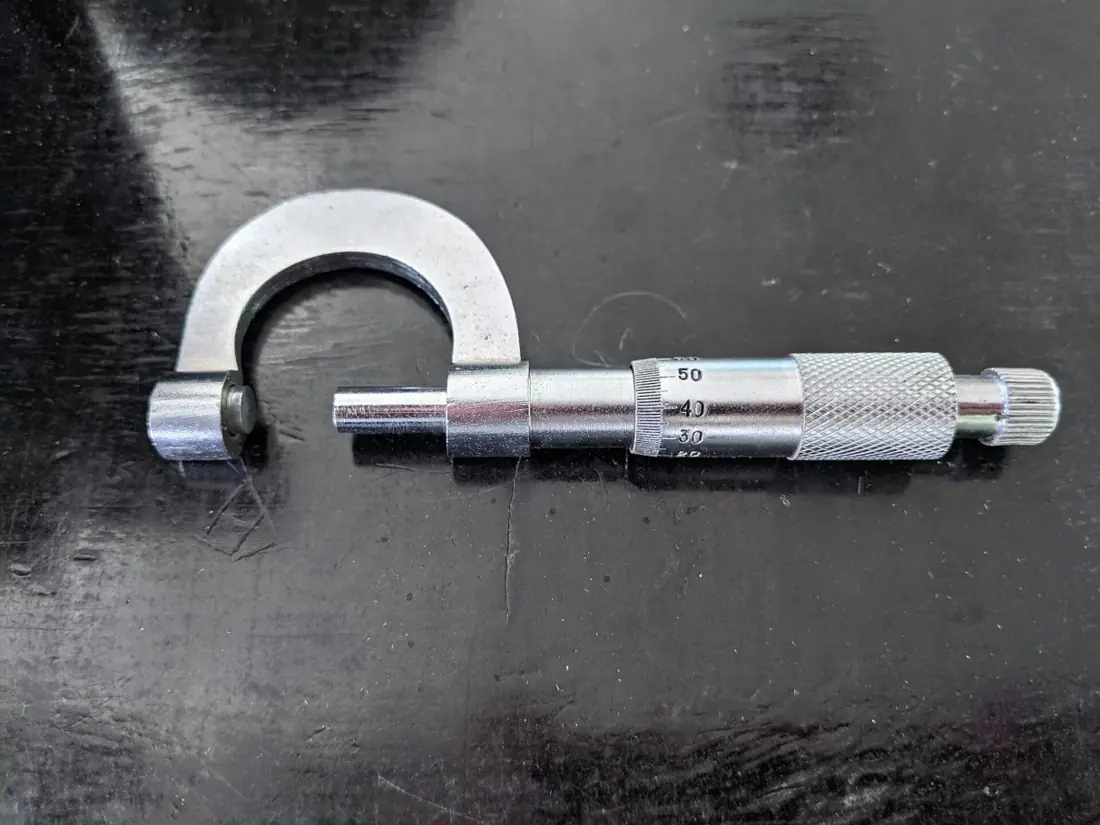
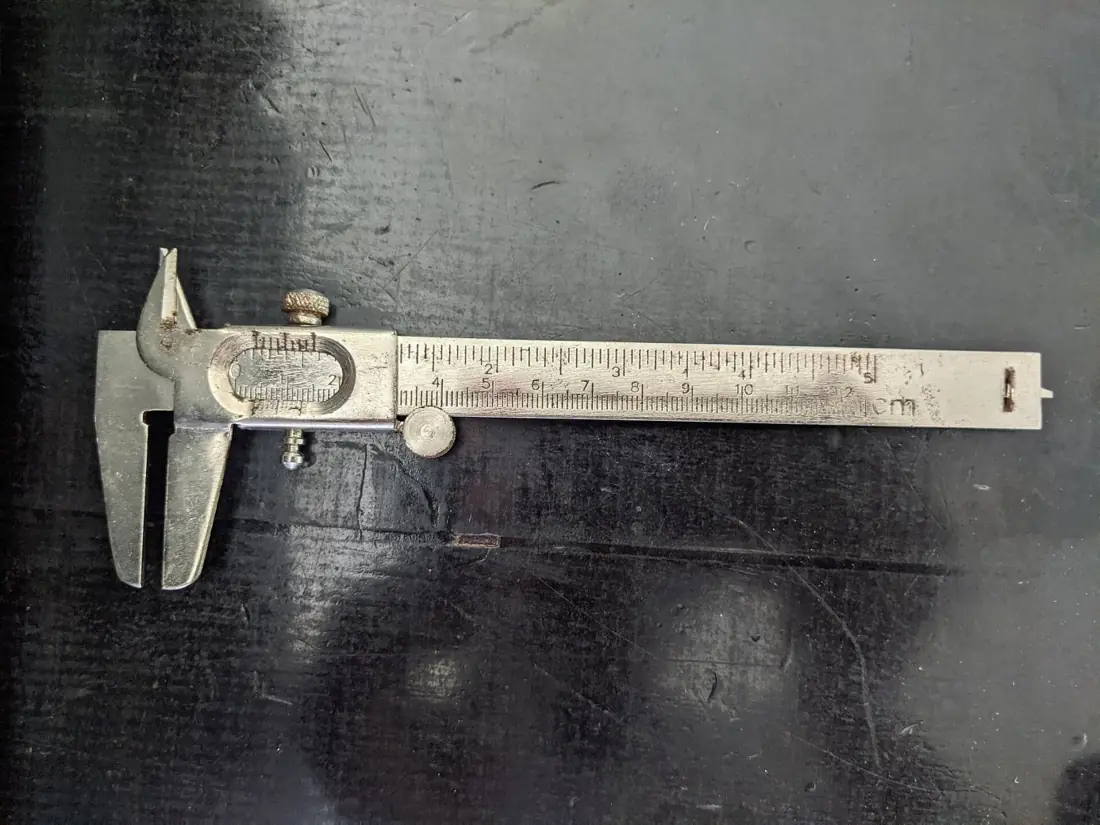
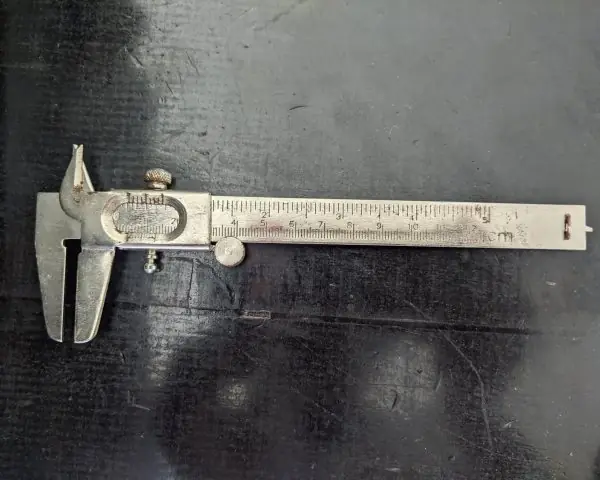
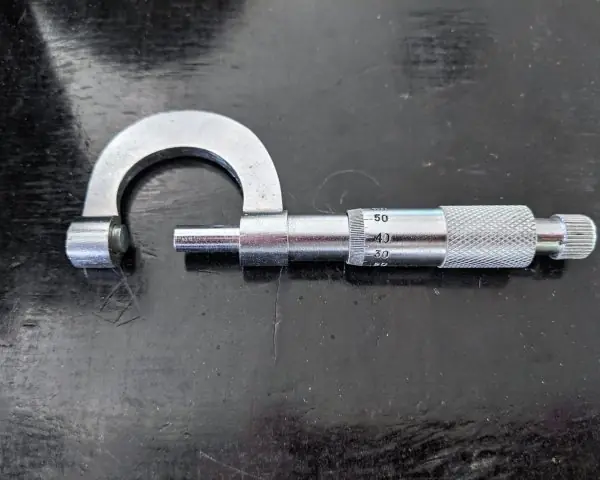
Least count (the smallest reading an instrument can make): vernier calliper LC = 1 MSD − 1 VSD = (value of 1 MSD)/(number of vernier divisions), when n VSD coincide with (n-1) MSD; screw gauge LC = pitch / number of circular-scale divisions.
A metre rule has LC 1 mm, a typical vernier 0.1 mm, a typical screw gauge 0.01 mm.
Combining errors
| Result | Maximum error |
|---|---|
| Z = A + B or Z = A - B | \Delta Z = \Delta A + \Delta B (absolute errors add) |
| Z = AB or Z = A/B | \frac{\Delta Z}{Z} = \frac{\Delta A}{A} + \frac{\Delta B}{B} (relative errors add) |
| Z = A^n | \frac{\Delta Z}{Z} = n\frac{\Delta A}{A} |
| Z = \frac{A^pB^q}{C^r} | \%Z = p(\%A) + q(\%B) + r(\%C) |
Even when a quantity is divided or appears with a negative power, its percentage error is added. In Z = A^2/B^3 the percentage error is 2(\%A) + 3(\%B), not 2(\%A) - 3(\%B).
And a subtraction A - B of two nearly equal numbers has a large percentage error even if each reading is good.
Problem. In g = 4\pi^2 l/T^2 the length l is measured with an error of 2 % and the period T with an error of 1 %. Find the maximum percentage error in g.
Solution. 4\pi^2 is exact. \%g = 1\times(\%l) + 2\times(\%T) = 2 + 2(1) = 4\,\%. The power of T doubles its share — measure T (time many oscillations) most carefully.
Significant figures
The significant figures (SF) of a measured value are the reliably known digits plus the first uncertain one.
| Rule | Example | SF |
|---|---|---|
| All non-zero digits count | 4.256 | 4 |
| Zeros between non-zero digits count | 4.005 | 4 |
| Leading zeros never count (they only fix the decimal point) | 0.00420 | 3 |
| Trailing zeros after a decimal point count | 4.200 | 4 |
| Trailing zeros of a whole number without a decimal point are ambiguous | 4200 | 2, 3 or 4 |
| The power of ten does not count | 6.02 × 10²³ | 3 |
Write 4200 as 4.2 × 10³ (2 SF) or 4.200 × 10³ (4 SF) to remove the doubt. Changing units does not change the number of significant figures: 2.30 m = 230 cm = 2.30 × 10⁻³ km — always 3 SF (230 cm is better written 2.30 × 10² cm).
Arithmetic.
- Addition and subtraction: keep as many decimal places as the number with the fewest decimal places. 12.1 + 0.25 + 1.256 = 13.606 → 13.6.
- Multiplication and division: keep as many significant figures as the factor with the fewest SF. 2.5 × 1.25 = 3.125 → 3.1.
- Rounding: drop a digit below 5 (2.743 → 2.74); raise the previous digit if the dropped digit is above 5 (2.746 → 2.75). When the dropped digit is exactly 5, the common convention keeps the previous digit if it is even and raises it if it is odd (2.745 → 2.74, 2.735 → 2.74).
Dimensions and dimensional analysis
The dimensions of a quantity are the powers to which the base quantities must be raised to represent it; the expression is its dimensional formula. Force = ma has [M][LT^{-2}] = [MLT^{-2}].
| Quantity | From | Dimensional formula | SI unit |
|---|---|---|---|
| Force | ma | [MLT^{-2}] | N |
| Work, energy, torque | Fs, rF | [ML^2T^{-2}] | J, N m |
| Power | W/t | [ML^2T^{-3}] | W |
| Momentum, impulse | mv, Ft | [MLT^{-1}] | kg m s⁻¹, N s |
| Pressure, stress, elastic modulus, energy density | F/A | [ML^{-1}T^{-2}] | Pa |
| Surface tension, spring constant | F/l, F/x | [MT^{-2}] | N m⁻¹ |
| Coefficient of viscosity | F/(A\,dv/dx) | [ML^{-1}T^{-1}] | Pa s |
| Gravitational constant G | Fr^2/(m_1m_2) | [M^{-1}L^3T^{-2}] | N m² kg⁻² |
| Planck's constant, angular momentum | E/f, mvr | [ML^2T^{-1}] | J s |
| Moment of inertia | mr^2 | [ML^2] | kg m² |
| Frequency, angular velocity, velocity gradient | 1/T, \theta/t | [T^{-1}] | Hz, rad s⁻¹ |
| Specific heat capacity | Q/(m\Delta T) | [L^2T^{-2}K^{-1}] | J kg⁻¹ K⁻¹ |
| Latent heat | Q/m | [L^2T^{-2}] | J kg⁻¹ |
| Stefan's constant \sigma | P/(AT^4) | [MT^{-3}K^{-4}] | W m⁻² K⁻⁴ |
| Charge | It | [AT] | C |
| Potential difference | W/q | [ML^2T^{-3}A^{-1}] | V |
| Resistance | V/I | [ML^2T^{-3}A^{-2}] | Ω |
| Magnetic field B | F/(qv) | [MT^{-2}A^{-1}] | T |
Dimensionless quantities: strain, angle, refractive index, relative density, coefficient of friction, Poisson's ratio, Reynolds number. (Angle has a unit, the radian, but no dimensions.)
Every term on both sides of a correct physical equation has the same dimensions. Only quantities of the same dimensions can be added, subtracted or equated, and the argument of \sin, \cos, e^x or \log must be dimensionless.
Uses.
- Checking an equation: s = ut + \frac{1}{2}at^2 — each term is [L], so it is dimensionally correct (correctness of the \frac{1}{2} is not tested).
- Dimensions of a constant: in v = at + \frac{b}{t+c}, c is added to t so c = [T]; b/t is a velocity, so b = [LT^{-1}][T] = [L].
- Converting units: a quantity with dimensions [M^aL^bT^c] has numerical values related by n_2 = n_1\left(\frac{M_1}{M_2}\right)^a\left(\frac{L_1}{L_2}\right)^b\left(\frac{T_1}{T_2}\right)^c. For example 1 J = 1\times(10^3\ \text{g/g})(10^2\ \text{cm/cm})^2 = 10^7 erg.
- Deriving a relation when a quantity is a product of powers of others.
Problem. The speed v of a transverse wave on a string depends on the tension F and the mass per unit length \mu. Find the form of the relation.
Solution. Put v = kF^x\mu^y: [LT^{-1}] = [MLT^{-2}]^x[ML^{-1}]^y. Matching powers: M: 0 = x + y; L: 1 = x - y; T: -1 = -2x. So x = \frac{1}{2}, y = -\frac{1}{2} and v = k\sqrt{F/\mu} (experiment gives k = 1).
Limitations. Dimensional analysis cannot find dimensionless constants (\frac{1}{2}, 2\pi); cannot handle relations containing sums of different terms, or trigonometric, exponential and logarithmic functions; cannot, in mechanics, find a relation with more than three unknown powers (only three equations, from M, L, T); and cannot tell apart quantities with the same dimensions (work and torque).
Memorise five anchors — force [MLT^{-2}], energy [ML^2T^{-2}], pressure [ML^{-1}T^{-2}], charge [AT], voltage [ML^2T^{-3}A^{-1}] — and build the rest by one division or multiplication.
To compare options, check one base quantity at a time (often the power of T alone eliminates three options).
1.2 Scalars and vectors: laws of addition, resolution, scalar and vector products
A scalar has magnitude only (mass, time, work, energy, power, pressure, temperature, charge, electric current, potential).
A vector has magnitude and direction and obeys the laws of vector addition (displacement, velocity, acceleration, force, momentum, impulse, torque, electric field).
Electric current has a direction but adds algebraically at a junction, so it is a scalar; finite rotations do not add like vectors either.
Addition of vectors
- Triangle law: place \vec B with its tail at the head of \vec A; the resultant runs from the tail of \vec A to the head of \vec B.
- Parallelogram law: if \vec A and \vec B are the adjacent sides from one point, the diagonal from that point is \vec R = \vec A + \vec B.
- Polygon law: for many vectors joined head to tail, the closing side (tail of the first to head of the last) is the resultant. If they form a closed polygon, the resultant is zero.
For two vectors at angle \theta, the resultant's magnitude and its angle \alpha with \vec A are
| Angle \theta | Resultant R |
|---|---|
| 0° (parallel) | A + B (maximum) |
| 90° | \sqrt{A^2+B^2} |
| 180° (antiparallel) | |A - B| (minimum) |
| any \theta, with A = B | 2A\cos(\theta/2) |
| 120°, with A = B | A |
So |A - B| \le R \le A + B: forces of 3 N and 5 N can give any resultant from 2 N to 8 N, but not 1 N or 9 N. Subtraction is adding the reverse vector: |\vec A - \vec B| = \sqrt{A^2 + B^2 - 2AB\cos\theta}. Vector addition is commutative and associative.
Problem. Forces of 3 N and 4 N act at a point with 60° between them. Find the resultant.
Solution. R = \sqrt{9 + 16 + 2(3)(4)\cos 60^{\circ}} = \sqrt{37} = 6.1\ \text{N}.
Check against the limits it must lie between 1 N and 7 N, and above 5 N (the 90° value) because the angle is less than 90°.
Two vectors give zero only if they are equal and opposite. Three coplanar vectors can give zero (they close a triangle) — e.g. 3 N, 4 N, 5 N — but 2 N, 3 N and 6 N cannot, because 6 > 2 + 3.
Three vectors that are not in one plane can never add to zero; at least four are needed.
Resolution and unit vectors
A vector \vec A at angle \theta to the x-axis has rectangular components A_x = A\cos\theta and A_y = A\sin\theta, so A = \sqrt{A_x^2 + A_y^2} and \tan\theta = A_y/A_x.
In three dimensions, \vec A = A_x\hat i + A_y\hat j + A_z\hat k and |\vec A| = \sqrt{A_x^2 + A_y^2 + A_z^2}. The unit vector along \vec A is \hat A = \vec A/|\vec A|.
The direction cosines satisfy \cos^2\alpha + \cos^2\beta + \cos^2\gamma = 1. A component can be zero but never larger than the vector itself.
Scalar (dot) and vector (cross) products
| Scalar product \vec A\cdot\vec B | Vector product \vec A\times\vec B | |
|---|---|---|
| Definition | AB\cos\theta (a scalar) | AB\sin\theta\,\hat n, \hat n by the right-hand rule |
| In components | A_xB_x + A_yB_y + A_zB_z | (A_yB_z - A_zB_y)\hat i + (A_zB_x - A_xB_z)\hat j + (A_xB_y - A_yB_x)\hat k |
| Order | commutative: \vec A\cdot\vec B = \vec B\cdot\vec A | anticommutative: \vec A\times\vec B = -\vec B\times\vec A |
| Unit vectors | \hat i\cdot\hat i = 1, \hat i\cdot\hat j = 0 | \hat i\times\hat j = \hat k, \hat j\times\hat k = \hat i, \hat k\times\hat i = \hat j, \hat i\times\hat i = 0 |
| Zero when | \theta = 90^{\circ} (perpendicular) | \theta = 0^{\circ} or 180^{\circ} (parallel) |
| Physics | W = \vec F\cdot\vec s, P = \vec F\cdot\vec v, flux = \vec B\cdot\vec A | \vec\tau = \vec r\times\vec F, \vec L = \vec r\times\vec p, \vec F = q\vec v\times\vec B |
| Geometry | projection of \vec A on \vec B = \vec A\cdot\vec B/B | area of parallelogram = |\vec A\times\vec B|; triangle = \frac{1}{2}|\vec A\times\vec B| |
The angle between two vectors: \cos\theta = \frac{\vec A\cdot\vec B}{AB}. \vec A\times\vec B is perpendicular to both \vec A and \vec B.
Problem. Find the angle between \vec A = \hat i + \hat j and \vec B = \hat j + \hat k.
Solution. \vec A\cdot\vec B = (1)(0) + (1)(1) + (0)(1) = 1 and A = B = \sqrt{2}. So \cos\theta = 1/2 and \theta = 60^{\circ}.
|\vec A + \vec B| = |\vec A - \vec B| means \vec A\perp\vec B. \vec A\cdot\vec B = |\vec A\times\vec B| means \theta = 45^{\circ}. \vec A\cdot\vec B = 0 means perpendicular; \vec A\times\vec B = 0 means parallel (for components, A_x/B_x = A_y/B_y = A_z/B_z).
1.3 Linear motion: equations of motion and their graphical treatment
Distance (path length, scalar) is never less than the magnitude of displacement (vector, straight line from start to end). Average speed = total distance / total time; average velocity = total displacement / total time.
Instantaneous velocity v = dx/dt; acceleration a = dv/dt = d^2x/dt^2 = v\,dv/dx.
Equations of uniformly accelerated motion
For constant acceleration a, initial velocity u, final velocity v, displacement s in time t:
s_n is the displacement in the nth second (its unit is metre; the "per second" is hidden in the 1 s interval). They hold only if a is constant.
| Fast fact (from rest, uniform a) | Ratio |
|---|---|
| Distances in successive equal intervals (1st, 2nd, 3rd second) | 1 : 3 : 5 : 7 (Galileo's odd numbers) |
| Total distances after 1, 2, 3 s | 1 : 4 : 9 (s\propto t^2) |
| Velocities after 1, 2, 3 s | 1 : 2 : 3 |
| Stopping distance for the same braking | s \propto u^2 — double the speed, four times the distance |
Average speed for two halves. Equal distances at v_1 and v_2: \bar v = \frac{2v_1v_2}{v_1+v_2} (harmonic mean). Equal times: \bar v = \frac{v_1+v_2}{2}.
Free fall (air resistance neglected) is uniform acceleration g downward. Dropped from rest: h = \frac{1}{2}gt^2, v = \sqrt{2gh}.
Thrown up at u: maximum height H = u^2/2g, time up = u/g = time down, total time 2u/g, and it returns with the same speed u. All bodies fall with the same g in vacuum, whatever their mass.
Relative velocity on a line: v_{AB} = v_A - v_B. Cars moving the same way at 60 and 40 km h⁻¹ close at 20 km h⁻¹; moving towards each other, at 100 km h⁻¹.
Motion graphs
| Graph | Slope gives | Area under it gives |
|---|---|---|
| Position–time (x–t) | velocity | — |
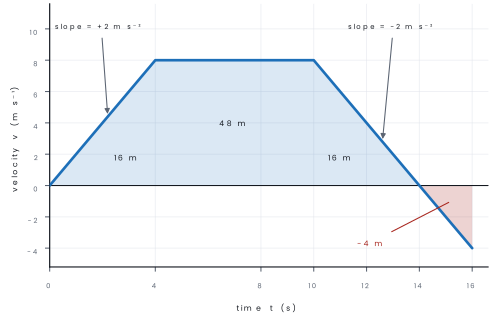
| Velocity–time (v–t) | acceleration | displacement (area above axis +, below −); total area ignoring sign = distance |
| Acceleration–time (a–t) | rate of change of acceleration | change in velocity |
| Motion | x–t graph | v–t graph |
|---|---|---|
| At rest | horizontal line | on the time axis |
| Uniform velocity | straight sloping line | horizontal line |
| Uniform acceleration | parabola, curving upward | straight line, positive slope |
| Uniform retardation | parabola, curving downward | straight line, negative slope |
| Ball thrown up and caught (up positive) | inverted parabola | straight line of slope -g crossing the axis at the top |
A v–t graph can never be vertical (infinite acceleration) and an x–t graph can never turn back in time (a body cannot be at two places at once).
Problem. A stone dropped from rest covers 25 m in the last second of its fall (g = 10\ \text{m s}^{-2}). From what height was it dropped?
Solution. In the nth second, s_n = \frac{g}{2}(2n-1) = 5(2n-1) = 25, so n = 3: the fall lasts 3 s. Height h = \frac{1}{2} g t^2 = \frac{1}{2}(10)(9) = 45\ \text{m}.
Choose one direction as positive and keep it. With "up" positive, a = -g on the way up and on the way down; at the top v = 0 but a = -g still.
A body thrown down from a height and one thrown up with the same speed reach the ground with the same speed (energy), but at different times.
1.4 Projectile motion, with and without a resistive force
A projectile is a body thrown into the air and then acted on by gravity alone (no air resistance). Its motion is two independent motions: uniform velocity horizontally (a_x = 0) and free fall vertically (a_y = -g).
For launch speed u at angle \theta above the horizontal on level ground: u_x = u\cos\theta (constant throughout), u_y = u\sin\theta.
| Quantity | Formula |
|---|---|
| Time of flight | T = \frac{2u\sin\theta}{g} |
| Maximum height | H = \frac{u^2\sin^2\theta}{2g} |
| Horizontal range | R = \frac{u^2\sin2\theta}{g}, maximum R_{max} = \frac{u^2}{g} at \theta = 45^{\circ} |
| Path (trajectory) | y = x\tan\theta - \frac{gx^2}{2u^2\cos^2\theta} = x\tan\theta\left(1 - \frac{x}{R}\right) — a parabola |
| Velocity at time t | v_x = u\cos\theta, v_y = u\sin\theta - gt, v = \sqrt{v_x^2 + v_y^2} |
| At the highest point | v = u\cos\theta (horizontal), a = g downward, KE = K\cos^2\theta |
| Range and height | R = 4H\cot\theta, so \tan\theta = 4H/R; at 45°, H = R/4 |
| Change in momentum, launch to landing | 2mu\sin\theta, vertically downward |
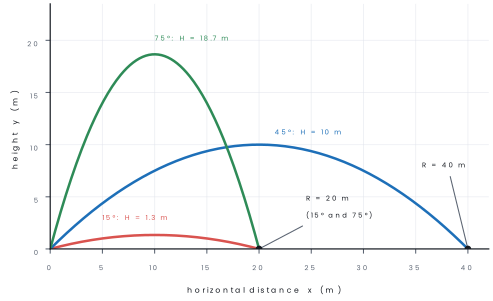
Complementary angles. \theta and 90^{\circ} - \theta give the same range (15° and 75°, 30° and 60°), but different heights and times; for them H_1 + H_2 = u^2/2g, T_1T_2 = 2R/g and R = 4\sqrt{H_1H_2}.
Problem. A ball is kicked at 20 m s⁻¹ at 30° above the horizontal (g = 10\ \text{m s}^{-2}). Find T, H and R.
Solution. u_y = 10\ \text{m s}^{-1}, u_x = 10\sqrt{3} = 17.3\ \text{m s}^{-1}. T = 2u_y/g = 2\ \text{s}; H = u_y^2/2g = 100/20 = 5\ \text{m}; R = u_xT = 34.6\ \text{m} (or u^2\sin60^{\circ}/g = 20\sqrt{3}).
Horizontal projection
A body thrown horizontally at speed u from height h: u_y = 0, so the time to fall t = \sqrt{2h/g} is the same as for a body simply dropped from that height.
Horizontal distance x = u\sqrt{2h/g}; path y = \frac{gx^2}{2u^2} (measured downward); striking speed v = \sqrt{u^2 + 2gh}, at angle \tan\phi = \sqrt{2gh}/u below the horizontal.
Problem. A helicopter flying horizontally at 50 m s⁻¹, 490 m above flat ground near Jumla, releases a relief packet (g = 9.8\ \text{m s}^{-2}, no air resistance). How far ahead of the release point does it land?
Solution. t = \sqrt{2(490)/9.8} = \sqrt{100} = 10\ \text{s}; x = 50\times10 = 500\ \text{m}. The packet stays vertically below the helicopter all the way down — both have the same horizontal velocity.
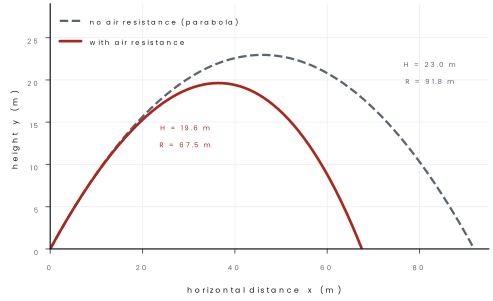
With a resistive force (air drag)
Real air exerts a drag force opposite to the velocity, roughly F = kv at low speeds and F \propto v^2 at high speeds. This changes the results above:
| Without air resistance | With air resistance |
|---|---|
| Horizontal velocity constant | Horizontal velocity keeps decreasing |
| Path a symmetric parabola | Path not a parabola; the descending branch is steeper than the rising one |
| Time up = time down | Time up less than time down (drag adds to g on the way up and subtracts from it on the way down) |
| Lands with the launch speed | Lands with a smaller speed (energy lost to the air) |
| Maximum range at 45° | Range and height both reduced; maximum range at an angle below 45° |
Terminal velocity. A body falling through a fluid speeds up until the drag (plus buoyancy) equals its weight; then the net force is zero and it falls at a constant terminal velocity.
For drag kv, mg = kv_t gives v_t = mg/k, and the velocity grows as v = v_t(1 - e^{-kt/m}), reaching about 63 % of v_t after one time constant m/k.
Raindrops and parachutists fall at terminal velocity; Stokes' law for a sphere in a viscous fluid (Chapter 4) is the same idea.
At the highest point the vertical velocity is zero, but the speed is u\cos\theta, not zero, and the acceleration is still g downward. Only a body thrown straight up (\theta = 90^{\circ}) is momentarily at rest at the top.
A formula is offered for the period of a pendulum in four forms: T = 2π√(l/g), T = 2π√(g/l), T = 2π√(ml/g), T = 2π(l/g). Which survive a dimension check?
- Dimensions: [l] = L, [g] = LT⁻², so l/g has dimensions T² and √(l/g) has dimension T ✓.
- √(g/l) has dimension T⁻¹ ✗ (that is a frequency).
- √(ml/g) contains M½T ✗ — a period cannot depend on mass this way.
- (l/g) alone has dimension T² ✗.
Only T = 2π√(l/g) can be correct — and you never needed the derivation. Note the limit of the method: it cannot verify dimensionless constants (the 2π) and cannot distinguish quantities with identical dimensions, like torque and energy.
2.4 × 1.35 = 3.24 on a calculator, but the answer may carry only two significant figures (that of 2.4): 3.2.
The rule: multiplication/division follows the fewest significant figures; addition/subtraction follows the fewest decimal places. Examiners place 3.24 and 3.2 side by side precisely to catch this.


Formula and fact sheet
| Topic | Formula or fact |
|---|---|
| Least count | vernier: 1 MSD − 1 VSD; screw gauge: pitch / circular divisions |
| Errors | Z = A\pm B: \Delta Z = \Delta A + \Delta B; Z = A^pB^q/C^r: \%Z = p\%A + q\%B + r\%C |
| SF in + / - | fewest decimal places |
| SF in \times / \div | fewest significant figures |
| Unit conversion | n_2 = n_1(M_1/M_2)^a(L_1/L_2)^b(T_1/T_2)^c |
| Same dimensions | work = energy = torque [ML^2T^{-2}]; momentum = impulse [MLT^{-1}]; pressure = stress = modulus = energy density [ML^{-1}T^{-2}]; h = angular momentum [ML^2T^{-1}]; surface tension = spring constant [MT^{-2}] |
| Resultant | R^2 = A^2 + B^2 + 2AB\cos\theta; \tan\alpha = B\sin\theta/(A + B\cos\theta); equal vectors: R = 2A\cos(\theta/2) |
| Dot product | AB\cos\theta = A_xB_x + A_yB_y + A_zB_z; zero for perpendicular |
| Cross product | AB\sin\theta; zero for parallel; \hat i\times\hat j = \hat k; area of parallelogram = |\vec A\times\vec B| |
| Equations of motion | v = u + at; s = ut + \frac{1}{2}at^2; v^2 = u^2 + 2as; s_n = u + \frac{a}{2}(2n-1) |
| Free fall | v = \sqrt{2gh}; thrown up: H = u^2/2g, T = 2u/g |
| Average speed, equal distances | 2v_1v_2/(v_1+v_2) |
| Projectile | T = 2u\sin\theta/g; H = u^2\sin^2\theta/2g; R = u^2\sin2\theta/g; R_{max} = u^2/g |
| Projectile extras | R = 4H\cot\theta; \theta and 90^{\circ} - \theta same R; KE at top = K\cos^2\theta |
| Horizontal projection | t = \sqrt{2h/g}; x = u\sqrt{2h/g}; v = \sqrt{u^2 + 2gh} |
| Linear drag | v_t = mg/k; with drag, time up < time down, range smaller, best angle < 45° |
Chapter summary
- Accuracy is closeness to the true value; precision is closeness of repeated readings. Systematic errors spoil accuracy and are not removed by repeating.
- Leading zeros never count as significant; trailing zeros after a decimal point do. Sums keep the fewest decimal places, products the fewest significant figures.
- Percentage errors always add, each multiplied by its power: \%(A^pB^q/C^r) = p\%A + q\%B + r\%C.
- Every term in a correct equation has the same dimensions; dimensions convert units and derive power-law relations, but cannot give numerical constants or tell work from torque.
- R^2 = A^2 + B^2 + 2AB\cos\theta; |A - B| \le R \le A + B; two equal vectors at 120° have a resultant equal to either.
- \vec A\cdot\vec B = AB\cos\theta (zero when perpendicular), |\vec A\times\vec B| = AB\sin\theta (zero when parallel, equals the parallelogram area).
- v = u + at, s = ut + \frac{1}{2}at^2, v^2 = u^2 + 2as, s_n = u + \frac{a}{2}(2n-1); slope of v–t = acceleration, area = displacement.
- Projectile: T = 2u\sin\theta/g, H = u^2\sin^2\theta/2g, R = u^2\sin2\theta/g; maximum range at 45°; complementary angles give equal ranges.
- Air resistance lowers and shortens the path, makes the fall slower than the rise, and moves the best angle below 45°; a falling body reaches terminal velocity when drag balances weight.
Practice questions
Set A — Recall (20 questions)
- The dimensional formula of Planck's constant isa[ML²T⁻²]b[ML²T⁻¹]c[MLT⁻¹]d[ML²T⁻³]
- The number of significant figures in 0.003060 isa2b3c4d7
- Which pair of quantities has the same dimensions?atorque and workbwork and powercforce and momentumdstress and strain
- A set of measurements is called precise whenaits mean equals the true valuebit is free of systematic errorcit is made with a calibrated instrumentdthe repeated readings agree closely with one another
- In a vernier calliper, 10 vernier divisions coincide with 9 main-scale divisions of 1 mm each. Its least count isa0.01 mmb0.1 mmc0.9 mmd1 mm
- Which of the following is NOT a vector quantity?aimpulsebtorquecelectric currentddisplacement
- Two forces of 3 N and 4 N act on a body. Their resultant is greatest when the angle between them isa0°b45°c90°d180°
- For the unit vectors along the coordinate axes, \hat{j}\times\hat{i} equalsa\hat{k}b1c0d-\hat{k}
- The scalar product of two non-zero vectors is zero when the angle between them isa0°b45°c90°d180°
- The slope of a velocity–time graph givesadisplacementbaccelerationcdistancedaverage speed
- The area under an acceleration–time graph over an interval equals theadisplacementbaverage accelerationcdistance covereddchange in velocity
- A body starts from rest with uniform acceleration. The distances it covers in the 1st, 2nd and 3rd seconds are in the ratioa1 : 3 : 5b1 : 2 : 3c1 : 4 : 9d1 : 2 : 4
- At the highest point of its path, a body projected obliquely (no air resistance) hasazero velocity and zero accelerationba horizontal velocity and acceleration g downwardczero velocity and acceleration g downwardda horizontal velocity and zero acceleration
- For a fixed speed of projection and no air resistance, the horizontal range on level ground is greatest when the angle of projection isa15°b30°c45°d60°
- Neglecting air resistance, the path of a body projected obliquely near the Earth's surface is aaparabolabcirclechyperboladstraight line
- The dimensional formula of the universal gravitational constant G isa[ML²T⁻²]b[M⁻¹L²T⁻²]c[M⁻²L³T⁻²]d[M⁻¹L³T⁻²]
- Which of the following is a dimensionless quantity?astressbsurface tensioncstraindangular velocity
- Dimensional analysis CANNOT be used toafind the value of a dimensionless constant in a formulabcheck the consistency of an equationcconvert a quantity from one system of units to anotherdfind how a quantity depends on others in a product-of-powers relation
- A raindrop falling through air has reached its terminal velocity. Its acceleration is nowag, downwardbzerocg/2, downwarddg, upward
- If Z = A^{2}B, the maximum percentage error in Z isa%A + %Bb2(%A) − %Bc(%A)² + %Bd2(%A) + %B
Answers and explanations — Set A
1. (b) — E = hf, so h = E/f = [ML^2T^{-2}]/[T^{-1}] = [ML^2T^{-1}], the same as angular momentum. (a) is energy and (d) is power.
2. (c) — leading zeros do not count; the digits 3, 0, 6 and the final 0 (after the decimal point) do: 4 significant figures.
3. (a) — torque (rF) and work (Fs) are both [ML²T⁻²], though torque is a vector and work a scalar. Power has an extra T⁻¹; strain is dimensionless.
4. (d) — precision is the closeness of repeated readings to each other; closeness to the true value is accuracy.
5. (b) — 1 VSD = 9/10 mm = 0.9 mm, so LC = 1 MSD − 1 VSD = 1 − 0.9 = 0.1 mm.
6. (c) — current has a sense of flow but adds algebraically at a junction; it does not obey vector addition, so it is a scalar.
7. (a) — R^2 = A^2 + B^2 + 2AB\cos\theta is greatest at \cos\theta = 1: R = 7 N. At 90° it is 5 N, at 180° only 1 N.
8. (d) — \hat i\times\hat j = \hat k in cyclic order; reversing the order reverses the sign, so \hat j\times\hat i = -\hat k. A cross product is a vector, so 1 is impossible.
9. (c) — \vec A\cdot\vec B = AB\cos\theta = 0 only for \theta = 90^{\circ}. At 180° it is -AB, not zero.
10. (b) — a = dv/dt is the slope; the area under a v–t graph is the displacement.
11. (d) — \int a\,dt = \Delta v. Displacement is the area under the v–t graph, not the a–t graph.
12. (a) — s_n = \frac{a}{2}(2n - 1) gives \frac{a}{2}, \frac{3a}{2}, \frac{5a}{2}: 1 : 3 : 5. The ratio 1 : 4 : 9 is for the total distances after 1, 2, 3 s.
13. (b) — only the vertical component vanishes at the top; u\cos\theta remains, and gravity still gives g downward.
14. (c) — R = u^2\sin2\theta/g is largest when \sin 2\theta = 1, i.e. \theta = 45^{\circ}.
15. (a) — uniform horizontal velocity plus uniform vertical acceleration gives y = x\tan\theta - gx^2/(2u^2\cos^2\theta), a parabola.
16. (d) — G = Fr^2/(m_1m_2) = [MLT^{-2}][L^2]/[M^2] = [M^{-1}L^3T^{-2}].
17. (c) — strain is change in length / original length, a ratio of two lengths. Stress is [ML⁻¹T⁻²], surface tension [MT⁻²], angular velocity [T⁻¹].
18. (a) — pure numbers such as \frac{1}{2} or 2\pi have no dimensions, so they cannot be found; the other three are standard uses.
19. (b) — at terminal velocity the drag (with buoyancy) balances the weight, the net force is zero and the velocity is constant.
20. (d) — relative errors add, each multiplied by its power: \%Z = 2(\%A) + 1(\%B). Errors never subtract.
Set B — Understanding (13 questions)
- Two vectors of equal magnitude P have a resultant that is also of magnitude P. The angle between them isa60°b90°c120°d180°
- For two non-zero vectors, |\vec{A}+\vec{B}| = |\vec{A}-\vec{B}|. The angle between them isa90°b60°c45°d0°
- A ball is thrown vertically upward and caught at the same height. Taking upward as positive and ignoring air resistance, its velocity–time graph isaa parabola opening downwardba horizontal lineca V-shaped pair of linesda straight line of negative slope crossing the time axis
- A ball is thrown vertically upward in air. Because of air resistance, the time it takes to fall back, compared with the time it takes to rise, isashorterblongercthe samedshorter for a heavy ball and longer for a light one
- Two stones are projected with the same speed at 30° and at 60° to the horizontal. The ratio of their maximum heights, H_{30}:H_{60}, isa1 : 3b1 : 1c3 : 1d1 : √3
- A car moving at speed v stops in a distance d under a constant braking force. Moving at 2v, under the same force, it stops ina√2 db2dc4dd8d
- An athlete runs exactly one lap of a 400 m circular track in 80 s. His average speed and the magnitude of his average velocity area5 m s⁻¹ and 5 m s⁻¹b0 and 5 m s⁻¹c5 m s⁻¹ and 2.5 m s⁻¹d5 m s⁻¹ and 0
- In the relation v = at + \frac{b}{t+c}, where v is a velocity and t a time, the dimensions of b area[LT⁻¹]b[L]c[LT⁻²]d[T]
- A rod exactly 10.00 cm long is measured five times with a vernier calliper that has a zero error: 10.21, 10.20, 10.22, 10.21 and 10.21 cm. These readings areaprecise but not accuratebaccurate but not precisecboth accurate and precisedneither accurate nor precise
- The momentum of a body of exactly known mass is measured with an error of 2 %. The percentage error in its kinetic energy isa1 %b2 %c3 %d4 %
- A stone is projected at 60° to the horizontal with kinetic energy K. Neglecting air resistance, its kinetic energy at the highest point isazerobK/4cK/2d3K/4
- The product 2.5 × 1.25, written to the correct number of significant figures, isa3.125b3.13c3.1d3
- When air resistance is taken into account, the angle of projection that gives the maximum horizontal range isaexactly 45°bgreater than 45°cless than 45°d90°
Answers and explanations — Set B
1. (c) — for equal vectors R = 2P\cos(\theta/2); R = P needs \cos(\theta/2) = \frac{1}{2}, so \theta/2 = 60^{\circ} and \theta = 120^{\circ}.
2. (a) — squaring both sides: A^2 + B^2 + 2\vec A\cdot\vec B = A^2 + B^2 - 2\vec A\cdot\vec B, so \vec A\cdot\vec B = 0: perpendicular.
3. (d) — v = u - gt is linear in t with slope -g; v passes through zero at the top and becomes negative on the way down. The V shape (c) is the speed–time graph.
4. (b) — going up, drag and gravity both act downward (deceleration greater than g); coming down, drag opposes gravity (acceleration less than g). The ball comes back slower, so the fall takes longer — for every mass.
5.(a) — H \propto \sin^2\theta: \sin^2 30^{\circ} : \sin^2 60^{\circ} = \frac{1}{4} : \frac{3}{4} = 1 : 3. The ranges are equal (complementary angles) — that is the trap in(b) .
6. (c) — v^2 = 2ad with the same a, so d \propto v^2: doubling the speed gives four times the distance.
7. (d) — the distance is 400 m, so average speed = 400/80 = 5 m s⁻¹; he ends where he started, so displacement and average velocity are zero.
8. (b) — c is added to t, so c is a time; b/t must be a velocity, so b = [LT^{-1}][T] = [L].
9. (a) — the readings agree within 0.01 cm (precise), but their mean 10.21 cm is off the true 10.00 cm because of the zero error (not accurate).
10. (d) — K = p^2/2m; with m exact, \Delta K/K = 2\,\Delta p/p = 2\times2\,\% = 4\,\%.
11. (b) — at the top only u\cos60^{\circ} = u/2 remains; KE \propto v^2, so KE = K/4.
12. (c) — in multiplication the answer keeps the fewest significant figures of the factors; 2.5 has two, so 3.125 → 3.1.
13. (c) — drag reduces the horizontal velocity throughout the flight, which penalises long, high flights; the best compromise is a flatter launch, below 45°.
Set C — Application (10 questions)
- A ball is thrown vertically upward at 19.6 m s⁻¹ (g = 9.8 m s⁻²). Its maximum height and total time of flight area9.8 m, 2 sb19.6 m, 2 sc39.2 m, 4 sd19.6 m, 4 s
- A body starting from rest with uniform acceleration covers 10 m in the third second of its motion. Its acceleration isa2.2 m s⁻²b4 m s⁻²c5 m s⁻²d6.7 m s⁻²
- A stone is projected at 20 m s⁻¹ at 30° above the horizontal (g = 10 m s⁻²). Its horizontal range on level ground isa34.6 mb20.0 mc40.0 md17.3 m
- G is 6.67 × 10⁻¹¹ N m² kg⁻² in SI units. Its value in CGS units (dyn cm² g⁻²) isa6.67 × 10⁻⁵b6.67 × 10⁻¹⁴c6.67 × 10⁻⁸d6.67 × 10⁻⁹
- A bus covers the first half of the distance from Kathmandu to Dhulikhel at 40 km h⁻¹ and the second half at 60 km h⁻¹. Its average speed for the whole journey isa50 km h⁻¹b48 km h⁻¹c45 km h⁻¹d52 km h⁻¹
- A ball rolls off the edge of a horizontal table 1.25 m high at 3 m s⁻¹ (g = 10 m s⁻²). How far from the foot of the table does it land?a0.75 mb3.0 mc1.25 md1.5 m
- The adjacent sides of a parallelogram are \vec{A} = \hat{i}+2\hat{j} and \vec{B} = 2\hat{i}+\hat{j} (in metres). Its area isa4 m²b5 m²c3 m²d1.5 m²
- The position of a particle moving along the x-axis is x = 2t^{3} - 3t^{2} + 4 (x in m, t in s). Its acceleration at t = 2 s isa18 m s⁻²b12 m s⁻²c24 m s⁻²d8 m s⁻²
- The period T of a simple pendulum depends only on its length l and on g. Dimensional analysis gives T proportional toa\sqrt{g/l}b\sqrt{l/g}cl/gd\sqrt{lg}
- A ball projected at 20 m s⁻¹ lands 20 m away on level ground (g = 10 m s⁻²). The possible angles of projection area30° and 60°b45° onlyc20° and 70°d15° and 75°
Answers and explanations — Set C
1. (d) — H = u^2/2g = (19.6)^2/19.6 = 19.6 m; total time 2u/g = 2(19.6)/9.8 = 4 s. (b) gives only the time to rise.
2. (b) — from rest, s_3 = \frac{a}{2}(2\times3 - 1) = \frac{5a}{2} = 10 m, so a = 4 m s⁻². (a) wrongly treats 10 m as the distance covered in 3 s.
3. (a) — R = u^2\sin2\theta/g = 400\sin60^{\circ}/10 = 20\sqrt{3} = 34.6 m. 40 m would need 45°.
4. (c) — [M^{-1}L^3T^{-2}]: n_2 = 6.67\times10^{-11}\times(1000)^{-1}\times(100)^3 = 6.67\times10^{-8}.
5. (b) — equal distances: \bar v = 2v_1v_2/(v_1+v_2) = 2(40)(60)/100 = 48 km h⁻¹. The 50 km h⁻¹ of (a) would be right only for equal times.
6. (d) — t = \sqrt{2h/g} = \sqrt{2(1.25)/10} = 0.5 s; x = ut = 3\times0.5 = 1.5 m.
7. (c) — \vec A\times\vec B = (1\cdot1 - 2\cdot2)\hat k = -3\hat k, so area = 3 m². 4 is \vec A\cdot\vec B, 5 is AB, 1.5 the triangle.
8. (a) — v = 6t^2 - 6t, a = 12t - 6 = 18 m s⁻² at t = 2 s. 12 m s⁻¹ is the velocity and 8 m the position at that instant.
9. (b) — T = kl^xg^y: [T] = [L]^x[LT^{-2}]^y gives x + y = 0 and -2y = 1, so y = -\frac{1}{2}, x = \frac{1}{2}: T \propto \sqrt{l/g}.
10. (d) — \sin2\theta = Rg/u^2 = 200/400 = 0.5, so 2\theta = 30^{\circ} or 150^{\circ}: \theta = 15^{\circ} or 75^{\circ} (complementary, as expected).
Group D — Model answers for long questions (10 marks each, for deeper revision)
- Derive the time of flight, maximum height and range of a projectile and solve a numerical. [10]
- Explain dimensional analysis, its uses and limitations, and combine errors in a measurement. [10]
Model answer D1: projectile motion (10 marks)
Introduction. A projectile is a body thrown into the air that then moves under gravity alone. Air resistance is ignored. Its path is a parabola because the horizontal motion is uniform and the vertical motion is uniformly accelerated.
Derivation. Let the speed of projection be u at an angle \theta above the horizontal. The components are u_x = u\cos\theta and u_y = u\sin\theta.
- Time of flight. The body returns to ground level when y = 0: 0 = (u\sin\theta)T - \tfrac12 gT^2, so T = \dfrac{2u\sin\theta}{g}.
- Maximum height. At the top v_y = 0, so 0 = u^2\sin^2\theta - 2gH and H = \dfrac{u^2\sin^2\theta}{2g}.
- Range. The horizontal distance is R = u_xT = u\cos\theta\cdot\dfrac{2u\sin\theta}{g} = \dfrac{u^2\sin2\theta}{g}.
- Equation of path. Eliminating t from x = u\cos\theta\,t and y = u\sin\theta\,t - \tfrac12gt^2 gives y = x\tan\theta - \dfrac{gx^2}{2u^2\cos^2\theta}, a parabola.
- Maximum range. R is greatest when \sin2\theta = 1, that is \theta = 45^{\circ}, and then R_{max} = u^2/g. Angles \theta and 90^{\circ}-\theta give the same range, and H = R\tan\theta/4.
| Quantity | Formula | Depends on |
|---|---|---|
| Time of flight T | 2u\sin\theta/g | u, \theta, g |
| Maximum height H | u^2\sin^2\theta/2g | u, \theta, g |
| Range R | u^2\sin2\theta/g | u, \theta, g |
| Speed at top | u\cos\theta | u, \theta only |
Numerical. A ball is thrown at 50\ \text{m s}^{-1} at 37^{\circ} (\sin37^{\circ} = 0.6, \cos37^{\circ} = 0.8, g = 10\ \text{m s}^{-2}).
Then T = 2(50)(0.6)/10 = 6\ \text{s}, H = (30)^2/20 = 45\ \text{m} and R = 40 \times 6 = 240\ \text{m}. The speed at the top is 40\ \text{m s}^{-1}, purely horizontal.
Conclusion. The two components are independent. Time and height depend on u\sin\theta, range on u^2\sin 2\theta, and the maximum range is at 45^{\circ}.
Model answer D2: dimensional analysis and combination of errors (10 marks)
Introduction. The dimensions of a quantity show how it depends on the base quantities mass [M], length [L] and time [T]. Dimensional analysis uses the rule that every term in a physical equation must have the same dimensions (the principle of homogeneity).
Uses.
- Checking an equation. For s = ut + \tfrac12at^2, each term has dimension [L], so the equation is dimensionally correct.
- Converting units. n_2 = n_1\left[\dfrac{M_1}{M_2}\right]^a\left[\dfrac{L_1}{L_2}\right]^b\left[\dfrac{T_1}{T_2}\right]^c. For example 1\ \text{N} = 10^5 dyne.
- Deriving a relation. For a pendulum, assume T = k\,l^xm^yg^z. Matching [T] gives y = 0, x = \tfrac12, z = -\tfrac12, so T = k\sqrt{l/g} (with k = 2\pi found by experiment).
Limitations. It cannot find dimensionless constants such as \tfrac12 or 2\pi.
It fails for relations containing sums of terms, trigonometric, logarithmic or exponential functions, and it cannot decide whether a quantity is a scalar or a vector. A dimensionally correct equation need not be physically correct.
Combination of errors.
| Operation | Rule |
|---|---|
| Z = A + B or A - B | \Delta Z = \Delta A + \Delta B (absolute errors add) |
| Z = AB or A/B | \dfrac{\Delta Z}{Z} = \dfrac{\Delta A}{A} + \dfrac{\Delta B}{B} |
| Z = A^nB^m | \dfrac{\Delta Z}{Z} = n\dfrac{\Delta A}{A} + m\dfrac{\Delta B}{B} |
Numerical. In a pendulum experiment l = 100.0 \pm 0.1\ \text{cm} and T = 2.00 \pm 0.02\ \text{s}. From g = 4\pi^2l/T^2, \dfrac{\Delta g}{g} = \dfrac{0.1}{100} + 2\left(\dfrac{0.02}{2.00}\right) = 0.001 + 0.020 = 0.021, which is 2.1\%.
Also g = 4\pi^2(1.000)/4.00 = 9.87\ \text{m s}^{-2}, so \Delta g = 0.21\ \text{m s}^{-2} and g = 9.87 \pm 0.21\ \text{m s}^{-2}.
Conclusion. Dimensional analysis checks and guides an equation but never proves it. In experiments the quantity with the highest power or the biggest percentage error (here T) controls the final accuracy.