Chapter 3 · Mental Agility Test · 5 questions in the paper · 31 min read
Logical Sequencing
What the syllabus asks for 4
- Number series
- Letter and alphanumeric series
- Patterns in grids and missing-number figures
- Calendar and clock reasoning
Logical sequencing carries 5 of the 20 MAT questions. A sequence of numbers, letters or letter–number groups follows a hidden rule, and you must find the next term, a missing term or the one term that breaks the rule.
The same skill reads number grids and "missing number" figures, and it also covers the two calendar-and-clock types that every reasoning paper includes.
The official MEC sample is a number series in which each term appears twice (53, 53, 40, 40, 27, 27, …). The whole chapter rests on one habit: write the differences (or the ratios) under the terms before you guess.
- Number series: constant difference, constant ratio, differences that themselves form a series, squares and cubes ± a constant, primes, "add the last two", and two series interleaved.
- Letter series: turn letters into positions (A = 1 … Z = 26) and treat them as numbers; opposite letters add to 27.
- Grids and figures: the same operation in every row (or column, or figure) — sum, product, (a × b) − c, squares — found from the complete rows and applied to the incomplete one.
- Calendar: odd days — an ordinary year has 1, a leap year 2; a month of 31 days has 3, of 30 days 2. Century years are leap years only if divisible by 400.
- Clock: the angle between the hands is |30H - 5.5M| degrees; the hands meet 22 times a day.
- Mirror clock: the real time is 11:60 minus the time shown in the mirror.
3.1 Number series
The method in four steps
- Differences. Write the difference between each pair of neighbours. Constant → arithmetic series. If the differences form their own pattern (2, 4, 6, 8 or 2, 4, 8, 16), continue that pattern.
- Ratios. If the terms grow fast, divide each term by the one before it. Constant ratio → geometric series; ratios ×2, ×3, ×4 … → a factorial-type series.
- Known numbers. Look for squares, cubes, primes, or these ± 1. Squares and cubes near the terms are the first suspects (24, 35, 48 are 5^2 - 1, 6^2 - 1, 7^2 - 1).
- Two series in one. If nothing fits, split the odd-numbered and even-numbered positions — each may be a simple series of its own. Also check for repeated terms (the MEC sample).
| Type | Example | Rule | Next |
|---|---|---|---|
| Arithmetic | 7, 11, 15, 19 | +4 | 23 |
| Geometric | 5, 15, 45, 135 | ×3 | 405 |
| Differences in AP | 2, 6, 12, 20, 30 | +4, +6, +8, +10 | 42 |
| Differences in GP | 5, 7, 11, 19, 35 | +2, +4, +8, +16 | 67 |
| Squares ± k | 3, 8, 15, 24, 35 | n^2 - 1 | 48 |
| Cubes ± k | 2, 9, 28, 65 | n^3 + 1 | 126 |
| Primes | 11, 13, 17, 19, 23 | consecutive primes | 29 |
| Fibonacci type | 2, 3, 5, 8, 13 | add the last two | 21 |
| × then + | 3, 7, 15, 31 | ×2 + 1 | 63 |
| Growing multiplier | 1, 2, 6, 24, 120 | ×2, ×3, ×4, ×5 | 720 |
| Interleaved | 1, 10, 3, 9, 5, 8 | 1, 3, 5 … and 10, 9, 8 … | 7 |
| Repeated pairs | 53, 53, 40, 40, 27, 27 | each term twice, −13 | 14 |
Problem. Look at this series: 53, 53, 40, 40, 27, 27, … Which number should come next? (A) 12 (B) 14 (C) 27 (D) 53
Solution. Each number is written twice, and the distinct numbers fall by 13: 53 → 40 → 27 → 14 (key B). The next pair would be 14, 14. Option C (27) is the trap for students who think the series has to repeat 27 a third time.
Problem. 5, 7, 11, 19, 35, ?
Solution. Differences: 2, 4, 8, 16 — each doubles. The next difference is 32, so the next term is 35 + 32 = 67.
Problem. 1, 10, 3, 9, 5, 8, 7, ?
Solution. The differences (+9, −7, +6, −4 …) have no pattern, so split the positions. Odd places: 1, 3, 5, 7 (+2). Even places: 10, 9, 8, ? (−1). The 8th term is in the even series: 7.
The wrong term
"Find the wrong number" uses the same method. Write the differences; the wrong term spoils two neighbouring differences, one too big and one too small.
In 3, 5, 9, 17, 34, 65 the differences are 2, 4, 8, 17, 31; the doubling pattern 2, 4, 8, 16, 32 is restored when 34 is replaced by 33. So 34 is wrong.
Many rules fit three terms; the right rule fits every term. Check your rule on the whole series before you look at the options — and if two rules fit, the options usually contain only one of the two answers.
When none of the options matches, you have the wrong rule, not a wrong question.


3.2 Letter and alphanumeric series
Change every letter to its position and the letter series becomes a number series. Count forwards past Z by subtracting 26 (Z + 2 = B).
| A | B | C | D | E | F | G | H | I | J | K | L | M |
|---|---|---|---|---|---|---|---|---|---|---|---|---|
| 1 | 2 | 3 | 4 | 5 | 6 | 7 | 8 | 9 | 10 | 11 | 12 | 13 |
| N | O | P | Q | R | S | T | U | V | W | X | Y | Z |
|---|---|---|---|---|---|---|---|---|---|---|---|---|
| 14 | 15 | 16 | 17 | 18 | 19 | 20 | 21 | 22 | 23 | 24 | 25 | 26 |
| Type | Example | Rule | Next |
|---|---|---|---|
| Fixed skip | D, G, J, M | +3 | P |
| Growing skip | A, D, H, M | +3, +4, +5 | S (13 + 6 = 19) |
| Backwards | Y, V, S, P | −3 | M |
| Opposite pairs | AZ, BY, CX | first letter +1, second −1 (sum 27) | DW |
| Groups | ABD, DEG, GHJ | each group +3; inside a group +1, +2 | JKM |
| Alphanumeric | B2, D4, F6 | letter +2, number = letter's position | H8 |
| Letter and number apart | KM5, IP8, GS11 | −2 / +3 / +3 | EV14 |
Repeating-letter series (fill the blanks)
A string like a _ b a a _ a a b _ a b hides a short block repeated. Try blocks of 2, 3 and 4 letters until the given letters all fit: here the block is aab (a a b | a a b | a a b | a a b), so the blanks are a, b, a.
Count the letters: the total length is usually a multiple of the block length.
Problem. A, D, H, M, ?
Solution. Positions 1, 4, 8, 13: differences +3, +4, +5. Next +6: 13 + 6 = 19 = S.
E J O T Y = 5, 10, 15, 20, 25 ("EJOTY"). Any letter is at most two steps from one of them: P = O + 1 = 16, W = Y − 2 = 23. The opposite letter is at 27 − position (H ↔ S).
3.3 Patterns in grids and missing-number figures
The figure (a grid, circles, triangles, a wheel) hides one operation that is the same in every row, column or figure. Find it from the complete parts, then apply it to the incomplete part. Try, in this order:
- Sum of the row (or column) is constant, or the third number = first + second.
- Product: third = first × second; or the centre = the product of the corners.
- Mixed: (first + second) × k, first × second − third, (a × b) − (c × d).
- Squares and cubes: third = first² + second², or a square in the centre.
- Rows versus columns: if no row rule works, try columns; then try the diagonals.
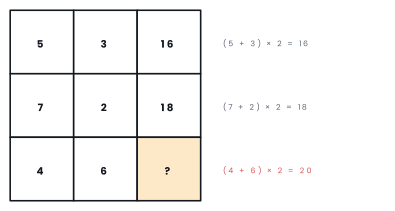
Problem. In the grid above, which number replaces the question mark?
Solution. Row 1: 5 + 3 = 8 and 8 × 2 = 16. Row 2: 7 + 2 = 9 and 9 × 2 = 18. The rule holds for both complete rows, so row 3 gives (4 + 6) × 2 = 20. (A product rule fails at once: 5 × 3 = 15, not 16.)
A rule that explains one row is a guess; a rule that explains two rows is an answer. If two different rules both fit the complete rows, they will usually give the same answer — if they do not, look again at the options.
3.4 Calendar and clock reasoning
Calendar: odd days
An odd day is a day left over after counting complete weeks. Days of the week repeat every 7 days, so only the remainder on division by 7 matters.
| Period | Days | Odd days |
|---|---|---|
| Ordinary year | 365 = 52 weeks + 1 day | 1 |
| Leap year | 366 = 52 weeks + 2 days | 2 |
| Month of 31 days | 31 = 4 weeks + 3 | 3 |
| Month of 30 days | 30 = 4 weeks + 2 | 2 |
| February | 28 or 29 | 0 or 1 |
| 100 years | 76 ordinary + 24 leap | 5 |
| 200 / 300 / 400 years | 3 / 1 / 0 |
Leap year rule. A year is a leap year if it is divisible by 4 — except century years (1900, 2100), which are leap years only if divisible by 400 (2000 was a leap year; 1900 was not).
Day of the week. Count the odd days and move that many days forward. With the odd-day method from the start of the calendar, 0 odd days = Sunday, 1 = Monday, …, 6 = Saturday.
Problem. Tenzing Norgay and Edmund Hillary first reached the summit of Mount Everest on 29 May 1953. What day of the week was it?
Solution. Count odd days up to that date. 1600 years: 0. 1601–1900 (300 years): 1. 1901–1952: 52 years with 13 leap years: 52 + 13 = 65 → 65 − 63 = 2. 1953 up to 29 May: January 3 + February 0 + March 3 + April 2 + 29 days of May (1) = 9 → 2. Total = 0 + 1 + 2 + 2 = 5 → Friday.
| Fact | Rule |
|---|---|
| Same date next year | 1 day later (2 days if a 29 February comes in between) |
| After n days | move forward n mod 7 days (100 days → 2 days on) |
| A year's calendar repeats | when the starting weekday and the leap/ordinary type both match (2026 → 2037) |
| Last day of a century | can only be Monday, Wednesday, Friday or Sunday |
Clock: the angle between the hands
The minute hand moves 6° per minute; the hour hand moves 30° per hour, i.e. 0.5° per minute. At H hours and M minutes:
If θ comes out above 180°, the smaller angle is 360° − θ.
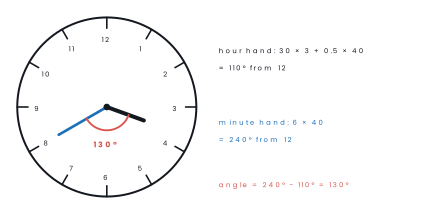
| Clock fact | Value |
|---|---|
| Minute hand gains on the hour hand | 5.5° per minute (55 minute-spaces per hour) |
| Hands together between H and H + 1 o'clock | at 60H/11 minutes past H |
| Hands together | every 65\frac{5}{11} minutes; 11 times in 12 hours, 22 times a day |
| Hands at right angles | 22 times in 12 hours, 44 times a day |
| Hands opposite (180°) | 11 times in 12 hours, 22 times a day |
| Mirror image (vertical mirror) | real time = 11:60 − time seen (mirror 3:15 → 8:45) |
| Clock gaining g minutes per hour | after t true hours it is ahead by g × t minutes |
Problem. (i) What is the angle between the hands at 4:30? (ii) At what time between 4 and 5 o'clock are the hands together?
Solution. (i) |30 × 4 − 5.5 × 30| = |120 − 165| = 45°. (ii) Hands together when 30H = 5.5M: M = 120/5.5 = 240/11 = 21 9/11 minutes past 4.
At 4:30 the hour hand is not on the 4 — it is halfway to the 5. Answers like 60° come from forgetting that the hour hand moves.
And the mirror rule 11:60 − t is for a mirror placed beside the clock; check one time in your head (mirror 3:00 must give 9:00) before using it.


Formula and fact sheet
| Topic | Rule |
|---|---|
| Series method | differences → ratios → squares/cubes/primes → split odd and even places |
| Second differences | constant second difference → next difference continues the AP |
| n^2 \pm 1 | 2, 5, 10, 17, 26 (n^2 + 1); 3, 8, 15, 24, 35 (n^2 - 1) |
| n^3 \pm 1 | 2, 9, 28, 65, 126 (n^3 + 1); 0, 7, 26, 63, 124 (n^3 - 1) |
| n(n + 1) | 2, 6, 12, 20, 30, 42 |
| Primes to 50 | 2, 3, 5, 7, 11, 13, 17, 19, 23, 29, 31, 37, 41, 43, 47 |
| Letters | EJOTY = 5, 10, 15, 20, 25; opposite letter = 27 − position |
| Wrong term | it spoils two neighbouring differences |
| Grid | the rule must fit every complete row/column/figure |
| Odd days | year 1 (leap 2); 31-day month 3, 30-day month 2, Feb 0 (leap 1); 100 years 5 |
| Leap year | divisible by 4; century years only if divisible by 400 |
| Day code | 0 Sunday, 1 Monday, … 6 Saturday |
| Clock angle | |30H - 5.5M|; use 360° − θ if θ > 180° |
| Hands together | at 60H/11 minutes past H; 22 times a day |
| Right angles / opposite | 44 / 22 times a day |
| Mirror time | 11:60 − time seen |
Chapter summary
- Logical sequencing carries 5 of the 20 MAT questions; the MEC sample (53, 53, 40, 40, 27, 27 → 14) is a series of repeated pairs falling by 13.
- Write the differences first; then ratios; then squares, cubes and primes; then split the series into odd and even places.
- A rule is right only when it fits every term; a wrong term spoils two differences.
- Letters become numbers (A = 1 … Z = 26, EJOTY, opposite = 27 − n); repeating-letter series hide a short repeated block.
- Grid and figure puzzles: find one operation from the complete rows and apply it to the incomplete one.
- Calendar: odd days (year 1, leap year 2, 31-day month 3, 30-day month 2); century leap years must divide by 400.
- Clock: θ = |30H − 5.5M|; the hands meet 22 times a day; mirror time = 11:60 − t.
Practice questions
Set A — Recall (25 questions)
- Find the next term: 4, 9, 14, 19, 24, ?a28b30c29d34
- Find the next term: 3, 6, 12, 24, 48, ?a96b72c84d100
- Find the next term: 1, 4, 9, 16, 25, ?a30b35c49d36
- Find the next term: 2, 3, 5, 7, 11, 13, ?a15b17c19d14
- Find the next term: 1, 1, 2, 3, 5, 8, 13, ?a21b18c20d26
- Find the next term: 243, 81, 27, 9, ?a1b6c3d0
- Find the next term: 2, 6, 12, 20, 30, ?a40b36c44d42
- Look at this series: 35, 35, 29, 29, 23, 23, … Which number should come next?a23b17c19d11
- Find the next term: 1, 8, 27, 64, ?a100b81c125d216
- Find the next term: 5, 10, 8, 16, 14, 28, ?a26b56c30d24
- Find the next letter: A, C, E, G, ?aHbJcKdI
- Find the next letter: Z, X, V, T, ?aSbQcRdP
- Find the next letter: B, E, H, K, ?aMbNcOdL
- Find the next term: AZ, BY, CX, ?aDWbDVcEWdWD
- Find the next term: A1, C3, E5, G7, ?aH8bI8cJ9dI9
- Find the next letter: A, B, D, G, K, ?aObPcQdN
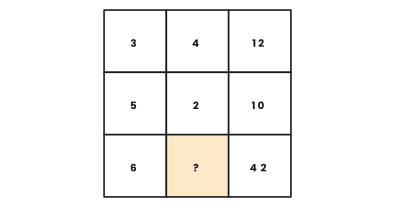
- In the figure above, which number replaces the question mark?a6b8c7d9
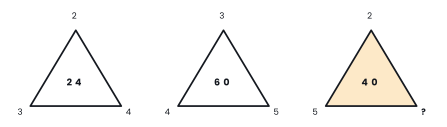
- In the figure above, which number replaces the question mark?a4b5c3d6
- If 1 January of a year is a Monday, what day of the week is 1 February of that year?aWednesdaybFridaycTuesdaydThursday
- How many odd days are there in a leap year?a1b2c0d3
- Which of the following years is a leap year?a1900b2100c2000d2022
- If today is Wednesday, what day of the week will it be exactly 100 days from today?aFridaybThursdaycSaturdaydTuesday
- The angle between the hands of a clock at 4:30 isa30°b60°c15°d45°
- How many times in a day do the hour hand and the minute hand of a clock coincide?a24b22c12d11
- The mirror image of a wall clock (mirror beside the clock) shows 3:15. The actual time isa9:45b8:15c8:45d9:15
Answers and explanations — Set A
1. (c) — Add 5 each time: 24 + 5 = 29.
2. (a) — Multiply by 2 each time: 48 × 2 = 96.
3. (d) — Squares of 1, 2, 3, 4, 5; next 6^2 = 36.
4. (b) — Consecutive prime numbers; the prime after 13 is 17 (15 = 3 × 5 is not prime).
5. (a) — Each term is the sum of the two before it: 8 + 13 = 21.
6. (c) — Divide by 3 each time: 9 ÷ 3 = 3.
7. (d) — Differences 4, 6, 8, 10, so next 12: 30 + 12 = 42 (the terms are 1 × 2, 2 × 3, …, 6 × 7).
8. (b) — Each number appears twice and the numbers fall by 6: 35, 29, 23, then 17.
9. (c) — Cubes of 1, 2, 3, 4; next 5^3 = 125.
10. (a) — The steps alternate ×2 and −2: 5 ×2 = 10, −2 = 8, ×2 = 16, −2 = 14, ×2 = 28, −2 = 26.
11. (d) — Positions 1, 3, 5, 7: skip one letter each time; next 9 = I.
12. (c) — Positions 26, 24, 22, 20: back two each time; next 18 = R.
13. (b) — Positions 2, 5, 8, 11: +3; next 14 = N.
14. (a) — First letters A, B, C, D (+1); second letters Z, Y, X, W (−1): DW. Each pair adds to 27.
15. (d) — Letters skip one (A, C, E, G, I) and the number is the letter's position: I9.
16. (b) — Positions 1, 2, 4, 7, 11: differences +1, +2, +3, +4; next +5 gives 16 = P.
17. (c) — In each row, first × second = third: 3 × 4 = 12, 5 × 2 = 10, so 6 × ? = 42 and ? = 7.
18. (a) — The centre is the product of the corners: 2 × 3 × 4 = 24, 3 × 4 × 5 = 60, so 2 × 5 × ? = 40 and ? = 4.
19. (d) — January has 31 days = 3 odd days; Monday + 3 = Thursday.
20. (b) — 366 days = 52 weeks + 2 days.
21. (c) — 2000 is a century year divisible by 400. 1900 and 2100 are century years not divisible by 400; 2022 is not divisible by 4.
22. (a) — 100 = 14 × 7 + 2, so two days after Wednesday: Friday.
23. (d) — |30 × 4 − 5.5 × 30| = |120 − 165| = 45°. The hour hand is halfway between 4 and 5.
24. (b) — 11 times in every 12 hours (the meeting at 12 is shared), so 22 times in 24 hours.
25. (c) — Real time = 11:60 − 3:15 = 8:45.
Set B — Understanding (16 questions)
- Find the next term: 2, 5, 10, 17, 26, ?a35b36c37d38
- Find the next term: 3, 7, 15, 31, 63, ?a127b125c126d95
- Find the next term: 6, 11, 21, 36, 56, ?a76b86c71d81
- Find the next term: 1, 2, 6, 24, 120, ?a240b720c600d144
- Find the wrong number in the series: 2, 5, 11, 20, 32, 48a5b11c48d32
- Find the next term: 4, 6, 9, 13.5, ?a18b20.25c19.5d27
- Find the next term: 1, 3, 4, 7, 11, 18, ?a25b27c28d29
- Find the next term: 0, 7, 26, 63, 124, ?a215b217c216d225
- Find the next letter: Z, W, S, P, L, I, ?aFbDcEdG
- Which group of letters fills the blanks, in order, in the series a _ b a a _ a a b _ a b?aabababbcbaadbab
- Find the next term: B2, D4, F8, H16, ?aI32bJ24cK32dJ32
- Find the next term: ABD, DEG, GHJ, ?aJKLbJLMcKLNdJKM
- If 15 August 2026 is a Saturday, what day of the week is 15 August 2027?aSaturdaybSundaycMondaydFriday
- The angle between the hands of a clock at 7:20 isa90°b110°c100°d120°
- In a mirror placed beside a wall clock, the clock appears to show 6:40. The actual time isa5:20b6:20c4:20d5:40
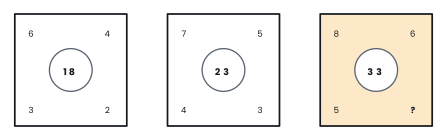
- In the figure above, which number replaces the question mark?a2b3c4d5
Answers and explanations — Set B
1. (c) — The terms are n^2 + 1 for n = 1 … 5 (differences 3, 5, 7, 9); next 6^2 + 1 = 37.
2. (a) — Each term is the one before × 2 + 1: 63 × 2 + 1 = 127.
3. (d) — Differences 5, 10, 15, 20; next 25: 56 + 25 = 81.
4. (b) — Multiply by 2, 3, 4, 5, then 6: 120 × 6 = 720.
5. (c) — The differences should be 3, 6, 9, 12, 15: 2, 5, 11, 20, 32, 47. 48 is wrong; changing any other term breaks two differences.
6. (b) — Each term is 1.5 times the one before: 13.5 × 1.5 = 20.25.
7. (d) — Each term is the sum of the two before it: 11 + 18 = 29.
8. (a) — The terms are n^3 - 1: 1 − 1, 8 − 1, 27 − 1, 64 − 1, 125 − 1; next 216 − 1 = 215.
9. (c) — Positions 26, 23, 19, 16, 12, 9: the steps alternate −3 and −4; next −4 gives 5 = E.
10. (a) — The block "aab" repeats: aab aab aab aab. The blanks (2nd, 6th and 10th letters) are a, b, a.
11. (d) — Letters skip one (B, D, F, H, J); numbers double (2, 4, 8, 16, 32): J32.
12. (d) — Each group starts 3 letters on (A, D, G, J), and inside a group the steps are +1, +2: J, K, M.
13. (b) — 15 Aug 2026 to 15 Aug 2027 is 365 days (no 29 February in between: 2027 is not a leap year), 1 odd day: Sunday.
14. (c) — |30 × 7 − 5.5 × 20| = |210 − 110| = 100°.
15. (a) — Real time = 11:60 − 6:40 = 5:20. Check: a mirror swaps 5:20 and 6:40, which are symmetric about the 12–6 line.
16. (b) — Middle = (top-left × top-right) − (bottom-left × bottom-right): 6 × 4 − 3 × 2 = 18 and 7 × 5 − 4 × 3 = 23. So 8 × 6 − 5 × ? = 33, giving 5 × ? = 15 and ? = 3.
Set C — Application (11 questions)
- Find the next term: 13, 15, 19, 27, 43, ?a59b75c71d86
- Find the next term: 2, 10, 4, 20, 8, 40, 16, ?a32b60c80d64
- Find the next term: 1, 2, 5, 14, 41, ?a122b123c121d82
- Find the next letter: C, F, J, O, ?aTbVcSdU
- Find the next term: KM5, IP8, GS11, EV14, ?aCY17bCX17cDY17dCY15
- If 1 January 2026 is a Thursday, what day of the week is 1 March 2026?aSaturdaybSundaycMondaydWednesday
- In which year will the calendar of 2026 be repeated exactly?a2032b2036c2037d2031
- At what time between 4 and 5 o'clock are the hands of a clock together?a20 minutes past 4b22 minutes past 4c21 7/11 minutes past 4d21 9/11 minutes past 4
- A clock gains 5 minutes every hour. It is set right at 6 a.m. What time will it show when the correct time is 6 p.m. the same day?a6:55 p.m.b7:05 p.m.c7:00 p.m.d7:12 p.m.
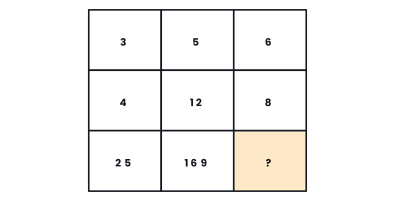
- In the figure above, which number replaces the question mark?a14b48c196d100
- The angle between the hands of a clock at 9:15 isa172.5°b180°c165°d157.5°
Answers and explanations — Set C
1. (b) — Differences 2, 4, 8, 16 double each time; next 32: 43 + 32 = 75.
2. (c) — Two series: odd places 2, 4, 8, 16 (×2) and even places 10, 20, 40 (×2). The 8th term belongs to the even series: 80.
3. (a) — Each term is the one before × 3 − 1: 41 × 3 − 1 = 122.
4. (d) — Positions 3, 6, 10, 15: steps +3, +4, +5; next +6 gives 21 = U.
5. (a) — First letters K, I, G, E, C (−2); second letters M, P, S, V, Y (+3); numbers 5, 8, 11, 14, 17 (+3): CY17.
6. (b) — January (31) + February 2026 (28, not a leap year) = 59 days = 8 weeks + 3 days; Thursday + 3 = Sunday.
7. (c) — A repeat needs the same first weekday (Thursday) and the same year type (ordinary). Odd days: 2026 to 2031 give 1 + 1 + 2 + 1 + 1 + 1 = 7, so 2032 starts on a Thursday — but 2032 is a leap year. 2032 to 2036 give 2 + 1 + 1 + 1 + 2 = 7 more, so 2037 starts on a Thursday and is an ordinary year.
8. (d) — Together when 30 × 4 = 5.5M: M = 240/11 = 21 9/11 minutes past 4.
9. (c) — From 6 a.m. to 6 p.m. is 12 hours; it gains 12 × 5 = 60 minutes, so it shows 7:00 p.m.
10. (d) — In each column, top² + middle² = bottom: 9 + 16 = 25, 25 + 144 = 169, so 36 + 64 = 100. 196 = (6 + 8)² squares the sum instead.
11. (a) — |30 × 9 − 5.5 × 15| = |270 − 82.5| = 187.5°, which is more than 180°, so the angle is 360 − 187.5 = 172.5°.
Group D — Model answers for long questions (10 marks each, for deeper revision)
- Explain a systematic method for number series and letter series and solve problems of each common type. [10]
- Explain the rules of the calendar and the clock and solve problems on odd days, the day of a date and angles between the hands. [10]
Model answer D1: Number and letter series (10 marks)
Introduction. A series follows a rule. A fixed order of checks finds the rule quickly.
Order of checks. (1) Differences; (2) differences of differences; (3) ratios; (4) squares, cubes, primes; (5) alternate terms; (6) mixed operations.
| Type | Series | Rule | Next term |
|---|---|---|---|
| Arithmetic | 5, 9, 13, 17 | +4 | 21 |
| Second-order differences | 2, 6, 12, 20, 30 | differences 4, 6, 8, 10, so next +12 | 42 (n × (n + 1)) |
| Geometric | 3, 6, 12, 24 | × 2 | 48 |
| Squares | 1, 4, 9, 16 | n² | 25 |
| Primes | 2, 3, 5, 7, 11 | prime numbers | 13 |
| Fibonacci type | 1, 1, 2, 3, 5, 8 | sum of previous two | 13 |
| Factorials | 1, 2, 6, 24, 120 | × 2, × 3, × 4, × 5, × 6 | 720 |
| Descending squares | 100, 81, 64, 49 | 10², 9², 8², 7² | 36 |
Two interleaved series. 2, 5, 4, 10, 8, 15, … The odd places are 2, 4, 8 (× 2), so the next is 16; the even places are 5, 10, 15 (+ 5), so the next is 20. The series continues 16, 20.
Letter series. Convert letters to positions (A = 1 … Z = 26).
Example A, C, F, J, O, … positions 1, 3, 6, 10, 15, with differences 2, 3, 4, 5, so the next difference is 6: 15 + 6 = 21 = U. Opposite letters: the opposite of a letter at position p is at 27 − p (A–Z, B–Y).
Missing number in a figure. In a triangle with 4, 5, 6 outside and 120 inside, the product is 4 × 5 × 6 = 120. Test the same rule in the second figure before using it.
Exam tip. If the numbers grow slowly, try differences; if they grow fast, try multiplication, squares or cubes.
Conclusion. Use the order of checks, test the rule on every term, and only then give the next term.
Model answer D2: Calendar and clock reasoning (10 marks)
Introduction. The calendar repeats in a 7-day week, so only the remainder after dividing by 7 (the odd days) matters.
Calendar rules.
- An ordinary year has 365 days = 52 weeks + 1 odd day; a leap year has 2 odd days.
- 100 years = 5 odd days, 200 years = 3, 300 years = 1, 400 years = 0.
- Months with 31 days give 3 odd days, with 30 days give 2, and February gives 0 (or 1 in a leap year).
- Leap year: divisible by 4, but a century year only if divisible by 400 (so 1900 was not a leap year, 2000 was).
Worked problem. What day was 15 August 1947? Verify: the day is Friday.
A quick check by odd days: 1600 years = 0 odd days; 300 years = 1; 46 completed years from 1901 to 1946 have 11 leap years, so 46 + 11 = 57 odd days = 1; days from 1 January to 15 August 1947 = 31 + 28 + 31 + 30 + 31 + 30 + 31 + 15 = 227 days = 3 odd days.
Total = 0 + 1 + 1 + 3 = 5, which is Friday (0 = Sunday). Similarly, 26 January 2000 was a Wednesday.
Clock rules.
- The minute hand moves 6° per minute and the hour hand 0.5° per minute, so the angle between them at H hours M minutes is |30H − 5.5M|.
- The hands coincide 22 times and are at right angles 44 times in a day.
- Mirror image of a clock time T is 11:60 − T; the water image is 6:00 − T.
| Time | Working | Angle |
|---|---|---|
| 3:40 | |90 − 220| | 130° |
| 4:20 | |120 − 110| | 10° |
| 9:00 | |270 − 0| | 270°, so 90° the short way |
| 12:30 | |0 − 165| | 165° (take the smaller of x and 360 − x) |
Mirror example. The mirror image of 3:25 is 11:60 − 3:25 = 8:35; its water image is 6:00 − 3:25 = 2:35.
Conclusion. Reduce the calendar to odd days and the clock to degrees per minute; both turn long counting into one short calculation.