Chapter 11 · Plant Physiology · 2 questions in the paper · 31 min read
Water Relations of Plants
What the syllabus asks for 3
- Diffusion, diffusion pressure deficit, osmosis and plasmolysis
- Osmotic pressure and potential, water potential, wall pressure and turgor pressure
- Absorption, imbibition, ascent of sap, transpiration, guttation and wilting
Plant Physiology begins here, and this chapter's 2 of the 40 Botany questions are among the most calculation-friendly in the subject: a water potential sum, a plasmolysis diagnosis, a theory name.
The whole chapter hangs on one quantity — water potential, Ψw — and one rule: water always moves from where Ψw is higher (less negative) to where it is lower.
Master that, the older DPD language the Nepali textbooks still use, the cohesion–tension account of the ascent of sap, and the small cast of related facts (root pressure, guttation, wilting), and both questions should fall.
- Definitions — diffusion (no membrane), osmosis (solvent across a selectively permeable membrane), imbibition (colloid swelling; protein > starch > cellulose), plasmolysis and deplasmolysis.
- Water potential — Ψw = Ψs + Ψp (+ Ψm + Ψg); pure water = 0, everything else negative; Ψs = −imRT.
- Old language — OP, TP ( = wall–turgor pressure), DPD = OP − TP; mapping: Ψw = −DPD, Ψs = −OP, Ψp = +TP.
- Cell states — turgid (Ψp > 0), flaccid (Ψp = 0), plasmolysed (hypertonic bath); incipient plasmolysis: Ψw = Ψs of the cell.
- Absorption — root hair zone; apoplast, symplast, transmembrane (aquaporin) paths; Casparian strip blocks the apoplast; no water pump exists — ions move actively, water follows.
- Ascent of sap — cohesion–tension (transpiration pull) of Dixon and Joly; why root pressure (≈0.1–0.2 MPa), capillarity and vital-force theories fail; Strasburger's killed-stem experiment; Ψp in xylem is negative.
- Transpiration — stomatal 80–90%, cuticular 5–10%, lenticular ~0.1%; "necessary evil" (Curtis); K⁺-influx opens stomata, ABA closes them; factors; potometer measures uptake.
- Guttation vs dew vs bleeding — hydathodes (water pores), root pressure at night, Colocasia; white salt crust on drying.
- Wilting — temporary (midday, recovers) vs permanent (soil below the permanent wilting point ≈ −1.5 MPa).
11.1 Diffusion, diffusion pressure deficit, osmosis and plasmolysis
Diffusion is the net movement of particles from a region of higher concentration to one of lower concentration, by their own kinetic energy. It needs no membrane, no energy and no living cell.
It brings CO₂ into a leaf and takes O₂ out — but it is usefully fast only over micrometres, which is why plants need plumbing.
Osmosis is the special case of diffusion in which water (the solvent) crosses a selectively permeable membrane, moving from higher water potential to lower.
In a plant cell the plasma membrane and the tonoplast select; the cell wall is freely permeable and selects nothing. Water entering a cell is endosmosis, leaving it exosmosis.
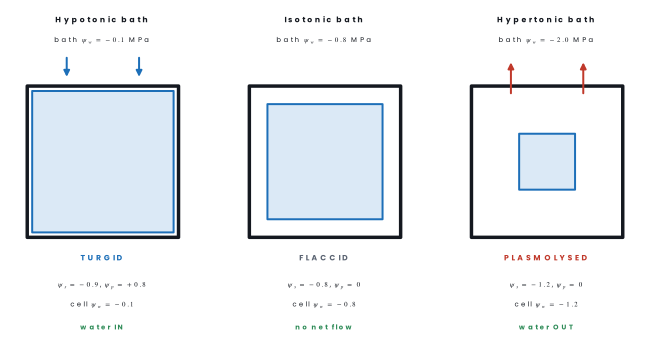
A solution outside a cell may be hypotonic (less concentrated → water enters, cell swells turgid), isotonic (no net movement, cell flaccid) or hypertonic (more concentrated → water leaves).
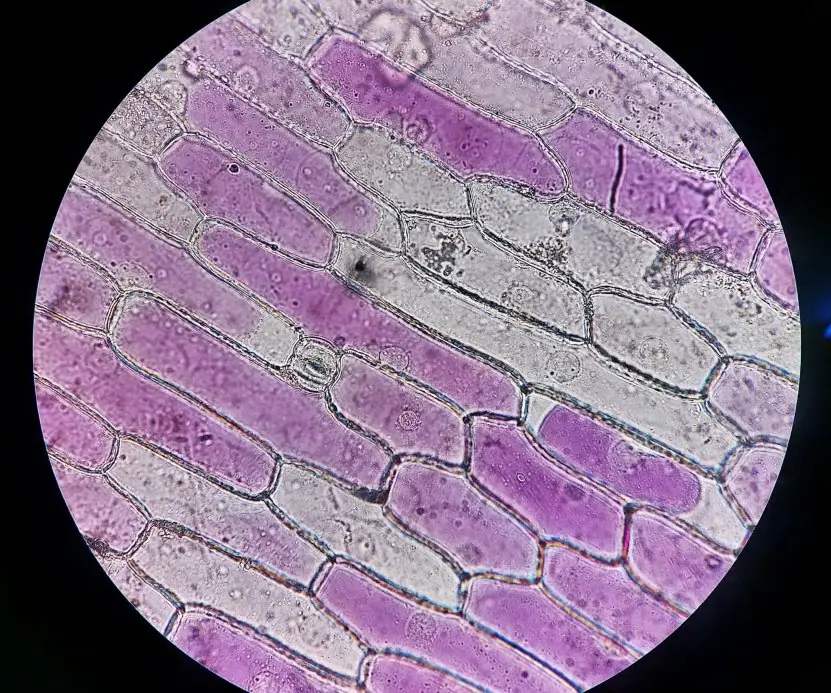
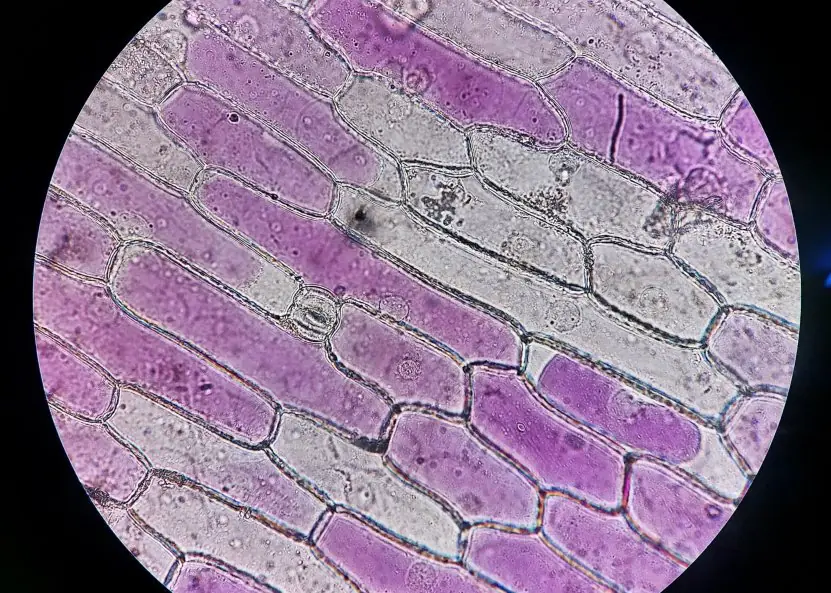
In a hypertonic bath the protoplast shrinks and pulls away from the wall — plasmolysis. Return the cell to water and it recovers — deplasmolysis.
Plasmolysis does three jobs in examinations: it proves the membrane is selectively permeable (a dead, boiled cell does not plasmolyse — its membrane is wrecked), and the bath concentration at which cells just begin to plasmolyse (incipient plasmolysis, where turgor pressure is exactly zero) gives the cell sap's osmotic concentration: at that moment Ψw(cell) = Ψs(cell) = Ψw(bath).
"Water moves from a dilute to a concentrated solution" is true only at equal pressures. Press on one side — as a turgid cell wall presses — and water can move into the dilute side. The definition that never fails: water moves from higher to lower water potential.
The older language: OP, TP and DPD
Nepali and Indian textbooks long described the cell with three pressures. The osmotic pressure (OP) of the cell sap is the pressure needed to stop osmosis into it.
As water enters, the protoplast presses the wall — the turgor pressure (TP) — and the wall pushes back with an equal and opposite wall pressure (WP). The cell's actual thirst is the difference, the diffusion pressure deficit:
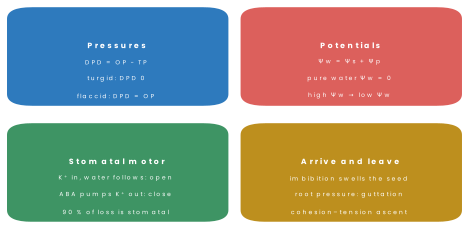
When TP = OP the cell is fully turgid, DPD = 0 and net entry stops; when the cell is flaccid or plasmolysed, TP = 0 and DPD = OP.
The modern water-potential system (next section) replaced DPD in 1960, but the CEE syllabus names DPD explicitly, so learn the exact translation: Ψw = −DPD, Ψs = −OP, Ψp = +TP.
If a question is set in DPD, convert, solve in Ψ, convert back.
Problem. Cell A has OP 12 atm and TP 5 atm; cell B has OP 9 atm and TP 1 atm. Which way does water move? Repeat in potentials: A has Ψs = −12, Ψp = +5; B has Ψs = −9, Ψp = +1.
Solution. DPD(A) = 12 − 5 = 7; DPD(B) = 9 − 1 = 8: water runs low DPD → high DPD, i.e. A → B. In potentials: Ψw(A) = −12 + 5 = −7; Ψw(B) = −9 + 1 = −8: water runs high Ψw → low Ψw, again A → B.
The two vocabularies are one physics with opposite sign conventions — which is exactly what the paper tests.

11.2 Osmotic pressure and potential, water potential, wall pressure and turgor pressure
The water potential Ψw is the free energy of water per unit volume, measured against pure free water. Hence
and dissolving anything, tensioning, or binding water to surfaces makes it negative. The working unit is the megapascal (MPa) — 1 MPa = 10 bar ≈ 9.87 atmospheres. Water potential is a sum:
| Component | Name | Sign | Cause |
|---|---|---|---|
| Ψs | solute (osmotic) potential | always ≤ 0 | dissolved solutes |
| Ψp | pressure potential | positive in turgid cells, negative in xylem | turgor, or tension |
| Ψm | matric potential | always ≤ 0 | water bound to walls, colloids, soil — huge in dry seeds |
| Ψg | gravitational potential | +0.01 MPa per metre of height | weight of the column |
For an ordinary vacuolated cell Ψm and Ψg are negligible, leaving the exam equation Ψw = Ψs + Ψp. The solute potential of a solution follows the van't Hoff relation,
where i is the ionisation factor (1 for sucrose, about 2 for NaCl), m the molality (≈ molarity when dilute), R = 0.00831 L MPa mol⁻¹ K⁻¹ and T the absolute temperature. The osmotic pressure OP is simply Ψs with the sign flipped, a positive number.
Problem. A cell has Ψs = −1.1 MPa. It is placed in a solution of Ψw = −0.3 MPa and left until no net water movement occurs. Find the cell's Ψp and Ψw at equilibrium, and state its OP, TP and DPD at that moment.
Solution. At equilibrium the cell's water potential equals the bath's:
The solute potential is (approximately) unchanged, so
The cell is turgid, pressing its wall with 0.8 MPa. In the old language: OP = −Ψs = 1.1 MPa, TP = Ψp = 0.8 MPa, and DPD = OP − TP = 0.3 MPa = −Ψw, as it must be.
Placed in pure water, the same cell would swell until Ψp = +1.1 MPa, Ψw = 0 and DPD = 0 — fully turgid and drinking no more.
11.3 Absorption, imbibition, ascent of sap, transpiration, guttation and wilting
Absorption and imbibition
Imbibition is the adsorption of water by a hydrophilic colloid, which swells: dry gram seed triples overnight; a wooden chopping block tightens in the monsoon.
Imbibing capacity runs protein > starch > cellulose (a protein-rich pea out-swells a starchy wheat grain), the force is the huge matric potential of the dry colloid, and the heat released as water binds is the heat of wetting.
Imbibition is the first step of seed germination.
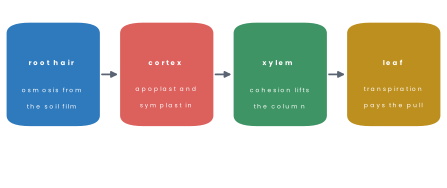
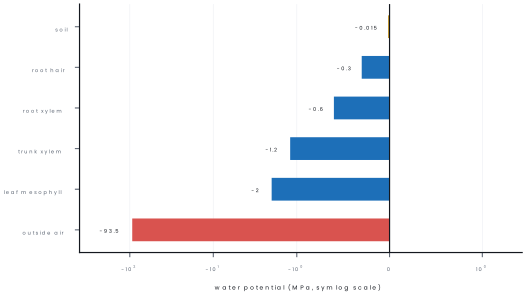
Roots absorb mainly through the root hair zone: each hair is one epiblema cell with a thin wall, no cuticle and sap at a more negative Ψw than the soil solution (field-capacity soil sits near −0.015 MPa).
Across the cortex water takes three parallel paths — apoplast (through walls, fastest), symplast (cytoplasm to cytoplasm through plasmodesmata) and transmembrane (in and out of each cell through aquaporin water channels — Peter Agre, Nobel Prize 2003).
At the endodermis the Casparian strip blocks the apoplast, forcing a membrane crossing: this is the root's selectivity checkpoint and what makes root pressure possible. Remember: no plant pumps water.
Ions are pumped actively; water always follows its potential gradient, which is why "active absorption" is really active salt uptake with osmosis trailing behind.
Ascent of sap
Root pressure — the positive pressure (≈0.1–0.2 MPa) that makes sap well from a cut tomato stump (Hales, 1727) — is osmosis into ion-loaded xylem sealed by the Casparian strip.
It cannot drive the ascent of sap: 0.1 MPa lifts water only about 10 m; it vanishes at midday when flow is fastest; many gymnosperms never show it; and killed stems still conduct.
Its real jobs are refilling air-locked vessels and driving guttation.
Vital-force theories (Godlewski's relay pump, J. C. Bose's pulsating cells) died with Strasburger's experiment: poison and boiling water rose through oak trunks, killing every living cell, while ascent continued.
Capillarity fails on arithmetic — it lifts water only about 0.6 m in a 25 μm vessel, centimetres in wide ones.
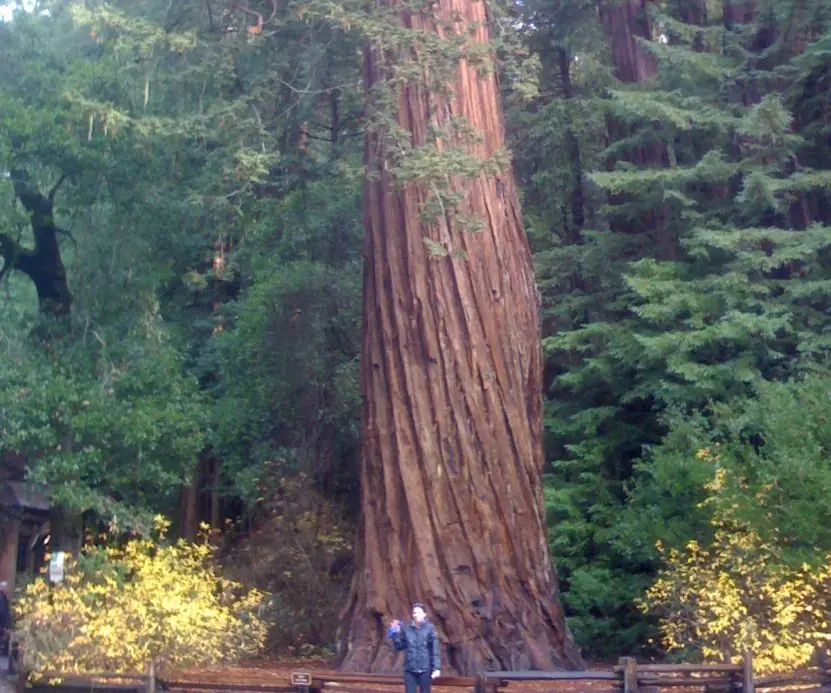
The accepted theory is cohesion–tension (transpiration pull), Dixon and Joly (1895): evaporation from nanometre pores in mesophyll walls pulls menisci that can generate tensions of tens of MPa; cohesion (hydrogen bonds between water molecules, tensile strength beyond 25 MPa) keeps the column unbroken, and adhesion to vessel walls holds it up.
The whole soil–plant–atmosphere path is one continuous, sun-powered, metabolically free water column under tension — xylem Ψp is negative, typically −0.5 to −3 MPa at midday.
Transpiration, guttation and wilting
Transpiration is the loss of water as vapour from aerial parts. Stomatal loss is 80–90% of the total, cuticular 5–10%, and lenticular (through lenticels) about 0.1%.
Stomata occupy a mere 0.5–3% of the leaf surface, yet dominate because many small pores diffuse almost as fast as one big hole.
Transpiration drags minerals up and cools the leaf; Curtis (1926) called it a "necessary evil" — better read today as the unavoidable price of opening stomata for CO₂. The rate is measured (as uptake) with a Ganong potometer.
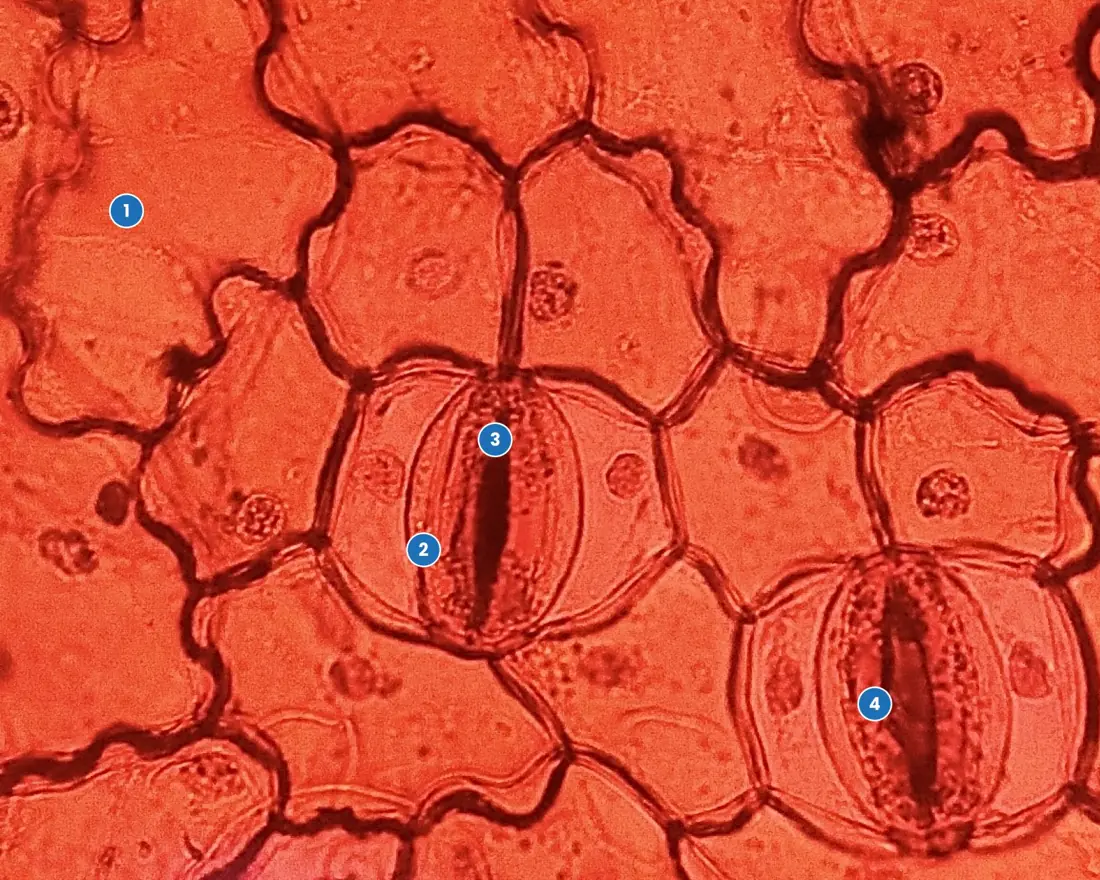
Stomata open when blue light switches on the guard cells' proton pump, K⁺ floods in (balanced by Cl⁻ and malate made from starch), Ψs falls, water enters, and the hoop-like wall microfibrils (radial micellation) force the swelling cells to bow apart.
Abscisic acid (ABA) from droughted roots reverses the flow and shuts the pore.
(The old "starch–sugar" theory is history: onion guard cells contain no starch yet work perfectly, using KCl.) Light, temperature and low humidity raise transpiration; wind first raises it (thinning the boundary layer) then lowers it (stomata slam); the true driving force is the vapour pressure deficit, not relative humidity alone.
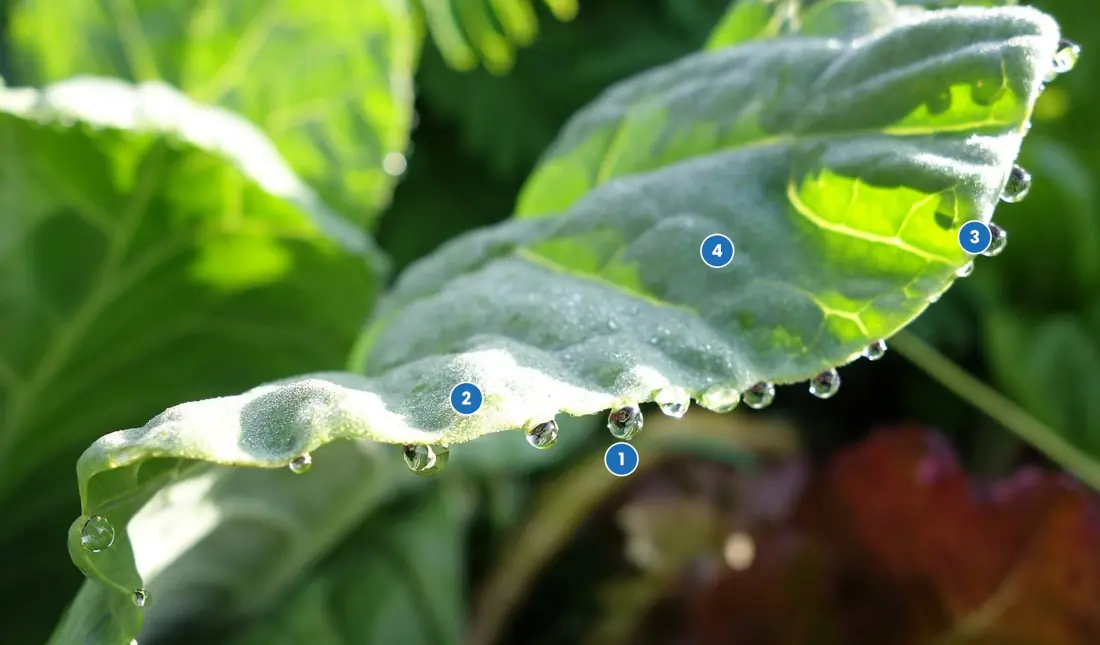
Guttation is the exudation of liquid xylem sap through hydathodes (permanently open water pores over loose epithem at vein endings) when root pressure is high and transpiration low — the dawn drops on Colocasia (pidalu), grasses and tomato.
Unlike dew (condensed, pure, settles anywhere), guttation fluid carries salts and sugars and dries to a white crust; unlike bleeding, it needs no wound.
Wilting is the droop of cells that have lost turgor. Temporary wilting strikes at midday when transpiration briefly outruns absorption, and the plant recovers by evening although the soil is still moist.
Permanent wilting sets in when the soil dries to the permanent wilting point (about −1.5 MPa), below which roots cannot extract water; the plant recovers only if watered before damage becomes irreversible.
Four pairs the paper swaps: DPD and Ψw point opposite ways (low→high DPD = high→low Ψw); OP is positive, Ψs negative, same magnitude; guttation is liquid from hydathodes by root pressure, transpiration is vapour from stomata by evaporation — dew is neither; and plasmolysis happens only in living cells, so a plasmolysing cell is by definition alive.
Problem. Cell A has \text{OP} = 14\text{ atm} and \text{TP} = 8\text{ atm}; adjacent Cell B has \Psi_s = -12\text{ atm} and \Psi_p = 3\text{ atm}. In which direction does water flow?
Solution. For Cell A, \Psi_w = -\text{OP} + \text{TP} = -14 + 8 = -6\text{ atm} (\text{DPD} = 6\text{ atm}). For Cell B, \Psi_w = -12 + 3 = -9\text{ atm} (\text{DPD} = 9\text{ atm}).
Water moves from higher (less negative) \Psi_w to lower \Psi_w (lower DPD to higher DPD): from Cell A to Cell B.

Formula and fact sheet
- Water moves high Ψw → low Ψw. Pure water Ψw = 0; cells and solutions negative. 1 MPa = 10 bar ≈ 9.87 atm.
- Ψw = Ψs + Ψp (+ Ψm, Ψg = +0.01 MPa/m). Ψs = −imRT, R = 0.00831 L MPa mol⁻¹ K⁻¹; i = 1 sucrose, ≈2 NaCl.
- Legacy terms: DPD = OP − TP; Ψw = −DPD; Ψs = −OP; Ψp = +TP = WP (wall pressure, equal and opposite).
- States: fully turgid Ψw = 0 (DPD = 0, TP = OP); flaccid/plasmolysed Ψp = 0 (DPD = OP); incipient plasmolysis measures cell Ψs.
- Imbibition: colloid swelling, protein > starch > cellulose, heat of wetting; starts germination.
- Root paths: apoplast (walls, fast), symplast (plasmodesmata), transmembrane (aquaporins, Agre 2003); Casparian strip blocks apoplast at endodermis.
- Root pressure: 0.1–0.2 MPa (Hales 1727), ion-loading + osmosis; refills emboli, drives guttation; cannot raise sap in tall trees.
- Ascent: cohesion–tension (Dixon and Joly, 1895); hydrogen-bond cohesion + adhesion + transpiration pull; xylem under negative Ψp; Strasburger's dead trunks refute vital theories; capillarity only ~0.6 m in narrow vessels.
- Transpiration: stomatal 80–90%, cuticular 5–10%, lenticular 0.1%; K⁺ in → open, ABA → close; Ganong potometer; "necessary evil" (Curtis, 1926).
- Guttation: hydathodes + epithem, night/early morning, Colocasia; leaves white crust; ≠ dew, ≠ bleeding.
- Wilting: temporary (midday lag) vs permanent (soil ≤ about −1.5 MPa, the permanent wilting point; field capacity ≈ −0.015 MPa).
Rapid-revision tables and high-yield facts
| Quantity | Value |
|---|---|
| DPD | OP − TP |
| Turgid / flaccid | DPD 0 / DPD = OP |
| Ψw | Ψs + Ψp; pure water 0 |
| Flow rules | low DPD → high DPD; high Ψw → low Ψw |
| WP vs TP | equal magnitude, opposite direction |
| Imbibition | hydrophilic colloids swell; seeds, wood |
| Routes | apoplast (walls), symplast (cytoplasm) |
| Ascent of sap | cohesion–tension (transpiration pull) |
| Transpiration | ~90 % stomatal; K⁺ opens, ABA closes |
| Guttation | hydathodes, liquid, night, root pressure |
| Wilting point | soil water held tighter than roots pull |
Chapter summary
- Diffusion needs no membrane; osmosis is water diffusing across a selectively permeable one; plasmolysis (reversible) demonstrates both the membrane's selectivity and the cell sap's osmotic strength.
- Water potential Ψw = Ψs + Ψp rules every movement: pure water is zero, all else negative, and water runs from less negative to more negative; van't Hoff's Ψs = −imRT sizes any solution.
- The older DPD = OP − TP is the same physics with flipped signs (Ψw = −DPD): fully turgid means DPD zero; flaccid means DPD = OP.
- Roots absorb through root hairs by apoplast, symplast and aquaporin routes, with the Casparian strip as the membrane checkpoint; imbibition by colloids (protein strongest) starts germination.
- Root pressure (≈0.1–0.2 MPa) is too feeble and too nocturnal to lift sap; the sun does it instead — transpiration tension dragging a cohesive, adhesive water column from soil to air (Dixon and Joly), with xylem under negative pressure.
- Transpiration is mostly stomatal, opened by potassium influx and closed by ABA, driven by vapour pressure deficit and measured with a potometer.
- Liquid water forced out of hydathodes by root pressure is guttation (not dew, not bleeding), and loss of turgor shows as wilting — temporary at midday, permanent below the soil's wilting point of about −1.5 MPa.
Practice questions
Set A — Recall (20 questions)
- Diffusion is the movement of particlesaagainst a concentration gradient using ATPbfrom higher to lower concentration by their kinetic energyconly across a membranedonly in living cells
- Osmosis is the diffusion of water across aafreely permeable wallbcompletely impermeable membranecselectively permeable membranedsheet of glass
- The water potential of pure free water isa+1 MPab−1 MPac100 MPadzero
- Diffusion pressure deficit (DPD) of a cell is equal toaOP − TPbOP + TPcTP − OPdOP × TP
- Plasmolysis occurs when a cell is placed in aahypertonic solutionbhypotonic solutioncisotonic solutionddistilled water
- At incipient plasmolysis, the turgor (pressure) potential of the cell isamaximumbequal to the osmotic pressurecnegativedzero
- Turgor pressure in a plant cell develops because ofaexosmosisbphotosynthesiscendosmosis pressing the protoplast against the walldtranspiration
- The correct order of imbibition capacity isacellulose > starch > proteinbstarch > protein > cellulosecprotein > starch > cellulosedprotein > cellulose > starch
- The principal water-absorbing region of the root is thearoot hair zonebroot capczone of elongationdmeristematic zone
- The Casparian strip blocks which pathway of water movement in the root?asymplastbapoplastctransmembranedxylem vessels
- The cohesion–tension theory of ascent of sap was proposed byaJ. C. BosebGodlewskicStephen HalesdDixon and Joly
- Root pressure in plants is typically abouta5–10 MPab0.1–0.2 MPac50 MPad2–3 MPa
- Stomatal transpiration accounts for about what share of total water loss?a5–10%b0.1%c50%d80–90%
- Stomata open primarily because of the influx into guard cells ofaNa⁺ ionsbK⁺ ionscCa²⁺ ionsdMg²⁺ ions
- Guttation takes place through special structures calledahydathodesblenticelscstomatadnectaries
- Transpiration was called a "necessary evil" byaDixonbStrasburgercCurtisdHales
- In the xylem of a transpiring plant, the pressure potential Ψp isastrongly positivebzerocequal to Ψsdnegative (tension)
- Permanent wilting occurs when the soil water potential falls to abouta0 MPab−1.5 MPac−0.015 MPad+1.5 MPa
- Aquaporins areawater pumps using ATPbenzymes splitting watercmembrane proteins forming water channelsdholes in the cell wall
- The rate of transpiration (water uptake) is measured with aaGanong potometerbrespirometercauxanometerdmanometer only
Answers and explanations — Set A
1. (b) — Net movement down the gradient by thermal motion; membranes and ATP are not involved.
2. (c) — Osmosis needs a membrane that passes water but restricts solutes.
3. (d) — Pure free water is the reference state, Ψw = 0; all solutions and cells are negative.
4. (a) — The cell's thirst is its osmotic pull minus the wall's push-back (turgor).
5. (a) — A more concentrated (more negative Ψw) bath draws water out until the protoplast leaves the wall.
6. (d) — Just as the protoplast loses contact, turgor has fallen to zero, so Ψw = Ψs.
7. (c) — Water taken in by endosmosis inflates the protoplast against the inextensible wall.
8. (c) — Proteins are the most hydrophilic colloids, then starch, then cellulose.
9. (a) — Root hairs multiply the absorbing area; the tip zones behind them absorb little.
10. (b) — The ligno-suberin band seals the wall pathway at the endodermis, forcing membrane control.
11. (d) — Dixon and Joly (1895); Bose's pulsation and Godlewski's relay pump are the discarded vital theories.
12. (b) — A tenth or two of a megapascal lifts water only about ten to twenty metres.
13. (d) — Cuticular loss is 5–10% and lenticular only about 0.1%.
14. (b) — Light-driven proton pumping lets K⁺ flood in; water follows osmotically.
15. (a) — Hydathodes (water pores over epithem) release liquid sap at vein endings.
16. (c) — Curtis (1926); the modern reading is the price of admitting CO₂.
17. (d) — The whole cohesion–tension mechanism runs on xylem under tension, −0.5 to −3 MPa at midday.
18. (b) — The permanent wilting point, against a field capacity of about −0.015 MPa.
19. (c) — Channels (Peter Agre, Nobel 2003): they speed water down gradients, they never pump.
20. (a) — A potometer tracks the water a cut shoot takes up; an auxanometer measures growth.
Set B — Understanding (12 questions)
- Defining osmosis as movement "from dilute to concentrated" fails in a turgid cell becauseacells have no membranesbthe wall selects solutescsolutes move insteaddthe pressure potential can make water move towards the dilute side
- For a flaccid or plasmolysed cell, DPD equals OP becauseaOP is zerobthe wall has dissolvedcturgor pressure is zerodwater potential is positive
- A cell placed in pure water stops taking in water whenaits Ψs becomes zerobits Ψp rises to balance Ψs, making Ψw = 0cits membrane becomes impermeabledall its solutes leak out
- Aquaporins cannot cause "active absorption" of water because theyaare channels that only speed movement down a water-potential gradientboccur only in leavescare made of lipiddblock water completely
- Root pressure cannot raise water to the top of a tall tree chiefly because itais only about 0.1–0.2 MPa, enough for roughly ten metresbacts downwardscoccurs only in monocotsdneeds stomata
- The capillarity theory of ascent of sap was rejected because capillary rise in wide vessels isaseveral hundred metresbindependent of radiuscexactly ten metresdonly a few centimetres to about half a metre
- The water column in xylem does not snap under tension mainly because ofaroot pressureblignin ringscliving xylem parenchymadcohesion between water molecules through hydrogen bonds
- Strasburger's experiment, in which poisoned and boiled tree trunks still conducted water, disproved theavital-force theoriesbcohesion–tension theorycroot pressure measurementsdexistence of vessels
- A gentle breeze increases transpiration, but a very strong wind can decrease it, because strong windafreezes the leafbfills the stomata with dustccauses stomatal closure after first thinning the boundary layerdraises humidity
- In drought, abscisic acid (ABA) reaching the leaves causesastomatal openingbmore root hairscstomatal closure by driving ions out of guard cellsdfaster photosynthesis
- Drops of water at leaf margins at dawn that dry to a white crust are guttation, not dew, because they areacondensed from airbxylem sap forced out by root pressure, carrying dissolved saltscrain waterdsecreted nectar
- A plant that wilts at midday but recovers by evening in moist soil shows temporary wilting becauseaits roots have diedbtranspiration temporarily exceeds absorptioncthe soil is below the wilting pointdits stomata are missing
Answers and explanations — Set B
1. (d) — Turgor makes Ψw of a concentrated cell equal to or above that of dilute water outside; only the Ψ definition survives.
2. (c) — DPD = OP − TP with TP = 0 when the wall is unstressed.
3. (b) — Entry stops at full turgor: Ψw = Ψs + Ψp = 0, the same as the bath.
4. (a) — A channel cannot move water uphill; the gradient still does the work.
5. (a) — It is also absent at the midday peak of flow and in many gymnosperms.
6. (d) — h = 2\gamma/\rho g r: even a 25 μm vessel manages only about 0.6 m.
7. (d) — Hydrogen bonding gives the column a tensile strength greater than 25 MPa; adhesion holds it to the walls.
8. (a) — Dead stems conduct, so no living pump (relay cells, pulsations) can be doing the lifting.
9. (c) — First the humid boundary layer is swept away; then guard cells lose water and the pores close.
10. (c) — ABA opens anion and outward K⁺ channels; guard cells deflate and the pore shuts.
11. (b) — Dew is pure condensed water anywhere; guttation sap exudes at hydathodes and leaves its salts behind.
12. (b) — A midday lag between loss and uptake, corrected when transpiration eases.
Set C — Application (8 questions)
- The solute potential of a 0.4 M sucrose solution at 27 °C (R = 0.00831 L MPa mol⁻¹ K⁻¹) is abouta−1.0 MPab−0.25 MPac−2.5 MPad+1.0 MPa
- A cell has Ψs = −0.9 MPa and Ψp = +0.5 MPa. Its water potential isa−1.4 MPab+0.4 MPac0 MPad−0.4 MPa
- The cell of question 2 is placed in a solution of Ψw = −0.8 MPa. It willagain water and burstbshow no changecbecome fully turgiddlose water and tend towards plasmolysis
- A cell has OP = 12 atm and TP = 7 atm. Its DPD isa19 atmb12 atmc5 atmd0 atm
- Cell A has Ψw = −0.6 MPa and neighbouring cell B has Ψw = −1.1 MPa. Net water movement isafrom B to Abnonecfrom A to Bdout of both cells
- The solute potential of 0.2 M NaCl at 25 °C, taking i ≈ 2, is abouta−0.5 MPab−1.0 MPac−2.0 MPad−0.1 MPa
- Onion epidermal cells mounted in strong salt solution under the microscope show the protoplast shrunk away from the wall. The cells areaturgidbplasmolysedcdividingddead and dissolved
- The gravitational potential cost of raising water 30 m up a tree is abouta0.3 MPab3.0 MPac0.03 MPad30 MPa
Answers and explanations — Set C
1. (a) — Ψs = -(1)(0.4)(0.00831)(300) = -1.0 MPa.
2. (d) — Ψw = \Psi_s + \Psi_p = -0.9 + 0.5 = -0.4 MPa.
3. (d) — The bath (−0.8) is more negative than the cell (−0.4), so water leaves.
4. (c) — DPD = \text{OP} - \text{TP} = 12 - 7 = 5 atm.
5. (c) — Water moves from the less negative (−0.6) to the more negative (−1.1) potential.
6. (b) — Ψs = -(2)(0.2)(0.00831)(298) \approx -0.99 MPa; ionisation roughly doubles the effect.
7. (b) — Exosmosis into the hypertonic mount has plasmolysed them; water would deplasmolyse living cells.
8. (a) — Ψg rises 0.01 MPa per metre: 30 \times 0.01 = 0.3 MPa (friction costs extra on top).
Group D — Model answers for long questions (10 marks each, for deeper revision)
- Explain water potential, osmosis and the absorption of water by roots with the apoplast and symplast pathways. [10]
- Describe transpiration, the mechanism of stomatal opening, the ascent of sap and the translocation of food. [10]
Model answer D1: water potential, osmosis and absorption (10 marks)
Introduction. Water moves into, through and out of plants by physical processes. Its tendency to move is measured as water potential \Psi_w (in pascal or MPa), which is 0 for pure water at standard pressure.
Components. \Psi_w = \Psi_s + \Psi_p, where \Psi_s is the solute (osmotic) potential (always negative) and \Psi_p the pressure potential (positive in a turgid cell). Water moves from a region of higher to lower water potential.
Osmosis. The diffusion of water across a selectively permeable membrane.
| Condition | Effect on a cell |
|---|---|
| In hypotonic solution (higher \Psi_w outside) | endosmosis; the cell becomes turgid |
| In hypertonic solution | exosmosis; the protoplast shrinks, which is plasmolysis |
| In isotonic solution | no net movement |
At full turgor, \Psi_p = -\Psi_s, so \Psi_w = 0. Turgor pressure gives rigidity to young plants. Imbibition (swelling of seeds and wood) is the absorption of water by hydrophilic colloids such as cellulose and proteins.
Absorption by roots. The root hairs greatly increase the surface and absorb water mainly by osmosis from the soil solution. The water crosses the cortex by two pathways:
- Apoplast: through the cell walls and spaces, with no crossing of membranes. It is blocked at the endodermis by the Casparian strip (suberin).
- Symplast: through the cytoplasm via plasmodesmata, and so the water must pass through the cell membranes at the endodermis, which controls what enters the xylem.
Active absorption (the root cells use energy) produces root pressure, shown by guttation and bleeding. Passive absorption (about 98\%) results from the pull of transpiration.
Mycorrhiza (fungal association) helps absorb phosphate and water.
Numerical. Cell A has \Psi_s = -1.0 and \Psi_p = 0.4, so \Psi_w = -0.6\ \text{MPa}. Cell B has \Psi_w = -0.9\ \text{MPa}. Water flows from A to B since A has the higher potential. In a plasmolysed cell \Psi_p = 0, so \Psi_w = \Psi_s.
Conclusion. Water enters the root along a gradient of water potential, and the endodermis forces it through the cell membranes.
Model answer D2: transpiration, ascent of sap and translocation (10 marks)
Introduction. Transpiration is the loss of water as vapour from the aerial parts, mainly through the stomata (90\%), the cuticle (5\%) and lenticels. A single maize plant loses about 2 litres a day, and about 98\% of the absorbed water is lost.
Value. It is a "necessary evil": it pulls water and minerals up, cools the leaf and keeps cells turgid, but it can wilt the plant.
Factors. Light, temperature, low humidity and wind increase it. Water supply and leaf structure (thick cuticle, sunken stomata, few stomata) affect it. Antitranspirants (such as aspirin and kaolin) reduce it.
Stomatal mechanism (active \text{K}^+ theory). In light, the guard cells take up \text{K}^+ ions by a proton pump (using ATP from the light reaction), and malate forms.
The \Psi_s becomes more negative, water enters and the guard cells become turgid and bow outwards, so the stoma opens. In the dark or under stress, abscisic acid (ABA) causes \text{K}^+ to leave, so the stoma closes.
Guard cells have thicker inner walls, so they curve.
Ascent of sap (cohesion-tension theory, Dixon and Joly).
- Evaporation from the leaf mesophyll creates a tension (negative pressure) in the xylem.
- Water molecules cling together by cohesion (hydrogen bonds), and to the xylem walls by adhesion.
- A continuous water column in the narrow vessels is pulled up from the root to the leaf. The column holds, and the tension can be as great as -1 to -3\ \text{MPa}.
Root pressure is only 0.1 to 0.2\ \text{MPa} and is not enough for tall trees.
Translocation of food (Münch's pressure-flow hypothesis). Sugar is loaded into the sieve tubes at the source (leaf), which lowers \Psi_s, so water enters from the xylem and a high turgor pressure forms.
The sap flows to the sink (root, fruit), where the sugar is unloaded and the water returns. It is bidirectional (in different sieve tubes) and needs living cells.
| Feature | Xylem transport | Phloem transport |
|---|---|---|
| Substance | water and minerals | sucrose and amino acids |
| Direction | upward | up and down |
| Cells | dead | living |
| Force | transpiration pull | pressure flow |
Numerical. A leaf with 200 stomata per \text{mm}^2 and a leaf area of 50\ \text{cm}^2 (5000\ \text{mm}^2) has 10^6 stomata.
If a plant lost 450\ \text{g} of water to make 1\ \text{g} of dry matter, a crop of 10\ \text{t} of dry matter would transpire 4500\ \text{t} of water.
Conclusion. Transpiration pull and cohesion lift the sap in the xylem, while pressure flow moves food through the phloem.