Unit 7 · Trigonometry · 4 teaching hours · 23 min read
Solution of Triangles
What the syllabus asks for 2
- Solution of triangles (simple cases)
- Heights and distances
Unit 6 built the tools; this unit uses them. To solve a triangle is to find all six parts — three sides and three angles — from the three that are given.
Which law you reach for depends entirely on which three you were given, and there are only four patterns. Three of them have exactly one answer.
The fourth, two sides and a non-included angle, may have two answers, one, or none at all, and knowing why is worth several marks every year.
"Solve the triangle in which …" — identify the pattern (SSS, SAS, ASA/AAS, SSA), use the law that matches, and quote angles to the nearest minute.
Always finish with the check A+B+C = 180^{\circ} and "largest angle faces the largest side". Applications are height-and-distance problems: draw the figure first, mark every given, then solve the triangle inside it.
7.1 Solution of triangles (simple cases)
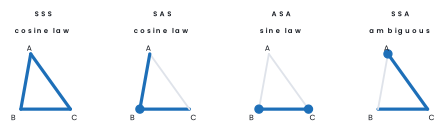
Three parts fix a triangle provided at least one of them is a side. (Three angles do not: AAA gives the shape but not the size, since every similar triangle has the same angles.) That leaves four data patterns.
| Given | Name | First step | Answers |
|---|---|---|---|
| three sides | SSS | cosine law, or half angle law | exactly one |
| two sides and the angle between them | SAS | cosine law, or tangent law | exactly one |
| one side and two angles | ASA / AAS | third angle, then sine law | exactly one |
| two sides and an angle not between them | SSA | sine law | 0, 1 or 2 |
Case 1 — three sides (SSS)
Use the cosine law for one angle, then either the cosine law again or the sine law for a second, and subtract from 180^{\circ} for the third.
If logarithm tables are being used, or if an angle is close to 90^{\circ} (where the cosine changes slowly and reading it back is inaccurate), the half angle law is safer.
Problem. Solve the triangle a = 5 cm, b = 7 cm, c = 8 cm.
Solution.
Check. The largest angle C faces the largest side c = 8 ✓, and \cos C = \frac{25+49-64}{2 \times 5 \times 7} = \frac{10}{70} = 0.1429, which is indeed \cos 81^{\circ}47'. ✓
Problem. Solve a = 5, b = 7, c = 8 using half angles, and find the area.
Solution. s = \frac{5+7+8}{2} = 10, so s-a = 5, s-b = 3, s-c = 2.
so \frac{A}{2} = 19^{\circ}6' and A = 38^{\circ}13' — as before.
C = 81^{\circ}47'. Area, by Heron,
Check. \frac12 ca\sin B = \frac12(8)(5)\sin 60^{\circ} = 20(0.8660) = 17.32 ✓.
Case 2 — two sides and the included angle (SAS)
The cosine law gives the third side at once; the sine law (or another cosine) then gives a second angle. The tangent law gives both unknown angles without ever finding the third side, which is why it was the standard method before calculators.
Problem. Solve the triangle a = 3 cm, c = 2 cm, B = 60^{\circ}.
Solution. B lies between a and c, so
Check. a = 3 is the largest side and A = 79^{\circ}6' is the largest angle ✓.
Problem. Solve a = 3, c = 2, B = 60^{\circ} by Napier's analogy.
Solution. The unknown angles are A and C, and
Adding and subtracting:
Then b = \frac{a\sin B}{\sin A} = \frac{3(0.8660)}{0.9822} = 2.646 cm — the same triangle as Example 7.3.
Case 3 — one side and two angles (ASA or AAS)
Subtract to get the third angle, then use the sine law twice. This case is never ambiguous: the two angles fix the shape and the one side fixes the size.
Problem. Solve the triangle A = 60^{\circ}, C = 75^{\circ}, b = 10 cm, and find its area.
Solution. B = 180^{\circ}-60^{\circ}-75^{\circ} = 45^{\circ}.
Check. Sides increase in the same order as their opposite angles: b = 10 < a = 12.25 < c = 13.66 for 45^{\circ} < 60^{\circ} < 75^{\circ} ✓.
Case 4 — two sides and a non-included angle (SSA): the ambiguous case
Suppose a, b and A are given. The sine law gives \sin B = \frac{b\sin A}{a} — but \sin B does not determine B: both B and 180^{\circ}-B have the same sine.
Geometrically, the side a is a compass arc swung from C, and an arc can cut the base line twice, once, or not at all.
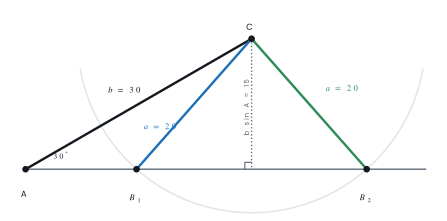
Compare a with the altitude b\sin A from C to the base, which is the shortest possible distance from C to the line.
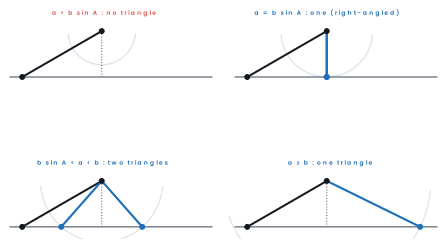
Compute h = b\sin A. Then
- a < h: no triangle (\sin B > 1);
- a = h: one triangle, right-angled at B;
- h < a < b: two triangles, B and 180^{\circ}-B;
- a \ge b: one triangle (the obtuse option is rejected).
If A is obtuse there is one triangle when a > b and none otherwise.
Problem. In a triangle a = 20 cm, b = 30 cm and A = 30^{\circ}. Solve it.
Solution. h = b\sin A = 30(0.5) = 15, and 15 < 20 < 30, so two triangles exist. By the sine law,
Both are admissible because A + B < 180^{\circ} in each case.
First triangle: C_1 = 180^{\circ}-30^{\circ}-48^{\circ}35' = 101^{\circ}25', so
Second triangle: C_2 = 180^{\circ}-30^{\circ}-131^{\circ}25' = 18^{\circ}35', so
Check. In the figure above, AB_1 = 12.75 and AB_2 = 39.21, and 25.98 \pm 13.23 gives exactly those two feet. ✓
Problem. Can a triangle have a = 10 cm, b = 30 cm and A = 30^{\circ}?
Solution. \sin B = \frac{b\sin A}{a} = \frac{30 \times 0.5}{10} = 1.5. No angle has a sine greater than 1, so no such triangle exists. Equivalently h = b\sin A = 15 > 10 = a: the side a is too short to reach the base line. ∎
Problem. Solve a = 40 cm, b = 30 cm, A = 30^{\circ}.
Solution. Here a > b, so only one triangle exists.
The second value 157^{\circ}59' is rejected: it would make A+B = 187^{\circ}59' > 180^{\circ}. (Equivalently, b < a forces B < A, so B cannot be obtuse.)
When the sine law gives \sin B = k, write both B and 180^{\circ}-B, then test each: keep it only if A+B < 180^{\circ}. Students lose marks for silently taking the calculator's answer.
Conversely, if the given angle is opposite the larger side, the obtuse root is always impossible — say so, do not just drop it.
7.2 Heights and distances
Every height-and-distance problem is a triangle with one known side (a measured baseline) and two known angles, so Case 3 solves it. Draw the figure, mark the angles of elevation from the horizontal, and name the triangle you intend to use.
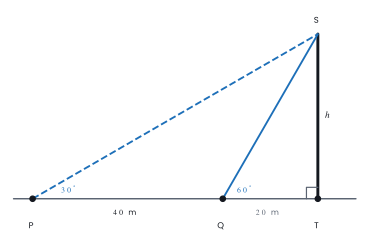
Problem. From a point P on level ground the angle of elevation of the top of a tower is 30^{\circ}. Walking 40 m towards the tower to a point Q, the elevation becomes 60^{\circ}. Find the height of the tower.
Solution. Let S be the top and T the foot. In triangle PQS:
- \angle SPQ = 30^{\circ};
- \angle SQT = 60^{\circ} is an exterior angle of triangle PQS at Q, so \angle PQS = 180^{\circ}-60^{\circ} = 120^{\circ};
- hence \angle PSQ = 180^{\circ}-30^{\circ}-120^{\circ} = 30^{\circ}.
Triangle PQS therefore has two equal angles, so QS = PQ = 40 m. Now in the right triangle QTS,
Check. QT = h\cot 60^{\circ} = 20 m and PT = h\cot 30^{\circ} = 60 m, and PT - QT = 40 m ✓.
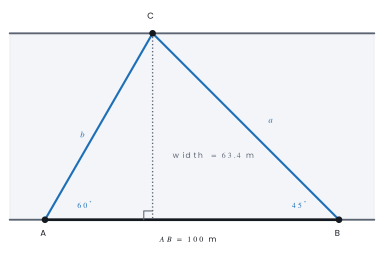
Problem. A and B are two points 100 m apart on one straight bank of a river. A tree C stands on the opposite bank. It is found that \angle CAB = 60^{\circ} and \angle CBA = 45^{\circ}. Find AC, BC and the width of the river.
Solution. \angle ACB = 180^{\circ}-60^{\circ}-45^{\circ} = 75^{\circ} (Case 3, ASA). By the sine law, with c = AB = 100,
The width is the perpendicular distance from C to the bank AB:
Check. The same width from the other triangle: BC\sin 45^{\circ} = 89.66(0.7071) = 63.40 m ✓.
Problem. A triangular field in Chitwan has sides 120 m, 170 m and 250 m. Find its area in square metres and in ropani (1 ropani = 508.72 m²).
Solution. s = \frac{120+170+250}{2} = 270 m, so s-a = 150, s-b = 100, s-c = 20.
Check. The field is nearly degenerate (120+170 = 290, only 40 m more than 250), so a small area for such long sides is exactly what we expect. ✓
Problem. Two roads leave a junction J at an angle of 60^{\circ}. A cyclist rides 3 km along one and a walker 2 km along the other. How far apart are they, and what angle does the line joining them make with the cyclist's road?
Solution. This is SAS with the 60^{\circ} angle included, exactly the triangle of Example 7.3 measured in kilometres: a = 3, c = 2, B = 60^{\circ}.
The required angle is the one at the cyclist's end, opposite the walker's distance c = 2:
So they are 2.65 km apart, and the joining line makes 40^{\circ}54' with the cyclist's road.
Marking points in a solution
State the case (SSS, SAS, …) in words before computing — it shows the examiner you chose the law deliberately. Keep five figures during the work and round only at the end. Give angles in degrees and minutes (1^{\circ} = 60'): 0.5^{\circ} is 30', not 50'.

Chapter summary
- Three parts solve a triangle if at least one is a side; AAA gives shape only.
- SSS: cosine law \cos A = \frac{b^{2}+c^{2}-a^{2}}{2bc}, or half angles \tan\frac{A}{2} = \sqrt{\frac{(s-b)(s-c)}{s(s-a)}}.
- SAS: a^{2} = b^{2}+c^{2}-2bc\cos A; or Napier, \tan\frac{A-B}{2} = \frac{a-b}{a+b}\cot\frac{C}{2} with \frac{A+B}{2} = 90^{\circ}-\frac{C}{2}.
- ASA/AAS: third angle first, then \frac{a}{\sin A} = \frac{b}{\sin B}.
- SSA is ambiguous: with h = b\sin A and A acute — none if a<h, one (right-angled) if a = h, two if h<a<b, one if a \ge b.
- Area: \Delta = \frac12 ab\sin C = \sqrt{s(s-a)(s-b)(s-c)}.
- Heights and distances: draw the figure, use the exterior-angle trick to find the angle at the near point, then solve the triangle on the baseline.
Practice questions
Group A — Multiple choice (1 mark each)
- To solve a triangle given its three sides you should start with [1]athe sine lawbthe cosine lawcthe projection lawdthe angle sum
- A triangle can not be solved from [1]aSSSbSAScAAAdASA
- If a = 20, b = 30, A = 30^{\circ}, the number of possible triangles is [1]a0b1c2dinfinitely many
- In a triangle b = 4, c = 5 and A = 60^{\circ}; then a equals [1]a\sqrt{21}b\sqrt{41}c\sqrt{61}d9
- If \sin B = 0.8 and b < a, then B is [1]a53^{\circ}8' onlyb126^{\circ}52' onlyceitherdneither
- From the top of a tower h m high the angle of depression of a point on the ground is 45^{\circ}; the point is at a distance [1]a\frac{h}{2}bhch\sqrt{3}d2h
Answers to Group A
1. (b) — the sine law would need an angle, which SSS does not give.
2. (c) — AAA fixes only the shape; all similar triangles share it.
3. (c) — h = b\sin A = 15 and 15 < 20 < 30, the two-triangle case.
4. (a) — a^{2} = 16+25-2(4)(5)\left(\frac12\right) = 21.
5. (a) — b < a gives B < A, so B cannot be obtuse.
6. (b) — \tan 45^{\circ} = h/d = 1, so d = h.
Group B — Short answer (5 marks each)
- Solve the triangle a = 5 cm, b = 7 cm, c = 8 cm and find its area. [5]
- Solve the triangle in which a = 3 cm, c = 2 cm and B = 60^{\circ}, using the tangent law for the angles. [5]
- Solve the triangle A = 60^{\circ}, C = 75^{\circ}, b = 10 cm. [5]
- Show that no triangle exists with a = 10 cm, b = 30 cm, A = 30^{\circ}, but that exactly one exists with a = 40 cm, b = 30 cm, A = 30^{\circ}; solve the second. [5]
- The angle of elevation of the top of a tower from a point on level ground is 30^{\circ}; on walking 40 m towards the tower it becomes 60^{\circ}. Find the height of the tower. [5]
- A triangular plot has sides 120 m, 170 m and 250 m. Find its area and the radius of its circumcircle. [5]
Answers to Group B
1. \cos A = \frac{49+64-25}{112} = 0.7857, so A = 38^{\circ}13'; \cos B = \frac{64+25-49}{80} = 0.5, so B = 60^{\circ}; and C = 81^{\circ}47'. With s = 10, \Delta = \sqrt{10 \times 5 \times 3 \times 2} = 10\sqrt{3} = 17.32 cm².
2. \frac{A+C}{2} = 90^{\circ}-30^{\circ} = 60^{\circ} and \tan\frac{A-C}{2} = \frac{3-2}{3+2}\cot 30^{\circ} = \frac{1.7321}{5} = 0.3464, so \frac{A-C}{2} = 19^{\circ}6'.
Hence A = 79^{\circ}6', C = 40^{\circ}54', and b = \frac{a\sin B}{\sin A} = \frac{3(0.8660)}{0.9822} = 2.65 cm (= \sqrt{7}).
3. B = 45^{\circ}; a = \frac{10\sin 60^{\circ}}{\sin 45^{\circ}} = 12.25 cm; c = \frac{10\sin 75^{\circ}}{\sin 45^{\circ}} = 13.66 cm. (Area, if wanted: \frac12 ab\sin C = 59.15 cm².)
4. First: \sin B = \frac{30 \times 0.5}{10} = 1.5 > 1, impossible, so no triangle.
Second: a = 40 > b = 30, so exactly one. \sin B = \frac{30 \times 0.5}{40} = 0.375 gives B = 22^{\circ}1' (the obtuse root 157^{\circ}59' fails A+B<180^{\circ}).
Then C = 127^{\circ}59' and c = \frac{40\sin C}{\sin 30^{\circ}} = \frac{40(0.7883)}{0.5} = 63.06 cm.
5. With P, Q the two points and S the top: \angle SPQ = 30^{\circ}, \angle PQS = 180^{\circ}-60^{\circ} = 120^{\circ}, so \angle PSQ = 30^{\circ} and the triangle PQS is isosceles with QS = PQ = 40 m. Then h = QS\sin 60^{\circ} = 40\left(\frac{\sqrt{3}}{2}\right) = 20\sqrt{3} = 34.64 m.
6. s = 270 m; \Delta = \sqrt{270 \times 150 \times 100 \times 20} = 9000 m². Then R = \frac{abc}{4\Delta} = \frac{120 \times 170 \times 250}{4 \times 9000} = \frac{5\,100\,000}{36\,000} = 141.67 m.
Group C — Long answer (8 marks each)
- Explain what is meant by solving a triangle and list the four cases of given data. Solve the triangle a = 20 cm, b = 30 cm, A = 30^{\circ} completely, explaining why it has two solutions, and state the condition for each of the other possibilities. [8]
- Derive the tangent law \tan\frac{A-B}{2} = \frac{a-b}{a+b}\cot\frac{C}{2} and use it to solve the triangle a = 9 cm, b = 7 cm, C = 60^{\circ}. Find the area of that triangle. [8]
- A and B are points 100 m apart on a straight bank of a river and C is a tree on the opposite bank, with \angle CAB = 60^{\circ} and \angle CBA = 45^{\circ}. Find AC, BC, the width of the river and the area of triangle ABC. [8]
Answers to Group C
1. Solving a triangle means finding all six parts from three given ones, at least one of which must be a side.
The four cases are SSS and SAS (cosine or tangent law), ASA/AAS (angle sum, then sine law) and SSA (sine law, possibly ambiguous).
Here h = b\sin A = 30 \times 0.5 = 15 and 15 < a = 20 < b = 30, which is the two-triangle case: the arc of radius a centred at C cuts the base twice. \sin B = \frac{b\sin A}{a} = 0.75, so B = 48^{\circ}35' or 131^{\circ}25', and both satisfy A+B < 180^{\circ}.
First C = 101^{\circ}25', c = \frac{20\sin C}{\sin 30^{\circ}} = \frac{20(0.9803)}{0.5} = 39.21 cm.
Second C = 18^{\circ}35', c = \frac{20(0.3189)}{0.5} = 12.75 cm. Other possibilities (for acute A): a < h gives no triangle, a = h gives one right-angled triangle, and a \ge b gives exactly one triangle.
2. Derivation. By the sine law a = 2R\sin A, b = 2R\sin B, so
and since \frac{A+B}{2} = 90^{\circ}-\frac{C}{2}, \cot\frac{A+B}{2} = \tan\frac{C}{2}, giving \tan\frac{A-B}{2} = \frac{a-b}{a+b}\cot\frac{C}{2}.
Application \frac{A+B}{2} = 60^{\circ} and \tan\frac{A-B}{2} = \frac{2}{16}\cot 30^{\circ} = 0.2165, so \frac{A-B}{2} = 12^{\circ}13', A = 72^{\circ}13', B = 47^{\circ}47'.
Third side: c^{2} = 81+49-2(9)(7)\left(\frac12\right) = 67, c = 8.19 cm. Area: \Delta = \frac12 ab\sin C = \frac12(9)(7)(0.8660) = 27.28 cm².
3. \angle ACB = 180^{\circ}-60^{\circ}-45^{\circ} = 75^{\circ}, so with AB = c = 100 m the sine law gives
Width = AC\sin 60^{\circ} = 73.21(0.8660) = 63.40 m (check: BC\sin 45^{\circ} = 63.40 m ✓). Area = \frac12 \times AB \times \text{width} = \frac12(100)(63.40) = 3170 m², and equally \frac12(AC)(BC)\sin 75^{\circ} = \frac12(73.21)(89.66)(0.9659) = 3170 m².
Group D — Model answers for long questions (10 marks each, for deeper revision)
- Explain how to solve a triangle in each of the cases SSS, SAS, ASA and the ambiguous case SSA, with examples. [10]
- Explain heights and distances with an example of a surveyor measuring the height of a temple or a tower. [10]
Model answer D1: solving triangles, including the ambiguous case (10 marks)
Introduction. Solving a triangle means finding all of its three sides and three angles from three given parts, at least one of which is a side. The sine and cosine rules and the sum of the angles (A+B+C=180^{\circ}) are the tools.
Case 1: SSS (three sides). Use the cosine rule for two angles and subtract from 180^{\circ} for the third.
Example a=13, b=14, c=15. \cos A=\dfrac{196+225-169}{2(14)(15)}=0.6, so A=53.13^{\circ}; \cos B=\dfrac{169+225-196}{2(13)(15)}=0.5077, so B=59.49^{\circ}; C=180^{\circ}-53.13^{\circ}-59.49^{\circ}=67.38^{\circ}. The area is 84 square units.
Case 2: SAS (two sides and the included angle). Use the cosine rule for the third side, then the sine rule for a second angle (find the smaller angle first, which is always acute).
Example a=5, b=7, C=80^{\circ}. c^{2}=25+49-70\cos80^{\circ}=61.85, so c=7.86. Then \sin A=\dfrac{5\sin80^{\circ}}{7.86}=0.626, so A=38.8^{\circ} and B=180^{\circ}-80^{\circ}-38.8^{\circ}=61.2^{\circ}.
Case 3: ASA or AAS (two angles and a side). The third angle is 180^{\circ} minus the other two; the sine rule then gives the remaining sides.
Example A=40^{\circ}, B=60^{\circ}, c=10: C=80^{\circ}, a=\dfrac{10\sin40^{\circ}}{\sin80^{\circ}}=6.53 and b=\dfrac{10\sin60^{\circ}}{\sin80^{\circ}}=8.79.
Case 4: SSA (two sides and a non-included angle): the ambiguous case. Given a, b and A, the sine rule gives \sin B=\dfrac{b\sin A}{a}.
| Condition | Number of triangles |
|---|---|
| \sin B>1 | None |
| \sin B=1 | One (right-angled) |
| \sin B<1 and a\geq b | One (B must be acute) |
| \sin B<1 and a<b | Two: B and 180^{\circ}-B (if A+B<180^{\circ} for both) |
Example (two triangles). a=10, b=16, A=30^{\circ}. \sin B=\dfrac{16\times0.5}{10}=0.8, so B=53.13^{\circ} or 126.87^{\circ}.
- Triangle 1: B=53.13^{\circ}, C=96.87^{\circ} and c=\dfrac{10\sin96.87^{\circ}}{\sin30^{\circ}}=19.86.
- Triangle 2: B=126.87^{\circ}, C=23.13^{\circ} and c=\dfrac{10\sin23.13^{\circ}}{\sin30^{\circ}}=7.86.
Both satisfy the given data, which is why the case is called ambiguous.
Conclusion. SSS and SAS need the cosine rule, ASA needs the sine rule, and SSA may have no, one or two solutions.
Model answer D2: heights and distances (10 marks)
Introduction. Triangle solutions let us find heights and distances that cannot be measured directly: the height of a temple, a tower or a hill and the width of a river.
Terms.
- The angle of elevation is the angle above the horizontal from the observer's eye to an object above.
- The angle of depression is the angle below the horizontal to an object below.
- A bearing is the angle of a direction, measured clockwise from the north.
Method.
- Draw a clear figure, marking the known angles and distances.
- Identify the right-angled or general triangles.
- Use \tan\theta=\dfrac{\text{height}}{\text{distance}} in a right triangle, or the sine and cosine rules in a general triangle.
- Solve the equations and check the result for reasonableness.
Worked example 1 (two observations). A surveyor sees the top of a temple at an elevation of 30^{\circ}. After walking 40\ \text{m} towards the temple on level ground, the elevation is 45^{\circ}. Find the height h.
- From the first point, the distance to the base is h\cot30^{\circ}=1.732\,h.
- From the second, it is h\cot45^{\circ}=h.
- The difference is the walked distance: 1.732\,h-h=40, so h=\dfrac{40}{0.732}=54.6\ \text{m}.
Worked example 2 (river width). From a point on one bank, a tree directly across the river is sighted.
The surveyor walks 60\ \text{m} along the bank and measures the angle between the tree and the starting point as 50^{\circ} (at the new point, the angle between the bank and the line to the tree).
Since the tree is perpendicular to the bank at the start, the width w=60\tan50^{\circ}=71.5\ \text{m}.
Worked example 3 (general triangle). Two observers 100\ \text{m} apart on level ground see a tower on the same side with angles of elevation 60^{\circ} (nearer) and 30^{\circ} (farther) in line.
By the same method, h(\cot30^{\circ}-\cot60^{\circ})=100, so h=\dfrac{100}{1.732-0.577}=86.6\ \text{m}.
| Given | Tool | Result |
|---|---|---|
| Elevation and distance | h=d\tan\theta | Height |
| Two elevations, one baseline | Difference of cotangents | Height without the base distance |
| Triangle with no right angle | Sine rule or cosine rule | Distance |
Conclusion. Trigonometry in right and general triangles turns measured angles and a baseline into inaccessible heights and distances.
Practise more: Mathematics question bank